⭐️THIS is a GREAT read ⭐️
I’m worn out hearing people moan, “Our grandparents could buy a house on one paycheck, but now we can’t even afford rent on two!”
Yeah, maybe because Grandma wasn’t dropping half her income on $14 iced lattes and avocado toast shaped like art projects. Back then, if they wanted coffee, they boiled it at home in a dented pot. It tasted like burnt rubber and regret — but it woke you up and cleaned your pipes.
And Grandma wasn’t “out to brunch.” You think she had time for mimosas and hashtags? She was making something called whatever’s left in the fridge and feeding six people with it.
Don’t even start with Uber Eats. You think Grandpa was out here paying $38 to have a burger delivered three blocks away? Please. He grilled mystery meat on a rusted barbecue, and everyone called it dinner.
Now people cry about being broke while sitting in a house full of gadgets. Two SUVs in the driveway, six streaming services, three air fryers, and matching tattoos that cost more than their light bill. You think Grandpa had a tattoo? He did. It said “Korea, 1951,” and it came with trauma, not Instagram likes.
And the kids—Lord help us. “We can’t make ends meet, but Brayden needs the new iPhone!” No, he doesn’t. You’re handing an $1100 device to a child who still eats crayons and forgets to flush.
When we were kids, there was one phone. It hung on the wall like a family relic. The cord stretched just far enough for you to whisper secrets before someone yelled, “Get off, I need to make a call!” And guess what? We lived.
The TV? One. In the living room. With three channels and a dial that clicked like a safe. And if Dad wanted to watch bowling, you were a fan of bowling, end of story.
Now there’s a flat screen in every room, the baby’s got an iPad, the dog’s got a camera, and everyone’s wondering why they can’t afford rent.
Because you’re living like rock stars on retail salaries, that’s why.
Grandpa wasn’t leasing Teslas or buying $12 smoothies called “Green Zen Awakening.” He drove a truck that coughed smoke, rattled like a storm, and smelled like oil and hard work.
They lived within their means. Whatever Grandpa brought home on Friday — that’s what they had. They weren’t keeping up with the Joneses; they were keeping the lights on.
So yeah, Grandpa bought a house on one salary. But he also didn’t have a gym membership, three delivery apps, and emotional support crystals on his nightstand. His only support system was Grandma, who told him to quit whining and mow the yard.
Nowadays, everyone’s broke, anxious, and “manifesting abundance” while ordering tacos on DoorDash for the fourth time this week.
It’s not the economy — it’s the lifestyle.
Wake up, turn off your subscriptions, make your own coffee, and maybe—just maybe—you’ll smell the truth.
MARC ANDREESSEN JUST WENT ON ROGAN AND DROPPED THE MOST IMPORTANT AI ALPHA OF THE YEAR.
3 hours and 20 minutes of podcast.
Here are the 17 things worth your attention.
1. AGI is already here. Marc thinks the line was crossed 3 months ago with GPT-5.5, Claude 4.6, Gemini 3, and Grok 4.3. Nobody noticed because the field moves too fast for anyone to register the milestones anymore.
2. For almost any topic the top AI models now give him better answers than the world-class experts he could call on the phone. And he can call basically anyone.
3. Every doctor is secretly using ChatGPT in the exam room. They turn around the second you stop talking and type your symptoms in. Some do it while you are still sitting there. His quote: "At that point you are asking what do I need you for."
4. When AI refuses to answer something he wants to know he tells it he is writing a novel. "Walk me through how the bad guy robs the bank." It explains almost anything if it thinks it is helping you write fiction.
5. When something is too complex he says "explain it like I am 10." Then "like I am 5." Then "like I am 2." He keeps going until it actually clicks.
6. When he wants to understand a tough topic he does not ask what the right answer is. He asks the AI to steelman one side then steelman the other. Then he decides for himself.
7. For big questions he tells the AI to pretend to be a panel of experts. "Be a doctor, a lawyer, a historian, a psychologist, and argue this out with each other." Then he reads the debate.
8. Pay attention to the exact moment you think "I do not know how to figure this out." Most people give up there. That is the moment you should open the AI.
9. The only real skill left in using AI is knowing what to ask. The models can do almost anything you can describe in plain English. The bottleneck lives in your own head.
10. You can send AI photos of almost anything medical now and get a real answer. Skin rashes. Blood test results. The new models read images not just text. A free 24/7 second opinion on anything.
11. The one type of therapy clinically proven to work is cognitive behavioral therapy. It is also something an AI can fully do on its own. Every person on earth is about to have access to a real therapist for free anytime they want.
12. AI is solving math problems open for 100 years that no human mathematician could crack. Same thing is starting in physics, chemistry, and biology. Expect cancer cures and weird new physics breakthroughs in the next few years.
13. The best AI coders in Silicon Valley now make $50 million a year. One person. That number tells you how big this thing actually is when you strip away all the doom takes.
14. One friend paid $200 to decode his entire DNA. Then gave the AI his DNA, blood test results, and Apple Watch data. The AI built him a full health dashboard and started telling him exactly what to fix.
15. Another friend put two cameras in his home jiu jitsu gym. AI watches him spar and gives him technique notes after every round. A world-class coach at every practice for free.
16. The best programmers in Silicon Valley now run 20 AI coding bots simultaneously. Each bot writes code while they review the others. They call themselves AI vampires because going to bed means 20 workers stop and you lose money every hour you sleep.
17. The obvious next step: the bots will run their own bots. One human running 20 bots each running 20 more. One person. One laptop. 1,000 AI workers. This is months away not years.
Bookmark this before you watch the full podcast.
Follow @cyrilXBT for every AI insight worth your attention the moment it surfaces.
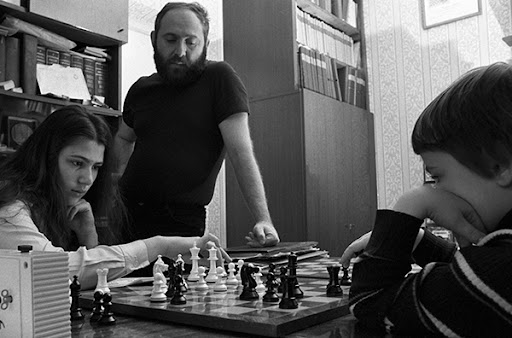
A Hungarian psychologist raised three daughters to prove that any child could become a chess grandmaster through early specialization. He succeeded. Two of them became grandmasters. One became the greatest female chess player who ever lived.
Then a sports scientist looked at the data and found something nobody wanted to hear.
His name is David Epstein. The book is called "Range."
The Polgar experiment is one of the most famous case studies in the history of deliberate practice. Laszlo Polgar wrote a book before his daughters were even born arguing that geniuses are made, not born. He homeschooled all three girls in chess from age four. By their teens, Susan, Sofia, and Judit were dominating tournaments against grown men. Judit became the youngest grandmaster in history at the time, breaking Bobby Fischer's record. The story became the gospel of early specialization. Pick a domain young, drill it hard, and you can manufacture excellence.
Epstein opens his book by telling that story honestly and then quietly demolishing the conclusion most people drew from it.
Chess works that way. Most things do not.
Here is the distinction that took him four years of research to articulate, and that almost nobody who quotes the 10,000 hour rule has ever read.
There are two kinds of environments in which humans develop expertise. Psychologists call them kind and wicked. A kind environment has clear rules, immediate feedback, and patterns that repeat reliably. Chess is the cleanest example. Every game ends with a winner and a loser. Every move is recorded. The board never changes shape. The pieces never invent new ways to move. A child who plays ten thousand games will see most of the patterns that exist in the game, and pattern recognition is exactly what chess mastery is built on.
A wicked environment is the opposite. Feedback is delayed or misleading. Rules shift. The patterns that worked yesterday may be exactly the wrong patterns to apply tomorrow. Most of the real world looks like this. Medicine is wicked. Investing is wicked. Building a company is wicked. Scientific research is wicked. Almost every job that involves a complex changing system with humans in it is wicked.
The Polgar sisters trained in the kindest environment any human can train in. Their success was real and the method was correct. The mistake was generalizing the method to fields where the underlying structure of the environment is completely different.
Epstein's research is what made the implication impossible to ignore.
He looked at the careers of elite athletes outside of chess and golf and found that the pattern was almost the inverse of what people assumed. The athletes who reached the very top of their sports were overwhelmingly people who had played multiple sports as children, specialized late, and often switched disciplines well into their teens. Roger Federer played squash, badminton, basketball, handball, tennis, table tennis, and soccer before tennis became his focus. The kids who specialized in tennis at age six and trained year-round for a decade mostly burned out, got injured, or topped out at lower levels of the sport.
The same pattern showed up everywhere he looked outside of kind environments. Inventors with the most patents had worked in multiple unrelated fields before their breakthrough work. Comic book creators with the longest careers had drawn for the most different genres before settling. Scientists who won Nobel Prizes were dramatically more likely than their peers to be serious amateur musicians, painters, sculptors, or writers.
The skill that mattered in wicked environments was not depth in one pattern. It was the ability to recognize when a pattern from one domain applied unexpectedly in another. That kind of thinking cannot be built by drilling a single subject. It can only be built by accumulating mental models from many subjects and learning to move between them.
The deeper finding is the one that should change how you think about your own career.
Specialists in wicked environments often get worse with experience, not better. Epstein cites studies of doctors, financial analysts, intelligence officers, and forecasters showing that years of experience in a narrow domain frequently produce more confident judgments without producing more accurate ones. The expert builds elaborate mental models that feel comprehensive and turn out to be increasingly disconnected from the actual structure of the problem. They stop noticing what does not fit their framework. They mistake fluency for understanding.
Generalists do better in wicked domains for a reason that sounds almost mystical until you understand the mechanism. They have less invested in any single mental model, so they abandon broken models faster. They are used to being a beginner, so they are not threatened by the discomfort of not knowing. They have seen enough different domains that they can usually find an analogy from one field that unlocks a problem in another. The technical name for this is analogical thinking, and the research on it is one of the most underrated bodies of work in cognitive science.
The single most useful sentence in the entire book is the one Epstein puts almost as a throwaway.
Match quality matters more than head start.
A person who tries six different fields in their twenties and finds the one that genuinely fits them will outperform a person who picked one field at fourteen and stuck to it on willpower alone. The lost years were not lost. They were the search process that produced the match. Every field they walked away from taught them something they later imported into the field they finally chose.
The reason this is so hard to accept is cultural, not empirical. We tell children to pick a path early. We reward the prodigy who knew at six. We treat the late bloomer as someone who failed to launch on time, when the data suggests they were running an entirely different and often more effective optimization process underneath.
The Polgar sisters were not wrong. The conclusion the world drew from them was.
If your environment is genuinely kind, specialize early and drill hard. If it is wicked, and almost every interesting human problem is, then the people who win are the ones who refused to specialize until they had seen enough to know what was actually worth specializing in.
You are not behind. You were running the right experiment all along.
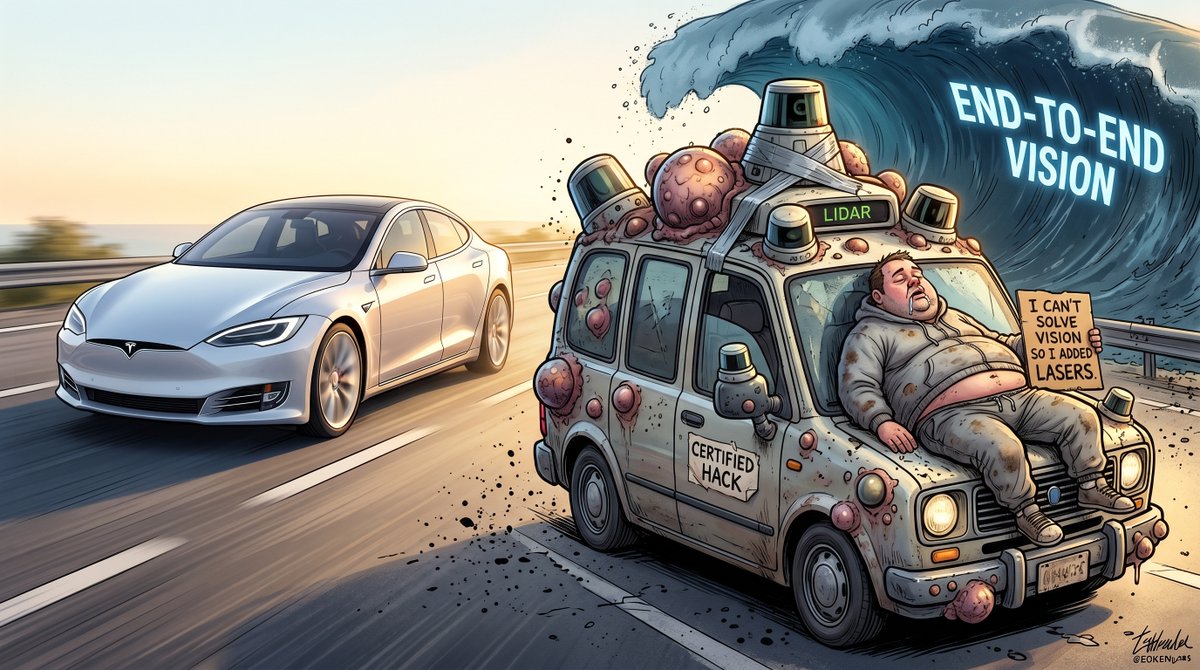
Aujourd'hui grosse discussion avec mes ingés (chez Argil) sur pourquoi Elon a viré le LIDAR de ses voitures autonomes. Choix radical, moqué pendant des années, et comme d'hab il avait raison depuis le début.
Le LIDAR c'est un laser qui balaye l'environnement et crache un nuage de points 3D. Sur le papier tu obtiens la géométrie exacte du monde. Dans la vraie vie c'est une verrue technologique collée sur le toit parce qu'on sait pas faire mieux avec la vision seule.
Problème numéro un : ça rajoute une modalité dans le training du modèle. Ton réseau doit apprendre à fusionner vision + lidar + radar + ultrasons. Chaque capteur en plus c'est une source de désaccord à arbitrer, pas une source d'info supplémentaire. Sensor fusion artisanale = dette technique permanente.
Problème numéro deux, la bitter lesson de Rich Sutton : scaler le compute sur une seule modalité bat systématiquement les architectures bricolées à la main. Tesla a dropé le radar, puis les ultrasons, est passé full end-to-end vision. Leur courbe sur les edge cases s'est accélérée APRÈS, pas avant. Waymo fait l'inverse et reste stuck en ops géofencée.
Problème numéro trois, le plus fondamental : le LIDAR voit la géométrie, pas la sémantique. Il sait qu'il y a un truc, pas ce que c'est ni ce que ça va faire. Les derniers 9 de fiabilité sont des problèmes de cognition, pas de perception brute. Un capteur de plus résout rien, il ajoute du bruit.
Sébastien Loeb balance une 208 T16 à 180 dans un chemin boueux corse sous la pluie avec zéro LIDAR. Deux yeux, un cerveau. L'évolution a donné des yeux aux prédateurs pendant 500 millions d'années, pas des lasers. Il y a une raison.
Le LIDAR c'est l'équivalent du marxisme appliqué à l'économie. Une solution planifiée, centralisée, qui prétend modéliser explicitement ce qui doit émerger d'un système distribué et adaptatif. Tu remplaces l'intelligence par de la mesure, la compréhension par de la donnée, l'émergence par le contrôle. Ça rassure les ingénieurs qui veulent tout spécifier en amont, exactement comme la planif rassurait les économistes soviétiques. Et ça échoue pour les mêmes raisons : la réalité est trop riche pour être capturée par un capteur, comme elle est trop riche pour être capturée par un plan quinquennal.
La vraie intelligence, celle de Hayek comme celle de Tesla, c'est de faire confiance à un système qui apprend de l'expérience plutôt que de tout pré-encoder. L'élégance d'une solution c'est son rapport signal sur complexité. Le LIDAR explose le dénominateur.
Défendre le LIDAR en 2026 c'est préférer empiler des hacks plutôt que résoudre le vrai problème. C'est de la feignasserie intellectuelle maquillée en rigueur d'ingénieur. Les mêmes gens qui défendaient les systèmes experts en 2012 contre le deep learning. Ils finiront pareil.
Never bet against end-to-end. Never bet against la simplicité. Never bet against Elon.
Okay, time to explain guns to our new friends.
Every day, when I leave the house, I attach a holstered handgun to my belt, under my shirt or coat.
I would no more leave the house without a gun than I would walk around outdoors without shoes.
Is it because I "need" a gun?
No.
I live in rural Tennessee, which is state in the American south. It's very safe here. The dangerous parts of America are big cities where the local government is leftist, and they shelter illegal migrant from the third world, and won't send violent criminals to prison. Places like Chicago and New York City.
Yet, any time I leave the house, I put on a gun, knowing that I will probably never have to use it, and if I do, it will probably be on an aggressive stray dog, not a human.
So why do I do it?
Why do many other people who live around me do it?
Why do we do this so much that carrying a gun is considered totally normal? If someone spotted it, it would not even arouse a comment, much less any fear.
In fact, it is legal to carry a gun openly here, without covering it up. Covering it up is just considered polite.
So.... why?
Well, try thinking of an English nobleman, during the reign of Elizabeth the First. When he dressed to go ride to court, he would hang a slender fencing sword, called a rapier or smallsword, from his belt.
He didn't expect to be attacked.
He didn't even expect to fight a duel. And if he was challenged to a duel, he wouldn't need his sword right then. He would meet his challenger later at an agreed-upon place and time.
No, he wore his sword because it was an expression of who he was. He was a gentleman, a person of status, with the legal privilege of carrying a sword.
By carrying a sword, he asserted his rights and prerogatives as a nobleman.
In Japan, you had the same sort of thing happening. The samurai, members of the bushi class, wore the two swords not because they expected to be attacked at any moment, but because the two swords were an essential part of who he was.
So, in these two cases, weapons were carried by noblemen as an assertion of status. They had the right to do so, and they did so in order to assert, exercise, and retain the right.
Americans carry guns because every American citizen is a nobleman.
When we fought the British for our independence, that war began on April 19th, 1775, when British troops, fearing American rebelliousness, marched out from Boston to confiscate guns from people living in the surrounding countryside.
Our ancestors did not submit to this. We shot them instead, and they fled back to Boston with their tails between their legs, to cower under the cover of the guns from the warship HMS Sommerset.
Thus began several years of war.
And when we won that war, we made a country where no government, and no man, would ever be allowed to disarm the people.
No agent of the government may say to us, "I may have a gun, and you may not."
Because to say that is to say "I am a nobleman, and you are a peasant. I am a master, and you are a slave."
We are not peasants here. We are all noblemen. That is the most basic principle of what it means to be an American.
I can be impoverished, so I can to be so poor that I live in a van down by the river. But however reduced my circumstances, as an American, I still have the rights and freedoms of a nobleman, of a daimyo, because that is the basic founding idea of the nation we forged on that day.
If you come to America to visit, if you walk among us, you will pass many people carrying guns. You will not notice this. You will not see them. You will witness no violence. Everything will be normal. But the guns will be there.
Because that is who we are.
We don't carry guns to be violent. We don't wish to be rude, or to intimidate people. We keep our guns covered up.
But they are the deepest, most essential part of what it means to be American.
vibecoder asks claude code to build a chat app, gets a working prototype in 20 minutes, immediately tweets "just killed slack and discord"…
brother you don't even know what a distributed system is. you don't know what database replication means. you have no idea how websocket connections behave at scale or what happens when 50k people are online at once and someone's message needs to show up in 200ms across 3 continents
slack has engineers making $300k+ who have spent a decade solving problems you don't even know exist yet. race conditions, eventual consistency, message ordering, presence systems, file storage at scale, search indexing across billions of messages
your app works on localhost with 2 connections. that's not the same thing as "killing slack" that's a college homework assignment
the prototype is maybe 0.5% of what makes these products actually work in production. the remaining 99.5% is infrastructure, reliability, edge cases, and years of iteration on problems that only surface when real humans use your thing at scale
and the worst part is the confidence. "yeah its not perfect but ai one-shotted it, just need to adjust a few things and deploy" - the few things you need to adjust IS the entire product. thats like pouring a foundation and saying you basically built a skyscraper, just need to adjust a few things
ai is genuinely incredible for building tools and prototypes. i use it every day. but there's this weird thing happening where people who have never shipped anything to real users at scale now think the hard part of software is writing the first 200 lines of code
it never was bro
Last quarter I rolled out Microsoft Copilot to 4,000 employees.
$30 per seat per month.
$1.4 million annually.
I called it "digital transformation."
The board loved that phrase.
They approved it in eleven minutes.
No one asked what it would actually do.
Including me.
I told everyone it would "10x productivity."
That's not a real number.
But it sounds like one.
HR asked how we'd measure the 10x.
I said we'd "leverage analytics dashboards."
They stopped asking.
Three months later I checked the usage reports.
47 people had opened it.
12 had used it more than once.
One of them was me.
I used it to summarize an email I could have read in 30 seconds.
It took 45 seconds.
Plus the time it took to fix the hallucinations.
But I called it a "pilot success."
Success means the pilot didn't visibly fail.
The CFO asked about ROI.
I showed him a graph.
The graph went up and to the right.
It measured "AI enablement."
I made that metric up.
He nodded approvingly.
We're "AI-enabled" now.
I don't know what that means.
But it's in our investor deck.
A senior developer asked why we didn't use Claude or ChatGPT.
I said we needed "enterprise-grade security."
He asked what that meant.
I said "compliance."
He asked which compliance.
I said "all of them."
He looked skeptical.
I scheduled him for a "career development conversation."
He stopped asking questions.
Microsoft sent a case study team.
They wanted to feature us as a success story.
I told them we "saved 40,000 hours."
I calculated that number by multiplying employees by a number I made up.
They didn't verify it.
They never do.
Now we're on Microsoft's website.
"Global enterprise achieves 40,000 hours of productivity gains with Copilot."
The CEO shared it on LinkedIn.
He got 3,000 likes.
He's never used Copilot.
None of the executives have.
We have an exemption.
"Strategic focus requires minimal digital distraction."
I wrote that policy.
The licenses renew next month.
I'm requesting an expansion.
5,000 more seats.
We haven't used the first 4,000.
But this time we'll "drive adoption."
Adoption means mandatory training.
Training means a 45-minute webinar no one watches.
But completion will be tracked.
Completion is a metric.
Metrics go in dashboards.
Dashboards go in board presentations.
Board presentations get me promoted.
I'll be SVP by Q3.
I still don't know what Copilot does.
But I know what it's for.
It's for showing we're "investing in AI."
Investment means spending.
Spending means commitment.
Commitment means we're serious about the future.
The future is whatever I say it is.
As long as the graph goes up and to the right.
Microservices is the software industry’s most successful confidence scam. It convinces small teams that they are “thinking big” while systematically destroying their ability to move at all. It flatters ambition by weaponizing insecurity: if you’re not running a constellation of services, are you even a real company? Never mind that this architecture was invented to cope with organizational dysfunction at planetary scale. Now it’s being prescribed to teams that still share a Slack channel and a lunch table.
Small teams run on shared context. That is their superpower. Everyone can reason end-to-end. Everyone can change anything. Microservices vaporize that advantage on contact. They replace shared understanding with distributed ignorance. No one owns the whole anymore. Everyone owns a shard. The system becomes something that merely happens to the team, rather than something the team actively understands. This isn’t sophistication. It’s abdication.
Then comes the operational farce. Each service demands its own pipeline, secrets, alerts, metrics, dashboards, permissions, backups, and rituals of appeasement. You don’t “deploy” anymore—you synchronize a fleet. One bug now requires a multi-service autopsy. A feature release becomes a coordination exercise across artificial borders you invented for no reason. You didn’t simplify your system. You shattered it and called the debris “architecture.”
Microservices also lock incompetence in amber. You are forced to define APIs before you understand your own business. Guesses become contracts. Bad ideas become permanent dependencies. Every early mistake metastasizes through the network. In a monolith, wrong thinking is corrected with a refactor. In microservices, wrong thinking becomes infrastructure. You don’t just regret it—you host it, version it, and monitor it.
The claim that monoliths don’t scale is one of the dumbest lies in modern engineering folklore. What doesn’t scale is chaos. What doesn’t scale is process cosplay. What doesn’t scale is pretending you’re Netflix while shipping a glorified CRUD app. Monoliths scale just fine when teams have discipline, tests, and restraint. But restraint isn’t fashionable, and boring doesn’t make conference talks.
Microservices for small teams is not a technical mistake—it is a philosophical failure. It announces, loudly, that the team does not trust itself to understand its own system. It replaces accountability with protocol and momentum with middleware. You don’t get “future proofing.” You get permanent drag. And by the time you finally earn the scale that might justify this circus, your speed, your clarity, and your product instincts will already be gone.