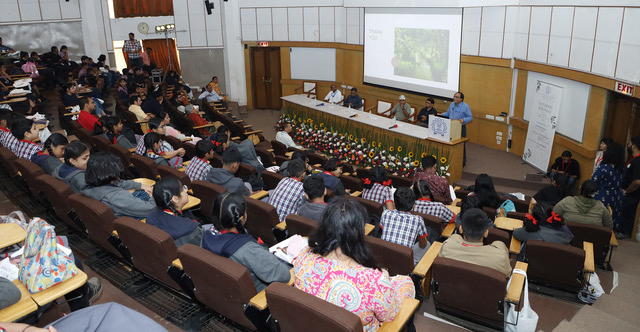
National Bird Day 2026 celebration at IIT Bombay
National Bird Day 2026 was celebrated at IIT Bombay on 5th January 2026, marking the culmination of ‘Bird Watching Month’ organised by the Biodiversity Lab, Office of the Dean IPS, IIT Bombay.
The day began with the inauguration of the ‘Bird Map of IIT Bombay’ at Soneri Baug by Prof. Shireesh Kedare, Director, IIT Bombay in the presence of Prof. Milind Atrey, Deputy Director (ART), Prof. Ravindra Gudi, Deputy Director (FIA), Prof. P. Vedagiri, Dean (IPS) and Prof. Prakash Nanthagopalan, Associate Dean (EHS). The map, designed by Pitta Labs, showcases the rich avian diversity of the campus.
The programme featured engaging activities for school students, including a bird origami workshop by Origami Mitra and a bird introduction workshop conducted by campus resident Ms. Megha Gupta. A guided bird walk led by the Guest of Honour, Mr. Adesh Shivkar, offered participants an immersive experience of the campus birdlife.
The formal event featured a guest talk by the Chief Guest, Dr. Sumiti Saharan, Neuroscientist and Regional Coordinator, Bird Count India. Prof. Rajesh Patkar, Lead, Biodiversity Lab, outlined the vision and mission of the Biodiversity Lab. Prof. Kedare interacted particularly with the school children, encouraging values of conservation and sustainability in young minds. Prof. Nanthagopalan highlighted that the IIT Bombay campus alone is home to almost 20% of the total bird species recorded in India. Prof. Vedagiri drew an insightful correlation between thermodynamics and bird migration. Dr. Saharan emphasised that birdwatching is an activity open to people of all ages and that becoming a birder simply requires curiosity and patience.
The addresses were followed by a prize distribution ceremony for competitions conducted in two categories, namely Bird Photography and Essay/Creative Writing on bird experiences. Entries from three sub-categories—school students, IIT Bombay students, and campus residents—were evaluated by a competent screening committee and further vetted by the Guest of Honour. Supported by the Offices of the Dean IPS and Facility Management, the event brought together students, faculty, staff and campus residents in a shared celebration of biodiversity and the rich birdlife of IIT Bombay.
https://t.co/1jUlBxXFV1 Super excited! Talks about how “A Candida species re-purposed mating machinery to interact with another sp., instead of its opp. mating type, to aid piggybacking during infection”. Thank you @India_Alliance@iitbombay@BsbeIitb@ICMRDELHI@AnandParnandi
📢 Get ready! The India Yeast Meeting 2025 (IYM 2025), the 13th international conference on fungal biology, is coming to Bangalore! at Indian Institute of Science (IISc), Bengaluru from Dec 3rd-6th, 2025. stay tuned for updates @IYM_2025_IISc#IYM2025#FungalBiology#yeast
Excited about our paper in Phytopathology Research https://t.co/pi1HRIR4sr. We show that a secondary metabolite gene cluster in a fungal pathogen can possibly be associated with adaptation to one of its several host plant species. #Magnaportheoryzae#cerealblast#cropdisease
New Preprint Alert!
I'm excited to share our work (@tparth97, Harshita Panchal, @FungalBio) on inter-species interaction between Candida albicans and C. glabrata! It all started with a simple question during journal club: Why and how do these two species strike a harmony?
🧵1/6
New Preprint Alert!
I'm excited to share our work (@tparth97, Harshita Panchal, @FungalBio) on inter-species interaction between Candida albicans and C. glabrata! It all started with a simple question during journal club: Why and how do these two species strike a harmony?
🧵1/6
An insightful example of how simple, often overlooked observations can lead to new findings in science!
Thrilled to be a part of this study—my first ever🤩! Grateful to @FungalBio for making me a part of this!
Congrats to all the authors @fungalbio@AnandParnandi Harshita!🥳🎉
Cabinet approves BioE3 (Biotechnology for Economy, Environment and Employment) Policy for Fostering High Performance Biomanufacturing https://t.co/CB0fn1EDEA
How cool is this! Soil fungus uses a bacterial metabolite (produced endocymbiotically) to protect against nematodes!
Bacterial endosymbionts protect beneficial soil fungus from nematode attack https://t.co/6MU4gzkvXl