Jeff Bezos famously said, “Your margin is my opportunity.”
Now, your office is your competitor’s opportunity, writes @chris_herd. Any company that’s less remote than its competitors risks losing its most talented people.
Why remote startups will win the war for top talent 🧵👇
Machine learning when paired with biological data has the potential to forever change the way we face diseases including cancer, says @cjimmylin of @Freenome.
But there will be challenges along the way as Lin outlines in this Q&A. 👇 https://t.co/i1QMiLoZPD
Instead of companies stuffing themselves on SaaS, @AndrejSafundzic argues for a new kind of software diet.
One that changes the priorities of IT, security, and procurement from fixing problems to helping them create infrastructure that empowers employees. https://t.co/w8r1QK8P0X
Did We Overeat on Software? https://t.co/2wnsVb9iWQ < @AndrejSafundzic of @lumosidentity on how companies can treat SaaS as a competitive advantage instead of an all-you-can-eat buffet
Cities have been called "the largest technology we make." 🌃
We should be asking these questions, then, before building them, says @zachcaceres.
"Is it expensive to run?"
"Does it scale?"
And especially: "How good are its APIs?" https://t.co/GMiwunnJf4
37signals (Basecamp/HEY) CEO @jasonfried advocates "short-term thinking" when running a company.
No long-term plans. No to-do lists. You make decisions in the moment and the maximum amount of time devoted to any project is 6 weeks.
He explains why 👇 https://t.co/T21hjknVa9
In the same way e-commerce has decimated many physical stores, @chris_herd believes virtual companies will crush office-based companies.
Read more: https://t.co/ZevnENO4H7
For companies that have gone or are planning to go to a hybrid-remote model, @chris_herd explains why "hybrid" needs to mean the same thing to management and employees, because it often doesn't.
Far too many products fail because there’s simply no demand for them. How does that happen? By overlooking user research.
@Sprig founder @ryanglasgow provides a blueprint for investment in research to fuel the right decisions at every stage of growth. https://t.co/9Wq7J7H5Sa
SuperGoals not only saved @anchor on multiple occasions, but helped us reach new heights on our path to reinvent podcasting.
Hoping other teams can adopt the framework when needed to create urgency, creativity, and clarity.
And thanks to @a16z / @future for sharing my work!
When your startup is on the line, SuperGoals create focus, says @anchor founder @mignano.
SuperGoals have an urgent timeframe, an open-ended method of achievement, and a single measure of success. https://t.co/waKGxhjlYY
Have you heard about synthetic embryos? Wonder what they are, how scientists are using them, and what they WANT to do with them? I spoke with @Cambridge & @Caltech Professor and embryology pioneer @ZernickaGoetz about the state of the field.
New models for synthetic embryos have recently emerged, but bioengineers aren’t growing humans now.
The immediate goals, explains @Cambridge & @Caltech scientist @ZernickaGoetz, are to understand how life is created and teach us how to rejuvenate tissues. https://t.co/zI4qqzZybJ
I interviewed @jasonfried on work culture. This bit, on why writing > brainstorms, stuck:
"You’ve got to be able to fully form your thoughts in a narrative style that other people can understand. You can’t just drive by and throw an idea in there. There are unlimited ideas."
New interview re: the power of short-term thinking, figuring it out as you go, flowing with human nature, getting comfortable making tough decisions, appetites vs. estimates, what we look for when hiring remote workers, and plenty more.
Here it is:
https://t.co/oeGk19UAjc
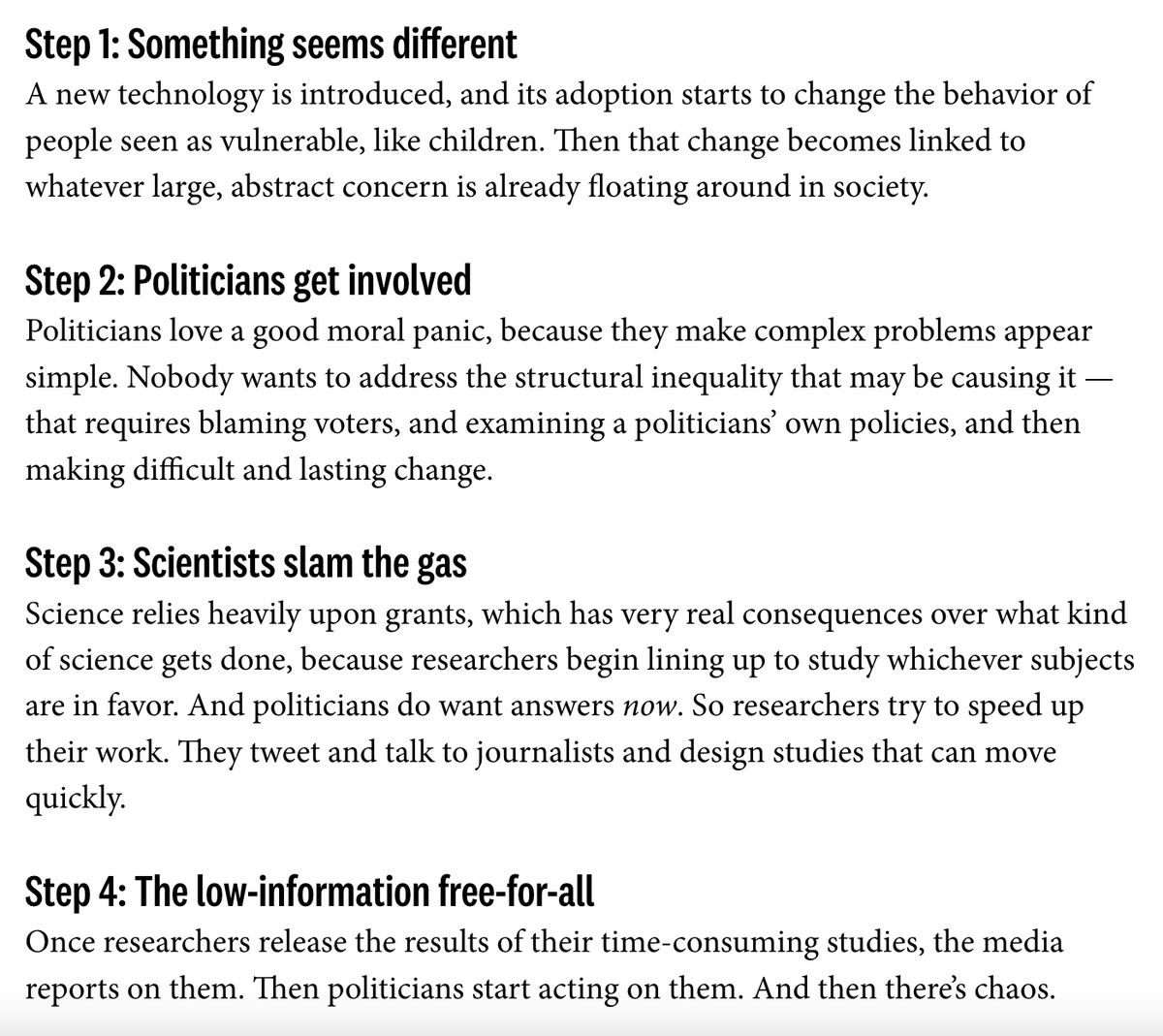
How to break the cycle of technology panics:
Instead of being reactive, science should be proactive. If researchers need 5 years to begin understanding something, the process shouldn’t start while everyone’s hyped up and politicians are demanding answers. https://t.co/P52nJni3f0
The Sisyphean cycle of technology panics (and how to break it).
In his new book, @heyfeifer writes about @OrbenAmy’s four-step theory for what keeps happening when a new technology takes hold, especially with young people.
No long-term planning. No politics. No Zoom. No 10-12 hour days. No project managers. Fully remote.
@jasonfried shares his unconventional approach to running agile companies. https://t.co/T21hjknnkB