Major institutions and agencies are making major tokenization moves. But only some of it is happening on public chains.
What actually counts as a public chain, who decides what that is, and where will most assets live?
🔴 LIVE Thu, Nov 19, 11am EST with
Nico Poggi (@cosmos)
Gustav Arentoft (@ZenithFdn)
and Rocky Rock (@injective) 👇
https://t.co/hmBZUyZBHT
Institutional tokenization needs interoperability, liquidity, and efficient settlement to scale across markets.
On Nov. 19, join the X Space hosted by @defiantnews with @qxnico, CBO at Cosmos, @ARockyRock, Ecosystem Marketing Lead at @injective, and @GArentoft Head of Ecosystem at @ZenithFdn on the future of tokenization.
I recently sat down with @GArentoft, Head of Ecosystem at @ZenithFdn, to discuss the work they’re doing to introduce EVM compatibility into the Canton Network.
We covered how Argentina’s inflation led him into crypto, what Circle’s Arc means for purpose-built blockchains, and his spiciest take: a wave of major blockchains is about to go under.
Timestamps:
0:00 Introduction
2:05 Argentina, inflation and the path into crypto
4:02 MakerDAO and early institutional tokenization
6:25 How Zenith connects Ethereum applications to Canton
12:45 Why Gustav joined Zenith
15:10 Canton super validators and governance
16:10 What changed for DAO governance
20:33 Can Canton build a retail ecosystem?
25:45 Circle's Arc and purpose-built blockchains
28:37 Why some major blockchains could disappear
31:44 Where to learn more about Zenith
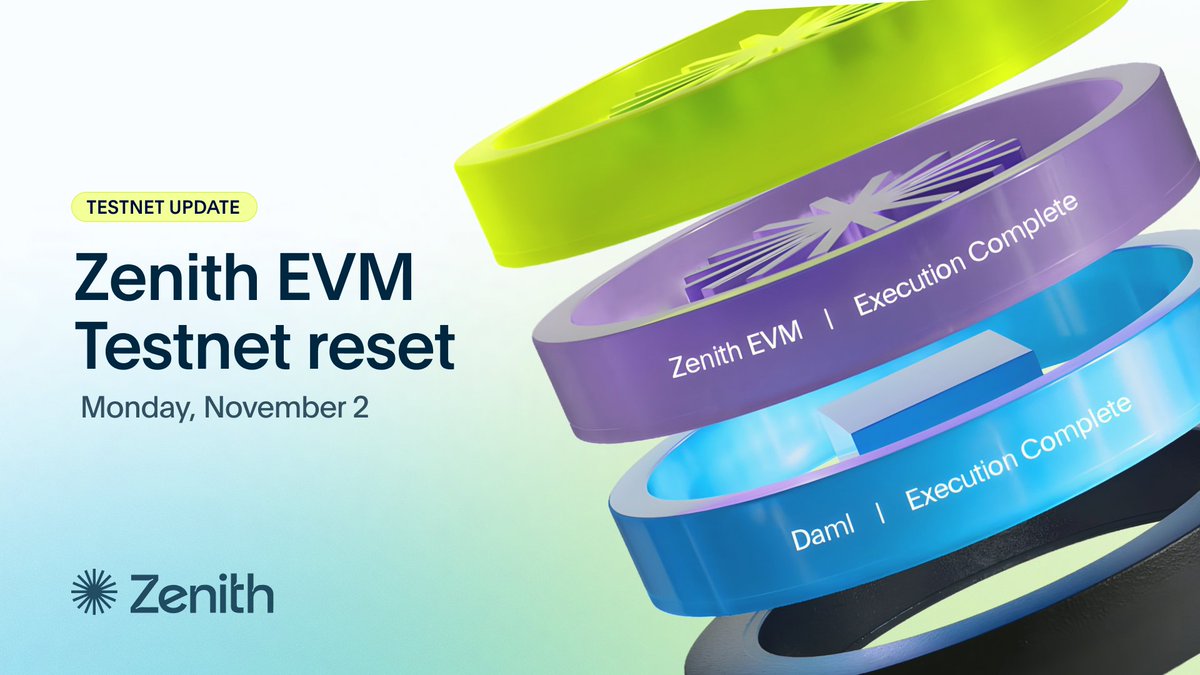
Thanks to everyone who has been building on and testing Zenith EVM Testnet.
The Zenith EVM Testnet will be reset on Monday, 2 Nov 2026, between approximately 2pm and 5pm CET (13:00 to 16:00 UTC), to ship a protocol upgrade, performance improvements and network hardening.
What the reset means for you:
• All testnet state will be wiped: balances, deployed contracts and transaction history.
• Re-fund your wallet from the faucet once the network is back.
• Redeploy your contracts after the reset.
What’s changing:
• Faucet bot protection: The faucet is now protected by a captcha, so bots and spammers can’t block real users from getting tokens.
• Stricter faucet rate limits: Claims are now more tightly rate-limited, so funds are spread fairly among builders and testers.
• Per-block transaction cap removed: The previous limit on transactions per block is increasing too.
• Fixes and hardening: This upgrade includes fixes for issues discovered on the current testnet, plus general stability improvements.
A note on testnet ZTH:
All existing testnet ZTH balances, including any previously farmed ZTH, will be gone after the reset. Testnet ZTH has no value, and farming it provides no benefit. The faucet exists so developers can test, and the new protective measures are there to keep it that way.
Network details:
We expect RPC endpoints and other network settings to stay the same. If anything changes, we’ll update our docs accordingly.
Expect some downtime during the upgrade. We’ll post here as soon as the network is live again.
For more info about our testnet, please visit our docs: https://t.co/Uw1qopgIgF
Zth.
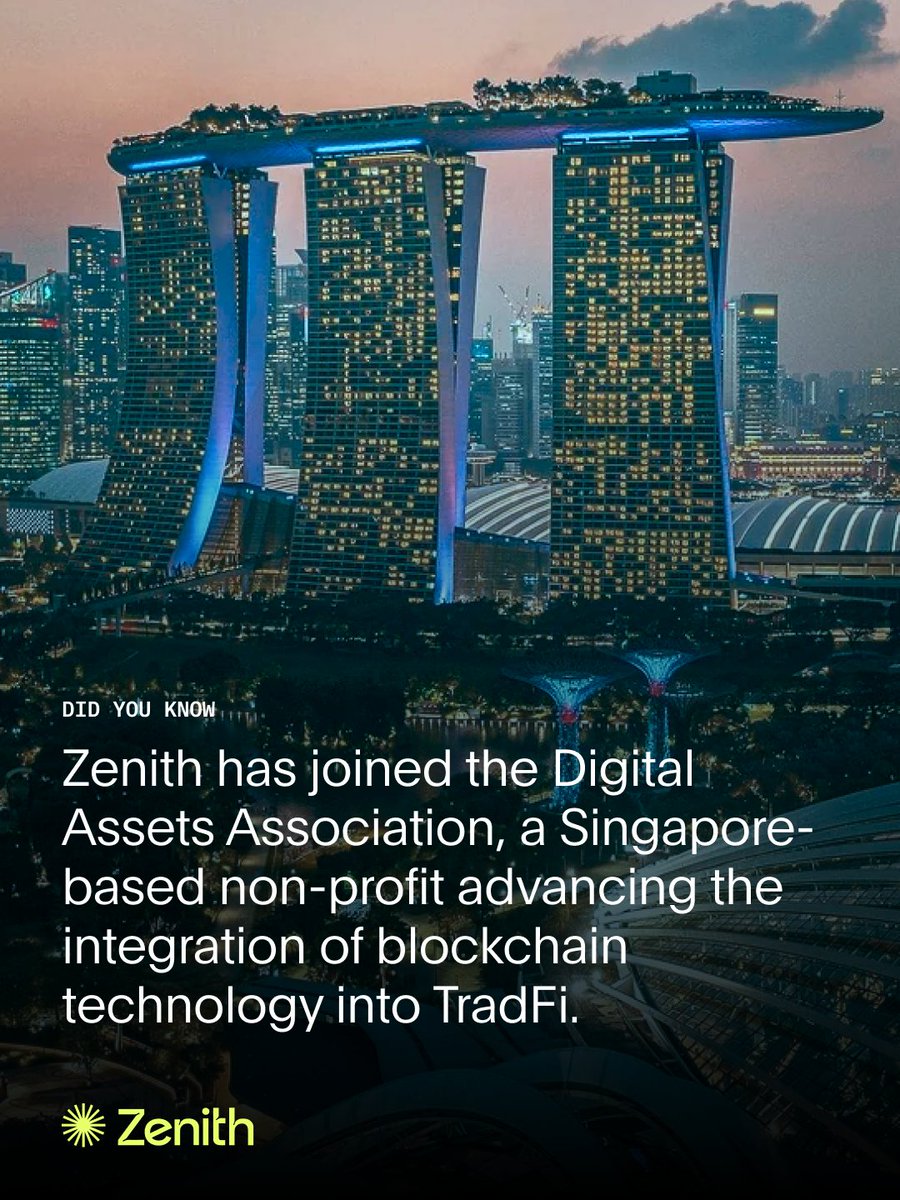
Zenith has joined the Digital Assets Association (DAA), a Singapore-based non-profit advancing the integration of blockchain technology into traditional finance.
Singapore is an important meeting point for financial institutions, digital asset infrastructure, and cross-border capital markets. DAA brings these worlds together, with a focus on institutional blockchain adoption, asset tokenization, and connecting traditional finance with on-chain markets.
Zenith is joining a network of industry players including @coinbase, @BitGo, @GSR_io, @trmlabs, Murex, and many others.
At Zenith, we're building Ethereum-compatible execution infrastructure for Canton Network. Zenith EVM lets developers build Solidity applications that interact atomically with Canton-native assets and workflows, and Zenith Stack enables institutions to deploy their own customizable EVM environments with greater control over how they operate.
Looking forward to being part of the DAA community and contributing to what's being built across the region.
Learn more: https://t.co/n6Tj1AjAKt
Zth.
With the Zenith EVM Testnet live, one question keeps coming up: is Zenith an L2 or a bridge?
Neither. For institutions and developers building serious financial applications, the difference is not just architectural. L2s and bridges extract value from the networks they connect to. Sequencer fees flow out, settlement risk sits in the gaps between environments, and the base layer captures less of what the activity actually generates.
Zenith works the other way. Every EVM transaction is native Canton activity, fees stay within Canton's economic model, finality is deterministic, and atomic composability with Canton-native workflows means both sides of a transaction settle together or not at all. No exposure window. No reconciliation overhead.
@NorbertVadas, Zenith Head of Product, explains what's under the hood in the clip above.
Check it out: https://t.co/Uw1qopgIgF
Zth.
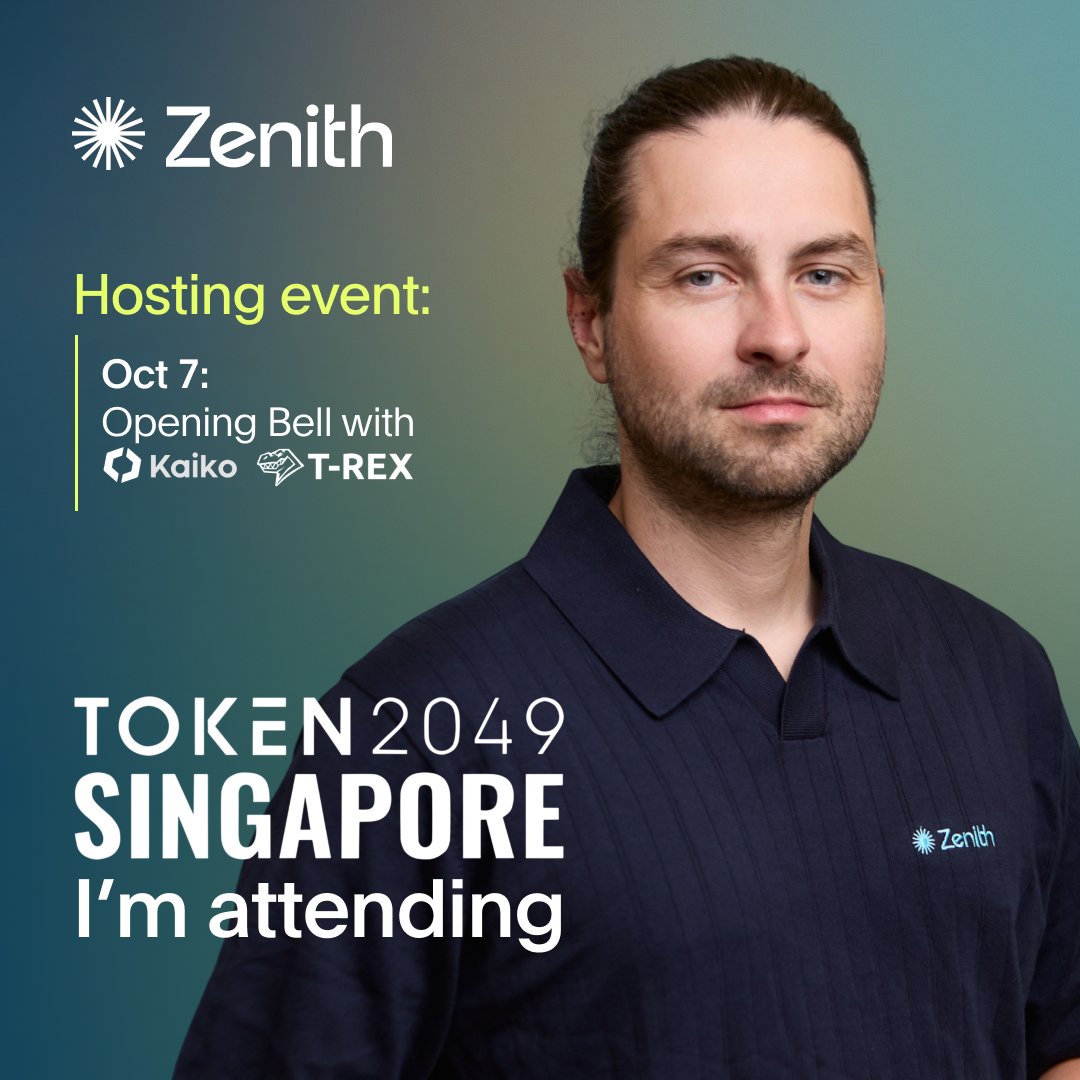
gmgm @token2049 such a pleasure to be back in Singapore! Reach out if you want to talk how we enable EVM functionality and logic natively on Canton !
@ZenithFdn@CantonNetwork
서울에서 한국 금융기관들과 토큰화의 다음 단계를 논의했습니다.
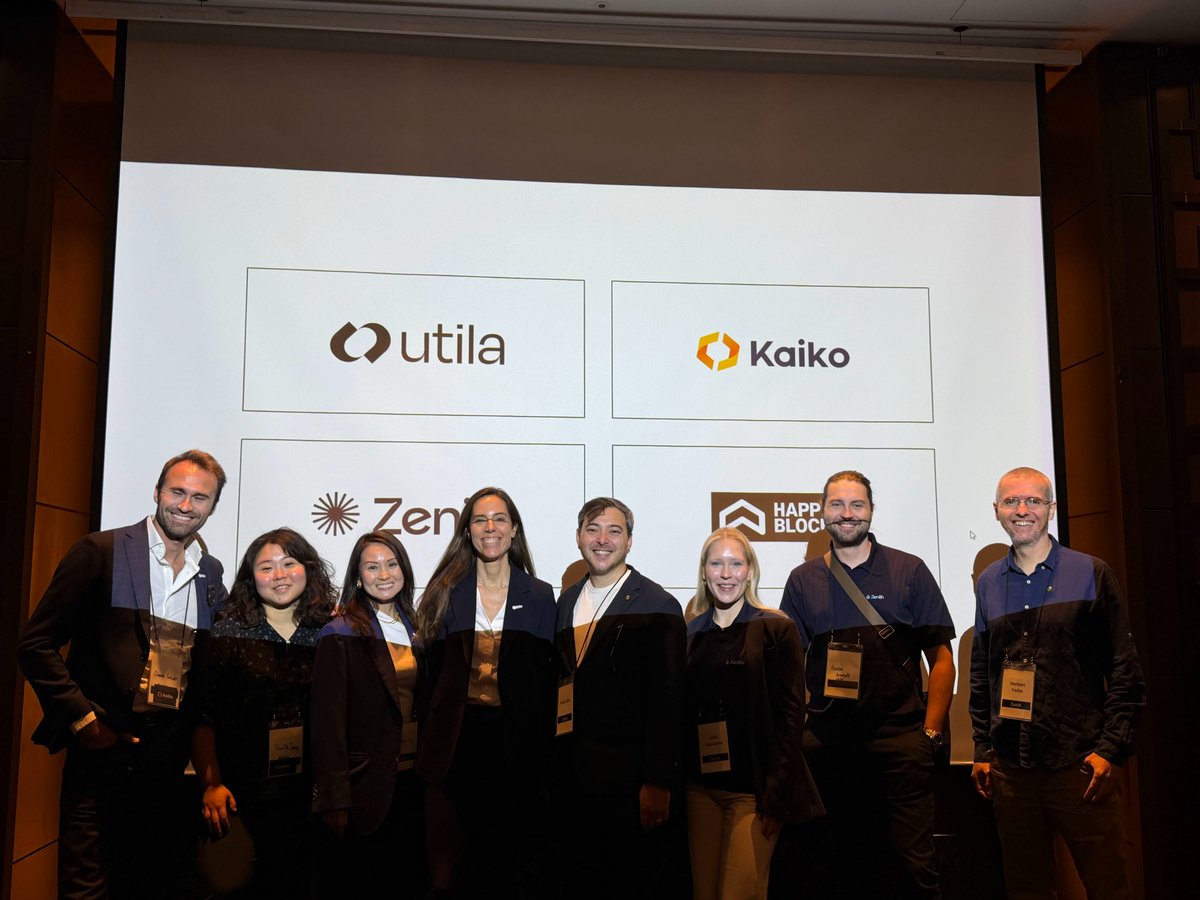
Zenith co-hosted the Seoul Table, an institutional lunch, alongside @KaikoData, @utila_io and Happyblock during @kbwofficial, bringing together a cross-section of Korea's financial and digital asset ecosystem. Banks, securities firms, asset managers, custodians, legal advisors and infrastructure providers, all navigating the same questions about how tokenization, digital assets and institutional blockchain infrastructure come together at scale in regulated markets.
Korea is not watching this space from the sidelines. With the token securities framework taking effect in February 2027, institutions are preparing now, and multiple tokenization and won stablecoin initiatives are already taking shape. Thank you to Woori Bank, Mirae Asset Securities, Kyobo Life Insurance, Kyobo Securities, Meritz Securities, LS Securities, iM Bank, Shin & Kim, Deloitte Korea, Bithumb and many others for being in the room, alongside ecosystem teams from across the region and beyond.
Being in these conversations, and hosting them, is how Zenith stays close to the decisions that matter. Grateful to our co-hosts and to everyone who made time to join.
Next stop: Singapore.
Zth.
JUST IN: The Zenith EVM Testnet is live and open to the public.
For the first time, 31800+ Ethereum developers can deploy standard Solidity applications that compose atomically with @CantonNetwork - the institutional blockchain where DTCC, JPMorgan, Goldman Sachs, and Visa process $9T+ in monthly settlement volume.
Point your existing tools at the Zenith RPC endpoint and deploy. Your contracts don't change, your tooling doesn't change, and every transaction is finalized through Canton's consensus with deterministic finality in seconds. The external_call() primitive enables atomic composability with Canton-native Daml workflows directly, and the Linked Transactions explorer shows you the full lifecycle of every transaction across both environments in one place.
Zenith is already contributing to two of the most significant tokenization initiatives running on Canton: @The_DTCC 's DTC Digital Assets Solutions Industry Working Group bringing $114 trillion in U.S. securities on-chain, and @progmat_en's Tokenized JGB working group targeting Japan's $1.6 trillion JGB repo market alongside MUFG, Mizuho, and BlackRock Japan.
This is the first public venue where Ethereum's programmability and Canton's institutional rails meet.
Get started: https://t.co/Uw1qopgIgF
Explore: https://t.co/JOKTd82ShO
Full announcement: https://t.co/cWxsQi1ur2
To test atomic cross-environment workflows with the Zenith Gateway, reach out to us directly: [email protected]
Zth.
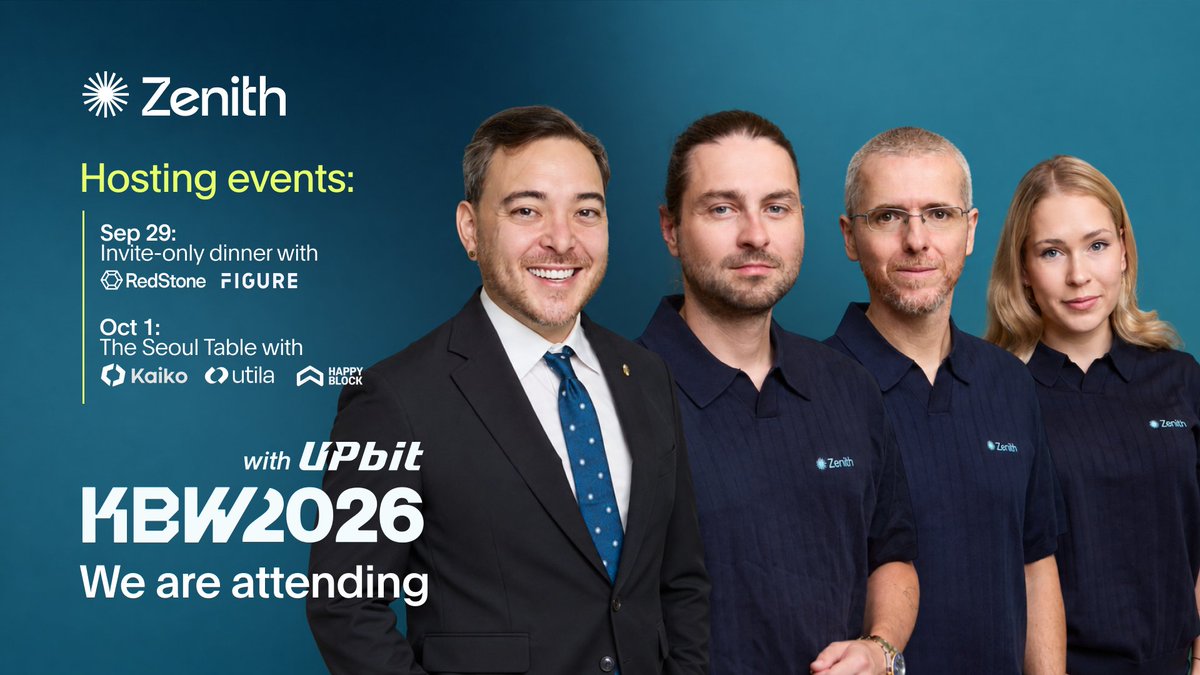
The institutional tokenization conversation in Asia is moving faster than most people outside the region realize. Next week the Zenith team is in Seoul for @Official_Upbit's @kbwofficial, hosting two events and joining the conversations at the center of it.
Here's where to find us:
September 29, 17:30-21:30
Invite-only dinner at Samwon Garden, co-hosted with @redstone_defi and @Figure. An intimate seated evening built for the conversations that don't fit a conference agenda. If you're working at the intersection of institutional finance and digital assets and want to be in the room, reach out directly.
Details: https://t.co/ZnZHGIwHIr
September 30
@HeslinKim speaks at the RealFi x Asia Stablecoin Conference in Seoul.
Check info: https://t.co/sVipaZLn8i
October 1, 11:00-14:00
The Seoul Table, an institutional lunch at Conrad Seoul, co-hosted with @KaikoData, @utila_io, and Happyblock. Meet the teams behind institutional digital asset adoption alongside banks, funds, and capital market participants working through the same questions.
RSVP: https://t.co/9J4CrxWGsF
If you're going to be in Seoul, we'd love to see you. Reach out or find @HeslinKim, @GArentoft, @NorbertVadas, and @SuontamaJulia on the ground.
Zth.
Super exited to represent @ZenithFdn at @Official_Upbit next week in Seoul! Reach out to discuss institutional finance and Ethereum Composability. Always a pleasure to return to Korea
They say breakfast is the most important meal of the day. We'd argue the most important breakfast of the year is October 7 in Singapore.
Zenith is co-hosting the Opening Bell alongside @trex_network and @KaikoData, a short walk from Marina Bay Sands. No stage, no panels, the people actually building tokenized markets, good food, good coffee, and the conversations that set the tone for the week.
Breakfast is on us. Limited seats.
RSVP: https://t.co/OWY6l9G3En
Zth.
JUST IN: Zenith has completed its next major technical milestone on the path to full EVM composability on @CantonNetwork Mainnet.
Earlier this year Zenith demonstrated the first atomic transaction flows between EVM applications and Canton. Today that goes further, a fully atomic swap between a Canton-native CIP-56 asset and an ERC-20 asset on Zenith, executed through a Canton-native application on a feature-complete test network, between a Canton-only user with just a partyID and a Zenith-only user with just an EVM account. Neither party required knowledge of the other's environment.
At the core is external_call(), a new primitive now merged into Canton's repository that allows Daml contracts on Canton to invoke Solidity contracts on Zenith from within Daml workflows, settling multi-leg operations atomically through Canton's Global Synchronizer. The foundation for full EVM composability at the protocol layer is laid. external_call() is scheduled for rollout to Canton Mainnet as part of the Canton 3.6 release in late Q3 or early Q4 2026.
Full announcement: https://t.co/Tc4KTDK1rp
Zth.
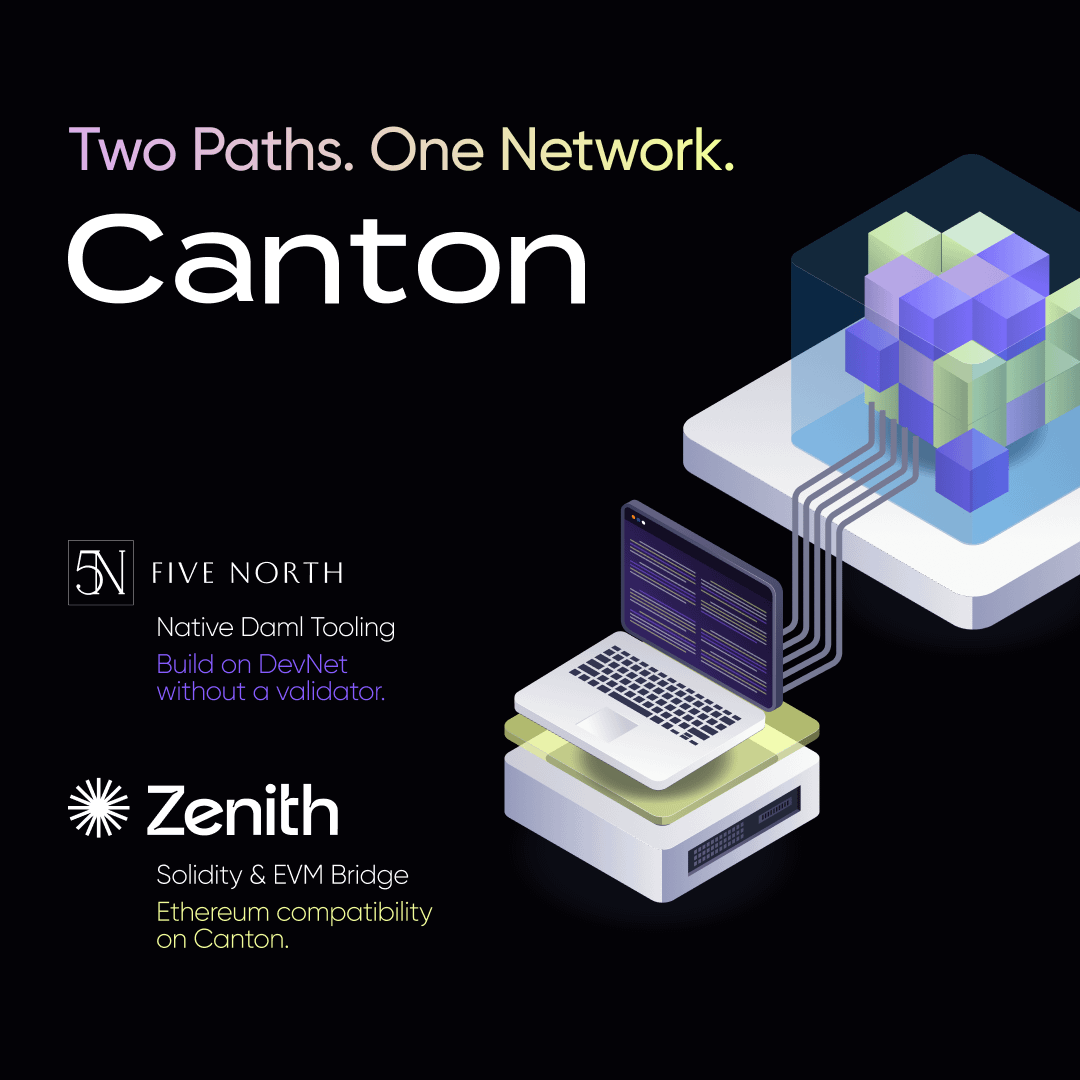
Coming from Ethereum, or ready to build native? Canton has a path either way.
@FiveNorthHQ builds core developer infrastructure for native Daml development on Canton, including deployment tooling that lets builders get onto DevNet without running their own validator.
@ZenithFdn brings Solidity and EVM compatibility to Canton, giving Ethereum developers a bridge into the network without needing to learn Daml from scratch.
Two teams. Two entry points. One network.
Thanks again @andres_solt it was a pleasure to talk shop. No one has asked about my background before in an interview so it was great being more casual.
32:35 I referenced massive Japanese deals I couldn’t discuss yet. Now public 😆
@ZenithFdn is being piloted on for the tokenization of $1.6T in Japanese Govt. Bonds.
https://t.co/PkOnUOCoJg
Zth.
JUST IN: Zenith has been invited to join Progmat's Tokenized JGB and On-chain Repo Working Group, a consortium bringing together MUFG, Mizuho, Sumitomo Mitsui, BlackRock Japan, State Street, SBI Securities, Japan Exchange Group, and other major players, conducting a joint study on bringing Japan's $1.6 trillion JGB (Japanese Government Bond) repo market on-chain.
Japan's JGB repo market is one of the largest in the world, processing ¥250-270 trillion annually and representing roughly 10% of the global government bond-backed repo market. Today it settles a business day after a trade is executed, operates within traditional market hours, and requires manual processes at every step. The working group is targeting same-day settlement, 24/7 availability, and cross-border access, enabling fully on-chain repo transactions using tokenized JGB collateral paired with stablecoin cash legs via lending protocols.
A comprehensive report is expected in October 2026, with issuance pilots targeted for later this year. Read the full announcement: https://t.co/3qkmqesLfN
Zth.
🔔 Canton Builders Office Hours returns tomorrow.
👥 @Bc1pxxx and @GArentoft will walk through @CantonNetwork development pathways including native Daml via @FiveNorthHQ and Solidity/EVM compatibility via @ZenithFdn.
🗓️ 1PM UTC | 9AM ET on Discord.
→ https://t.co/35mkzYijgd
Canton Builders Office Hours returns June 10th.
This session features @FiveNorthHQ and @ZenithFdn, the teams behind Canton's two builder pathways. Native Daml development through 5North. Solidity and EVM compatibility through Zenith.
Both teams will be live to walk through their tooling and answer questions.