Jeff Currie thinks we are sleepwalking into one of the biggest commodity shocks since Covid and the market is still pricing it like a headline risk instead of a physical crisis (Save this).
He calls it molecular contagion and last week, jet fuel shortages were concentrated in Singapore, where prices spiked to roughly 230 dollars a barrel.
This week the same pattern has shown up in Rotterdam at around 220 dollars and in Thailand, the Philippines, New Zealand, and Australia which means the dislocation has gone intercontinental.
In his words, there is no longer any meaningful spread between Singapore and Rotterdam, no spare barrels to re route, and no policy lever that can solve the problem in the short term.
Currie’s core point is brutally simple, you can print money, but you cannot print molecules.
The futures curve, the paper market is still trading around 100 dollars a barrel.
The physical market on the other side of the Strait of Hormuz is telling a completely different story, with Oman crude spiking to 173 dollars and Asia bound blends effectively clearing around 130 dollars a barrel.
Refined products like jet fuel and diesel are already spiraling north of 200 dollars a barrel in multiple hubs.
That is the tale of two markets he is talking about.
On one side you have screen prices that look volatile but manageable, helped by algorithmic trading, cross commodity hedging and the lingering belief that high prices fix high prices before anything breaks.
On the other side you have physical supply chains that are already breaking, tankers being diverted, refineries bidding against each other for the last uncommitted barrels, and regional shortages that cannot be solved with central bank liquidity.
Diesel is the pinch point. Hormuz is only part of the story. And equity markets may be missing the bigger repricing ahead.
In the latest EA Forum podcast, @ea_amrita and @CommodMkt unpack one of the biggest market dislocations in energy and commodities right now.
Key takeaways:
- The market is still conflating a deficit with a shortage and until that shifts, prices may not fully reflect the underlying reality.
- Even if the Strait of Hormuz reopened tomorrow, long-dated oil still needs to reprice on the structural set-up.
- Jeff argues this could be the biggest repricing opportunity across the commodity complex.
- Meanwhile, equity markets are in “la la land”, having repriced the energy halo lower while overlooking the broader hard asset story.
- Diesel remains the critical pinch point, with implications that feed through the entire system.
Watch the full episode now: https://t.co/fi9ii0WEwR
Recorded on 8 May, this episode features Energy Aspects Founder and Director of Market Intelligence Dr Amrita Sen and Jeff Currie, Co-Chair at Abaxx Exchange, Co-Founder of 1947 Oil & Gas Plc and Non-executive Director at Energy Aspects.
EA Forum brings together leading voices in global commodities and macroeconomics, offering unique perspectives and in-depth analysis from both EA and external experts.
#EnergyAspects #EAForum #EnergyMarkets
Commodity market guru Jeff Currie on the coming, inevitable oil price spike:
“Demand is up here; supply is down here. We’re filling that gap with inventory. When you eventually run out of inventory, demand has to come down to supply… You can’t print molecules.”
The stock market is in what I believe is a historic,final parabolic leg of a 44 yr secular bull market.I am raising some of my targets as follows: SPX 10,000, Nasdaq Comp 36,000, DJIA 67,000, RUT 4000, QQQ 950, SMH 800, gold $7000 & silver $200. My other targets remain unchanged.
As someone who builds institutional quant systems, this Anthropic lecture on Claude for Finance is the closest thing to an HFT research desk I've ever seen released for free.
Bookmark & watch today. It's the most valuable 1 hour in quant AI right now. Then read article below.
A little-known Swiss trading company played a key role in getting an oil supertanker transit through the Strait of Hormuz, a stop-start journey that captivated the market earlier this month https://t.co/F8llNC7EDj
Five "deal" announcements, zero closed (yet). That's a trend. Sell the tweet, buy the molecule. Iran's leverage increases with every day that passes and inventories decline, while it decreases for the West.
Thank you to @SquawkCNBC Asia for having me on this morning. Attached is the clip: 50 years of efficiency made oil cheaper per unit of GDP but more irreplaceable in function -- it is the rare earth of the macro system.
https://t.co/z7gKF3NABH
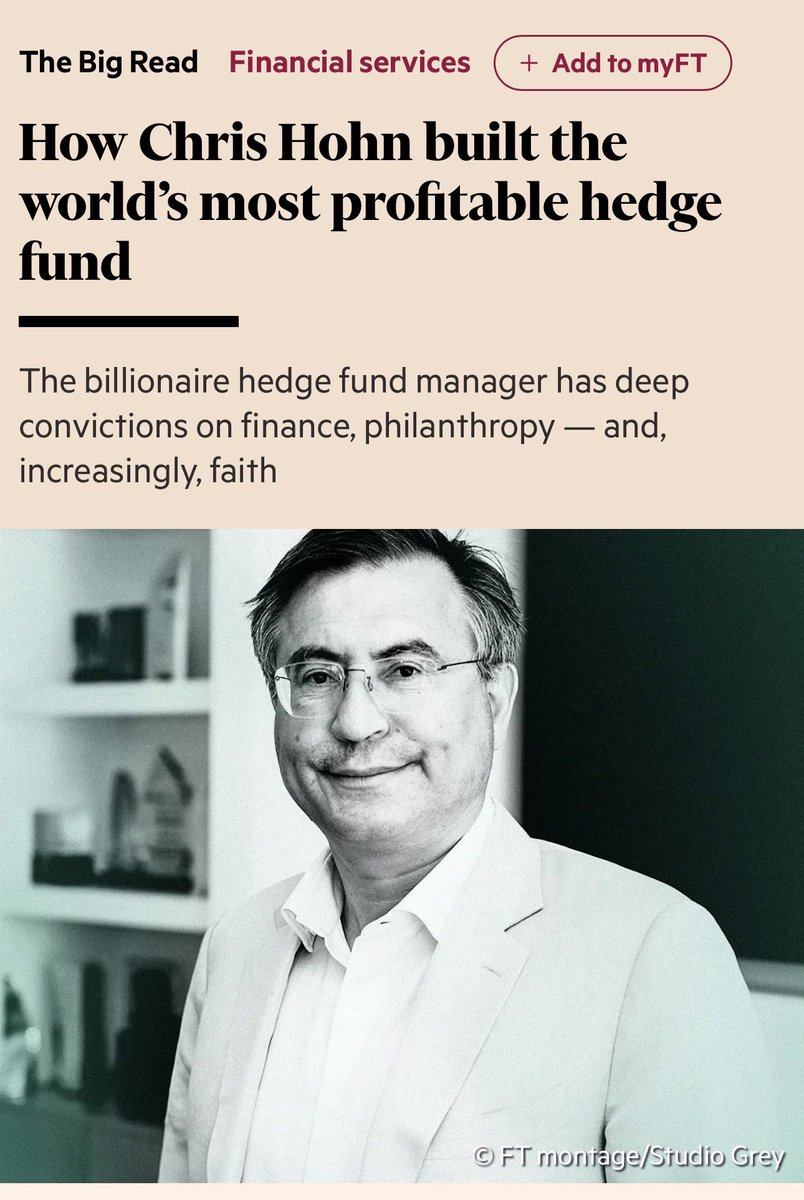
Chris Hohn did a 90-minute sit-down with Nicolai Tangen and then dropped an investor letter the FT got hold of last week.
You’d think the guy who printed a record $18.9B last year would be doing victory laps. Instead he’s quietly rewiring his whole portfolio.
My favorite takes from both:
1.The most important thing in investing isn’t growth. It’s barriers to entry. Growth without a moat is the airline industry: 5% volume growth for 100 years and basically zero cumulative profit.
2.There are only about 200 companies on earth he considers high-quality and investable. His fund holds 15.
3.Average holding period: 8 years. Some positions 13. “You have to hold the company forever, because the stock market may be at very bad prices when you want to sell.”
4.His real test for a moat: can the company price above inflation? A 20% margin business that prices 1% above inflation grows profits 5% faster than revenue. Forever. Almost no companies can do this.
5. Industries he won’t touch: banks, autos, retail, insurance, tobacco, asset managers, fossil fuel utilities, airlines, wireless telecom, media, advertising. On banks: “sooner or later someone without a lot of intelligence comes to run them, and then it can be toxic.”
6.On AI generally: call centers go bankrupt. Indian outsourcing coders are next. But for everyone else, AI lowers costs and raises productivity. Companies with real moats become MORE valuable.
7. Here’s the punchline. The FT got hold of his investor letter. He cut his Microsoft stake from 10% of the fund to 1%. Roughly $8B sold. He’d held it since 2017 through a 400% rally. His reason: AI could disrupt Office and Azure faster than the market thinks.
8.He moved that capital into Alphabet. Doubled it from 3% to 5%. Now his largest tech position. The world’s best quality investor sold Microsoft and bought Google because he thinks Google’s moat is more durable in an AI world. Not the consensus trade.
9.The underlying thesis: “AI eats software.” If AI agents do the work humans used to pay per-seat SaaS licenses for, the whole SaaS model gets re-rated. Oracle, Adobe, Salesforce all ~40% off highs. Microsoft 25% off. Market is starting to agree.
10.When to sell? Not when something gets expensive. When conviction drops. Valuation is one variable, conviction is the other. What kills you isn’t being wrong, it’s permanent loss of capital.
11.He admits hardcore activism doesn’t work anymore. Too much of the shareholder base is passive index funds. And even when activism wins, you usually win in a bad business. “The business always wins.”
12.Counterintuitive take: there are more good companies in public markets than in private equity. The best businesses are too big for PE to buy. And when public companies sell something to PE, they’re selling the assets they want to get rid of.
13.On intuition: “thinking without thinking.” Pattern recognition from 20 years of reps. It’s how he sniffed out Wirecard while the German establishment was defending it. “Most investors trust authority too much.”
14.He basically stopped shorting. “You’re going to be eventually right but not be able to fund the losses.” The first guy to short Wirecard had to cover 19 years before it hit zero. Buffett told him he and Charlie studied shorting and concluded it was too hard.
15.He gives almost everything away. ~$500M a year. $10 prevents an unwanted pregnancy in Africa. $40 saves a child from severe malnutrition. $50 prevents permanent blindness.
16.Tangen asks: advice to young people? Hohn, who runs the world’s most profitable hedge fund: “Go on a spiritual path.” The guy who made $18.9B last year ends the interview saying only purpose and meaning matter.
The headline: the world’s best quality investor just sold his biggest tech compounder because he thinks AI is breaking the moat. Quietly, with conviction, on an 8-year horizon, while everyone else is still buying the AI winners of 2023.
The fact that @CommodMkt still has fewer X followers than I have by itself disproves the Efficient Markets Hypothesis!
Clue in, Wake Up, Follow Jeff. It's that simple. You're doing yourself a major disservice if you haven't followed Jeff yet.
I suppose the other explanation would be that I have more followers because I'm better looking, but somehow I don't think that's it! 🤣
@robin_j_brooks your comments below reveal a profound lack of understanding of the oil market. Commodity futures price inventory, NOT expectations. That isn't ideology; it's a fact grounded in the economics of carry.
The Brent price in your graph is not a risk anyone can actually hold — it's a spot contract stitched together at each expiry. In normal times that's a fair proxy; these are not normal times. Construct a series an investor could truly hold — a rolled BCOM index, or the USO ETF — and the picture inverts: it slopes hard up and to the right, consistent with the largest supply shock in history.
USO keeps climbing because the shortage is showing up in the futures curve — not in the headline price on the screen. The carry pays an investor nearly 50% a year, even if the price of oil never moves.
The SPR was drawn down before commercial inventories — when it is normally the other way round. Strategic stocks are meant to be the last line of defence, not the first, but this time Washington spent them first, managing headlines not risk.
When you have no crude in storage, THEN and only then will the spot price move to a level to destroy demand. I have no idea if it is 150, or 200, or 250. The observed indication from Asia is ~200.
a quant at Two Sigma told me something at a bar i can't stop thinking about
"retail looks at price. we look at the autocorrelation of price changes - completely different signal"
i asked him to explain it like i was 12
he drew on a napkin:
if today's move predicts tomorrow's move - even slightly, 53% of the time - that's an edge
that edge, sized with Kelly, compounds into something insane
data is free - Bloomberg and the Fed publish all of it. math takes a weekend to learn
reason retail loses isn't intelligence. it's that they're reading the wrong representation of the same data
"a chart hides serial correlation. a time series shows it naked"
went home, ran autocorrelation tests on 3 years of SPY data
found 4 patterns - statistically significant, all exploitable on a 5-day window
signals aren't perfect, right 58% of the time. Kelly says that's enough
data was free the whole time, framework sitting in every stats textbook. nobody pointed retail toward it
they kept you staring at candles