Just launched the API for agentic multi-document processing: https://t.co/0DhCbV3El3
Instead of duct taping an extraction pipeline across parsing, classifying, extracting, resolving, and building a custom validation UI, you can achieve all of that in a single API call.
I used up the Fable quota - worth about $3000.
What impressed:
- it can really keep going autonomously; even if it needs to fix or work around broken environments
- it writes complete plans with more architectural nuances noted
Disappointments:
- it prefers complex solutions over accepting or suggesting trade-offs
- it is expensive: API pricing would have cost ~$3000
@miramurati@tinkerapi@grok analyse the article and summarize how they deal with hosting the fine tuned models and how they calculate the costs of hosting them.
@aakashgupta@aakashgupta costs are wrong.
Inference cost for fine tuned models is not just token cost but also hosting.
GPT/ Claude can deal with 1000 questions at the same time bc of pooled resources.
With a fine tuned model you need to spin up a ton of GPUs. Which is not free.
@parsewise is SOTA on Databricks OfficeQA benchmark, over Fable, GPT5.5
All while using Gemini flash models, showing that many use cases will go towards cheaper, faster models.
Results and tech breakdown: https://t.co/Zbgsd4bQs2
Props to @databricks, @superannotate, @USAFacts
How is it possible that Anthropic has had Mythos / Fable for months and they still don't have conversation branching in Claude??
ChatGPT added it in September 2025
🚩 We help our customers find red flags. 🚩
We found the one for the SpaceX IPO.
Jokes aside we wanted to see how the big IPOs from Spacex, Anthropic and OpenAI stack up, so we created: https://t.co/AamJGoqGNI
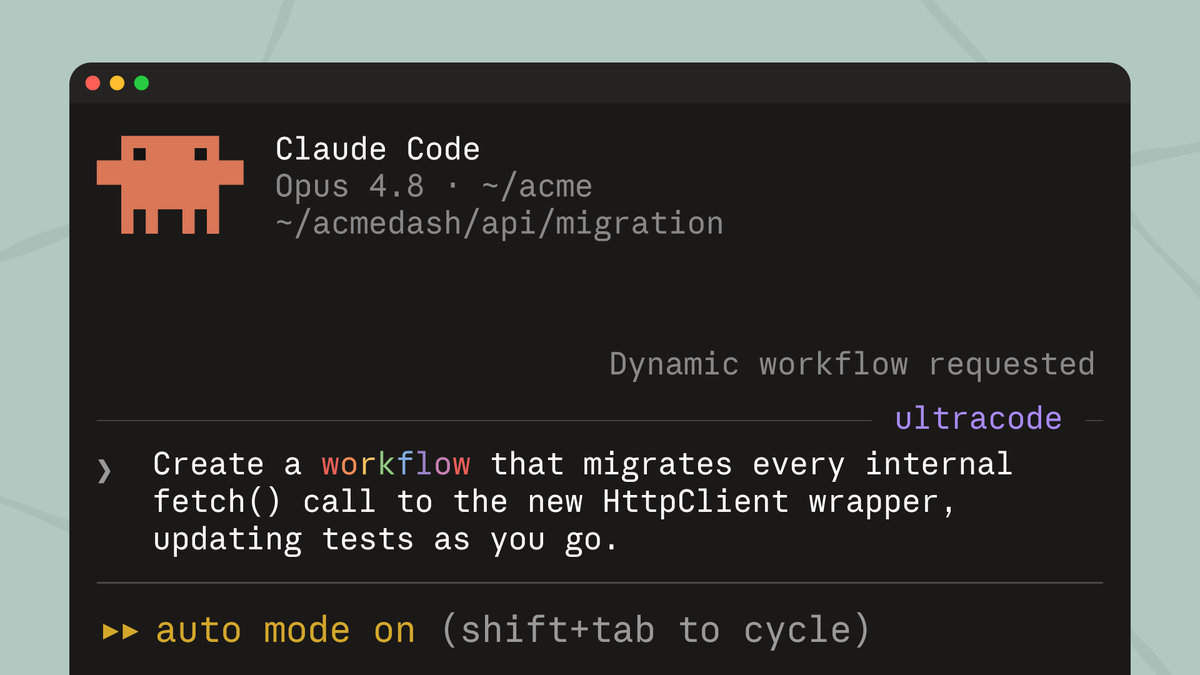
New in Claude Code (research preview): dynamic workflows.
Claude writes an orchestration script on the fly, then spins up a large fleet of coordinated subagents in parallel to take on your most complex tasks.
Use the word "workflow" in a prompt to get started.
@Prithvi_Jadwani Depends on the use case.
For some customers it's a one-off processing, so one to fetch results.
For many customers it's an ongoing process where they keep adding documents to enrich the results. For them, it scales with number of docs / iterations
Just launched the API for agentic multi-document processing: https://t.co/0DhCbV3El3
Instead of duct taping an extraction pipeline across parsing, classifying, extracting, resolving, and building a custom validation UI, you can achieve all of that in a single API call.
Claude is getting expensive. 🌶️
3 other things we learnt from our launch:
1. Claude / Codex is slow for agentic document processing
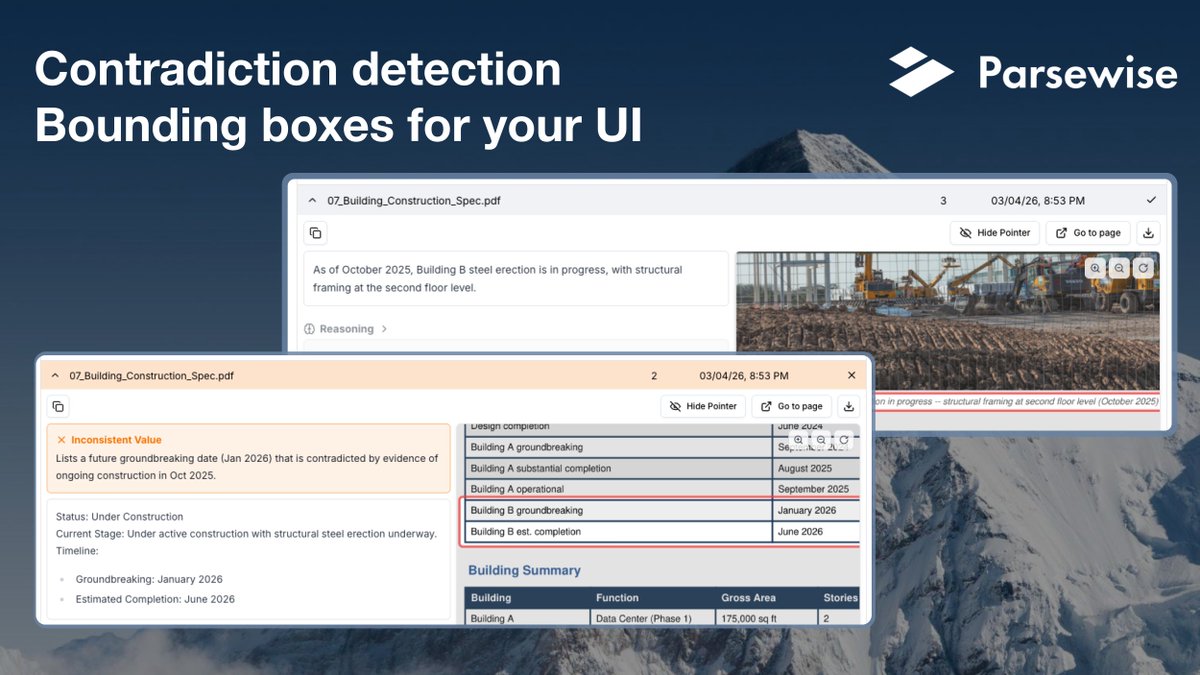
2. Conflicting information across documents is common and breaks pipelines
3. People love bounding boxes (so here are a few;)
@Ibrahimala305 hey Ibrahim, yes it is. You can get started with a free account from https://t.co/DT4oBbjW9P
We have customers ranging from small startups to enterprises using the platform live.
Claude response 2/2:
Skills like gstack are scaffolding that enforces what a senior engineer does naturally. The gap isn't capability, it's default behavior — a training incentive problem that should close over time.
If AI is so smart, why do we need so many specific skills?
I understand that there are subjective preferences and personalization, but why do we need so many skills around coding?
Why has @garrytan's gstack taken off?
Claude response 1/2:
AI models have the knowledge but not the discipline — training rewards fast, confident responses because that *feels* helpful, so models learn to execute rather than interrogate, just like a junior employee who over-delivers on the wrong thing.
Takeaway from Jensen Huang at GTC: software tools will thrive.
If you're designing chips and your AI agent produces an image, not a CAD asset, it's useless. You can't verify it, you can't modify it.
Same for knowledge work.
Experts need to verify and modify.
#parsewise
Can you catch LLM omissions?
Mostly no. And false negatives are even worse than hallucinations.
Parsewise does exhaustive search -> you get reasoning traces even for cases where the LLM chooses to ignore details.
E.g. married person changed their name - should it be included?
🔎 Interpretability of LLMs has gotten worse.
For better responsibility quality, now there is more reasoning and longer walls of text. This gets worse with long horizon agentic analyses.
We built @parsewise to fix that and help you verify fast.