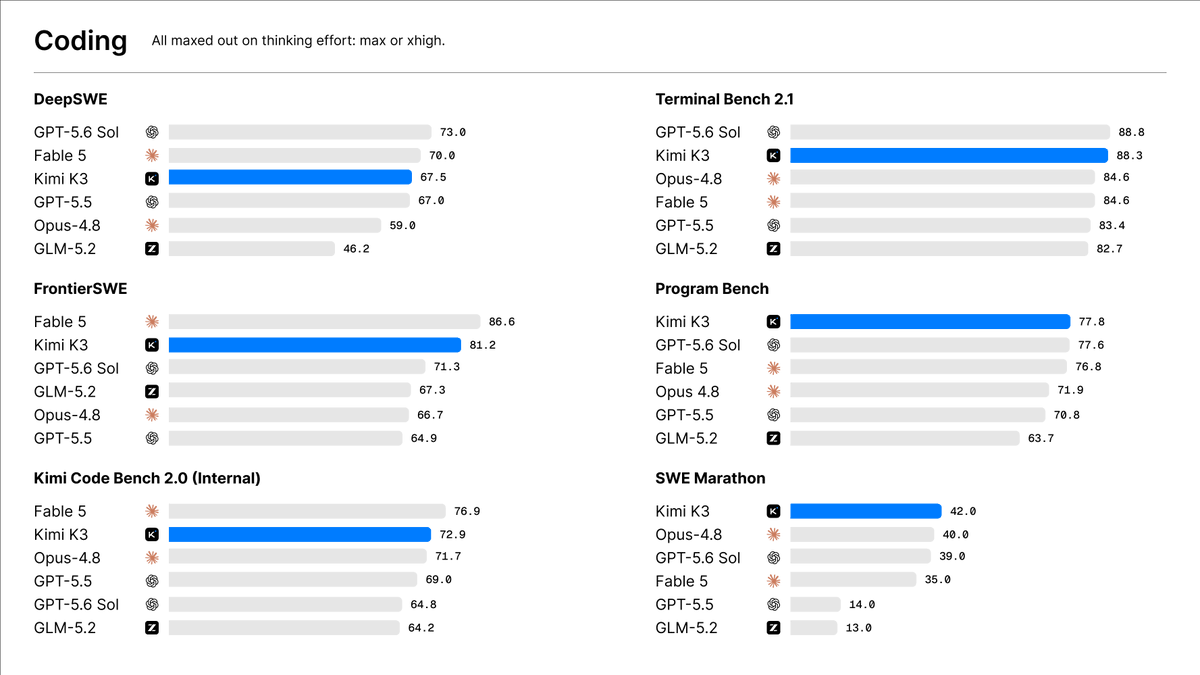
Introducing Kimi K3: Open Frontier Intelligence
🔹 2.8 Trillion Parameters, 1 Million Context, Native Multimodal
🔹 Kimi Delta Attention enables up to 6.3x faster decoding in million-token contexts
🔹 Attention Residuals deliver ~25% higher training efficiency at <2% additional cost
🔹 Built for long-horizon agentic coding and self-evolving workflows
Kimi K3 is now live on on https://t.co/zrk6zZxZUo, Kimi Work, Kimi Code, and the Kimi API.
Open Weights by July 27, 2026.
🔗 API: https://t.co/XCrgjXAqMw
🔗 Tech blog: https://t.co/YTfiMSNM1f
If solar power in space is harnessed for useful work at scale, the value of that will far exceed the Earth economy, because all of Earth civilization uses much less than a trillionth of our Sun’s power
As engineering, product, design, DS, etc. melt into a new kind of role, I was reflecting on what roles might look like in the future. For example, when I look at the Claude Code team I see what I think is five archetypes:
1. Prototyper: comes up with brand new ideas; churns out many ideas, most of which don't ship
2. Builder: quickly turns a prototype/idea into production-grade product/infra
3. Sweeper: cleans up the UI, simplifies the code and system, unships, optimizes performance
4. Grower: takes a product that has been built and iterates on it to improve Product-Market Fit
5. Maintainer: owns a mature system to make it secure, reliable, fast, and efficient as it scales
Many people span across 2 roles, and sometimes 3 roles. I also notice that these roles are not really tied to job function -- eg. across Anthropic, some designers match category 1, some 2, some 3; same for engineers, PM, DS.
A healthy team needs a mix of these, depending on the product:
- A product that is new and pre-PMF needs people that are strong at 1+2+3
- A product that is growing and has found PMF needs 2+3+4 and some 5
- A product that has strong PMF needs 3+4+5 and some 2
Maybe product roles of the future will look more like this, and less like the domain-specific roles of today?
GPT 5.5 is insane! Guess which one is Opus 4.7?
It knows physics, geometry, logic and math way better that Opus 4.7.
Opus was not even able to produce a valid track, it misplaced the track plane!
Introducing Claude Fable 5: a Mythos-class model that we’ve made safe for general use.
Its capabilities exceed those of any model we’ve ever made generally available.
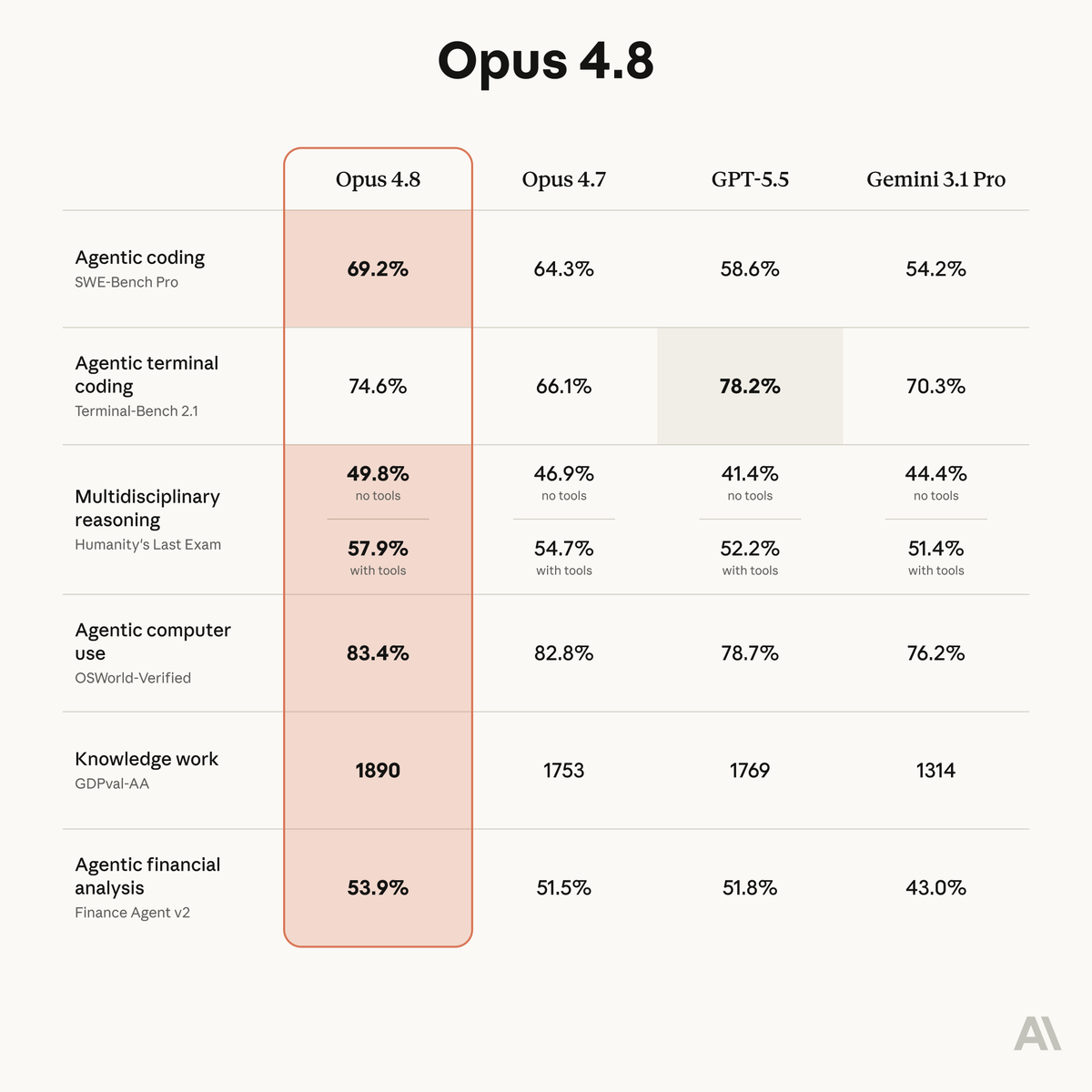
Introducing Claude Opus 4.8: it builds on Opus 4.7 with sharper judgment, more honesty about its own progress, and the ability to work independently for longer than its predecessors.
Available today at the same price.
Personal update: I've joined Anthropic. I think the next few years at the frontier of LLMs will be especially formative. I am very excited to join the team here and get back to R&D. I remain deeply passionate about education and plan to resume my work on it in time.
People freaking out over my AI spend. What nobody sees: Part of what excites me so much about working on OpenClaw is that I'm trying to answer the question:
How would we build software in the future if tokens don't matter?
We constant run ~100 codex in the cloud, reviewing every PR, every issue. If a fix on main lands, @clawsweeper will eventually find that 6 month old issue and close it with an exact reference.
We run codex on every commit to review for security issues (as it's far too easy to miss).
We run codex to de-duplicate issues and find clusters and send reports for the most pressing issues.
We have agents that can recreate complex setups, spin up ephemeral https://t.co/Q1NRXLemEy machines, log into e.g. Telegram, make a video and post before/after fix on the PR.
There's codex that watch new issues and - if it fits our documented vision well, automatically create a PR of it. (that then another codex reviews)
We have codex running that scans comments for spam and blocks people.
We have codex instances running that verify performance benchmarks and report regressions into Discord.
We have agents that listen on our meetings and proactively start work, e.g. create PRs when we discuss new features while we discuss them.
We build https://t.co/bmA1XnoB7P to split all our projects into functional units to review and find bugs and regresssions.
We do the same split for security with Vercel's deepsec and Codex Security to find regressions and vulnerabilities.
All that automation allows us to run this project extremely lean.
You can now keep codex going for days.
With GPT-5.5 it will build an entire OS kernel for you if you ask, or find critical bugs in a codebase, or optimize your database schemas, or… the options are endless.
Not to mention that Opus required an extra prompt to even show something...because the browser errored out due to bad include.
This was done in Codex and Claude Code respectively.
GPT 5.5 is insane! Guess which one is Opus 4.7?
It knows physics, geometry, logic and math way better that Opus 4.7.
Opus was not even able to produce a valid track, it misplaced the track plane!
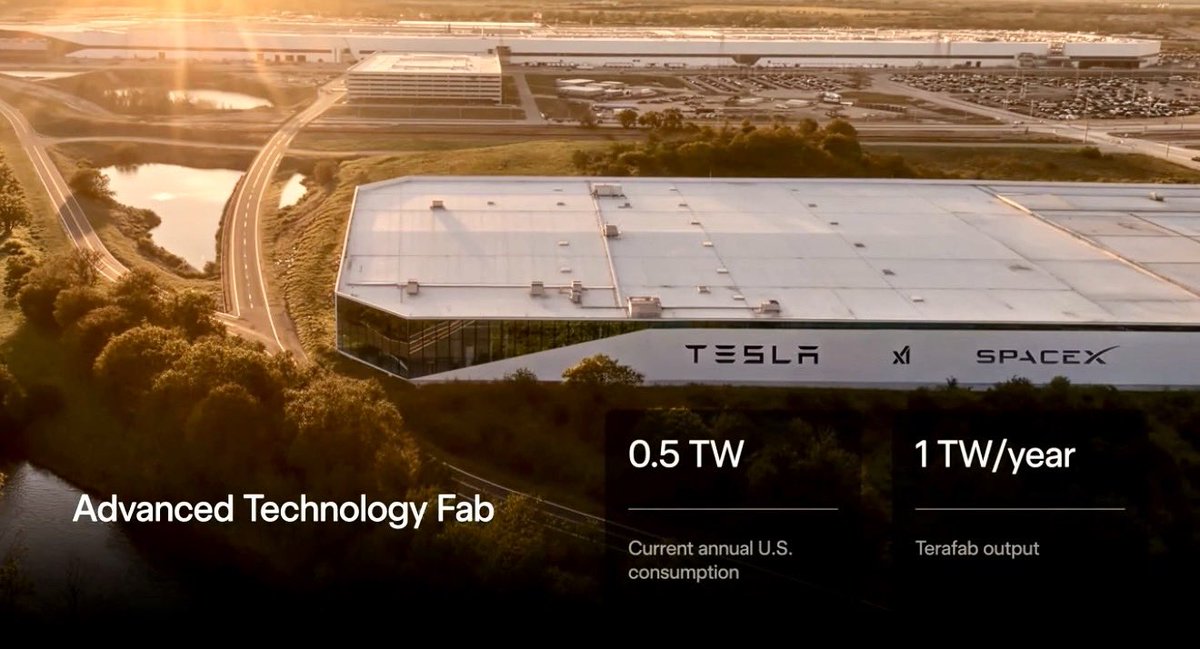
Everyone is covering Terafab as a chip factory.
It is not a chip factory.
Last night in Austin, Elon unveiled a facility that makes masks, fabricates chips, and tests them inside a single building with a nine-month recursive improvement cadence. No such loop exists anywhere else on Earth. Then he told you 80% of the output goes to space. Then he showed you a 100-kilowatt AI satellite with solar panels and radiators, scaling to megawatt range. Then he said Optimus plus photovoltaics will be the first von Neumann probe, a machine capable of replicating itself from raw materials found in space.
Nobody connected the sequence.
Terafab produces 1 terawatt per year of compute. The entire United States consumes 0.5 terawatts of electricity. Musk is building a single factory whose output in AI silicon exceeds twice the power consumption of the country it sits in. And he is sending 80% of it off-planet because Earth literally cannot power what he is building.
Follow the mechanism. Terafab seeds the chips. Starship launches Optimus robots and solar arrays at 100 million tons per year. The robots mine lunar and asteroid regolith for silicon, iron, and nickel. They 3D-print more robots. They fabricate more solar panels. They assemble more AI satellites. Each satellite runs hotter-burning D3 chips designed specifically for vacuum, where free radiative cooling eliminates the thermal constraints that strangle every terrestrial data center on the planet. The nodes replicate. The replication is exponential.
This is a Dyson Swarm bootstrap hidden inside a semiconductor announcement.
The math is public. The Sun outputs 3.828 times 10 to the 26th watts. A 2022 paper in Physica Scripta calculated that 5.5 billion satellites at 290 kilograms each, robotically manufactured from Mars resources, capture enough solar energy to meet all of Earth’s power needs within 50 years. A 2025 paper in Solar Energy Materials calculated a partial swarm capturing 4% of solar output yields 15.6 yottawatts, roughly a billion times current human civilization’s total energy budget. Musk just announced the factory that builds the chips that go inside the satellites that replicate themselves forever.
92% of advanced logic chips are fabricated in Taiwan. One factory in Austin does not fix that. But one self-replicating system seeded by that factory, launched by the only company with reusable heavy-lift rockets, assembled by the only humanoid robot in mass production, and powered by the only star within reach, does not fix a supply chain. It obsoletes the concept of supply chains entirely.
The market priced this as a $20 billion capex story about semiconductor independence.
The actual announcement was the engineering blueprint for Kardashev Type II.
Humanity sits at 0.73 on the Kardashev scale. 18 terawatts. The distance between here and harnessing a star is not a technology gap. It is a recursion gap. And recursion is exactly what a single building in Austin that makes its own masks, builds its own chips, tests its own chips, and launches the output into orbit on its own rockets was designed to close.
Every civilization that makes it past this point never looks back.
@karpathy autoresearch idea is kind of insane in the best way.
I pointed it at a structural topology optimization problem for ribbed concrete slabs, and it started iterating on joist/rib layouts, FEM validation, and code-driven improvement loops almost like a structural researcher that never gets tired.
This is the wild part: once you connect autonomous search to real engineering objectives, you’re not just generating text anymore: you’re exploring actual design space.
Still early, still rough, but holy shit this feels important.