@taofeek_ob@Rohit7101@dfinity@DFINITYDev 1/N
-ICP Smart Contracts execute Wasm code and hold both code and state as data inside a "Canister"
-Canisters deployed w/ a controller can be mutated/patched, or rendered immutable if controller is removed
-Canisters can serve both front and back end services w/o the need of AWS
@RayFernando1337 APM is now agents-per-minute! OmO/OmX is just next level. Particularly liked how they added Hashline for token savings and consistency.
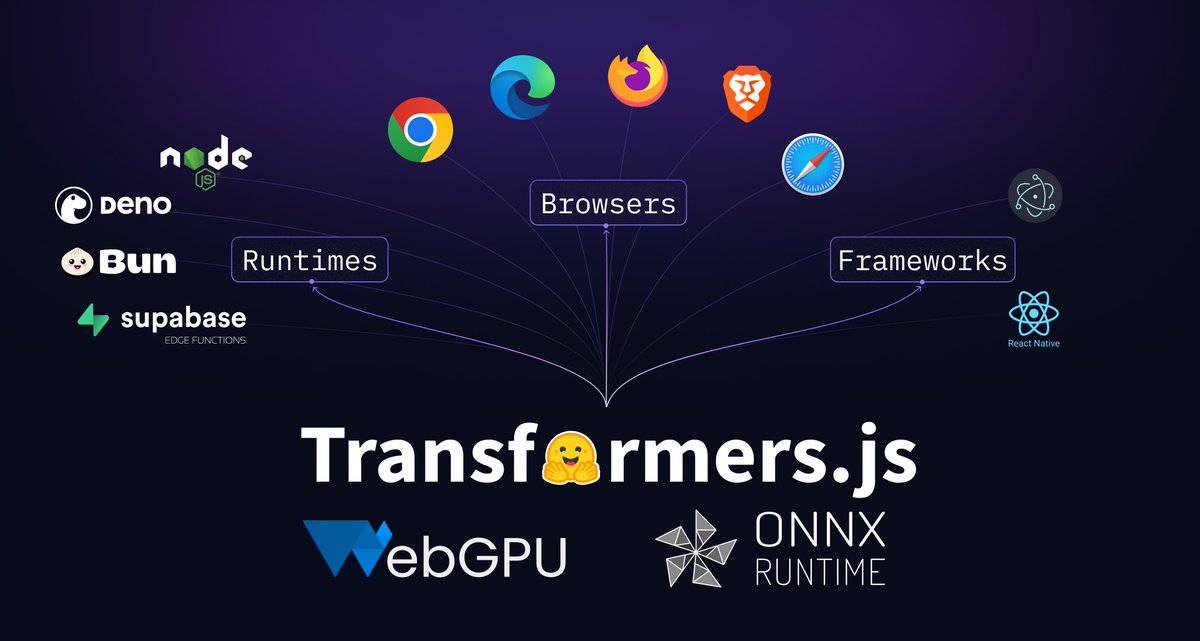
After nearly a year of development, 🤗 Transformers.js v4 Preview is finally out on npm!
npm i @huggingface/transformers@next
Build WebGPU-accelerated AI applications that run everywhere: browsers, Node.js, Bun, Deno, Electron, and more.
See what's new in our blog post 👇
Just attended the RP1 metaverse meetup and am excited for the future of the open Spatial Internet!
Looking at this ambitious project, I see lots of synergies between RP1's 3D Spatial Internet Browser and @dfinity's decentralized internet cloud on the Internet Computer Protocol.
Today is a huge moment for RP1, our team, and for anyone who believes the spatial internet must be open, interoperable, and built by all of us — not controlled by a single platform.
Six months ago, we introduced the world’s first metaverse spatial browser at AWE.
Today, we’re officially opening access to the first open ecosystem for the spatial internet.
Developers everywhere can now begin building and self-hosting proximity-based, real-time 3D experiences on their own servers — with full control of their data, content, and monetization.
No walled gardens.
No device lock-in.
No platform dependencies.
Just like the early web. This milestone is the result of years of effort from an unbelievably dedicated team at RP1. You built an entire technology stack — a 3D browser, a universal spatial fabric, massive scalability, real-time API services — long before the market realized how much it would need them.
And now the world is ready.
With the wave of new XR devices coming from Meta, Samsung, Apple, and others, it’s clear the internet is becoming spatial. But without an open foundation, companies can’t move forward. They can’t build the infrastructure they need. They can’t own their data or ensure long-term stability. They can’t innovate freely.
That changes today.
We’re launching the first set of developer tools and documentation to help anyone:
• Set up and host their own metaverse server
• Build persistent 3D environments
• Connect them to RP1’s universal spatial fabric
• Deploy proximity-based, real-time services (AI, payments, IoT, multiplayer, enterprise tools, and more)
And this is just the beginning.
2026 will see thousands of new tools, APIs, examples, and capabilities released openly to the world.
- To our team: Thank you. You built something that many said was impossible.
- To developers: The tools are yours. Start building.
- To enterprises: You can finally own your spatial infrastructure.
- To the entire XR community: The open spatial internet is here — and we get to build it together.
Join us for the launch event on December 8 at 10am PT:
https://t.co/37ZNvR4cCX
Explore the documentation and developer center:
https://t.co/ICrZDCLtdB
https://t.co/3SvmpZ1Ase
Adventure awaits — and today, the adventure becomes real.
The healthcare industry has a data standard so complex it breaks conventional LLM structured generation.
We just became the first to generate valid FHIR outputs with Qwen3-4B-Instruct. 👇
A breakthrough in healthcare AI.
@josephfounder Icp Ninja coding agents support is great, but why lock exclusively to Caffeine when there is Claude Code or even Qwen3-Coder via https://t.co/uFMf5Jz9co?
For the FASTEST agentic coder, nothing beats @cerebras' Cerebras Code that does Qwen3-Coder 480B at 2000+ TPS
@dfinity