BREAKING: EU proposals delivered to Vladimir Putin include a scenario in which Russian forces are allowed to walk home on designated routes escorted by Ukrainian drones, as long as they leave their weapons and raise their hands while the Russians play "The world turned upside down"
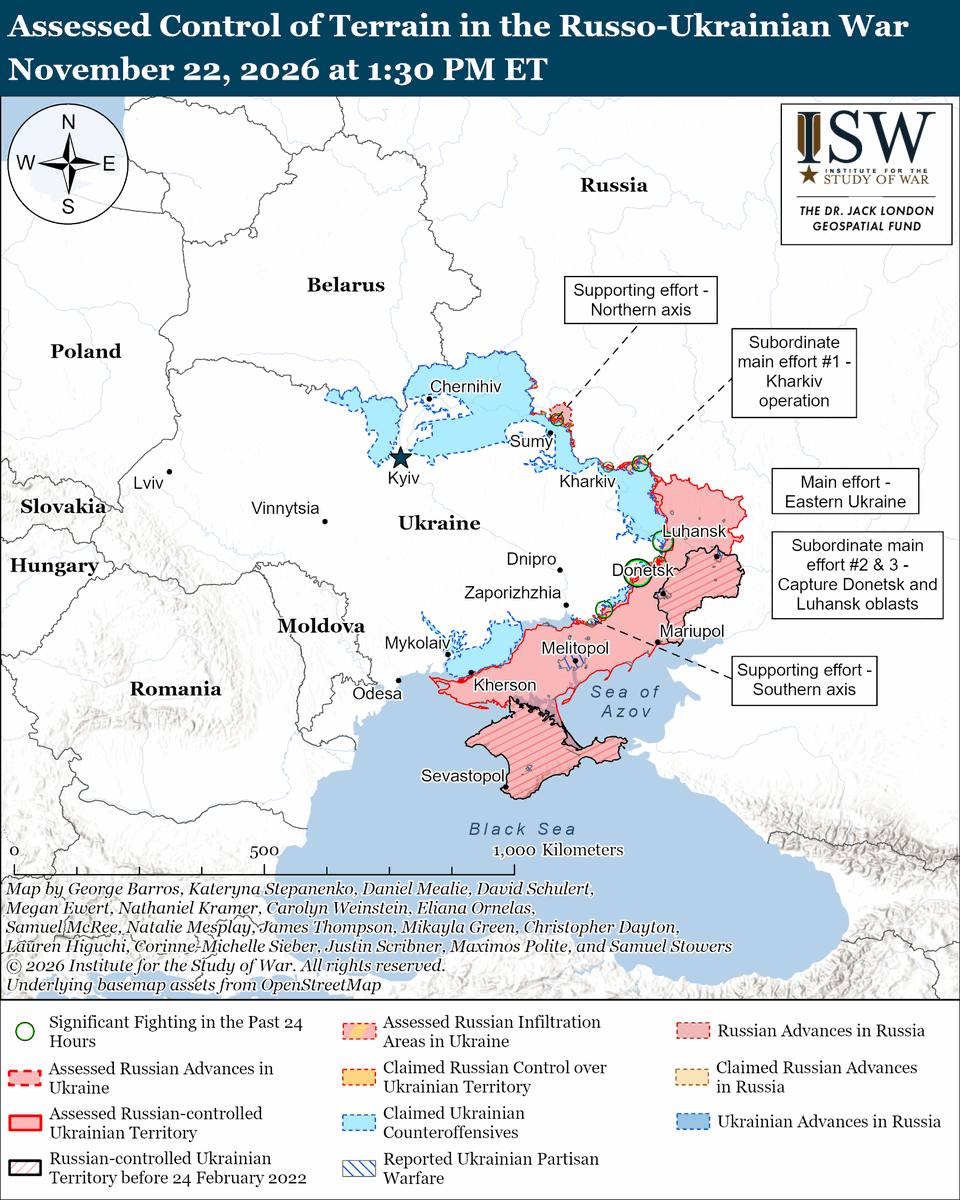
NEW: Russian air defense systems activated in Baltiysk, Kaliningrad Oblast, on November 21, but the reason for the air defense activity remains unclear, and many significant details remain unconfirmed. (1/2)
MORE: Ukrainian forces struck two Russian vessels near Benghazi, Libya, destroying at least one of the ships.
- A Russian jet-powered drone violated Moldovan airspace twice on November 21 amidst Russian strikes against western Ukraine.
- Ukrainian forces struck Russian military infrastructure in Krasnodar Krai overnight. Russia launched 186 long-range strike drones against Ukraine overnight.
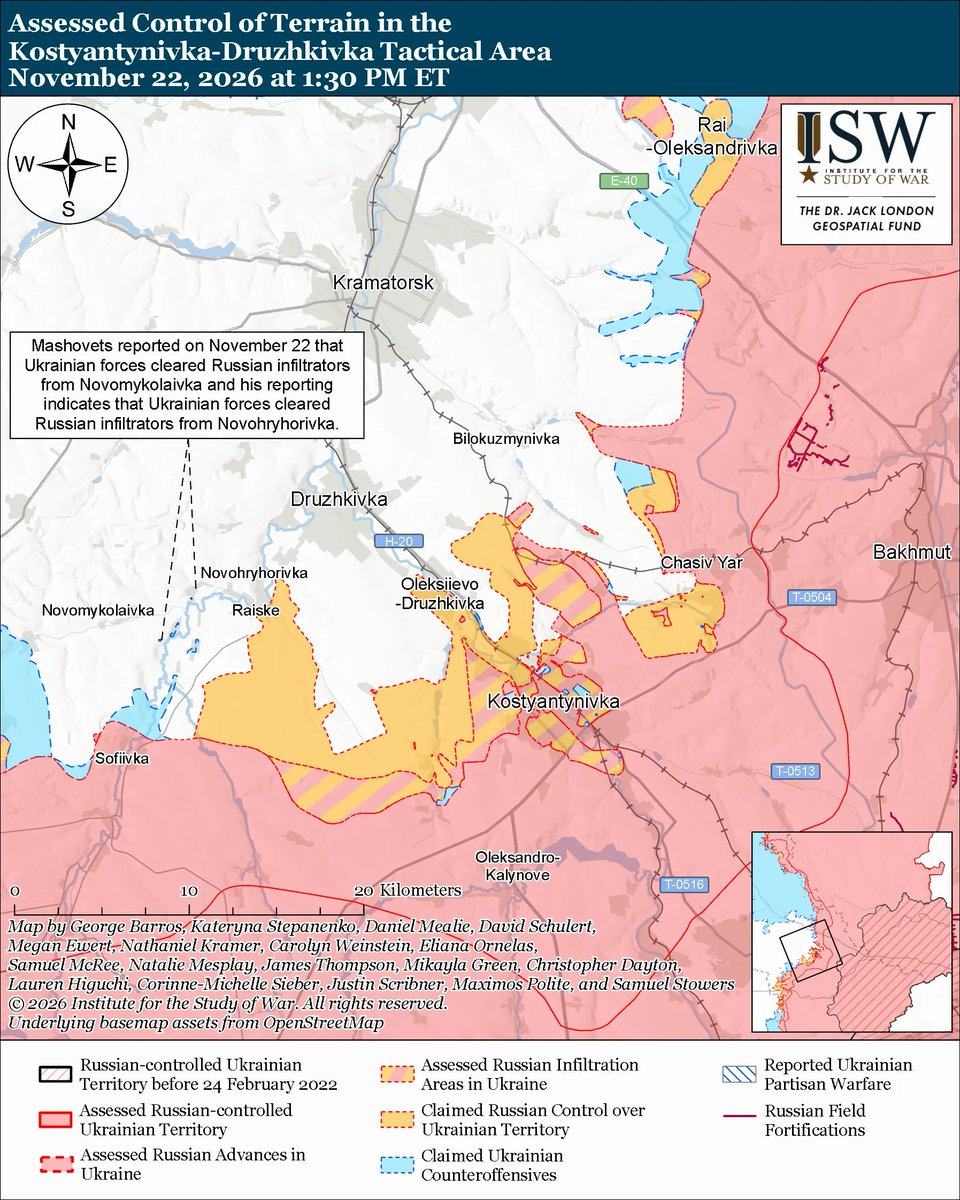
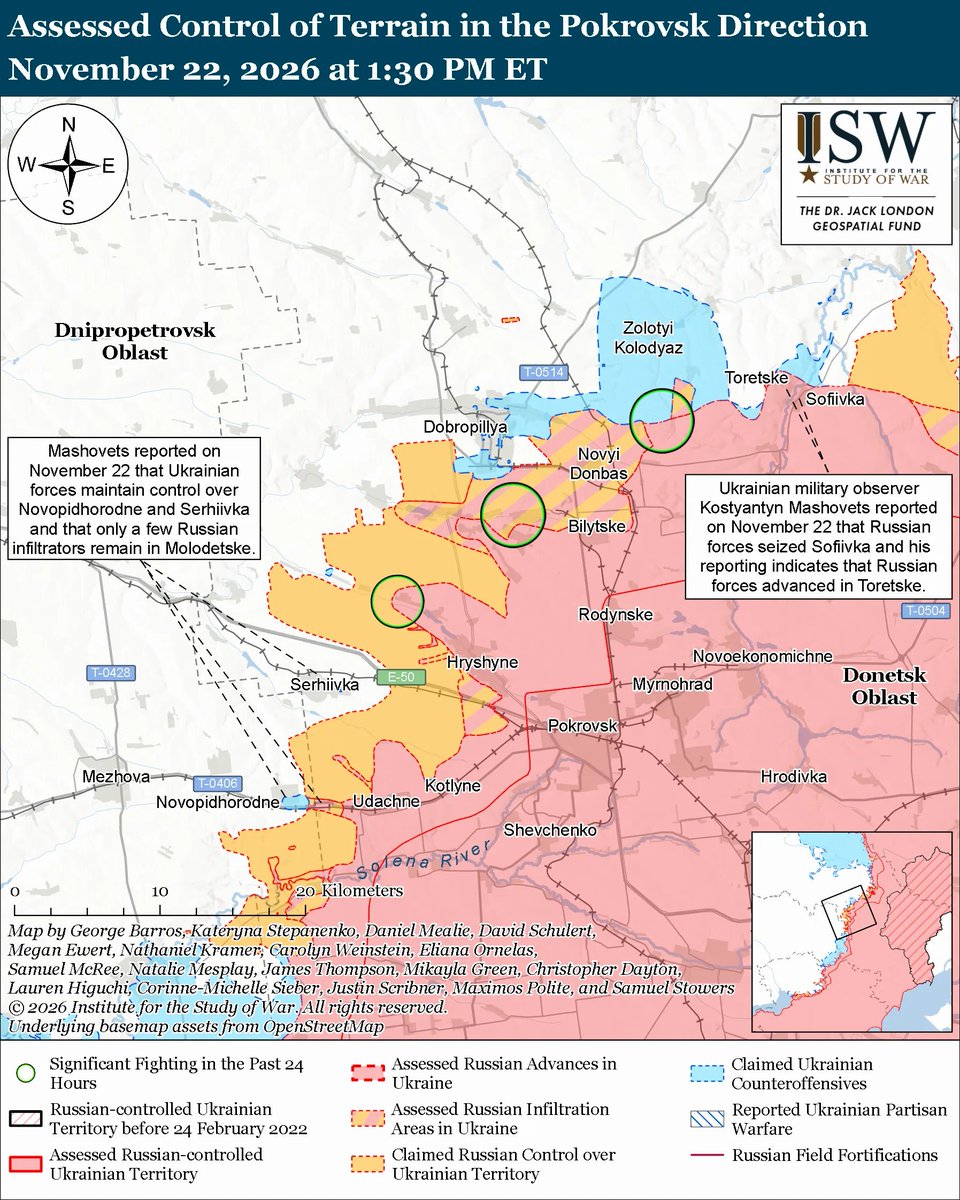
- Both Ukrainian and Russian forces recently advanced southwest of Druzhkivka and southwest of Dobropillya, as Ukrainian forces recently advanced within and east of Dobropillya.
After losing 3 ships in 36 hours, the message to Russia is clear:
You are not welcome in the north, you are not welcome in the west, you are not welcome in the south. Russia go home.
🚨 🇵🇱 All three objects that fell in Poland on 20 November turned out to be Russian Kh-101 missiles
It was previously believed that two missiles and one UAV had fallen on the country’s territory.
Debris found in Nowy Lipowiec, Rudnik and Mołodycz will be sent for additional expert examinations.
The Lublin Prosecutor’s Office says that all three missiles are new. They were manufactured in the fourth quarter of 2026 at a plant in Dubna in the Moscow region of the Russian Federation.
Today in Brussels, at Warsaw’s request, an emergency meeting of the NATO Council is to take place.
👏 Ukrainians have struck the Novoshakhtinsk oil refinery for the tenth (!) time — and it's honestly a mystery how the place is still standing
The fire at the only operational oil refinery in Russia's Rostov region can be seen from miles away. The attack on the facility lasted at least three hours.
At the same time, drones targeted another key piece of Russia's oil infrastructure: the Kaleykino oil pumping station in Almetyevsk, Tatarstan, a major hub on the Druzhba pipeline.
INCIDENT OR ACCIDENT? The Russian missile corvette Merkury has suffered a catastrophic explosion and burned and sank at the port of Benghazi, Libya. Merkury had been escorting convoys of Ru military-linked ships of the so-called Libyan Express, a logstics route supporting Putin’s operations in Africa. Video: @bayraktar_1love.
Russia's week of nautical horror continues, with a $200 million warship exploding at the port of Benghazi, Libya.
The Merkury, a Project 20380 Steregushchiy-class missile corvette commissioned in May 2023, is reportedly a total loss, according to analyst H. I. Sutton of Naval News, citing satellite imagery and other evidence.
The 104-meter, 2,200-tonne corvette carried eight Kh-35 anti-ship missiles, Redut air-defense missiles, a 100 mm naval gun and torpedoes. Its crew numbered approximately 100.
Built for Russia’s Black Sea Fleet, the Merkury had been operating in the Mediterranean, reportedly escorting Russian military cargo ships transporting weapons and equipment to support Moscow’s operations across Africa.
The Merkury was one of Russia’s newest missile corvettes, destroyed just three years after entering service.
Reports are appearing that Ukrainian forces allegedly broke through the border in Russia's Kursk region and took control of the settlement of Novyi Put. Waiting for confirmation.
MORE: Ukrainian President Volodymyr Zelensky proposed temporary localized ceasefires to evacuate Ukrainian civilians from 15 settlements along or near the Dnipro River in occupied Kherson and Zaporizhia oblasts — areas where a ceasefire is possible due to how the geography of the Dnipro River provides a stable frontline that impedes ground operations or forces being directly in contact with each other.
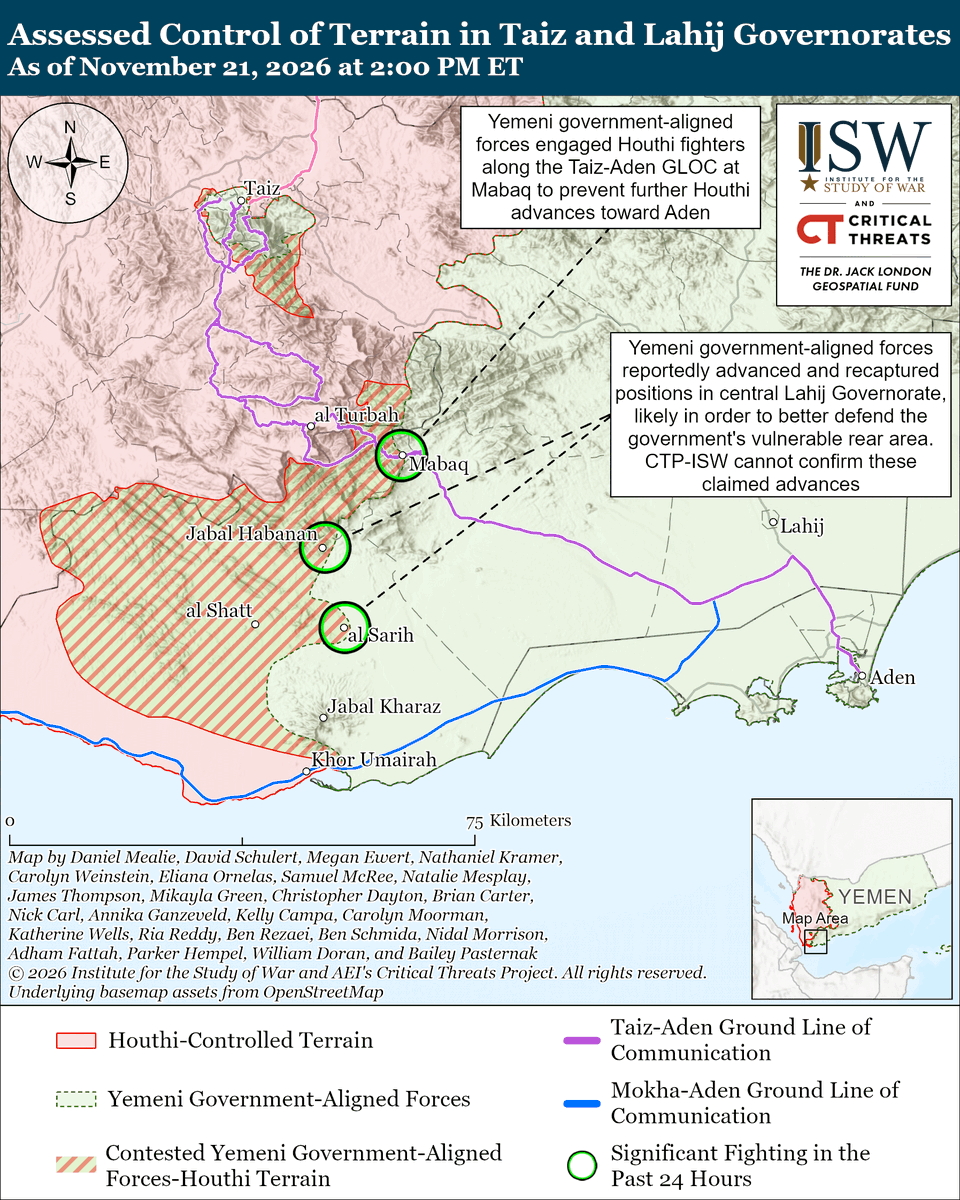
NEW: The Houthis are reportedly reinforcing their positions and military capabilities along the Bab al Mandeb Strait in order to develop a long-term ability to threaten civilian vessels in the strait at close range. Unspecified military and local sources told UK-based, Qatari-owned media on November 21 that the Houthis are constructing a network of fortifications, including tunnels and berms, along the Bab al Mandeb at the southern edge of the Red Sea coastal plain.
Q: “Do you think Putin is a friend of America?”
Trump: “I cannot speak on behalf of America. I believe that I have a very good relationship with Putin.”
An unfortunate limitation for the President of the United States.
Apparently, he can speak for Putin’s feelings, explain away Putin’s missiles and sympathise with Putin’s difficulties. America will need to leave a message.
The presidency now operates as the Kremlin’s customer complaints department.
I studied Russian for three years at West Point. The Cold War was underway and we were training to fight the Russians in the Fulda Gap.
Vladimir Putin is not our friend. He invaded a sovereign country and he threatens our friends from Poland to the Baltics.
The ability of the Russian military and state to provide,
1. Fuel,
2. Traffic controls,
3. Combat service support engineering to keep the roads in repair and
4. Wrecker services to recover/clear wrecks while under drone attack is...problematic.
Nearly 6,000 bridges in Russia are in a dangerous or near-dangerous condition.
5,900 bridges on regional and municipal roads are in a dangerous or near-dangerous condition and require urgent repairs. However, this is only the visible part of the problem: only 21% of structures have undergone inspection, and information about the remaining ones is either unavailable or outdated, according to Alexander Bedusenko, CEO of the Russian Road Research Institute.
According to him, the problem is particularly acute in the Far East: there are regions where more than 20% of bridges are in a non-standard condition.
What did it look like when the Soviet Union collapsed, and what would it look like if the Russian federation collapsed liked the Soviet Union did?
By 1990–91, Moscow’s revenues and control over the economy were deteriorating while it still funded subsidies, state firms, social programs, and the union-wide bureaucracy. The state covered large deficits by expanding the money supply rather than by raising reliable revenue or borrowing sustainably. In 1991, the aggregate fiscal deficit of the Soviet republics is estimated at about 26% of GDP.
According to world bank records, At the same time, the USSR’s hard currency position collapsed. Foreign-exchange reserves reportedly fell to about $5.1 billion by June 1990, less than two months of import;
By 1990–91, gold and foreign-exchange reserves were essentially exhausted as short-term foreign debts were repaid; imports had to be cut sharply.
-What would it look like if the Russian Federation collapses in the same way due to the Ukraine invasion?
Probably not as a clean replay of 1991. If the Russian Federation suffered a true state collapse event, it would more likely begin as a breakdown in Moscow’s ability to fund, command, and arbitrate.
Russia today is far more centralized than the late USSR: regional elites are weaker, heavily tied to federal security and economic structures, and most regions rely on the center.
That makes near-term fragmentation unlike; but if the center itself failed, the resulting breakdown could be more violent and uneven than the Soviet dissolution.
What if the elites removed Putin?
An elite coalition would probably choose a figure who is acceptable to the coercive apparatus and does not threaten existing property, wartime networks, or immunity arrangements.
The early moves would likely be:
Announce that constitutional order, pensions, salaries, banks, and military command remain intact.
Secure nuclear command, strategic forces, communications, and major media outlets immediately.
Remove or rotate a small number of visibly unpopular or politically exposed official ( look for that in the September election) but avoid broad purges that frighten the system.
Offer the public a stability narrative: “Putin’s course, corrected and professionally managed.”
Potentially pursue a tactical Ukraine ceasefire or frozen conflict if it protects the regime, reduces fiscal pressure, or eases sanctions. It would not necessarily provided a democratic or pro-Western shift.
They would aim their internal propaganda to present a victory and frozen line as what they had planned all along.