📇 A practical question:
Today, everyone is joining Novaex. Some people hold 10,000 NEX, some hold 100,000 NEX, and some even hold 1,000,000+ NEX
❔ Why is it that, even though everyone joins Novaex on the same day, some people may end up holding 10 times, 100 times, or even more NEX than you in the future?
👇 Open your Novaex account and check how many NEX you currently have
Leave your answer in the comments below.
🕰️ NEX DEX/CEX Listing Date:
June 21, 2026
#NovaexAI #NEX #WEB3 #Airdrop #Cryptocurrency
📇 A practical question:
Today, everyone is joining Novaex. Some people hold 10,000 NEX, some hold 100,000 NEX, and some even hold 1,000,000+ NEX
❔ Why is it that, even though everyone joins Novaex on the same day, some people may end up holding 10 times, 100 times, or even more NEX than you in the future?
👇 Open your Novaex account and check how many NEX you currently have
Leave your answer in the comments below.
🕰️ NEX DEX/CEX Listing Date:
June 21, 2026
#NovaexAI #NEX #WEB3 #Airdrop #Cryptocurrency
My father used to tell me the story of two friends who shared the same dream which is to one day become wealthy and change their lives. Tired of uncertainty, they decided to visit a famous soothsayer known for seeing into the future.
After a long journey, they arrived at his hut and asked the same question: "Will we ever become rich?"
The soothsayer looked at the first friend and said, "You will become wealthy, but your journey will be filled with hardship, setbacks, disappointments, and pain. Nothing will come easy."
The young man's excitement faded.
Then the soothsayer turned to the second friend and said, "You too will become wealthy. Unlike your friend, however, your riches will come easily. You will not struggle or suffer."
The second friend left overjoyed.
On their way home, neither realized that the prophecy had already begun changing their lives.
The first friend, believing hardship awaited him, decided to prepare for it. He worked harder than ever before, woke up earlier, learned new skills, and refused to quit whenever he faced failure. Every setback only convinced him that he was on the right path.
The second friend, however, believed his success was guaranteed. Since wealth would come easily, he saw no reason to push himself. He became comfortable, less disciplined, and gradually stopped pursuing opportunities.
Years passed.
The first friend endured countless failures, betrayals, and disappointments, but he kept moving forward. Eventually, his persistence paid off. His skills became valuable, opportunities appeared, and success followed. Before long, he became wealthy and respected.
The second friend remained where he had always been.
Confused and frustrated, he returned to the soothsayer.
"You lied to me," he said. "You promised I would become rich."
The old man smiled and replied, "No. I showed you a possible future."
The young man looked puzzled.
"When I told your friend that success would be difficult, he prepared himself for difficulty and became stronger with every challenge. When I told you that success would be easy, you stopped preparing for success altogether."
Then he added:
"Your futures were never determined by my words. They were determined by your response to them."
The young man finally understood. One friend treated success as something he had to earn. The other treated it as something he was destined to receive.
You can't flex your way to success, you have to work hard for it....
What other lessons is in this story?
Most traders think they need to predict the market to make money.
Predict the next crash. Predict the next bull run. Predict which stock will explode.
But after years of trading, I’ve learned something surprising…
The most profitable traders I know don’t predict the market at all.
Think about it.
If predicting the market was the key to making money, then economists, analysts, and TV experts should be the best traders in the world.
They spend all day forecasting interest rates, GDP, inflation, and where stocks are headed next.
But how many of them are running profitable trading accounts?
Here’s the uncomfortable truth:
You don’t need to predict the market to profit.
In fact, trying to predict the market is one of the fastest ways to lose money because predictions create:
• Bias (you see what you want to see)
• Overconfidence
• Emotional decisions.
Once you form an opinion about the market, you become attached to it. You think the market should go up, so you hold losing trades longer than you should… or worse, you add more.
Professional traders approach the market differently.
Instead of asking, “Where do I think the market will go?” they ask, “What does my system tell me to do?”
Their decisions are based on rules, not opinions, because opinions are like belly buttons: everyone has one, but most of them are useless.
For example, a systems trader might have a rule like this: if a stock drops three days in a row, buy. Then sell when it closes above the 5-day moving average.
They don’t need to know why it dropped, what the news says, or what analysts think. They simply follow the rule.
Sometimes the trade wins. Sometimes it loses. But over hundreds of trades, the edge plays out.
You don’t need to be right about the next trade. You just need a system with a positive edge.
So if you’ve been struggling with trading, the problem isn’t your discipline.
The problem is that you’re trying to predict the unpredictable (which is like trying to predict what my wife wants for lunch).
And that’s a game no trader can win.
Because the traders who survive long-term don’t predict the market…
They build trading systems for it.
Many traders think they need to predict the market.
They look for:
The perfect entry. The perfect indicator. The perfect signal.
But think about how many decisions that creates.
Every day you must decide:
Is this breakout real?
Is this support strong?
Is this trend ending?
Is this the top?
Is this the bottom?
Now imagine doing that:
Every day. Every week. Every month. For years.
No wonder most traders burn out.
Professional traders solve this differently.
They remove decision-making from trading.
And replace it with rules.
Have you ever noticed how some trades work out beautifully for a few weeks?
You're up. You're feeling good. You're mentally drafting your resignation letter so you can trade full-time.
Then suddenly...
BAM!
You give all your profits back.
Sounds familiar?
That's usually what happens when there's no edge behind your strategy.
You might be thinking…
"Of course I do, Rayner!”
“I use RSI + MACD”
“And I watch 3 YouTube gurus before breakfast while chanting trading mantras!”
Cool, but that's not an edge.
An edge (also known as expectancy) is something you do repeatedly over time that yields a positive outcome.
Here's the math behind it...
Edge = (Winning rate × Average profit) – (Losing rate × Average loss)
If it’s positive, great! You have an edge.
Otherwise, you’re just donating money to the markets.
So, what does a trading edge look like?
It's a trading system that generates a profit after hundreds of trades.
Not 5 trades. Not 10 trades. But hundreds.
And your trading system must tell you:
1. Which markets to trade
2. When to buy
3. When to sell
4. When to stay out
Now…
But what happens when you trade without an edge?
You rely on luck. Your results are random. And you can't repeat your success.
Think of it this way...
The casino always has an edge over the players. That's why the house always wins in the long run.
It doesn't matter if a player hits a lucky streak. Over time, the math catches up, and the casino takes its cut.
And it’s the same for trading.
If you don't have an edge, you are the player, and the market is the house.
Now…
You can't beat the house by playing harder.
You can't beat the house by watching more YouTube videos.
You can't beat the house by switching strategies every 2 weeks.
You beat it by BECOMING the house!
By having a trading system that tilts the math in your favour. That's what an edge is.
Trading is easy until you do it. Here's why...
1) Backtests don’t prepare you for real losses.
2) Discipline disappears when money is on the line.
3) You second-guess your rules at the worst time.
4) Losing streak makes you abandon your system.
How to unlock your trading potential
1) Read trading books with backtest results
2) Test the trading systems to make sure it works
3) Tweak the system to your needs
4) Trade it live with a small account
5) Scale up and add more systems
If you’re experiencing trading losses or inconsistent results, it’s not because you’re lazy or lack intelligence.
The real problem for most traders is that they are approaching it the wrong way.
One week, you’re convinced the MACD is the answer to all your problems.
Next, you’re trading support & resistance and think “THIS IS IT!”
Then, some YouTuber with a fancy car posts about a new strategy, and BAM, you found the “holy grail” again.
Sounds familiar?
You take a few trades, then the strategy stops working. You start losing money—and that’s when emotions take over.
You widen your stop loss (because it'll come back, right?)
You revenge trade (because the market OWES you.)
You hold onto losing trades like they're winning lottery tickets
Before you know it, your account is in a sea of red.
This explains why most traders struggle to make money consistently.
Not because trading is impossible. But because they’re approaching trading the wrong way.
On the other hand…
Profitable traders approach the markets differently.
Instead of asking… “Hmm, what will the markets do next?”
They ask something much simpler. They ask… “What does my trading system say?”
Their trading decisions are based on objective rules.
No guesswork.
No predictions.
No emotions.
Another way to think about this is like being a casino owner.
Casinos don’t try to predict whether the next player will win or lose.
They simply know that the games they offer have a mathematical edge.
Some players will win. Some players will lose.
But here’s the thing…
Over hundreds and thousands of games, the casino always comes out ahead.
It's not luck. It's not magic. It's pure mathematics.
A 20% return for 20 years will earn you 3733%.
A 100% return for 20 years will earn you 104,857,500%.
But you won’t get that because you’ll blow up in year 2.
Don’t chase returns. Chase longevity.
AI might be the most dangerous tool for traders right now.
Not because AI is bad.
But because it can make bad trading look incredibly smart—like putting a suit on my 5-year-old and calling him a CEO.
With AI, you can now ask questions like:
“Give me a profitable trading system.”
And instantly you’ll get something like:
• Buy when the 50MA crosses above the 200MA.
• Sell when the price closes below the 200-day moving average.
• Risk 1% on each trade.
• Retire to your private island.
It looks structured. It looks logical. It looks professional.
But it will fail in live trading.
Because AI doesn’t understand markets. It doesn’t understand trading. It doesn’t even know if a system works.
Before AI, creating trading systems took effort.
You had to:
1. Understand market behavior.
2. Come up with ideas.
3. Turn your ideas into a trading system.
4. Backtest your trading system.
Now you can ask AI:
“Give me 20 trading systems.”
And you’ll lose money faster than you can say margin call.
That’s because AI is not the solution you’re looking for.
Rather, it’s a tool to help you work more efficiently.
For example, AI can help you generate ideas, write code faster, and analyse information.
But AI is not the edge.
It's simply a tool like a hammer. Very useful for building a house, but useless if you don't know how to build a house.
Despite all the technology and tools available today…
Trading success still comes down to the same things it always has:
• Find an edge.
• Develop a trading system around it.
• Have the discipline to follow the rules.
Unfortunately, AI can’t do those things for you.
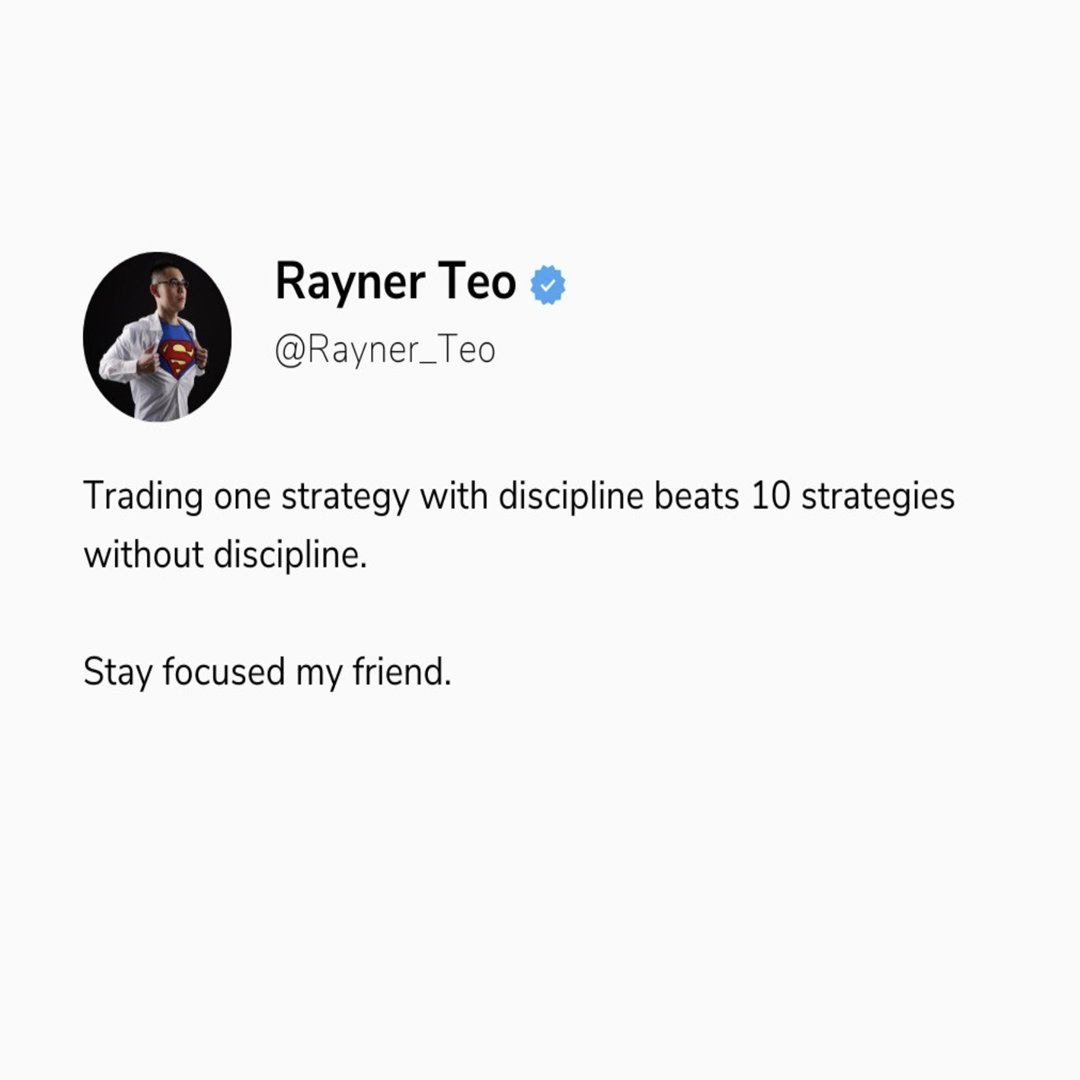
Most traders don’t fail because they’re lazy.
They fail because nobody tells them what’s ACTUALLY wrong.
Instead, you hear things like...
“Work on your mindset.”
“Be more disciplined.”
“Control your emotions.”
That’s like telling a drowning person...
“Try swimming harder.”
I know because I spent years making the exact same mistakes.
So here are the 3 mistakes that kept me (and probably you) from being profitable...
𝐌𝐢𝐬𝐭𝐚𝐤𝐞 #𝟏: 𝐍𝐨 𝐩𝐫𝐨𝐯𝐞𝐧 𝐬𝐭𝐫𝐚𝐭𝐞𝐠𝐲
Most traders are using strategies they found on a random YouTube video.
You’ve never backtested it. You’ve no idea if it works over 100 or 1,000 trades.
You’re gambling, but with fancier charts.
It's like following a recipe from a stranger on the internet who says...
"Trust me, bro, put ketchup on your ice cream. It's amazing!"
You try it. It's disgusting. And you wonder why dinner is ruined.
So here’s the deal…
If you don't have a proven strategy, you can't trust your system. And if you can't trust your system, everything else falls apart.
𝐌𝐢𝐬𝐭𝐚𝐤𝐞 #𝟐: 𝐒𝐭𝐫𝐚𝐭𝐞𝐠𝐲 𝐡𝐨𝐩𝐩𝐢𝐧𝐠
This one hits close to home because I was the king of strategy hopping.
My first trading strategy was using Bollinger Bands, and I had a few winning trades in a row.
I thought to myself...
"I'm going to retire by 30, buy a villa, and have a swimming pool."
Now, I'm almost 40. No villa. No pool. And I have 3 monkeys running around my house.
Then…
I encountered 5 losses in a row, and panic set in. I thought the strategy no longer works, so I tried to find something better.
I tried things like volume spread analysis, chart patterns, harmonic patterns, etc. But the only pattern I see is my trading account going down.
Here's why this is so deadly...
Every time you switch strategies, you reset. You never give any single system enough trades for the edge to play out.
It's like planting a seed, digging it up after 3 days to check if it's growing, then planting a different seed.
Nothing will ever grow.
𝐌𝐢𝐬𝐭𝐚𝐤𝐞 #𝟑: 𝐄𝐦𝐨𝐭𝐢𝐨𝐧𝐬
After 5 losses in a row, something snaps.
You have thoughts like…
"The market is out to get me!"
"How dare you take my money!"
"I'll show you who's boss!"
So you double down to make back what you've lost—and you lose even more.
Now here's what most traders don't realise...
All 3 of these mistakes?
They're symptoms. Not the cause.
It's like when you forget your anniversary and your wife says...
"Don't touch me."
"Go away."
"We need to talk."
Those are the symptoms. Forgetting the anniversary is the cause.
In trading, the cause behind these symptoms is the same thing...
You don't have an edge.
Without an edge, you can't trust your system.
Without trust, you can't follow the rules.
Without following the rules, emotions take over.
I'm not going to sugarcoat it anymore.
Why?
Because I’m tired of watching good traders turn into gamblers.
I've shared my setups, mentored traders who were genuinely hungry to learn, only to see the same pattern destroy them every single time.
They catch a beautiful move. +$800. +$1,200. Clean profit.
Then instead of stepping back, respecting the edge, and waiting for the next high-probability setup…
Greed takes the wheel.
They over-leverage. Chase. Add. Revenge-trade the pullback.
And in hours, sometimes minutes, the entire account is gone.
The problem with most of you traders isn’t the market… it’s your impatience.
Everybody wants quick money. Quick profits. Quick withdrawals. No discipline.
I’ve funded accounts for people, watched them make clean profits. Instead of waiting for the next A+ setup, they start forcing trades like addicts… and boom, account blown. For what?
Forex trading isn't a get rich quick scheme. It's not a casino; it’s a business.
It rewards discipline, process, and emotional control far more than it rewards speed or size.
What happened to patience? What happened to swing trades that run for weeks… months? What happened to that one clean setup that could literally change your year?
Now it’s “split now, split fast, flip account, repeat.”
You’re not trading anymore; you’re gambling with good setups. No risk management.
You don’t rush wealth. You build it.
I wish y’all understood that every blown account isn’t just money lost, it's time, effort, confidence, progress, belief in yourself, and often months or years of your trading journey erased in one impulsive moment.
Until you understand that, you’ll keep making money… and giving it back to the market.
If you recognise yourself in this…
pause.
Breathe.
Ask yourself what you’re really chasing.
Because the market will always be here.
The setups will always come.
But your capital, and your belief in yourself, won’t always survive the next impulsive decision.
I’m honestly and genuinely tired of watching good traders turn into gamblers. I’m just soooooooo done watching people sabotage themselves.
If this resonates, say something.
Share your story.
Let’s talk about how we actually build something lasting in this game.
Because real wealth in trading isn’t made in 24 hours.
It’s made in the months and years you choose patience over impulse.
Take Somtochukwu as a case study. He held gold for months until it hit an ATH of $4,000, and man made more than a million dollars. Then he left social media and locked in again.
He wasn't gambling; he was precise.
Precision over impulsiveness.
Bro to Bro:
Scaling up in trading isn’t about chasing fast money…
It’s about building something that survives.
Read this carefully:
First $100
This isn’t small… this is the beginning.
Proof you can flip something.
Proof you can follow a setup.
Proof you’re not just watching charts you’re in the game.
→ Don’t rush it
→ Don’t gamble it
→ Treat it like it matters
Because how you handle $100…
Is exactly how you’ll handle $100K.
$1,000
Now it’s getting real.
This is proof of consistency.
→ You’ve won more than once
→ You’ve controlled your losses
→ You’ve started building discipline
But this is where ego starts whispering.
Stay sharp. Stay humble.
Most people lose their first $1K trying to feel like pros.
$10,000
Now you have something dangerous: confidence.
This is where accounts get destroyed.
→ You think you’ve mastered it
→ You start forcing trades
→ You ignore your own rules
Instead:
Turn confidence into discipline.
Stay boring. Stay consistent.
Because $10K isn’t the goal…
It’s the filter.
$100,000
Now you’re different.
Not lucky. Not guessing.
You’ve built skill + control + patience.
→ Scale slowly
→ Think long-term
→ Protect capital like a business
At this level, one mistake isn’t small…
It’s expensive.
The Truth
It’s not one trade.
It’s not one lucky run.
It’s:
→ Risk management when you’re winning
→ Discipline when you’re losing
→ Patience when nothing is happening
$100 builds your foundation.
$1K proves consistency.
$10K tests your mindset.
$100K demands a new version of you.