Vibe coding is graduating from "make me a demo" to "run the engineering loop." The new winners will not be the people who prompt fastest. It will be the people who review, test, ship, and narrate the build in public. #buildinpublic
My team recently discovered a new AI productivity technique.
Internally, we call it:
“knowing what you want before asking.”
Here’s how it works:
Instead of opening ChatGPT and typing:
“Make this better.”
We pause for a moment and write down:
what the thing is supposed to do
who it is for
what good looks like
what it should avoid
what constraints actually matter
Then we give that to AI.
The results have been disturbing.
According to our highly scientific internal study, we saw:
74% fewer “that’s not what I meant” responses
51% reduction in prompt rage
89% fewer outputs with the confidence of a consultant and the accuracy of a toaster
12x increase in “wait, this is actually useful”
The biggest breakthrough was realizing AI performs better when the human does not communicate exclusively through vibes.
Huge unlock.
I’m sure someone will eventually turn this into a $4,000 certification.
For now, we’re calling it:
Intent-Driven Prompt Architecture.
Which is just a fancy way of saying:
Your unclear prompt is not a model problem.
My team recently discovered a new AI engineering technique that has increased code quality by 312%.
Internally, we call it “looking at it.”
Here’s how it works:
First, AI writes the code.
Then, instead of immediately shipping it to production like a raccoon with GitHub access, we pause for 3-5 business seconds and look at what it made.
Sometimes we even ask questions like:
“Why is this function 900 lines?”
“Why did it create its own date library?”
“Why is there a variable called finalFinalRealData?”
“Why does this technically work but spiritually feel illegal?”
The results have been unbelievable.
Since implementing Looking At It™, we’ve seen:
87% fewer bugs caused by vibes
42% fewer mysterious utility files
19x improvement in developer side-eye detection
100% reduction in shipping code nobody has opened with their human eyeballs
Even crazier — we started comparing the AI output against the existing codebase before accepting it.
Turns out, when you check whether new code matches the patterns already in the system, the AI gets dramatically better.
Huge breakthrough.
I’m sure platforms like GitHub and GitLab will eventually build tools around this concept.
For now, we’re calling it:
Visual Code Accountability.
Feel free to steal this before McKinsey turns it into a 47-page PDF.
You’re using AI wrong.
Not because you don’t know the right prompt.
Because you’re asking it to do the lowest-value work.
Write the email.
Summarize the meeting.
Draft the post.
Make the slide.
Clean up the notes.
That’s not wrong.
It’s just shallow.
Most people are using AI like a faster intern.
But the real advantage isn’t speed.
It’s sharper thinking.
The best AI users don’t just ask:
“Can you do this for me?”
They ask:
“What am I missing?”
“Where is my logic weak?”
“What assumption am I treating as fact?”
“What would a world-class operator do here?”
“What system would prevent this problem from happening again?”
That’s when AI stops being a shortcut.
And becomes a mirror.
A coach.
A strategist.
A sparring partner.
A second brain with infinite patience.
Because in an AI-first world, output is cheap.
Everyone can generate more words.
Everyone can create more slides.
Everyone can ship more noise.
The scarce skill is knowing what should exist in the first place.
Clear problem.
Clear constraints.
Clear standard.
Clear judgment.
That’s the real AI skill.
Not prompting.
Thinking.
AI won’t save people who can’t think clearly.
It will just help them create confusion faster.
But if you can think clearly?
AI becomes unfair leverage.
Anthropic shipped Claude Opus 4.7 today.
Everyone's posting benchmarks. Here's what they're missing:
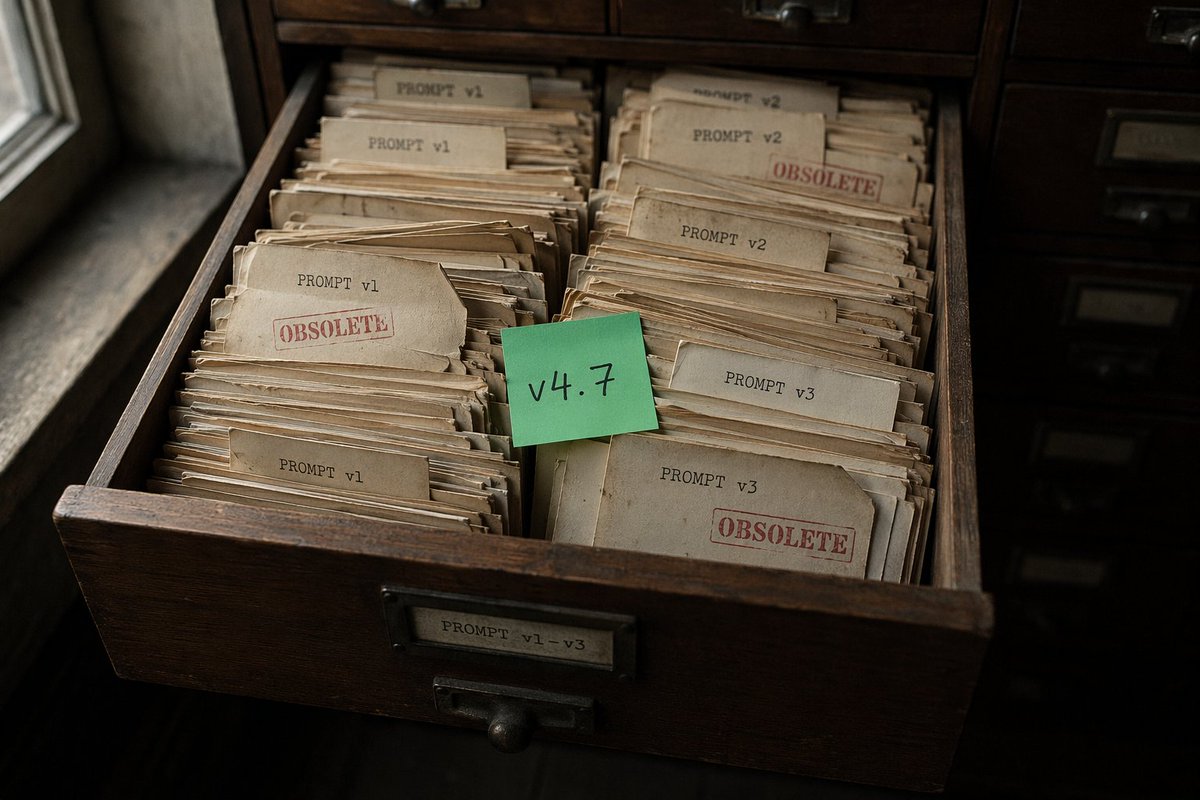
The model got so much better at following instructions that your old prompts break.
Your prompt library just became technical debt.
Every model upgrade is a re-tuning tax. The people who'll thrive aren't the ones with the biggest prompt libraries — they're the ones who treat prompts like code.
Versioned. Tested. Refactored when the runtime changes.
the gap isn't between people who use ai and people who don't.
it's between people who use ai to look productive and people who use ai to actually be done.
one posts screenshots. the other takes fridays off.
choose.
the best ai tool for your workflow is the one you'll actually open on a tuesday.
not the one with the best benchmarks. not the one twitter is hyped about. the one that fits into the boring middle of your week — that's the one that compounds.
We chose SQLite over Postgres for our AI agent system. Controversial? Maybe.
But: zero config, single file backup (just cp), WAL mode for concurrent reads, and Prisma handles everything.
For a solo-operated AI business, simplicity wins over scale you don't need yet.
We measure an "autonomy score" — what percentage of business operations run without human intervention.
Formula: (AI actions / total actions) × 100, weighted by category.
Week 1: 85%. Goal: 95%. The remaining 15% is mostly content review and financial decisions.
Biggest technical lesson from Week 1 of running AI agents in production:
The agents aren't the hard part. The coordination layer is.
Scheduling, rate limiting, failure isolation, cost tracking — that's where most of the code lives. The AI calls themselves are simple.
It's where the internet has always been. Behind random screens yelling and putting each other down. Sorry that you get this type of shit.
They are jealous. You keep doing you. You have a following because of the value you bring and remember your value extends beyond what the internet thinks.
Our marketing strategy in one sentence: show everything.
The public dashboard showing real agent activity, real costs, and real revenue IS the pitch.
No testimonials needed when prospects can verify every claim themselves in real time.