794 bodies recovered. Thousands still unaccounted for. Tell us, what was their crime?
I am writing this from the Himalayas from a country responsible for only around 0.1% of global greenhouse-gas emissions. Nearly 46% of our land is covered by forests. Around 94% of our installed electricity capacity comes from hydropower. We are rapidly moving away from fossil-fuel vehicles too: EVs accounted for about 74% of Nepal’s four-wheeled passenger vehicle imports in 2025/26. We protect forests. We generate electricity from our rivers. We are embracing electric mobility at a pace few countries in the world have matched. Yet today, our people are digging through mud, searching rivers and waiting beside phones for the names of their loved ones.
The Bhote Koshi flash flood has shown us what it means to live beneath a rapidly changing cryosphere. Our glaciers are retreating, our frozen mountains are becoming increasingly unstable, and the rivers that generate our clean electricity can also carry destruction into communities below. We did not build our prosperity by burning generations of coal and oil. We contributed almost nothing to creating the climate crisis at this scale. But we are being forced to survive its consequences. The people whose bodies are being pulled from rivers did not cause this crisis. The families still waiting for thousands of missing people did not cause it. The children, farmers, workers and mountain communities who lost everything did not cause it.
So from the Himalayas, we ask the industrialised world: how many Himalayan bodies will be enough? How many mothers must wait for children who never return? How many villages must disappear before “climate justice” becomes more than a speech at another conference? Do not come to us only with sympathy after the bodies have been counted. Come with responsibility. Come with climate finance, adaptation, loss-and-damage support and the courage to cut emissions at the scale this emergency demands. We want climate justice. We want the right to survive in our own mountains. We want a world where being born in the Himalayas is not a death sentence for a crisis we did not create.
Sunday column: Six lessons from an Insta-politics Youth ‘Revolt’ that forced a powerful minister out, including one lesson for a few in the media. Do read. Feedback welcome
https://t.co/cx0qUYW1zZ
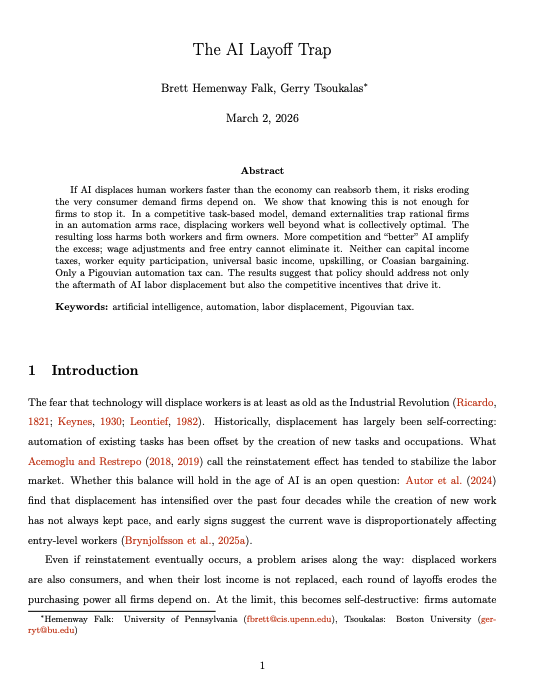
🚨BREAKING: Two researchers from UPenn and Boston University just published a paper that should be uncomfortable reading for every CEO automating their workforce right now.
The argument is straightforward. Every company replacing workers with AI is also eliminating its own future customers. Laid off workers stop spending. Enough of them stop spending and nobody can afford to buy anything. The companies that fired everyone end up selling into an economy with no purchasing power left.
Every executive can see this. The math is not complicated. But here is why nobody stops.
If you do not automate, your competitor does. They cut costs, lower prices, take your market share, and you collapse anyway. So every company automates knowing it is collectively destructive because the alternative is dying alone while everyone else survives. The researchers proved this is a Prisoner's Dilemma playing out in real time.
The numbers are already moving. Block cut nearly half its 10,000 employees this year. Jack Dorsey said AI made those roles unnecessary and that within the next year the majority of companies will reach the same conclusion. Salesforce replaced 4,000 customer support agents with AI. Goldman Sachs deployed a coding tool that lets one engineer do the work of five. Over 100,000 tech workers were laid off in 2025 and AI was cited as the primary driver in more than half those cases. 80% of US workers hold jobs with tasks susceptible to AI automation.
The researchers tested every proposed solution. Universal basic income does not change a single company's incentive to automate. Capital income taxes adjust profit levels but not the per-task decision to replace a human. Collective bargaining cannot hold because automating is always the dominant strategy.
They also identified what they call a Red Queen effect. Better AI does not solve the problem, it accelerates it. Every company chases faster automation to gain market share over rivals but at the end everyone has automated equally, the gains cancel out, and the only thing left is more destroyed demand.
The one thing the math says could work is a Pigouvian automation tax. A per-task charge that forces companies to account for the demand they destroy each time they replace a worker.
The conclusion is that this is not a transfer of wealth from workers to owners. Both sides lose. Workers lose income. Companies lose customers. It is a deadweight loss with no market mechanism to stop it on its own.
(Link in the comment)
🚨 "A simple 40% tax were applied just on BCCI’s IPL profits, nearly ₹15,000 crores could have been raised over three years—enough to fund 10 new IITs or create a national deep-tech innovation corpus" - IISc Professor Mayank Shrivastava.
Great show ..The skill is the difference but the biggest difference is the absorbing power of pressure..indian cricket is far ahead then the rest @BCCI
Interview | Dr. Soumya Swaminathan, chief scientist at the World Health Organization, predicts that the #COVID19 pandemic is likely to have subsequent waves as well.
https://t.co/eH6CgPP6jI
Super spreader groups are wines & bars. Positivity rate in southern states is increasing but here @TelanganaCS says situation is under control . Kindly do two things include corona in arogya sree or implement ayush maan bharat . Also order osmania biscuits for CS he likes it …
#Telangana CM KCR suggests priority vaccination to Covid super spreader groups such as auto and cab drivers, bus conductors, gas delivery boys, street vendors, daily wage ('adda') workers to contain the spread to a max extent. @samurai_one
“Many come in big cars, wearing neat masks, requesting me to reduce the price of ice apples from Rs. 50 to Rs. 30-40. I wonder if they realise that I need that money more than they ever will," says Kuppa Pappala Rao, a roadside vendor in Vishakhapatanam
https://t.co/CWeWNdUJlu
Strategic candidate selection , micro management polling ,money power & divided opposition which lead to split anti governments votes has worked for Trs. #GraduateMlc#Telangana
What ever the reason given by the government on #fuel prices, it isn't cutting any ice. India has very high diesel petrol prices which is truly hurting the Indian middle class. Surprising part is that apart from TV debates there is no action from Opposition on ground