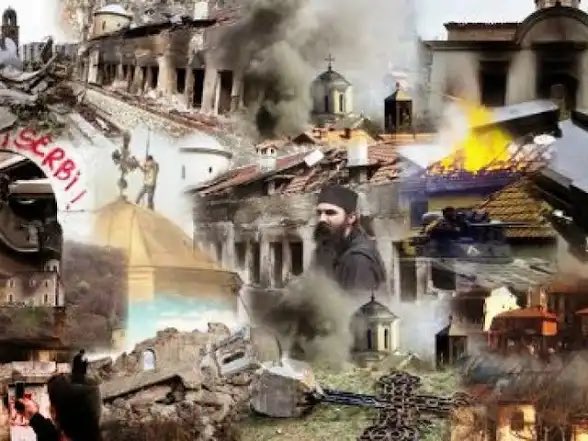
Twenty-Two Years since the Pogrom against the Serbs of Kosovo🕯️
Twenty-two years have passed since the tragic days of 17 and 18 March 2004, when the Serbs of Kosovo suffered one of the gravest pogroms in the modern history of Europe. That wave of violence, ignited by false accusations concerning the drowning of Kosovo Albanian children, escalated into organised assault, destruction, arson, and the expulsion of Serbs, accompanied by the deliberate devastation of our spiritual and cultural heritage.
In the course of two days of violence, Serbian homes, schools, hospitals and churches were attacked in more than thirty locations across Kosovo and Metohija. Nineteen people were killed, hundreds were injured, and more than four thousand Serbs were forced to abandon their homes. Thirty-five Orthodox sacred sites were destroyed or desecrated, among them ancient monasteries and churches that had borne witness to the faith and life of the Serbian people in Kosovo and Metohija across the centuries.
Yet in spite of these crimes and this violence, the Serbs of Kosovo and Metohija remained faithful to their faith, their land, their sacred places and their forebears.
The remembrance of 17 March 2004 is not only a commemoration of suffering. It is also a call to prayer, for those who were killed, for those who were driven from their homes, for the preservation of our holy sites, and for peace, for we believe that the last word belongs not to violence but to God.
https://t.co/9kiuZQRJlO
Feast of St. King Stefan Dečanski Solemnly Celebrated at Visoki Dečani Monastery
Today on November 24, 2025, the patronal feast of the Visoki Dečani Monastery, the Feast of Holy King Stefan Dečanski , was celebrated with great solemnity. The festive Divine Liturgy was presided over by His Eminence Metropolitan Teodosije of Raška-Prizren, co-served by His Grace Bishop Ilarion of Novo brdo and more than fifty priests and deacons from various dioceses of the Serbian Orthodox Church.
From the early morning hours, faithful from across Serbia, Montenegro, and the wider region began arriving at the monastery. By the time of the Liturgy, more than 1,300 souls had gathered to pray together and venerate the wonder-working and fragrant incorrupt relics of St. King Stefan, which have rested in the monastery church since 1331.
In his sermon, Bishop Ilarion conveyed the blessings and greetings of His Holiness Serbian Patriarch Porfirije, who himself received the monastic tonsure in this very monastery. Speaking of the heavenly beauty and grace palpable in Dečani, the bishop said: “Today we stand at a place where the gates of Paradise seem to have been opened… This is a martyric place of witness, thanks to our host, Holy King Stefan Dečanski, who has opened these gates for us. The martyrs bring us living testimony of what they have seen on the other side, and the power of that experience was so great that neither terror, nor torment, nor suffering could separate them from it.”
Reflecting on the Holy King’s life of patient endurance, Bishop Ilarion continued: “St. Stefan Dečanski allowed himself to be forged his whole life in the fire of trials that shape us for salvation… His body has overcome corruption because it was tempered in the gracious fire of the Holy Spirit. He shows us the only path: that every person must become a priest and witness of the living God, stepping courageously into that fire which refines and saves us.”
At the conclusion of the Liturgy and the blessing of the slava wheat and bread, Metropolitan Teodosije addressed the faithful, thanking them for their courage in coming despite all difficulties: “You have not spared effort or fear to be here today. This very day testifies that it is the glory of our Holy King. He has gathered us all, and today he rejoices most in heaven, blessing and bestowing royal gifts upon each of you who belong to him.”
The Metropolitan highlighted the virtues that adorned St. Stefan, royal authority united with humble service, rare wisdom, and a meekness that astonished even monks. “He never wished to abandon his home, this church,” Vladyka Teodosije stressed. “Others have tried to remove his holy relics, but unsuccessfully to this day — and, God willing, it shall remain so in the future.”
The metropolitan also praised the steadfast monastic community: “The abbot, the fathers, and the brethren have left everything to dedicate their lives to the Holy King and to the Lord, faithfully serving our people in this sacred abode.”
Following the Divine Liturgy, a festive agape meal was prepared for all the faithful in the monastery refectory.
The Visoki Dečani Monastery, founded by St. King Stefan in 1327 and completed by his son King Dušan, remains one of the most important spiritual and cultural treasures of the Serbian people and is inscribed on the UNESCO World Heritage List. Even in the challenging circumstances of Kosovo and Metohija, the monastery continues to shine as a beacon of Orthodox faith, prayer, and hospitality.
#SerbianOrthodoxChurch #DecaniMonastery #Kosovo
Good to see Serbian President @avucic again today in New York. We discussed the Strategic Dialogue our two nations will launch soon and U.S. participation in EXPO 2027, both opportunities to further strengthen our bilateral relationship as we seek to build a better future together.
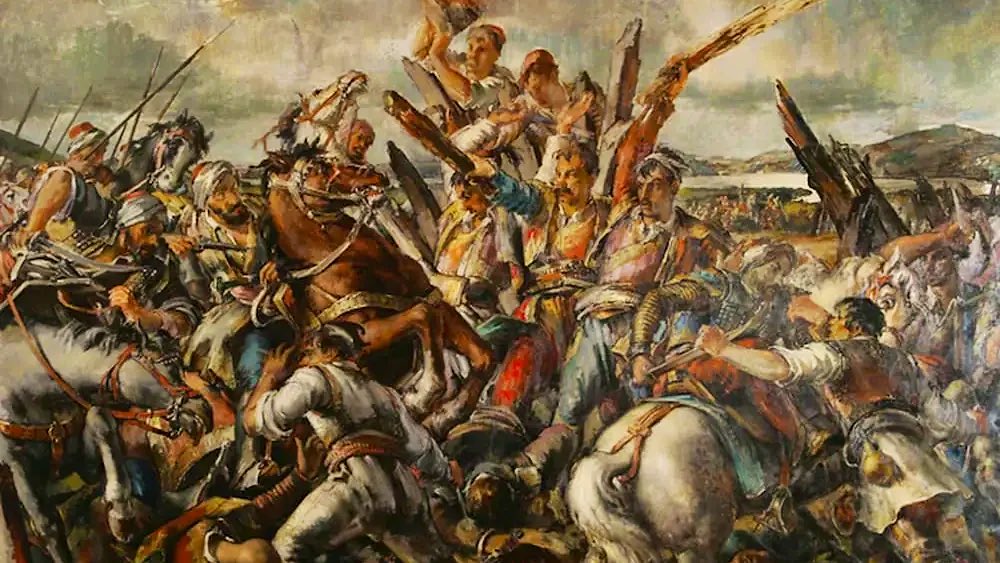
⚔️ 220 years ago today, on 18 August 1805, 2,500 Serb 🇷🇸 revolutionaries led by Karađorđe Petrović and Milenko Stojković humiliated 20,000 troops of the Ottoman Turkish 🇹🇷 army at the Battle of Ivankovac—the first full-scale confrontation of the First Serbian Uprising.
1/2 ⬇️
Famous actor and director #MelGibson has recently arrived at Mount #Athos, also known as the Holy Mountain, a thousand-year-old monastic community in northern #Greece and one of the most significant centers of Eastern Orthodox #Christianity.
Home to nearly 2,000 monks from all over the world, Mount Athos is a place of prayer, silence, and spiritual discipline, dedicated entirely to the worship of God. Gibson is currently being hosted at Hilandar Monastery, one of the 20 historic monasteries of the peninsula, founded by Serbian saints in the 12th century.
The video features several photos with the #Serbian #Orthodox monks at #Hilandar #Monastery including the Abbot Fr. Metodije and his monks.
Mel Gibson is expected to stay for several days, seeking spiritual retreat and inner stillness. Mel Gibson is beloved by millions worldwide for his powerful films, and especially respected among Christians for directing The Passion of the Christ. He is reported to have said: "I've never felt such deep connection with God as I do here".
Source: TikTok
Saint Constantine the Great, the first Roman emperor to embrace Christianity, and his mother Saint Helen hold a foundational place in the history of the Christian Church. Constantine’s conversion marked a pivotal moment in the transition of Christianity from a persecuted faith to an officially recognised religion within the Roman Empire. His Edict of Milan in 313 AD proclaimed religious tolerance and allowed Christians to freely worship, restoring their confiscated properties and legal rights. Constantine saw the Christian faith not only as a matter of personal conviction but also as a means of uniting a fractured empire. Under his rule, the Church was granted privileges, bishops took on public responsibilities, and Christianity began to shape the cultural and legal foundations of Christendom. Most notably, in 325 AD he convened the First Ecumenical Council in Nicaea, gathering bishops from across the empire to establish unity in doctrine and address the Arian controversy, resulting in the formulation of the Nicene Creed which remains central to Orthodox Christian faith to this day.
Saint Helen, Constantine’s mother, is revered for her piety, compassion, and tireless support of the Church. After her son’s accession, she undertook a pilgrimage to the Holy Land and, according to tradition, discovered the True Cross upon which Christ was crucified. Her deep devotion led to the construction of many churches, most famously the Church of the Holy Sepulchre in Jerusalem, built on the site believed to be the place of Christ’s Resurrection. Helen is venerated as a model of imperial sanctity and motherly care, both for her role in the spiritual formation of Constantine and for her own legacy of faith. Together, Saints Constantine and Helen are honoured in the Orthodox Church as “Equal-to-the-Apostles,” not only for their individual deeds but for the enduring impact of their partnership in establishing the visible foundations of Christian civilisation.
Relics and sarcophagus of St. Empress Helen
The Feast of Saint Symeon the Myrrh-Gusher: The Spiritual and Historical Founder of #Serbia
Today, on February 13/26, #Serbian#Orthodox#Church solemnly celebrates the feast of Saint Symeon the Myrrh-Gusher, the former Grand Župan of Serbia, who reposed in the Lord in 1199. Born as Stefan Nemanja (1113–1199), he was the great unifier and founder of the medieval Serbian state, the father of Saint Sava, and the spiritual progenitor of the Serbian people. His righteous life, crowned by monastic humility, ascetic struggle, and divine grace, made him a saint whose relics continue to pour forth myrrh, a sign of heavenly blessing upon his people.
The Spiritual Role of Saint Symeon in Serbian History
As the ruler of Serbia (1166–1196), Stefan Nemanja devoted himself to the consolidation of Serbian lands, the defense of Orthodoxy, and the building of numerous monasteries, including Studenica, which became a spiritual and cultural center of medieval Serbia. His life took a decisive turn in 1196, when he abdicated the throne in favor of his son Stefan and took monastic vows in Studenica, receiving the name Symeon. Soon after, he joined his youngest son, Saint Sava, on Mount Athos, where together they restored the Monastery of Hilandar in 1198, establishing a permanent Serbian monastic presence in the Holy Mountain. There, in humility and prayer, Symeon completed his earthly life on February 13, 1199, entering into eternal life in Christ.
The Myrrh-Streaming Relics and the Unbroken Bond of Saint Symeon and His People
A few years after his repose, the relics of Saint Symeon began to exude fragrant myrrh, an unmistakable sign of his holiness and divine favor. At the request of Saint Sava, his relics were transferred from Hilandar to Studenica in 1208, a journey that was seen as a spiritual unification of the Serbian people under their heavenly protector. His incorrupt relics became a source of healing and a rallying point for the Serbian nation, cementing his role as both the political founder and spiritual father of Serbia. Today, #Studenica #Monastery remains a living testimony to his legacy of faith, sacrifice, and piety, a beacon of Orthodox Christian identity for the Serbian people. On this day, we honor Saint Symeon, giving thanks to God for his holy intercessions and the spiritual inheritance he left to his descendants, the Serbian Orthodox faithful.
Today, with great joy and spiritual fervor, we celebrated the glorious Feast of the #Nativity of Christ at Visoki Dečani #Monastery. The solemn Divine Liturgy gathered monastics, faithful, and pilgrims from the surrounding areas and beyond, united in prayer and thanksgiving for the birth of our Lord and Saviour.
The radiant peace and hope of this holy day filled the hearts of all present as we rejoiced together in the mystery of Christ’s incarnation, singing hymns of praise and offering prayers for the world. May the light of the Divine Infant, born in the humility of the manger, illumine our lives and bring peace and blessings to all.
Advancements in nuclear reactors continue to provide the U.S. Navy’s aircraft carriers and submarines a competitive edge. Learn more about how @USNavyNNPP harnesses the atom to power a global naval fleet: https://t.co/YsUZ4rRds2
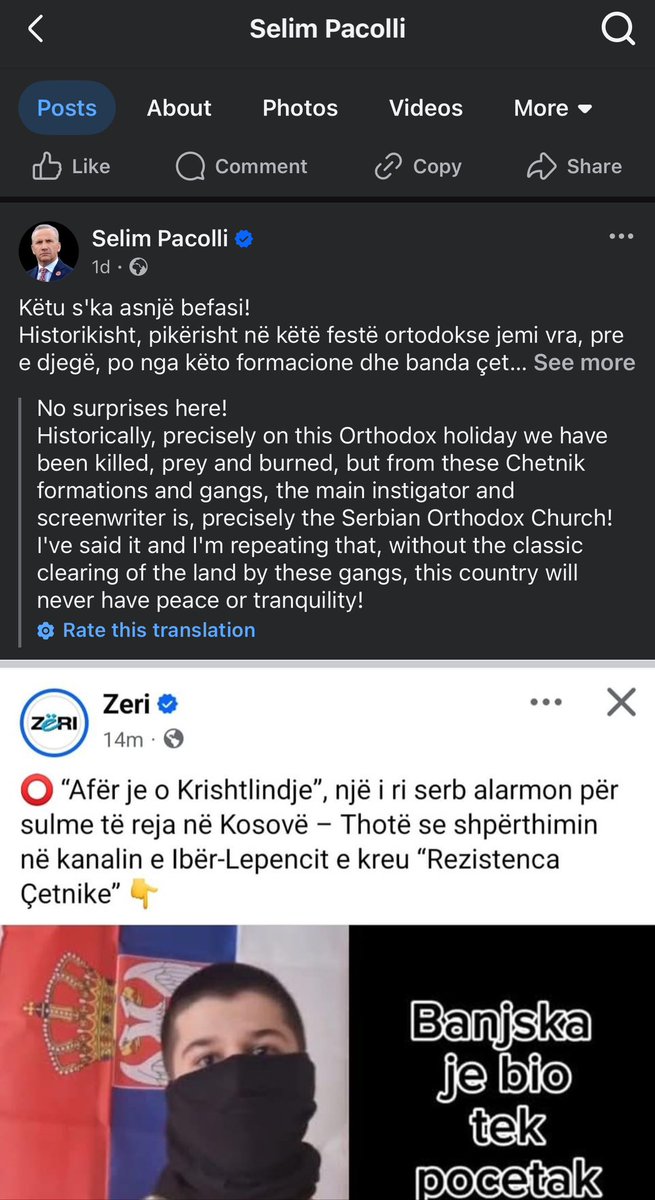
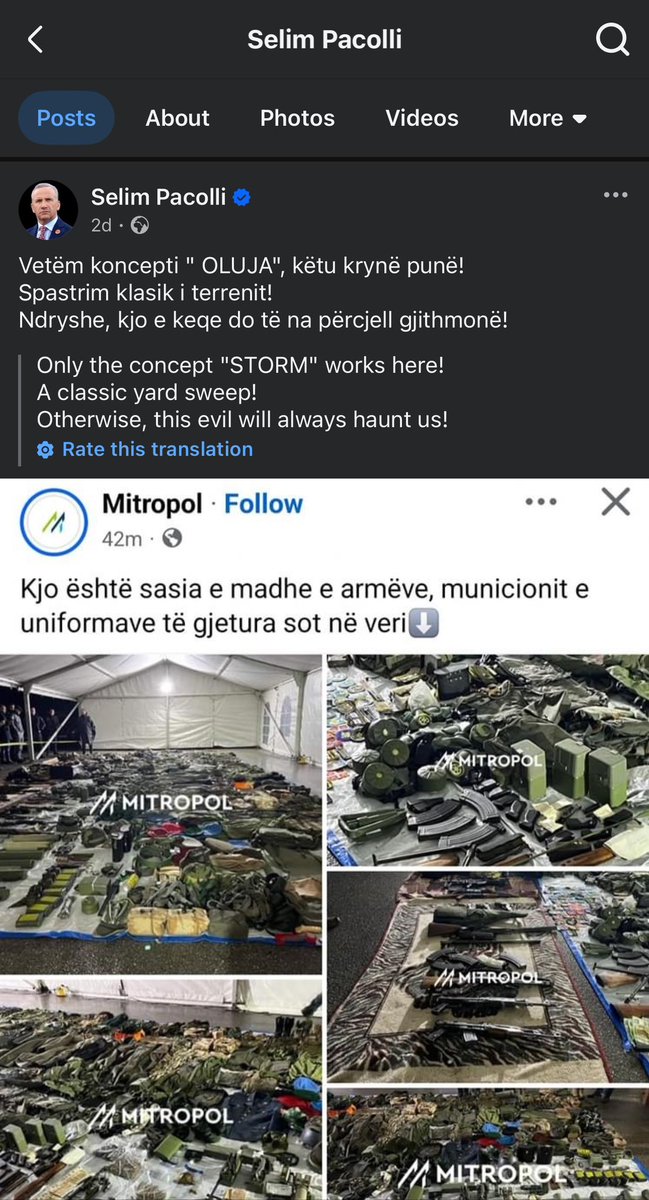
Serbian Orthodox Church Files Criminal Complaint Against Kosovo Albanian Politician Selim Pacolli after his hate speech and call for violence against our Church and Serbian people on Facebook
https://t.co/lAbldvBXL4
The Diocese of Raška and Prizren of the Serbian Orthodox Church has filed a criminal complaint today with the Basic Public Prosecutor’s Office in Pristina against Selim Pacolli, a senior official of the “New Kosovo Alliance” (AKR) party. The complaint concerns the criminal offense of inciting discord and intolerance. Pacolli, in two separate posts on his Facebook profile, initially called for the execution of an “Operation Storm” against the Serbian population—a term unequivocally associated by the Serbian people with ethnic cleansing. In a subsequent post, he escalated his rhetoric by making serious allegations against the Serbian Orthodox Church, branding it the “main instigator” of alleged “Chetnik bands” that, he claimed, “killed and burned during an Orthodox holiday.”

The Serbian Orthodox Church in Kosovo and Metohija has consistently opposed all forms of violence and has actively provided assistance to those in need, regardless of their ethnic or religious background—a fact recognized on numerous occasions by prominent international representatives. Consequently, such baseless and inflammatory accusations amount to hate speech by a political figure and represent a severe defamation aimed at inciting violence.
This kind of rhetoric not only deepens existing divisions and incites further criminal acts against the Serbian Orthodox Church and its faithful but is also wholly unacceptable in any society that seeks to portray itself as democratic and oriented toward a European future. Particularly concerning is the fact that these statements have resonated solely within the Serbian public, while other segments of Kosovo society have remained silent. This silence suggests that such incidents have become so normalized that they no longer provoke attention. It is a stark indicator of the actual state of a society whose officials publicly advocate for tolerance and coexistence while often tacitly overlooking hate speech or fostering an atmosphere of collective blame.

We hereby call upon international actors to respond and closely monitor the actions of Kosovo’s institutions, especially its judiciary. It is critical to observe whether this behavior will be appropriately sanctioned or whether—as has often been the case—a lack of consequences or the imposition of unacceptably lenient penalties will serve as implicit approval for further dissemination of hatred and the creation of an environment conducive to new crimes against Serbs and the #Serbian #Orthodox #Church.
Finally, it is time to ask what kind of society has been built in #Kosovo and #Metohija over the past 25 years. Does this society contribute to fostering trust and mutual coexistence among all citizens, or does it fail to provide the fundamental conditions for living in peace and mutual respect, irrespective of ethnic or religious origin?
#HumanRights #ReligiousFights #Facebook #HateSpeech
Response of the #Serbian#Orthodox#Church Diocese Regarding Recent Threats and Accusations in Some #Kosovo Albanian Media and on Social Networks
https://t.co/gzIUYACQMC
The Raška-Prizren Diocese of the Serbian Orthodox Church (SOC) is deeply concerned about the irresponsible and false statements made by certain public figures in Kosovo Albanian society. A recent statement by Selim Pacolli, an official of the “Kosovo New Alliance” and former deputy mayor of Pristina, falsely claiming that the SOC was the main organizer of violence against Albanians and calling for the ethnic cleansing of Serbs from Kosovo, is as untrue as the statement made yesterday by Gerakuci Kuqi of the Octopus Institute on KLAN TV. Kuqi suggested that weapons are being hidden in Serbian Orthodox churches and questioned the character of the people residing there.
ADDRESSING SELIM PACOLLI’S STATEMENT
The SOC in Kosovo and Metohija has never supported violence or war. On the contrary, the Church has actively worked against all forms of armed conflict, as evidenced by numerous interactions with international officials who have deeply appreciated the SOC’s stance. Many of these officials have visited our monasteries and strongly advocated for their protection.
Furthermore, during the 1999 conflict, monks from monasteries such as Visoki Dečani provided protection to Kosovo Albanian civilians and organized humanitarian aid in cooperation with the International Orthodox Christian Charities (IOCC) from the United States. After the war, Visoki Dečani Monastery also served as a refuge for many displaced Serbs and Roma who were expelled from their homes. These acts of solidarity have been documented by international media, and testimonies of assistance to Albanians, such as the one reported by BIRN in December 2022, further confirm this.
ADDRESSING PROVOCATIVE STATEMENTS BY GERAKUCI KUQI
The allegations made by Gerakuci Kuqi of the Octopus Institute represent a repetition of slander that first surfaced last year through British MP Alicia Kearns, claiming that weapons were being hidden in our monasteries. This baseless claim has been refuted by KFOR, and the Kosovo Police have never confirmed or provided evidence for such absurd accusations.
Following the tragic incident near Banjska Monastery in the fall of 2023, the police and EULEX confirmed that all weapons found in the wider area of the monastery had been discarded by a group of armed Serbs retreating through the monastery grounds. These individuals temporarily stayed in a building outside the monastery walls. The investigation, as well as the final report of the Kosovo Government on the Banjska case, established that no weapons were stored in the monastery and that neither the monastery nor the Church was implicated in this tragic event.
CONCERNS ABOUT SPREADING FALSE INFORMATION
The dissemination of such false information is part of a campaign by irresponsible individuals in Kosovo’s public sphere aimed at inciting religious and ethnic hatred. These individuals knowingly spread unsubstantiated claims, which have never been corroborated by the Kosovo Government or Police. Representatives of KFOR, EULEX, and the international community are well aware of the facts.
Spreading such misinformation does not contribute to de-escalating tensions; instead, it exacerbates ethnic and religious intolerance in Kosovo and Metohija, which is detrimental to both Serbs and Albanians in the region.
For the past 30 years, our Church has consistently called for the peaceful resolution of all issues in accordance with the teachings of the Gospel.
--------
1Facebook posts by Selim Pacolli:
https://t.co/33bPhzdScK
https://t.co/PkXqutuh30
2Media reports with provocative statements of Gerakuci Kuqi:
https://t.co/YHA5ytuG1B
https://t.co/05YhMIwSNY
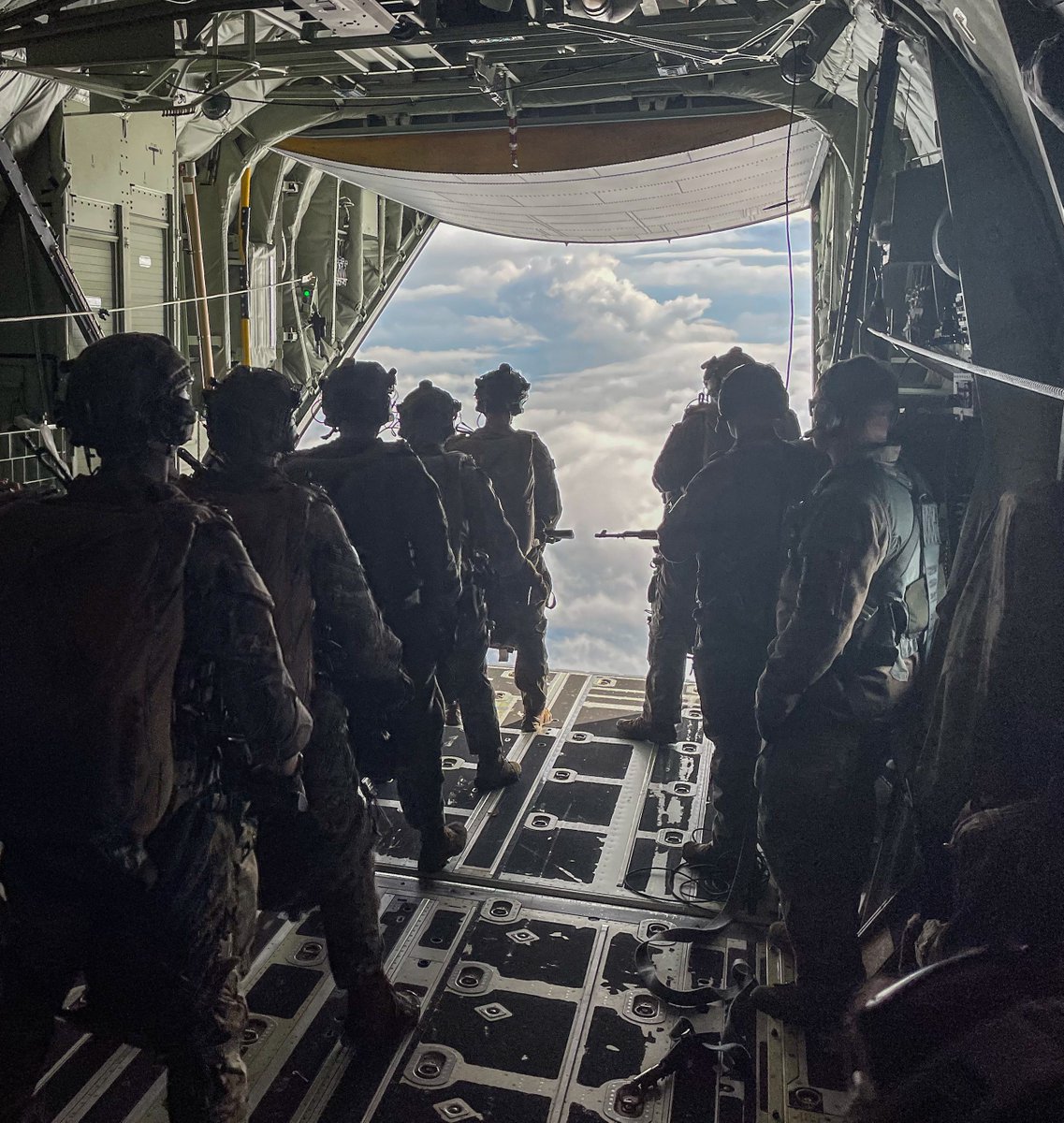
10th Special Forces Group (Airborne) Green Berets, alongside their Serbian counterparts, conducted an airborne jump in Pranjani, Serbia as part of a training event and ceremony in honor of the 80th anniversary of Operation Halyard.
#SOFinEurope#StrongerTogether#Halyard