We train, promote and implement GRADE in Aus/NZ and @JBIEBHC. Official @GRADE_WG Centre. Love GRADE? So do we! Tweets by @ZacMunn @TimHughBarker @SabiraHasanoff
Just published #GRADE paper in @AnnalsofIM: categorizing approaches to certainty rating as “minimally contextualized” and “partially contextualized” confusing, conceptually muddled. Must stop. Concept of contextualization still useful; this categorization is not.
https://t.co/F7qUIepxzP
📢 Exciting News! The #WorldEBHCDay 2025 campaign is officially launching! This year, we're focusing on Collaborative Knowledge Communication – because how we share knowledge matters as much as the knowledge itself https://t.co/1CBqBn3DhQ
@JBIEBHC@CampbellReviews@IDS_UK@cebhc
We are delighted to announce that abstract submissions are now open for oral presentations, posters and workshops for the JBI Colloquium 2025. Be a part of #JBIKochi
Submit your abstract & join the global conversation on building inclusive health systems👇
https://t.co/0BZ2z4BO43
Generally bad idea for GRADE users to make strong recommendations with low quality evidence. But we have defined 5 key situations (see Table 4) in which it is appropriate to do so. Once you know, when creating guidelines you’ll return there over and over. https://t.co/BWWpZkEMjP
🎉 The JBI Adelaide GRADE Centre's 2023 annual report is out now! Read about the Centre's activities, key milestones, and impact within Australia and internationally in 2023 https://t.co/xBuQUzKP4j
@JBIEBHC@GRADE_WG#GRADEApproach
Happy #WorldEBHCDay!
Somewhat fittingly I’ll be celebrating by starting the week at the @ECDC_EU as part of the methodological advisory group, discussing methodological advances in EBHC.
Have a great @WorldEBHCDay everyone wherever you are!
Have you ever been uncertain about how to conduct, report or disseminate your scoping review, mapping review or evidence and gap map? We want to hear what you were uncertain about!
For more info about how, follow this link:
#JBIscoping#PROSPECTdelphi https://t.co/6BOeilvlWp
Ignacio Neumann introducing the new GRADE book at @GES2024#GES2024
Will iteratively replace the old
Handbook that’s integrated here
https://t.co/iJgW2jdrHj
Including an AI companion that will be trained on new components of the book.
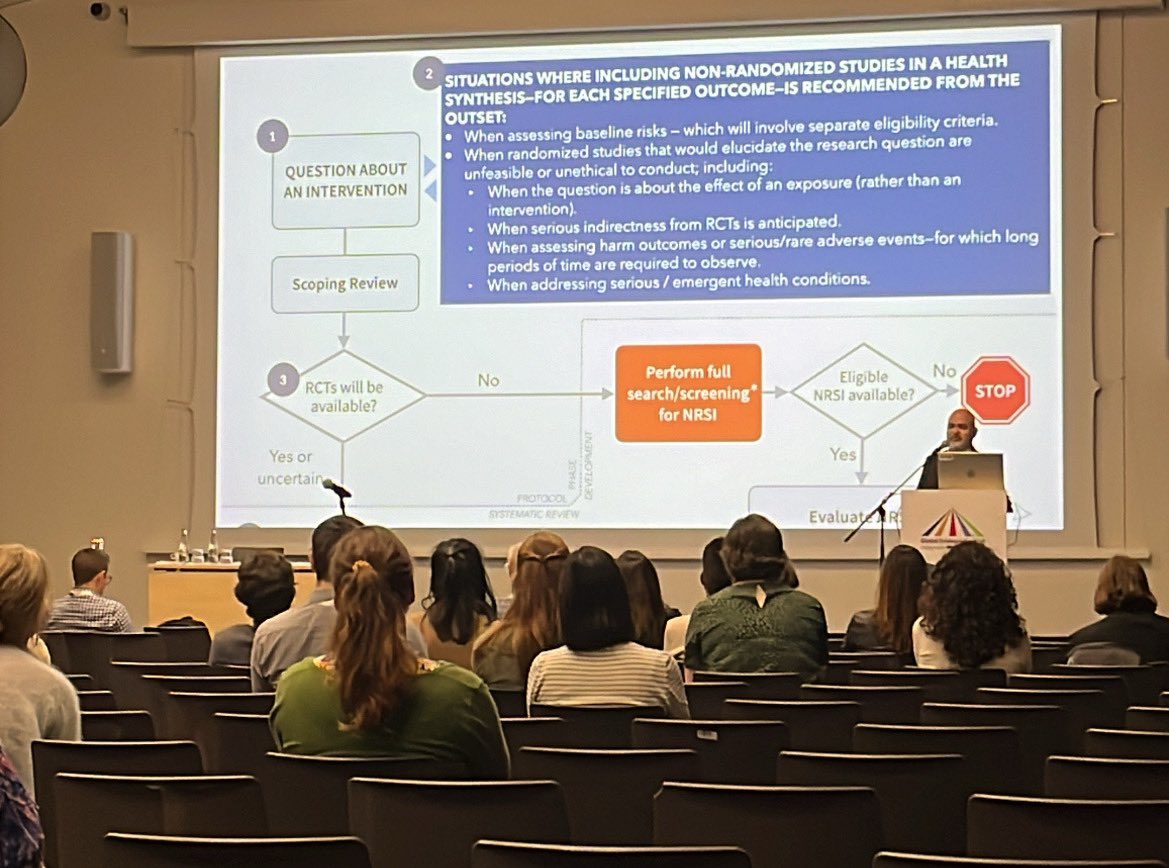
@CharlieNeck presenting how to integrate randomized and non-randomized studies of interventions in evidence synthesis and health guidelines at the #GlobalEvidenceSummit2024. Read the guidance here: https://t.co/2UgV0uS7YT
This #WorldEBHCDay serves as a global platform to share & access collective knowledge & wisdom for health & beyond, moving from evidence to action, while highlighting that interdisciplinary collaboration & innovation is pivotal to transformative change 👇
https://t.co/97lkXuxyC9
Chair of World Evidence-Based Healthcare (EBHC) Day Steering Committee & Director of Global Relations @JBIEBHC, @Biancajanepilla introduces the 2024 theme for #WorldEBHCDay, 'Health & Beyond: From Evidence to Action'. Learn more about the 2024 campaign.👇
https://t.co/qR2wFBTQVP
#WorldEBHCDay is held on 20 October each year. It is a global initiative that raises awareness of the need for better evidence to inform healthcare policy, practice and decision-making in order to improve health outcomes globally.
Learn more: https://t.co/KTZvwHu0Pq
Congratulations to our Director @ZacMunn for being named one of South Australia's @indaily 40 Under 40 and awarded the CMAX Discovery Award for his innovation, leadership and impact. You are an inspiration and we are so proud of you! 🙌
At HESRI we are delighted to be a partner on one of the first @cochranecollab Evidence Synthesis Units internationally under the leadership of @CochraneAus and Prof Sally Green. Exciting things to come!
Thank you to those who attended our online GRADE workshop on Tuesday! We had a GRADE time discussing the history, theory, and application of GRADE, practicing with hands-on activities. Stay tuned for future GRADE workshops from us
One of my fave things about #living#guidelines (I have a few!) is that the methods can change over time - like they did for our COVID guidelines @evidence_aus https://t.co/1vhiv75fPb