Led by @Susan_Athey, @StanfordGSB Golub Capital Social Impact Lab uses technology and social science to improve the effectiveness of social sector organizations
Tune in at 2 p.m. (ET) to catch professor @Susan_Athey from @Stanford deliver our annual John Kuszczak Memorial Lecture with opening remarks by Deputy Governor Sharon Kozicki
https://t.co/Mw8jiNPUom
#cdnecon
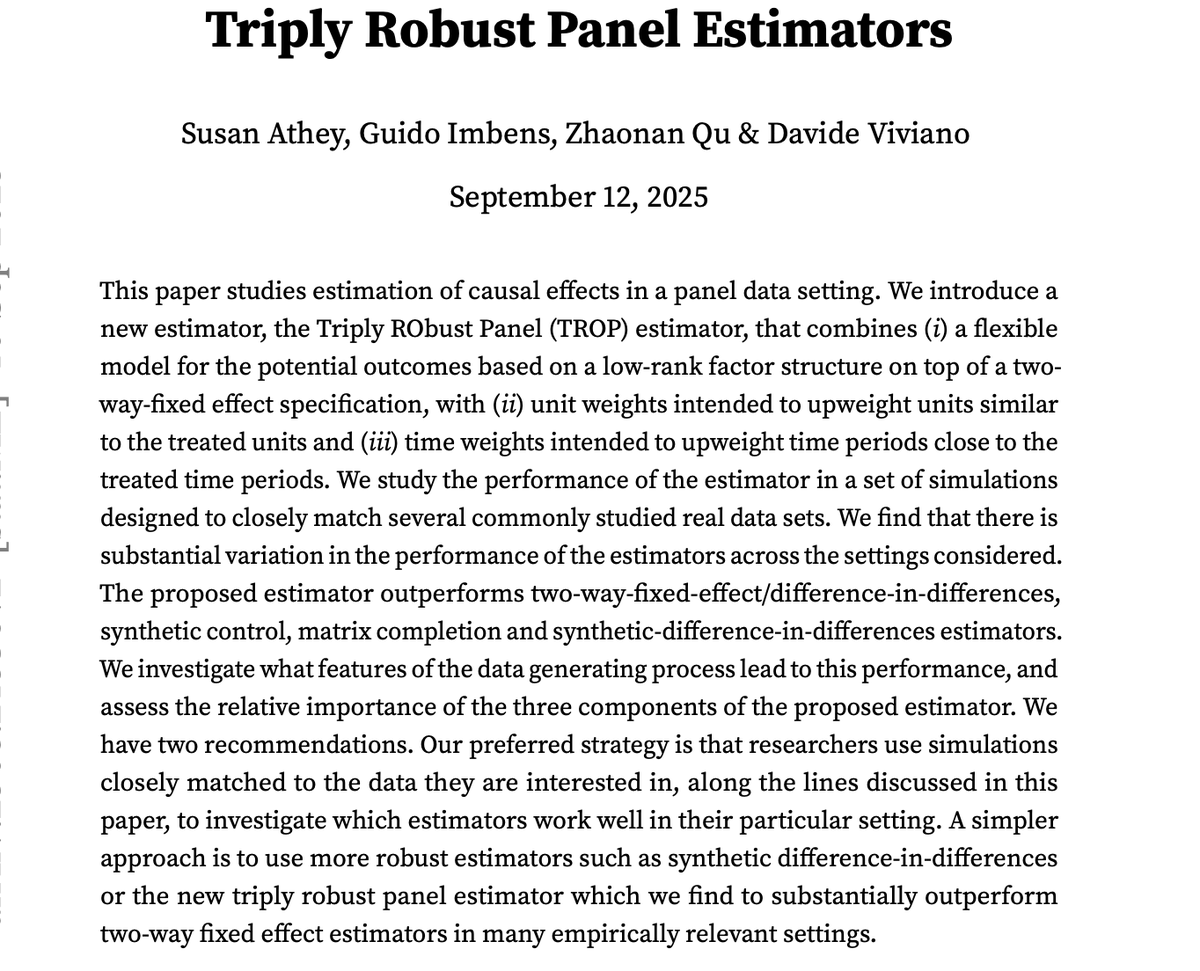
New paper: Triply Robust Panel Estimators (TROP) by @Susan_Athey@guido_imbens Zhanonan Qu @VivianoDavide. TROP estimates causal effects in panel models by combining a flexible outcome model (regularized low-rank factors + FE), unit weights, time weights https://t.co/N75fLshxaG
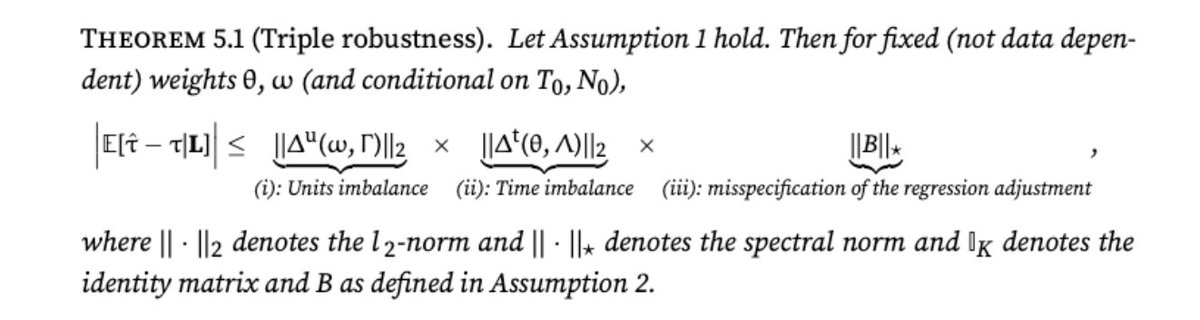
In our theory we show how the estimator’s bias depends on product of imbalance across units, time and bias of the regression adjustment, so that effectively only one of these three needs to be small. This gives flexibility in the choice of unit, time weights and outcome model.
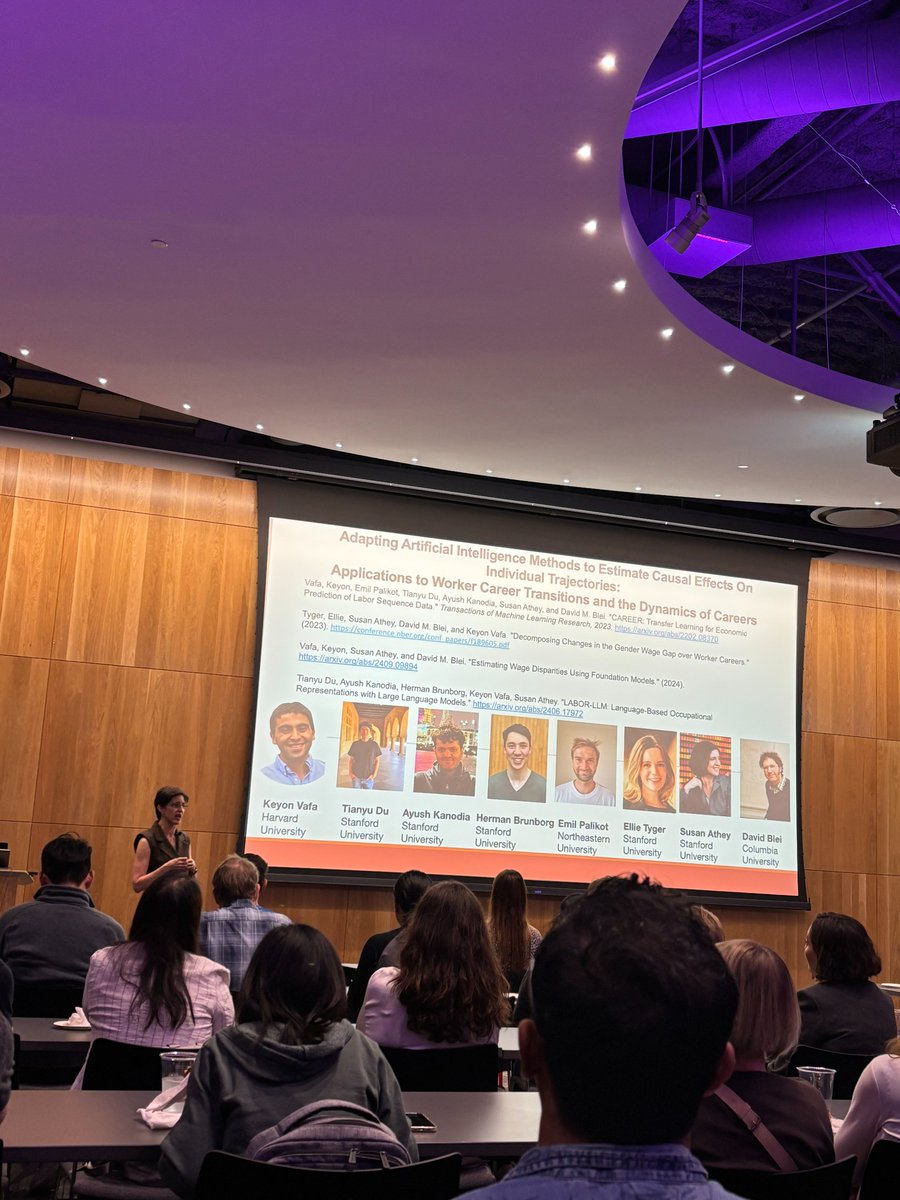
Great Thursday evening at the Bay Area Tech Economics Seminar! @Susan_Athey gave a fascinating talk on using AI to estimate causal effects on individual trajectories. Loved diving into these ideas and the lively intellectual energy in the room.
#AI#Economics#CausalInference
New Paper Alert! Read the thread below for key takeaways from “Does Q&A Boost Engagement? Health Messaging Experiments in the United States and Ghana” by @erika_kirgios, @Susan_Athey, @angeladuckw, Dean Karlan, Michael Luca, Katharine Milkman, and Molly Offer-Westort.
What happens if you *ask* instead of *tell*? Turns out, teasing people with a question before sharing a fact can shape whether people engage with critical health information. Read our new paper in Management Science to learn more: https://t.co/xMAEYiM6o5
During the GSB 100 Faculty Celebration of Scholarship @Susan_Athey highlighted the GSB’s proud tradition of synergy between business and practice during her presentation. Listen to her thoughts and more in the podcast linked below:
“We’re not in the business of giving our students simple, practical advice,” says Professor @amirgoldb. “We are helping them think about the world in analytical ways.”
Hear more on the first episode of GSB at 100, a new 4-episode podcast from @stanfordgsb.
Listen: https://t.co/p2rkCaAr2N
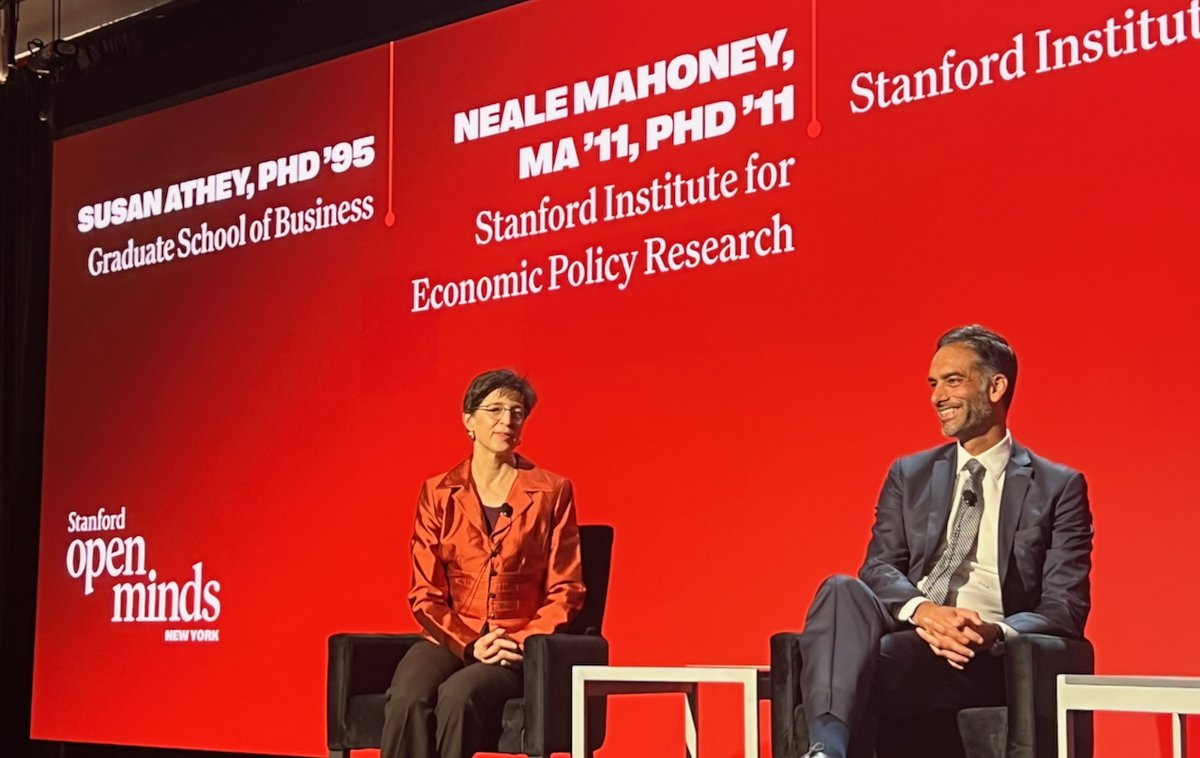
Tune into an episode of The Future of Everything recorded live as part of @StanfordAlumni's Stanford Open Minds: New York. Host Russ Altman speaks with @StanfordHAI’s Fei-Fei Li, @StanfordGSB's Susan Athey, and @SIEPR's Neale Mahoney on AI and the economy. https://t.co/AFUx0f6tWi
Earlier this month @Susan_Athey joined Stanford President Levin and other distinguished faculty to connect over cutting-edge research developments at Stanford Open Minds.
Excitement is in the air as @Stanford Open Minds in New York gets underway today! SIEPR Director @nealemahoney and SIEPR Senior Fellow @Susan_Athey will join @drfeifei on stage at the sold-out @stanfordalumni event for a conversation with Russ Altman on the innovation economy — to be recorded for a special episode of @stanfordeng’s The Future of Everything podcast.
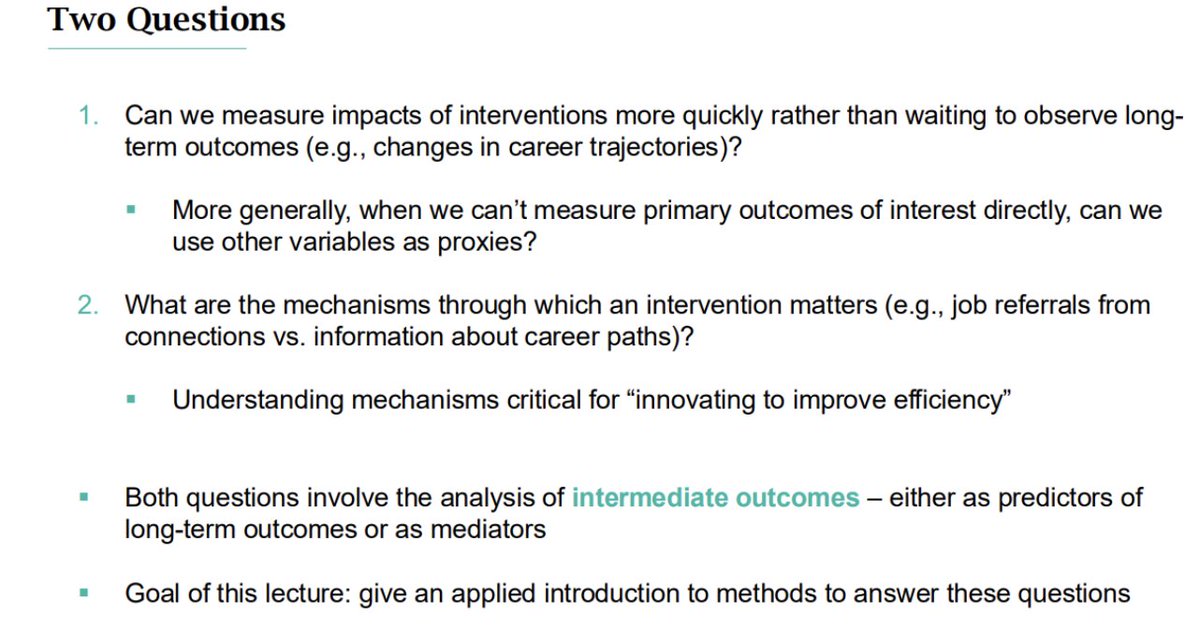
And learn more about surrogate approaches in the papers by @Susan_Athey, Raj Chetty, @guido_imbens, and Hyunseung Kang.
https://t.co/QANnMvMs32
https://t.co/DD1nI5GYCj
Listen to Raj Chetty talk about how surrogate indices make it possible to make decisions more quickly using multiple short-term outcomes to predict long-term effects with @nberpubs.
https://t.co/6rreWpuFKy
Learn more about how ratings, measurement, nudges, and dashboards are used to support service quality on online platforms in the paper by @Susan_Athey, Juan Camilo Castillo, & Bharat Chandar
https://t.co/eYW2Di1nJk
Check out @Susan_Athey’s interview on how AI-powered after-the-fact quality checks boost driver performance at Uber—and what it means when AI can track compliance. Insights via @StanfordGSB.
https://t.co/wmQVz6or7e