Political scientist @LSEEI (Fmrly: @unisouthampton). Political economy & environmental policy w/ EU-focus. Penchant for pasta. Views mine but could be yours.
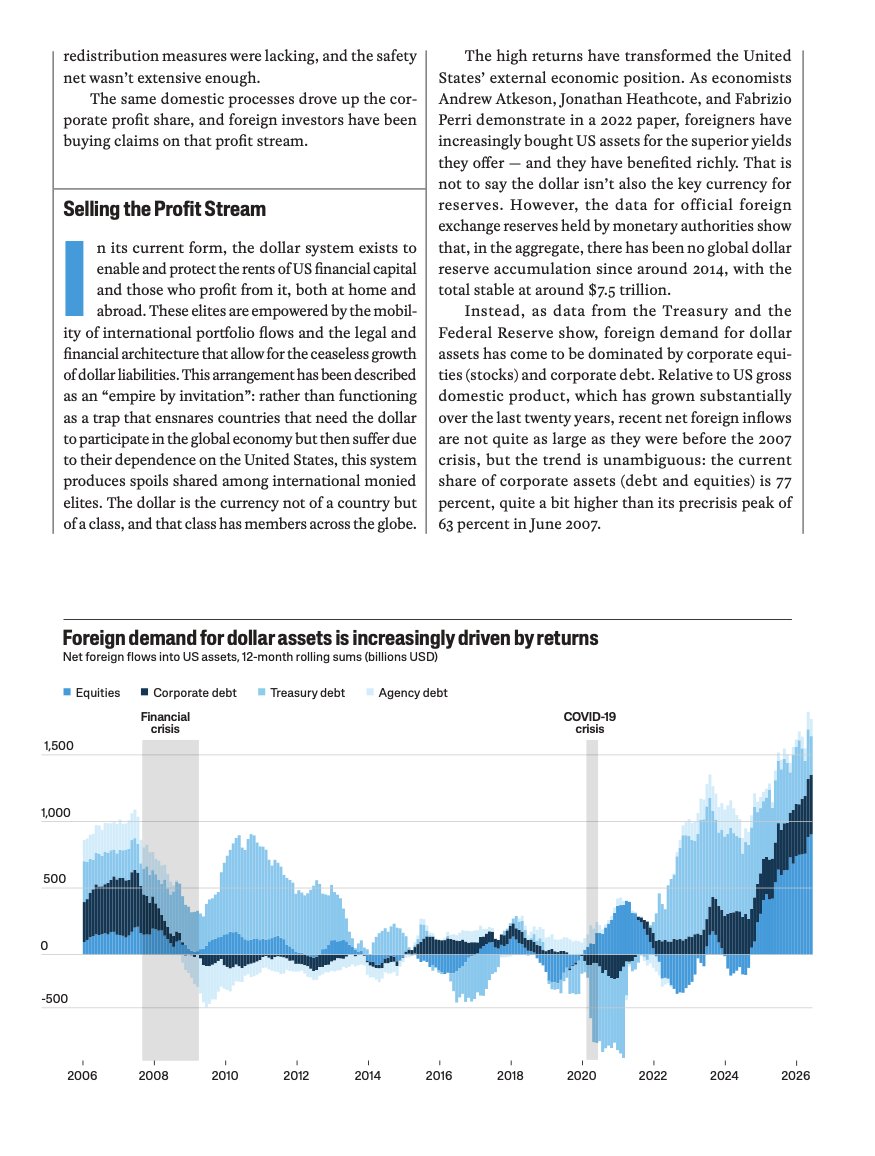
Just a reminder that I have a feature essay in the latest Jacobin issue (except below). It's a very good issue and worth subscribing for: https://t.co/plSbDaAras
An accompanying piece to my Odd Lots episode.
It's not just about the technicalities of comparing living standards: the obsession with relative decline and 'competitiveness' is a form of declinism: "the unwitting last refuge of great power delusions."
🧵 https://t.co/Tv5dlkZU89
I was very pleased to join podcasting heroes @TheStalwart and @tracyalloway on the Odd Lots to talk about Europe.
I explain why worries about Europe’s competitiveness vis-a-vis the US are overblown but why I’m bearish on European trade with China:
https://t.co/curFVPwT7N
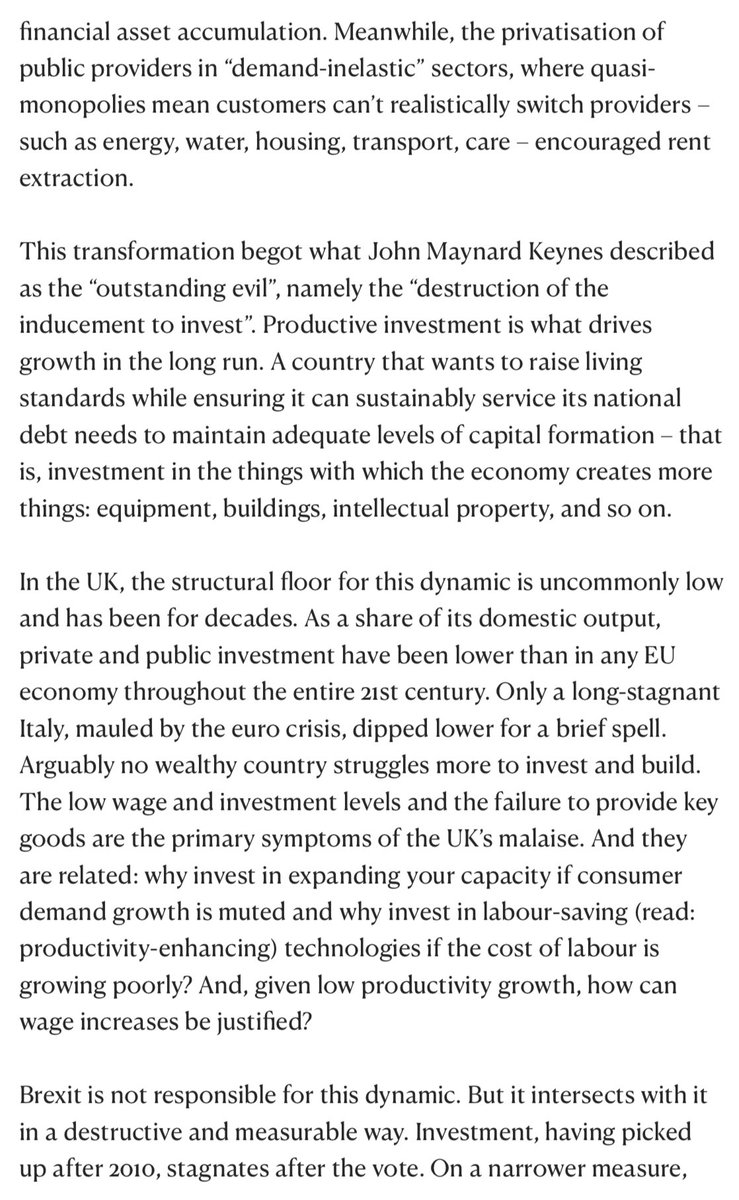
I’m in the @NewStatesman today, trying to account for Brexit’s role in Britain’s long decline.
The verdict: it killed the recovery from austerity, which had killed the recovery from the crisis.
Rejoining single market maybe worth the political capital one day—but not now.
🔗👇🏼
You can’t blame Brexit anymore, writes @NewLeftEViews:
No one in Britain knew how to mark the tenth anniversary of Brexit. And while British politics still seems to be grappling with its consequences, including the regicidal instincts it unlocked in our parliamentary parties, the debate around Brexit remains as contentious as it is confused. The incoming prime minister, Andy Burnham, is being urged to rejoin the EU from some quarters, having won a by-election in which he was forced to cosplay a Eurosceptic in homage to the memory of the referendum. And part of the problem is that contemporary political discourse tends to reward simple partisan narratives, which invariably bias towards single-cause explanations. An answer to the question “Whatever happened to the UK?” will struggle to incorporate the notion that Brexit was just an additional dent in the curve: hefty, but following a clear trend.
https://t.co/RlGtXs05WL
«Any viable solution to the British housing question requires a deliberate diminution of the housing wealth held by the current voting majority—which is why such solutions have been politely set aside for 40 years. […] The most obvious short-term response is to build more.»
Me in @unherd on the heels of @andyburnham’s speech on Monday.
A pessimistic piece, but I’m mildly bullish on this topic since Burnham is seemingly aware of the importance of housing costs and prepared to expand the public stock at scale.
https://t.co/CN8T7Q8Lo0
Europe vs America: Supplemental
Once more with feeling: here’s a small test that strengthens the case that the productivity wedge since 1995 in the constant PPP series is a deflator asymmetry mirage and that the chained PPP series adjusts for along with Balassa-Samuelson:
1/
Essay on Euro-American Decline: Part 1
The first instalment deals with a debate that recently re-emerged on but which in my view is still a bit confused.
Which growth and productivity series can we use for what purposes? How do cross-country price ratios, national accounts methodologies and the PPP construction distort long-run comparisons?
The stakes are quite real: depending on which data you use you can determine the direction of reform. If the European productivity frontier is declining relative to the US, then we need to become more like the US.
Fortunately, the ‘relative decline’ narrative is a myth. The core claim of the Draghi report is a statistical artefact.
Link below.
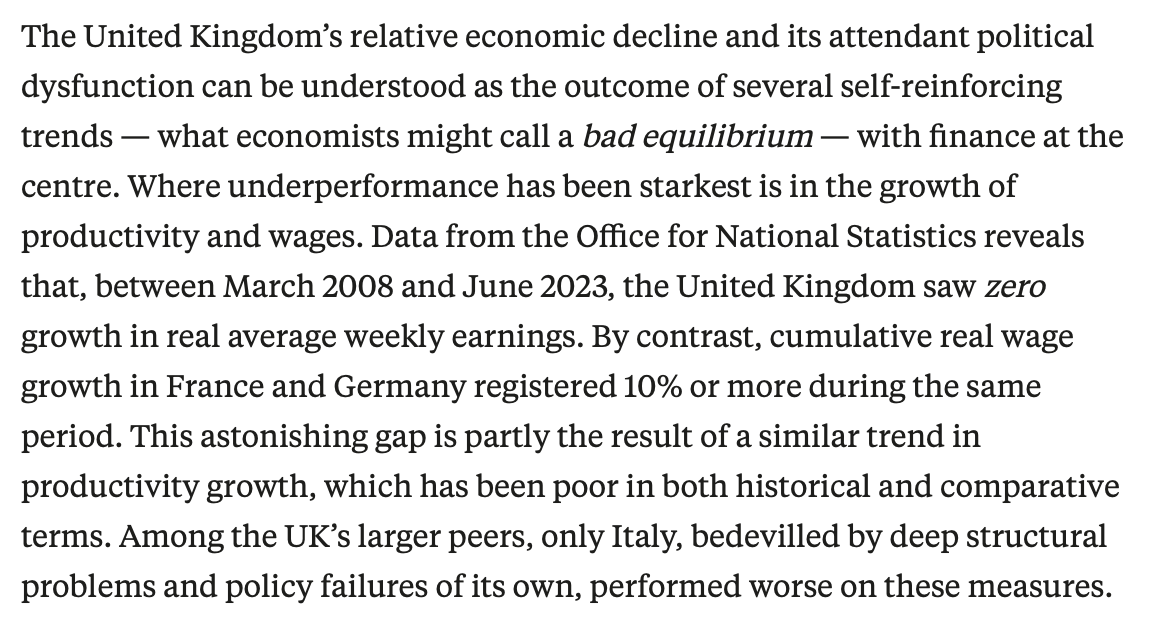
Andy Burnham recently identified the “four horsemen” of British decline as deindustrialisation, privatisation, austerity and Brexit. I argue that the country's relative decline––its unusually poor performance relative to its peers––is in fact down to the British elite overreacting to its perceived imperial decline, betting the house on finance and losing. Much of pre-2008 growth was debt and asset price driven and the devastating policy errors of the austerity era and Brexit were partly a failure to come up with the right diagnosis.
The logic of 'financialisation' (without quibbling over the concept) has penetrated far more deeply, its effect have been far more wide-reaching, the country's reliance off the financial sector is larger and the economy has far less to offset the detrimental effects than other countries that have undergone this transformation. It is the a extreme illustration of the main macroeconomic legacy of the neoliberal era: the long decline of private productive investment.
Link below.
/20/ Europe's Tech Problem
Dom sat down with Filippo Blancato (Fellow in Technology and Geopolitics at Harvard) to talk about the geoeconomics and political economy of cloud computing. How severe is Europe's dependence on US tech services and can the dominance of US hyperscalers be overcome?
[Link and transcript in the replies.]
This one is really informative if you care about the state of Europe's dependency on American hyperscalers (it's pretty bad). Filippo really knows his stuff and gives a great overview. Readings in the episodes description and transcript link in the replies.
Some thoughts on the age of mass disruption and how and to what extent we can prepare for future energy and commodity shocks. In short: I’m not terribly optimistic about the prospects of all but a few countries or about the source of the disruptions ebbing.https://t.co/JHeZ4TPF6j
The main cause of the disruptions of the 2020s is pretty clear: the countries whose political systems are explicitly defined by regional of global imperial projects: United States, Israel and Russia.
My Weekend Essay for the @NewStatesman: why the 'left-realist' critique of international law is a form of disenchantment that obscures more about political reality than it illuminates.
A short critique of Perry Anderson via EP Thompson, EH Carr, Weber.
https://t.co/kZHWvH2BgA
Why does the old regime persist?
For this @Equatormag symposium, I offer some stylised explanations of what the ECFR calls ‘strategic lunacy’: the tenacity of European servility despite the waning of both US power and the benefits of submitting to it.
https://t.co/xEY0QComEt
I've written an overview of the deindustrialisation discourse in Germany: the elite has been sleepwalking into crisis. The title exaggerates but what I do get at is that two decades of terrible macro policy set up German industry for China trade shock.
https://t.co/4JqetQJ5q9
Emerald Fennell’s ‘Wuthering Heights’ adaptation strips the novel of its racial, regional, and class dynamics, producing an empty spectacle emblematic of the erasure of working-class voices from the arts. https://t.co/yBbFTaBBP5
Is China exceptional or just another case of industrial development?
A striking recent data point implies the answer might be: both. I argue that solo households are both a sign of great success and that China can't escape global 'dual economy' dynamics.
https://t.co/9jWZD2J3ak