Launched the Dark Mode podcast 6 months ago:
Top 10 in #technology Australia
1 industry #award for innovation
5,000+ #listeners cross platform
6 strategic #partnerships created
35 unique #nations across the globe
17,444 #minutes in total podcast time
https://t.co/b5nKCNfCMO
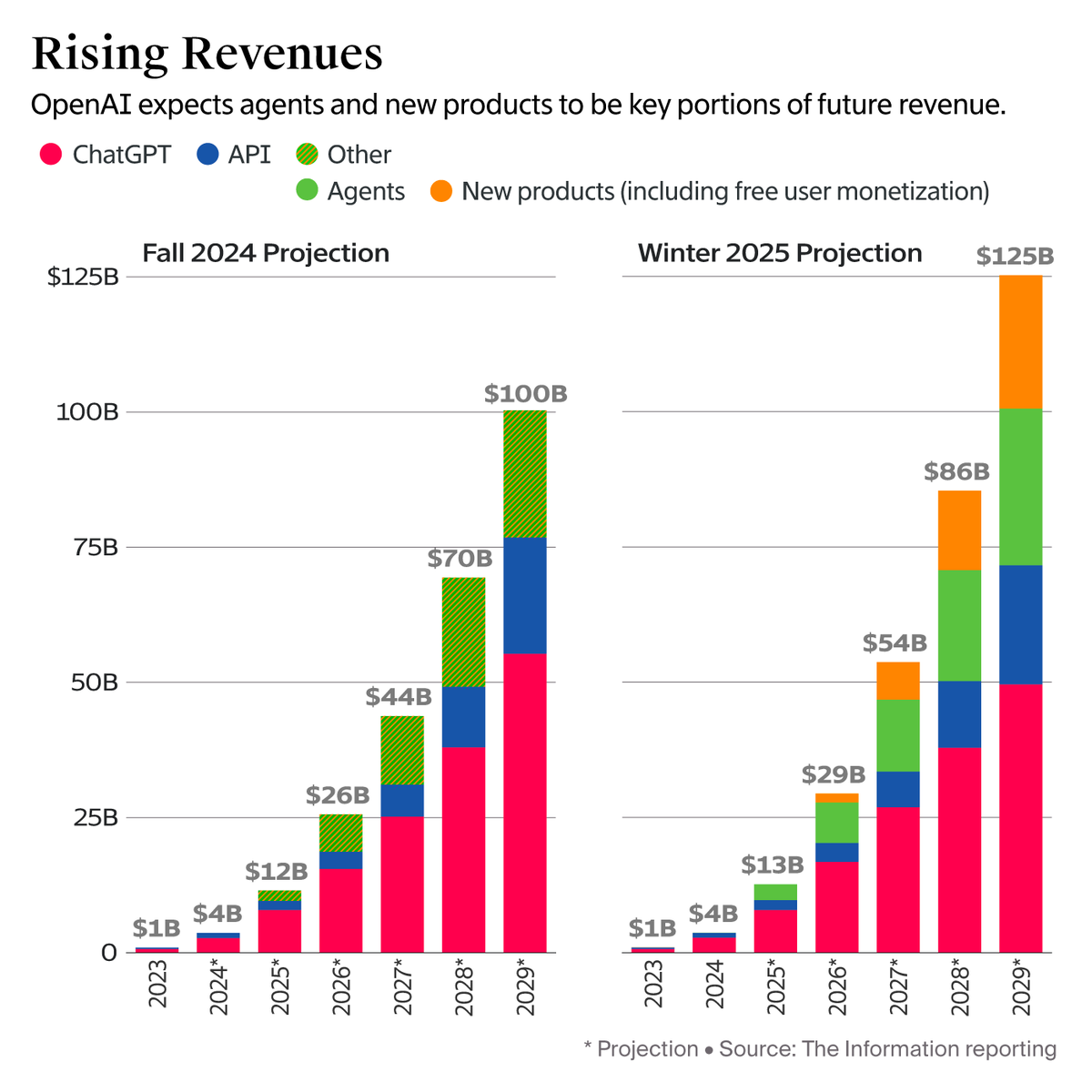
OpenAI now projects $125B in revenue in 2029, with $25B of that from new products not yet announced.
If they hit it, the current valuation ($300B) will be a steal; Google does ~$400B in revenue and is worth $2T
AI Agent interoperability is one of the most important topics right now in enterprise IT.
I’ve talked to a couple dozen IT leaders this week and it’s clearly going to be critical for AI adoption. Just as no single enterprise software product ever had all your data or workflows, no single AI Agent will have all the context necessary to perform every task for you.
Historically, enterprises have had different systems that are responsible for different parts of enterprise workflows, and they were wired together with APIs. There’s a clear sense that the same pattern will emerge in AI.
Enterprises are landing on architectures where any system’s AI Agents will be defined for a unique role in a particular workflow, and they will work with other Agents to complete a given task. The emerging patterns are often MCP being used to call outside systems for tool or agent use, and there’s additional standards emerging like A2A from Google and others that will work in complementary ways.
Now, the immediate question often emerges around whose AI Agent in the workflow is the “super agent” or “orchestrator”. For many tasks, it’s fairly obvious. For instance, a sales rep asking a question about sales materials will likely kick this off in Salesforce, with their Agent talking to a Box Agent. Similarly, an HR question in Workday would start with their Agent, and then coordinate with other systems.
Now, there are lots of workflows that don’t always have a clear home base for the workflow. And for those, we will likely see fully horizontal agent orchestration systems emerge when no one AI Agent makes sense as the center of gravity.
We’re in the *very* early days of AI Agent interoperability, but it’s clear that this is the future of how AI systems will talk to each other.
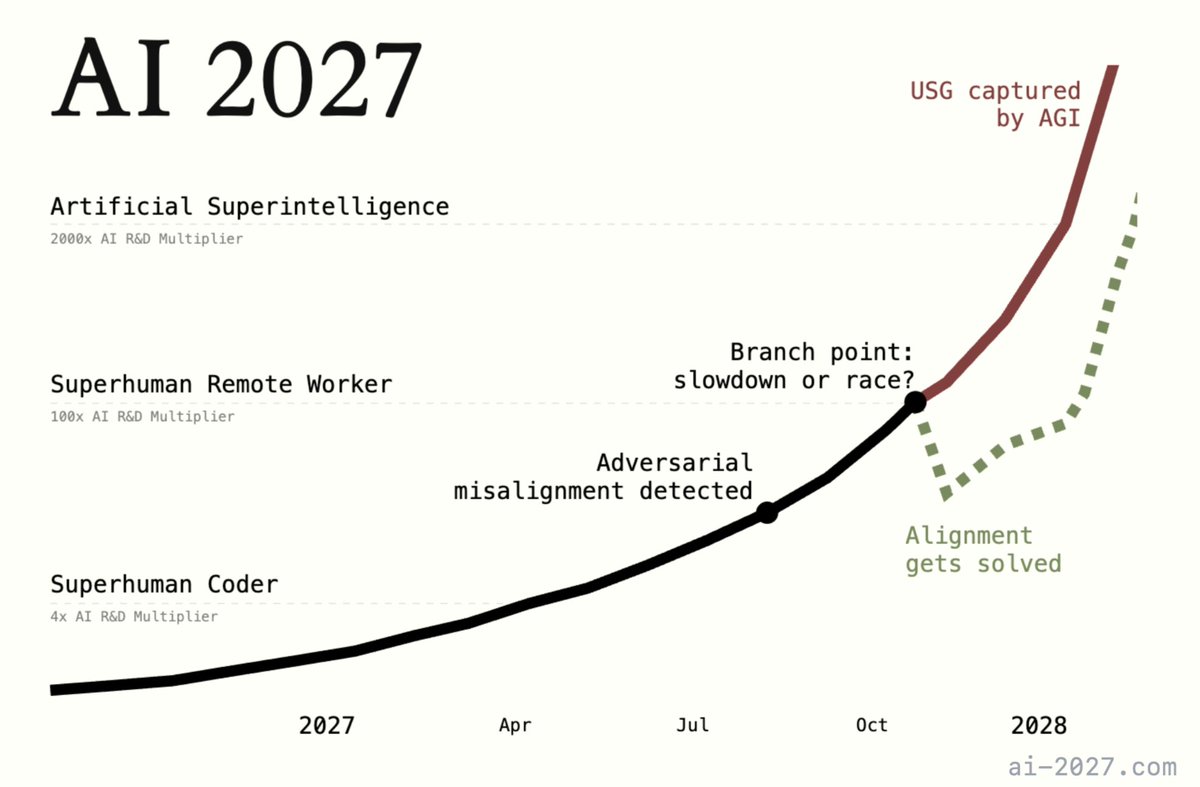
"How, exactly, could AI take over by 2027?"
Introducing AI 2027: a deeply-researched scenario forecast I wrote alongside @slatestarcodex, @eli_lifland, and @thlarsen
If I had to give one piece of advice to people in their 20s who want to build something great, it would be: “Never drink alcohol.”
I haven’t drunk alcohol in nearly 20 years. Alcohol clouds your mental clarity and intuition for days after consumption.
https://t.co/7kT1POt5yh
Microsoft launched the best course on Generative AI.
The free 12 lesson course is available on Github and will teach you everything you need to know to start building Generative AI applications.
Each lesson includes:
- a short video introduction to the topic
- a written lesson located in the README
- a Jupyter Notebook with code examples (for project-based lessons)
- a challenge or assignment to apply your learning
- links to extra resources to continue your learning
On first principles & continuous improvement:
You can only really improve something (innovation), when you know the intricacies of how it currently works (reality).
Announcing the Cybersecurity Grant Program — a $1M initiative to boost and quantify AI-powered cybersecurity capabilities and to foster high-level AI and cybersecurity discourse: https://t.co/kqHXqxAks1