Here is the latest @LFGincorporated Blockchain Retrospective on @staratlas solana:ATLASXmbPQxBUYbxPsV97usA3fPQYEqzQBUHgiFCUsXx. To be clear, I am a massive fan of the project, and they fell victim to a huge number of the same exact forces that have taken almost every other gamefi project down...and are still standing, credit to @at_mwagner and his team.
Read the report here: https://t.co/40s5V4zCwG
I’ve been sensing this as well. This “cycle” has certainly felt different than the rest I’ve been in since 2013. Call it a maturing industry, but it feels like we’ve lost part of the essence of what made crypto and blockchain unique. Reaching global capital market status was the holy grail for many, at the cost of losing (at least part of) our identity.
With that said, I still steadfastly believe that gaming can be the breakout application of the tech that leads to sustainable consumer adoption. It has all of the necessary value props: identity, ownership, earnings, and entertainment. Certainly hasn’t been a performant sector, but it could be precisely what is needed to reinvigorate interest.
Support great games and game builders.
The O.rigin airdrop season is in full swing! Build your status. Increase your reputation. And level up your account. Participation is easy through multiple entry points in @staratlas.
The COTI Show is out: https://t.co/tFx8INncm3
Your monthly recap from COTI core team members.
📈 PriveX drives volume on COTI
💉@StaTwig completes vaccine supply chain pilot for UNICEF and Government of Bangladesh on COTI
⛓️ @chain_port brings new liquidity on-chain via $ADA $USDT
🔏COTI's Privacy Sandbox Launches
🔉 @shahafbg 2026 thoughts
Privacy coins were Privacy 1.0.
The next wave? Programmable privacy for smart contracts.
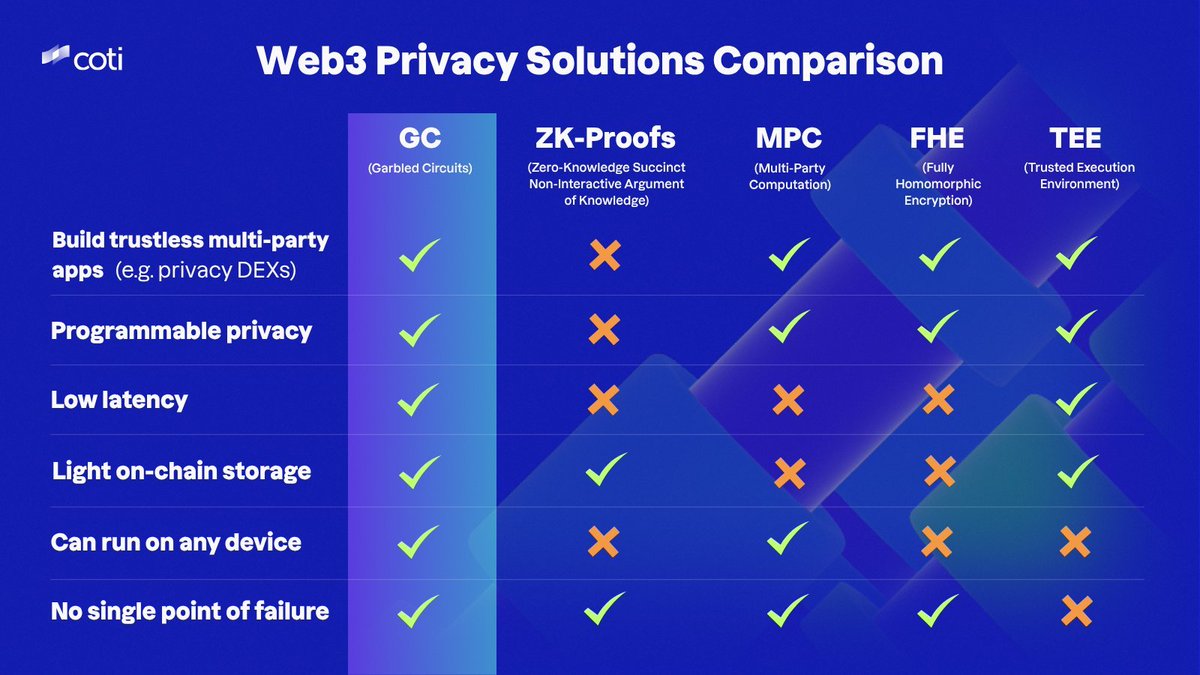
XMR/ZEC solve transaction privacy. But DeFi, RWAs, and enterprises need something more: confidential computation with selective disclosure.
That's where Garbled Circuits come in. Fast. Compliant. Live on mainnet.
Privacy 2.0 is here.
$COTI
Performance matters.
In 2026, COTI will cement its position as a leading privacy protocol.
As the fastest, lightest privacy layer in Web3, COTI is already live and powering real-world use cases.
Built for enterprises.
Built for institutions.
Built to perform.
LATEST: ⚡ Arthur Hayes says privacy will become crypto's dominant narrative in 2026 and disclosed that his investment fund, Maelstrom, has built a sizable Zcash position.
My Thesis for the Privacy Narrative
For the better part of a decade, the prevailing narrative in both traditional finance and crypto was that ''transparency is a virtue''. We were conditioned to believe radical openness is the default state of the future, and that only those with something to hide (criminals, tax evaders, paranoiacs) would ever demand privacy.
I think that era is ending.
As we enter 2026, the market is already showing a rotation that most people are still ignoring.
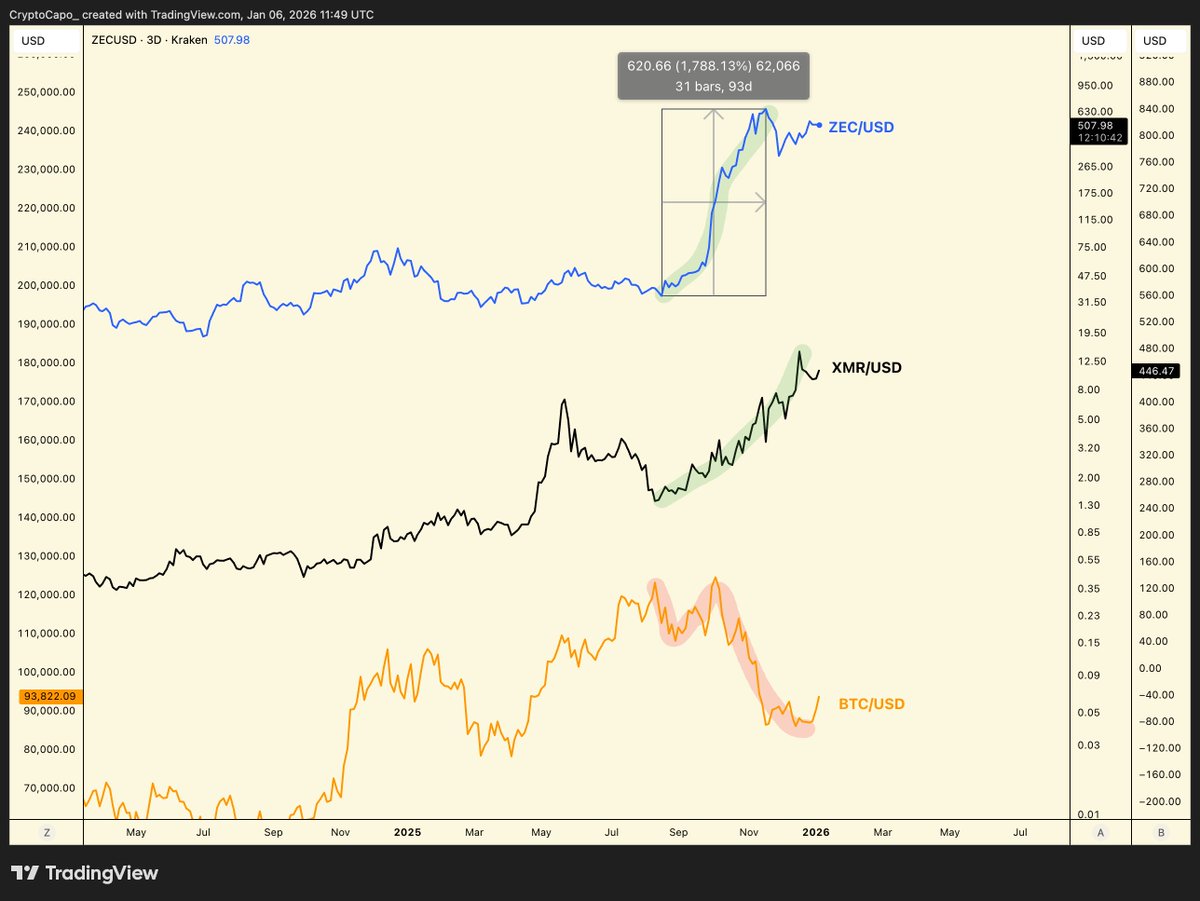
Take this chart as an example:
$ZEC printed an 18x to 20x move in roughly 3 months (Aug to Nov 2025), and is now consolidating. $XMR has also doubled in price in the same timeframe. All of this while #Bitcoin has retraced from the all-time high of $125k to a local low of $81k. This means money has been rotating, and it’s a clear sign of strength for privacy coins.
But… why is this happening?
Privacy is no longer a luxury. The social contract regarding money is being broken. Money is transitioning from being a tool of freedom to becoming a tool of surveillance.
Money is constantly evolving. Now digital money is becoming more integrated, more automated, and more connected to rules and systems. That trend is largely unavoidable.
CBDCs are part of that conversation. With 137 jurisdictions, representing 98% of global GDP, exploring Central Bank Digital Currencies (#CBDCs), the debate is no longer if they will arrive, but when and how. While CBDCs offer some benefits, like offering clear efficiency gains for central banks, their underlying programmable nature introduces the structural capacity for unprecedented oversight.
The design specifications of many pilot programs include features that could theoretically allow for expiration dates on funds, negative interest rates to enforce spending, or spending limits based on social metrics (social credit score). Even the potential for such control is altering the risk profile of holding cash within the traditional system. As these architectures get closer, the market is beginning to price in the demand for alternatives where money cannot be programmed or restricted by a central issuer. Not predicting a dystopian future, but hedging about the technological capabilities of it is always a smart choice.
This is also being accelerated by the systematic ‘’War on Cash’’. As governments eliminate physical cash, through withdrawal limits and the stigmatization of paper money, a massive vacuum is created. We already saw in Canada that a supposedly democratic government was willing to freeze the bank accounts of citizens for peaceful protest.
However, the argument for privacy extends far beyond that. There is a fatal flaw in the ''transparency'' narrative that the crypto community is only now starting to price in: security. Living in a ''Glass House'' is dangerous. With the advent of AI and advanced chain analysis, ‘’transparency’’ is a synonym for vulnerability. For example, if you pay for a coffee with Bitcoin on a public ledger, the barista can theoretically see your entire net worth, your income, and your home address. High net-worth individuals are realizing that total transparency makes them targets.
This is amplified by the reality of corporate espionage. Major corporations are less likely to move their supply chains to a public blockchain like Ethereum or Solana. Why? Because they cannot afford to have their competitors see exactly who they pay, how much they pay, and when their supply chains falter.
The market data confirms this rotation. We are seeing the DEX/CEX ratio hitting all-time highs as users seek non-custodial, private ways to trade.
Not to forget the technicals, which I consider even more important than fundamentals. #Monero remains the main privacy coin. There’s probably better privacy tech out there, but there are other factors that make it number one by market cap (though temporarily slightly surpassed by ZEC).
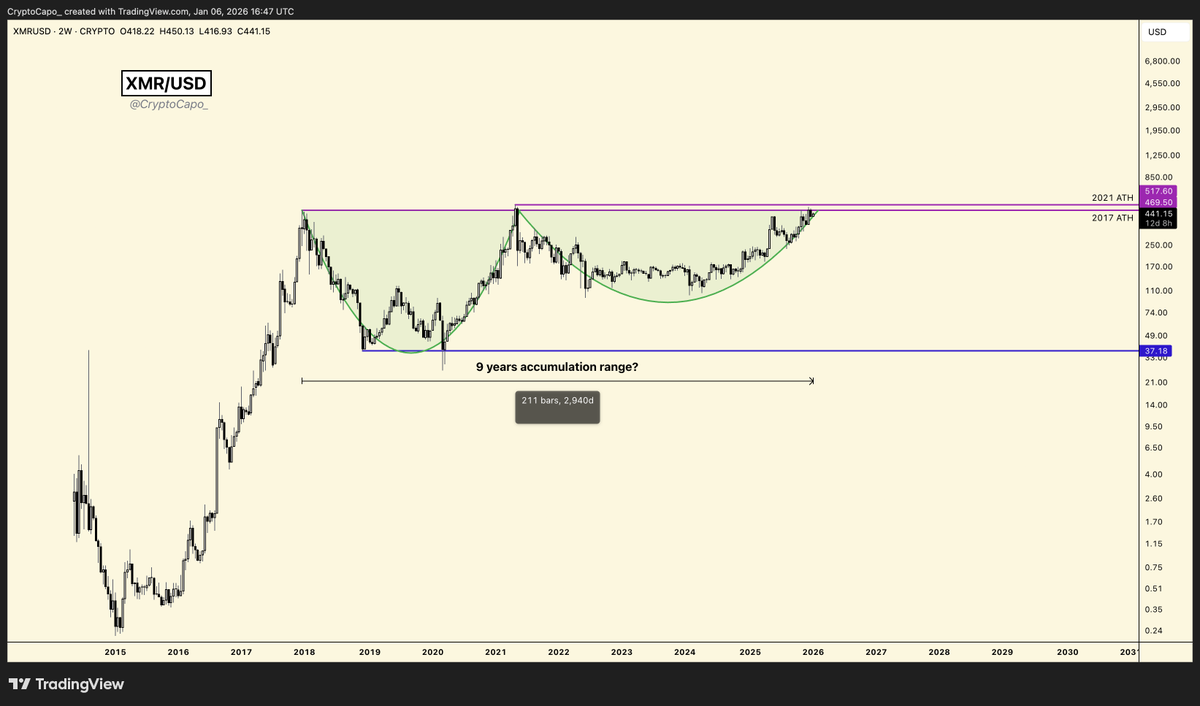
As I’ve been posting these last weeks, $XMR chart is one of a kind. With a massive bullish pattern that resembles similarities with the silver chart just before the breakout.
If we get a clean breakout, I see $1,000 as a minimum target. And if that happens, it likely pulls the entire privacy narrative with it.
Here's the bottom line:
-Privacy is being repriced as infrastructure, not just ideology.
-The world is building more digital control surfaces, whether people admit it or not.
-Cash is fading, reporting is expanding, and on-chain transparency is becoming a liability for both individuals and businesses.
-When a narrative concentrates into a small group of assets, moves can be violent.
I think 2026 is a year where the privacy theme can dominate for months, and potentially longer.
Security. Fairness. Sovereignty. Resilience.
And one last reminder: none of this is a call to live in fear. Privacy is a tool, not a lifestyle. Protect your optionality, but don’t forget to disconnect sometimes. Touch grass. Keep your mind clear. That’s an edge too.
Disclaimer: This is just my opinion and does not constitute financial advice.
epoch has secured https://t.co/SrZLFsehMz domain and is preparing to launch its official shopify store.
the goal is to expand the brand beyond the digital realm - bringing epoch to a wider audience through premium merchandise, physical art, plush toys and other goods. (don't ask when)
this week, epoch begins its transformation - registering as a legal entity and taking the first step toward becoming a fully-fledged IP brand, far beyond just an art collection.
@WhalesMarket I did not receive anything .
And seriously, you need to create a mechanism that allows people to cancel what they left as collateral, after 3 months, these ME diamonds are just opium, I want to cancel my collateral, otherwise I will take the appropriate measures