Joe Blitzstein, Harvard professor and author of the probability textbook most quant desks quietly learned from:
"Ten simple yes-or-no choices in a row produce over a thousand possible outcomes.
Quant desks running strategies with dozens of parameters are sitting on numbers so large no one has actually checked most of the scenarios their own model can produce."
this is the exact math behind why "we stress tested every scenario" is almost never literally true.
cut through the notation and the growth rate is brutal. each additional binary choice doesn't add outcomes, it multiplies them. ten choices already produces over a thousand combinations, and that number explodes exponentially from there.
a model with a modest number of parameters can generate more scenarios than anyone could enumerate in a lifetime, let alone one afternoon before a launch.
zoom out to what "comprehensive backtesting" actually means at that scale. testing a sample of scenarios and testing every scenario are two completely different claims, and the gap between them grows exponentially larger with every parameter added to a strategy.
most people reading "extensively tested across scenarios" assume something close to exhaustive coverage, when the combinatorics guarantee that's essentially impossible past a small number of variables.
this is exactly what risk reports skip. the parameter count sounds thorough. the actual fraction of the scenario space that was ever touched is the number nobody puts in the writeup, because it's usually a rounding error.
more parameters sounds like more rigor. it mostly just means fewer of the possible outcomes were ever checked.
Bookmark this legendary professor
Here’s a secret that every genuinely original thinker knows: there are no original ideas. there are only original combinations. Every “breakthrough” is two existing ideas from different domains meeting for the first time inside someone’s head.
The person who reads only within their field will only ever have ideas that their field has already had.
This is why the most interesting people are almost always polymaths.
Go wider. Read the thing that has nothing to do with your work. Talk to the person who has nothing in common with you. Visit the place that makes no sense on your itinerary. The irrelevant input is the one that will combine with everything else and produce something nobody’s ever seen.
@AnalyticaCamil1 @BenniKim Wouldn't the dominant returns driver be that rising TTF support fuel switching back to coal/lignite and hence support carbon in the short term ?
@gugus_bontaquin Effet dérivé de l'inflation des propriétés performatives du langage, doublée d'une confusion sur les effets de causalité (le langage produit le réel, donc le langage doit être scruté pour ne pas produire des effets de dominations dans le réel, etc.)
Imaginez que vous soyez assis sur un trésor depuis votre naissance… et que vous le traitiez comme un décor banal.
C’est l’histoire d’une ville morte économiquement à l’époque moderne, mais qui fut un centre majeur de l’Europe médiévale. Son patrimoine a permis sa renaissance...
Cette image de ville morte est déjà bien installée à la fin du XIXᵉ siècle, popularisée notamment par le roman Bruges-la-Morte, qui fixe durablement l’idée d’une cité splendide mais économiquement et socialement déclassée.
Ce regard mélancolique trouve un écho particulier dans le monde anglo-saxon, où Bruges commence à attirer, dès la fin du XIXᵉ siècle, des visiteurs britanniques et nord-européens sensibles à l’image d’une ville préservée, en marge de la modernité industrielle. Ville sous cloche ? Au départ, oui.
Ce premier tourisme, encore limité et élitiste, ne constitue pas un moteur économique à part entière, mais il prépare le terrain : il transforme une ville perçue comme déclinante en objet de contemplation, et fait de son immobilité apparente une valeur culturelle.
Il faut ensuite un événement culturel d’ampleur internationale, en 1902, pour rappeler explicitement ce que ce lieu avait représenté dans l’histoire européenne, et pour amorcer une relecture plus structurée de son héritage artistique, en particulier celui des primitifs flamands. Peut-être que vous l'ignorez, mais le terme de primitif n'avait pas une connotation négative.
La transformation économique effective n’intervient que plus tard, à partir des années 1960, lorsque la mise en valeur systématique du patrimoine devient un moteur central de l’activité locale, parallèlement au développement du port de Zeebruges, qui redonne à l’agglomération une fonction économique majeure sans modifier l’équilibre du centre historique. On en revient au point de départ...
Ce lieu, c’est Bruges.
Bruges-la-Morte : https://t.co/EOvpoVdEpJ
Articles exclusifs : https://t.co/tCw9dfkOdr
It only needs a few crazy ones to fix a continent… Let's be crazy… I got something to announce:
We're launching PROTOTYPE: a new fund, fully focused on Europe.
A small fund that punches way above it's size.
With it we back what Europe is world-class at: robotics, automation, manufacturing, and anything that requires hard engineering.
First check. First round. As early as it gets.
Europe invented industry. We're the birthplace of precision manufacturing. The second largest manufacturing hub on the planet. Leaders in automation and robotics.
And yet…
We sell out our best tech to China. We export our best founders & most of our investment money to the US. That's insanity.
What should we do instead?
Build the next trillion euro companies in robotics, manufacturing, automation right here: in Europe. Showcase to young founders what is possible and change the system around them where needed.
What we will do:
→ Publish all our fund updates and build in public: https://t.co/JROaYikB2Y
→ Showcase Europe’s Most Ambitious Startups on Youtube: https://t.co/l3xVkjtbox
→ Launch & support more projects like @euinc_petition. Enough talking about Europe. Time to build it: Startups, makerspaces, student clubs, and much more.
→ And most importantly, invest into the best founders in Europe. Same model as our previous funds that are in their top 1-5% cohorts worldwide.
We won’t do a VC fund in the classic sense.
This will be a community of hyper-ambitious people who want to actively change Europe for the better.
It only needs a few crazy ones to fix a continent… Let's be crazy.
Check out https://t.co/h2lPmypoaM!
@pwk Great to read a fair opinion on some constructively optimistic outcomes, among all the doom and gloom whose only purpose is for easy doomsayers to sell their books.
The officious motto of the EU, ultimately, is "integration from crisis to crisis"
Let me get this straight: EU deregulation favours American interests, not European.
As the latest US security strategy confirms, the EU regulatory capacity represents the single most significant constraint on American corporate dominance of global markets.
When Musk declares war on the Digital Services Act, he’s not objecting to specific compliance costs. He’s rejecting the principle that Europe can govern its own digital space.
Dear @vonderleyen & @EPP, it's time to reassess the EU deregulatory wave, as this is weakening us. cc: @Teresaribera
Extraordinary number of ships at #singapore. All bunched up here because of Red Sea disruption to shipping and shifts in way things are being shipped. Fascinating. This is where commerce and geo politics come face to face
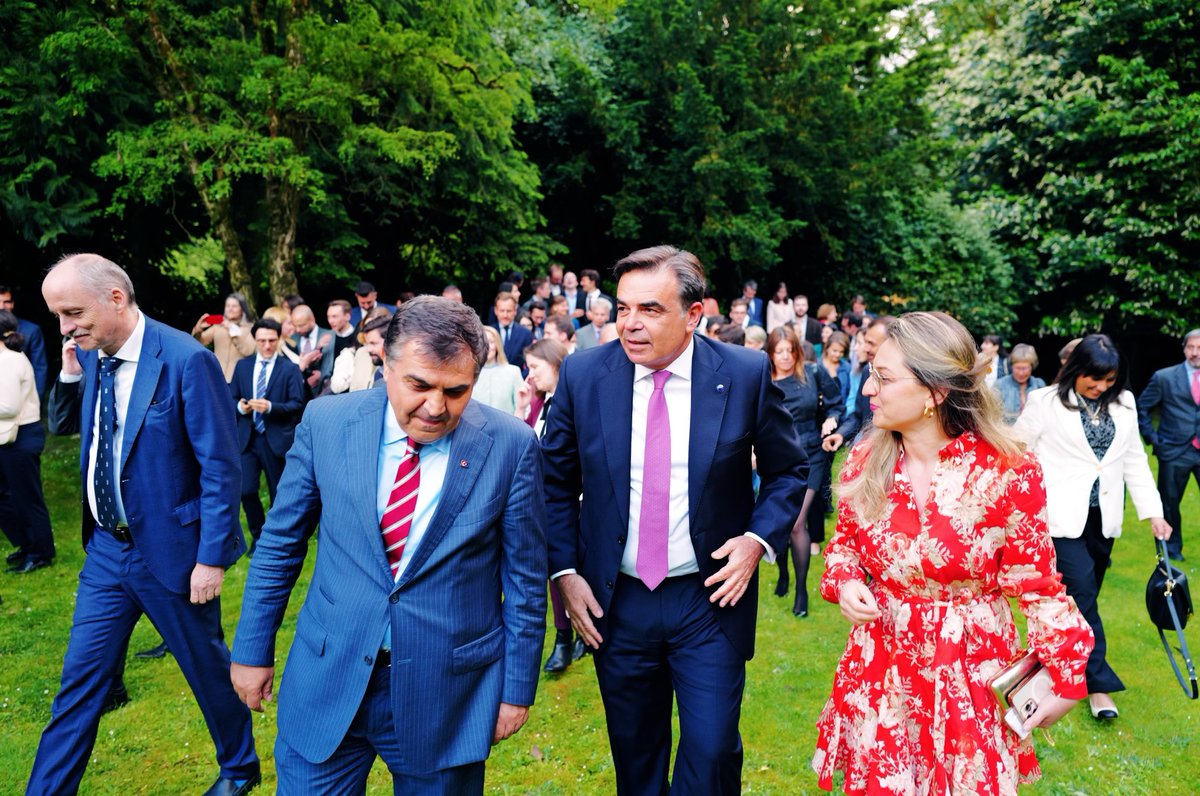
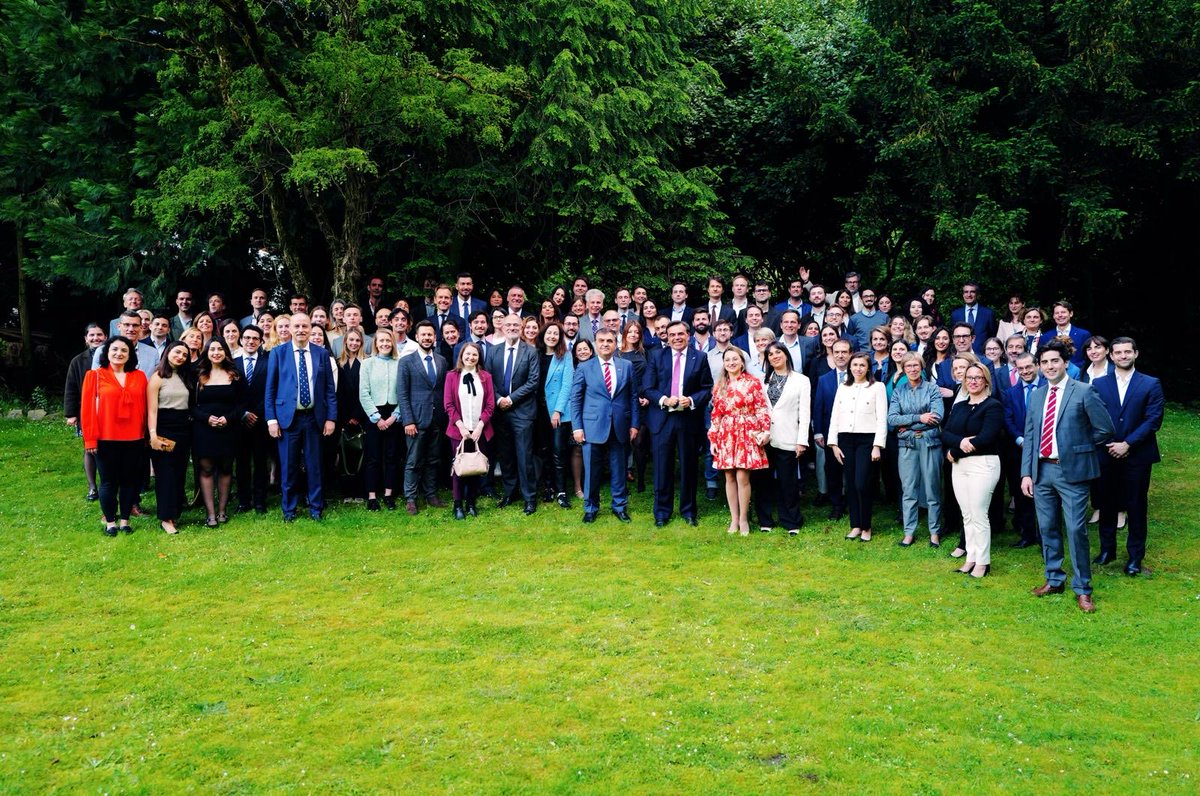
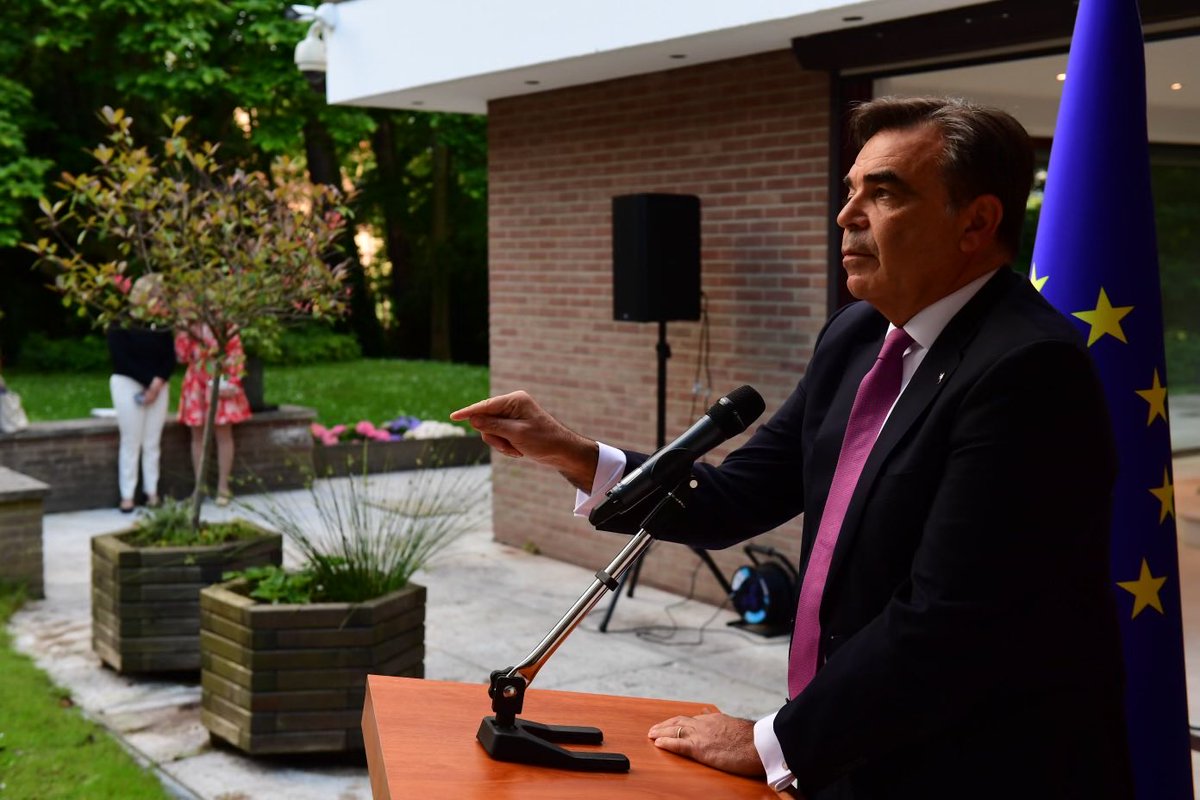
Happy to address the @collegeofeurope alumni gathering hosted by fellow alumnus @frkkymkc.
A look on the historic achievements of this term and lessons for the next.
In turbulent times Europe is part of the solution.
The spirit of Bruges more present than ever in our lives.
A pleasure to join Rector @FedericaMog at the @collegeofeurope today to deliver a lecture on Europe's role in the global clean energy transition
I highlighted that a new industrial masterplan is vital for Europe to compete globally & to be on track for its energy & climate goals
Today, 🇧🇪 King Philippe addressed the plenary of the 🇪🇺European Parliament. Historic moment! It was the first time that a Belgian King addressed the plenary during its Council Presidency in Brussels. He pleaded for a geopolitics of humanity.
20 years ago today Estonia 🇪🇪 joined NATO. Estonian nominal GDP at the time in 2004 was 12 billion USD. In 2023 it was 42 billion. Average monthly salary in 2004 was 466 EUR and it was 1904 EUR by the end of 2023. None of this would have been possible without credible security.