This should give you enough to start but here are some bonus tips.
-Start with trading longs only
-Start on lower time frames to build experience faster
-Keep things simple
-This guide is simplified, for in-depth tutorials check out my telegram
WEEKEND MUST READ LIST🚨
1. Price Action Part 1
https://t.co/i5Sixyxjsp
2. Price Action Encyclopedia Follow Up
https://t.co/EzlEv4SEwd
3. PA Liquidity by @ElChapoXBT
https://t.co/Kt2zEOew6I
4. Seven Lessons for the Pump
https://t.co/VWMeqXVJFb
Bitcoin Trading Master-Class Mentorship 💯
Price Action Part 3
Learn how to
1. Find right correction levels.
2. Buying after correction.
3. Finding the right Dip to Buy
👉 https://t.co/sUwzi9WoFE
We're on the verge of another face melting bull market.
Technical analysis has helped me reach financial freedom in crypto bull markets.
It took me 5 years to learn and I will teach it to you in 5 minutes.
Please, read this guide if you plan on trading.
Disclaimer: I've simplified concepts to teach you technical analysis quickly.
For a free detailed trading course check out my telegram (link in bio)
Step 1: Understand the Trend
I'm going to teach you to read market structure + trend.
Moving averages are the easiest tool for this.
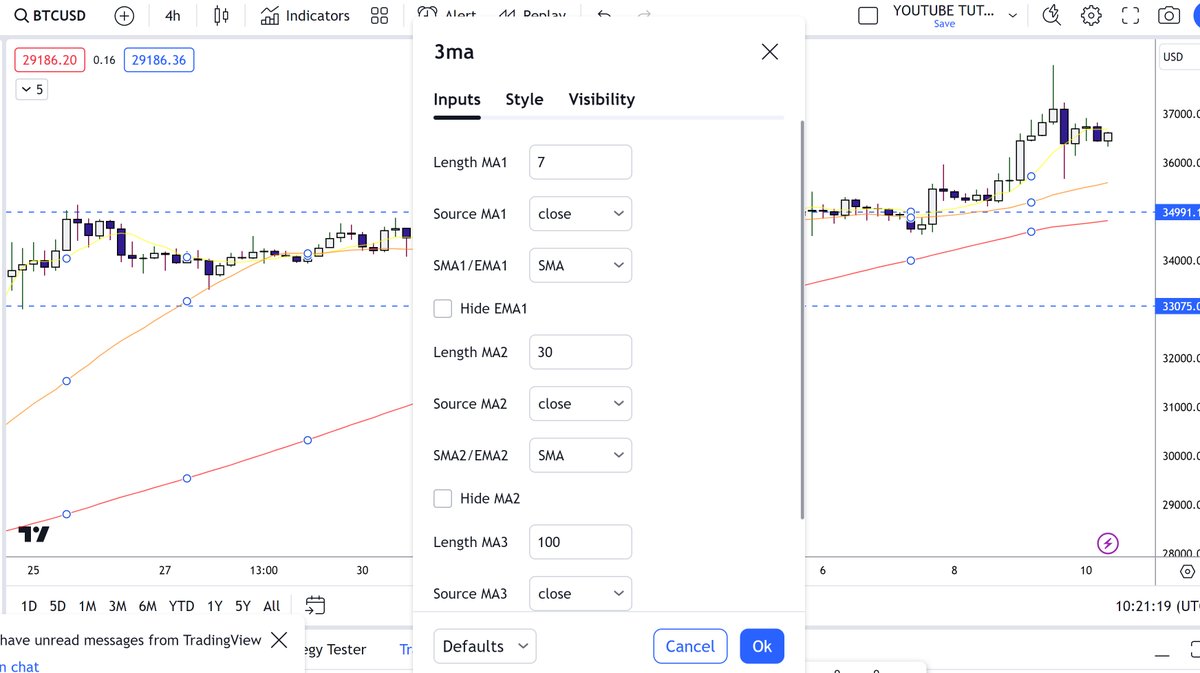
Set up Tradingview
Lower Time Frame: 7ma
Medium Time Frame: 30ma
High Time Frame: 100ma
Use MAs to identify the trend.
If you are using the free version and have limited indicators search for an indicator called "3ma" and put your settings like this.
Trend Cheat Sheet 1
Uptrend: All MAs fan out with 7ma at top and 100ma at the bottom
Neutral-Uptrend: 7ma & 30ma crossing with 100ma at bottom
Neutral Trend: All MAs crossing
Neutral-Downtrend: 7ma and 30ma crossing with 100ma at top
Downtrend: All MAs fan out with 7ma at bottom and 100ma at top
Trend Cheat Sheet 2
Uptrend: Support is stronger and resistance is weaker
Neutral-Uptrend: Support is stronger
Neutral: Support and Resistance are equally strong
Neutral-Downtrend: Resistance is stronger
Downtrend: Resistance is stronger and support is weaker
Step 2: Identify Key Levels
For this, you need support and resistance.
Support: An area where there is demand for an asset. People buy here usually.
Resistance: An area where there is supply for an asset. People sell here usually.
Key levels can;
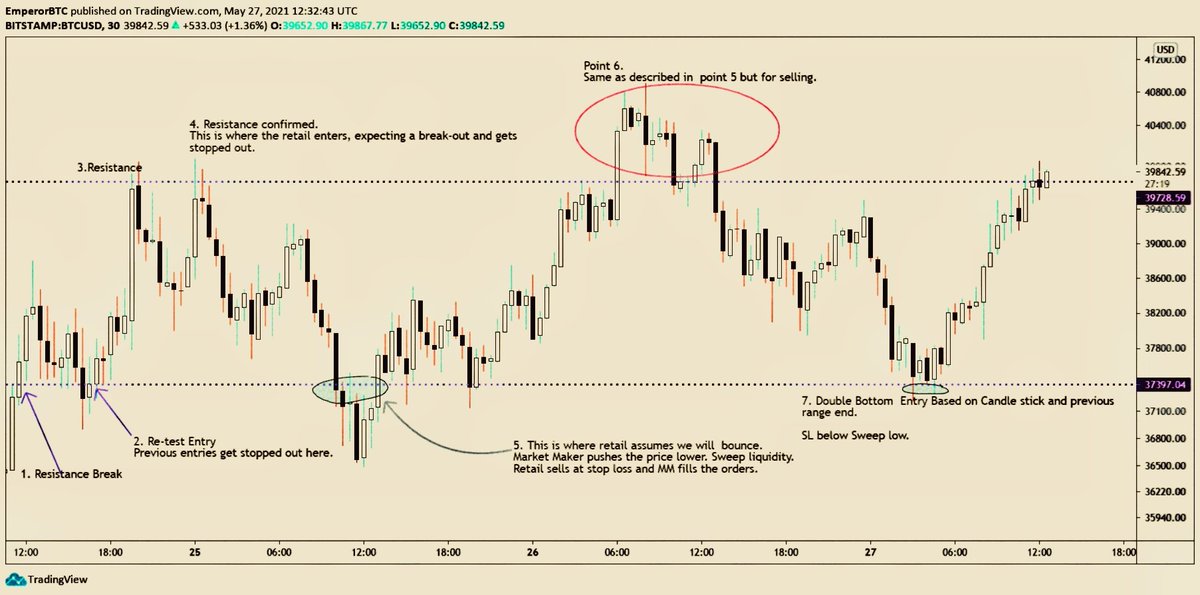
Hold: Buyers keep price above support. Sellers keep price below resistance.
Break: Buyers fail to keep price above support. Sellers fail to keep price below resistance.
Trap: Buyers/sellers fail to keep price above/below support/resistance temporarily.
How to find support and resistance.
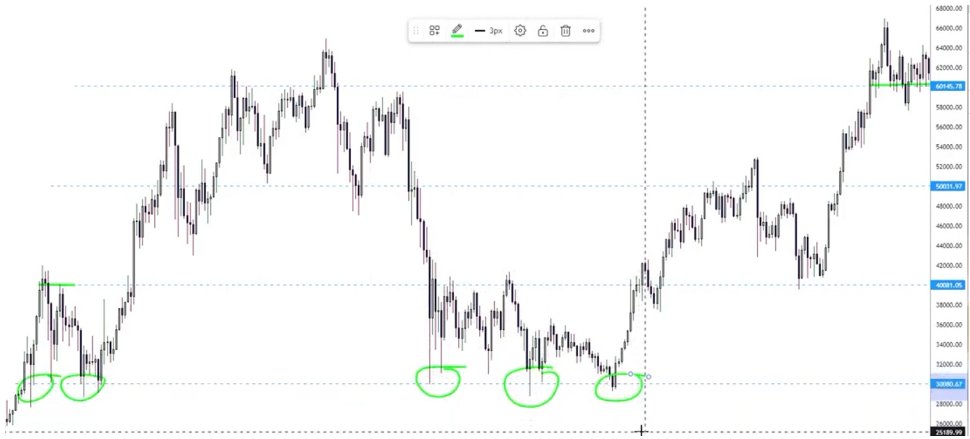
1. Round numbers are likely to act as key levels
2. If a level holds as support/resistance more than twice mark it
3. Support breaks it turns into resistance, if resistance breaks it turns into support
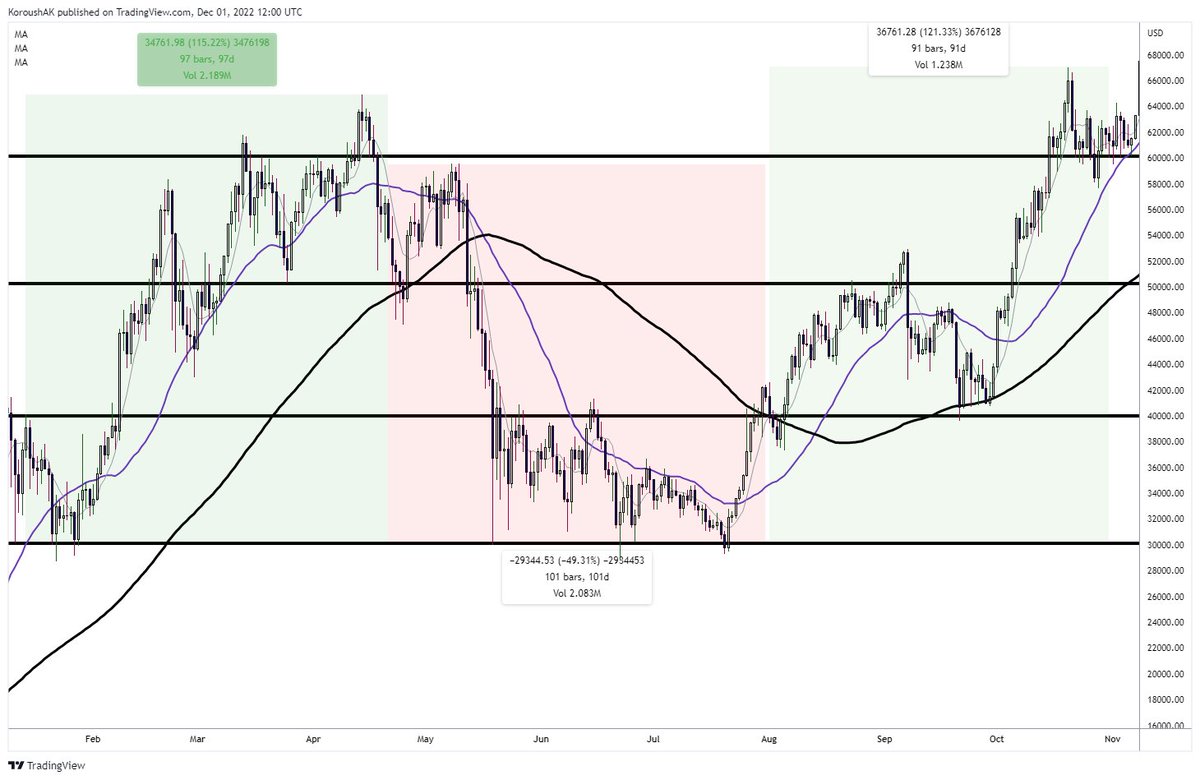
Look how well just the key round numbers work on $BTC
Step 3: Put it all together
1 - Identify key levels and trend
2- Apply all the rules and cheat sheets you've gotten today to perform you analysis.
And that's minimum viable technical analysis.
If you want to dive deeper and make the most of the next bull market.
Next learn learn risk management, strategy development and trade journaling.
Good luck.
Position Sizing, Leverage and Risk
You will never become a profitable trader if you don't learn these concepts.
Please read this carefully.
(Reply if you have any questions, will respond for the next hour)
1. Total Risk
This is the total loss you will allow before you stop trading with a strategy.
Are you okay losing 30% of your capital? What about 50%?
Know your risk tolerance before you start trading any strategy.
2. Risk Per Trade
Lot’s of misconceptions around this.
Low Risk: 0.5%
Medium Risk: 1%-1.5%
High Risk: 1.5%-2%
Very High Risk: 2%-3%
Degen territory: 3%-5%
Gambling: 5%+
Lower than you thought right?
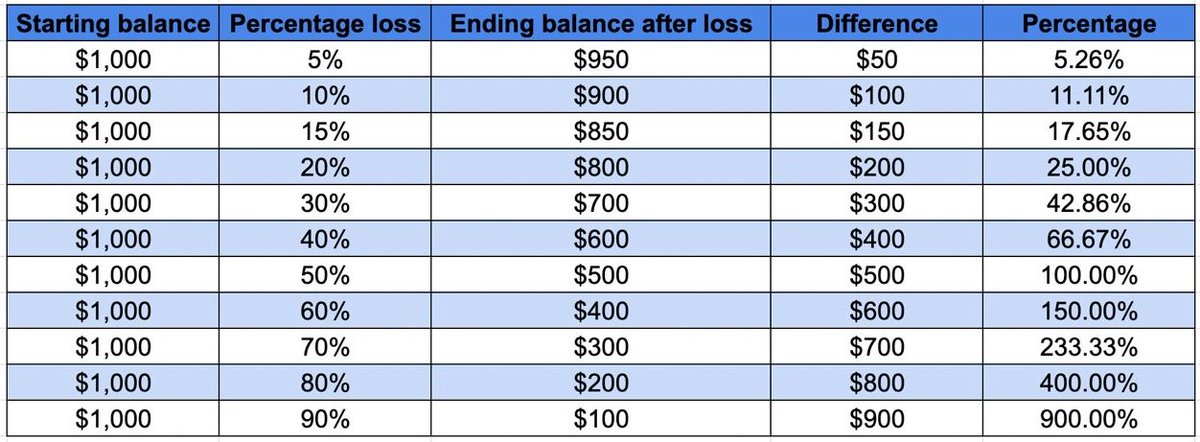
If you’re trading for 3+ years, at some point you WILL lose 10 trades in a row.
At 5% risk that’s ~50% of your portfolio…
When you understand what it takes to recover from drawdowns you realise this is completely unacceptable
3. Position Sizing
To size your positions you need to know 3 things.
Your account size, your risk per trade and the distance of your stop loss.
Position size = (account size * risk per trade) / (distance to stop loss)
See the below example
Position Size Cheat Sheet
Position size = (account size * risk per trade) / (distance to stop loss)
If account size is $10000
Risk per trade is 1%
Distance to stop loss is 10%
Position size = (10000*1%)/(10%) = $1000
4. Leverage
Leverage is very misunderstood. It's an essential tool for crypto traders.
Leverage is a tool that can change the size of a position. That's it, use all the same calculations as above.
Here's an example:
If account size is $10000
Risk per trade is 1%
Distance to stop loss is 0.5%
Position size = (10000*1%)/(0.5%) = $20000
$20,000 is bigger than your total account size so you can use leverage to reach this.
And you know it's okay because your risk per trade is still 1%.
Once you understand this, you can start using leverage to keep less money on exchanges.
Instead of putting all your money on the exchange, keep it in cold storage and just use leverage.
PDF cheat sheet released on my telegram.
Link in bio --> @koroushak
Hope this helps.
Survive it will be worth it.
Use this to make your own plan.
Follow @koroushak for more content like this.
You can also use my free trading course: https://t.co/osw5u7Z3U6
The most important thing crypto traders can do in the bear market is SURVIVE.
I will teach you to not lose your capital.
This is part 1 of the bear market survival kit.
Please share it and read.
https://t.co/2rCXeuJ02R
ATTENTION🚨
For those who want to learn Trading Crypto.
I am Sharing the link to the Complete Crypto Trading Class.
It's from absolute beginning so even your Grandma can Learn.
Part 3 will be out on Wednesday so read and be Ready!
Link - https://t.co/am5s47UlKM
Do it!
Want to Learn Trading?
1. Index of All tutorials - https://t.co/hnaxGiYAds
2. Favorite trading Straetgy- https://t.co/afDBz5HBHE
3. Altcoin Trading Strategy- https://t.co/Ji2feWmzCa
4. How to get Rich and keep it- https://t.co/TN6Cbmr1aU
Enjoy.
There are 4 Steps To a Profitable Strategy.
If you're tired of making trading profit then giving it all back. Here's how to build a strategy that actually works.
Here's your guide for:
1) Identifying market phases
2) Maximising profits
3) Making profit consistent
Step 1: Identifying The Environment
This is the biggest secret to trading less and making more profit.
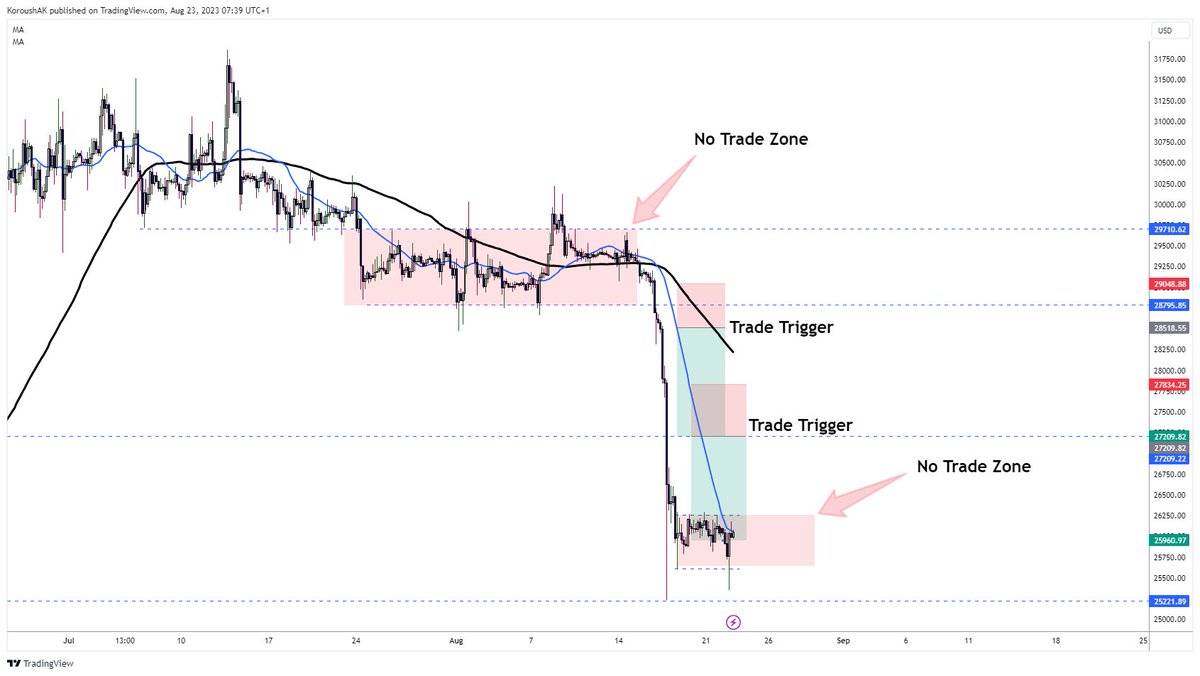
It helps you figure out your "no trade zones".
There are 3 ways to identify environment
A) Market structure
B) Market sentiment
C) Market news
I've done detailed tutorials on all 3 methods. I'll show you where to find them later.
Use the above to identify market conditions.
There are only 6;
-Up
-Up volatile
-Sideways
-Sideways volatile
-Down
-Down volatile.
Know which ones you do best in and avoid the other ones.
If you look through your trades, your biggest loss streaks will come from trading the wrong environment.
Step 2: Logic
Form a hypothesis: "I think x will happen because y"
90% of trading strategies fall into 2 categories.
-I think price will trend
-I think price will revert to the mean
Have a set of consistent conditions that you can use.
The simpler the better.
Step 3: Risk Management
A) Entry
B) Stop Loss
C) Profit Target
D) Risk (Position size)
I call this whole section risk management.
Because you're making sure that if you are wrong on your idea you limit losses relative to potential wins.
You can find tutorials on position sizing, stop losses and profit taking on my telegram.
Step 4: Execution/Management
A) Stick to your plan
B) Make changes based on new data
Trade management requires, testing, experience and intuition.
Execution is what separates the good from the great.
I've trained dozens of traders at this point. Step 1 - 3 are easy with the right guidance.
But even when traders have a profitable strategy, they can still lose money.
Execution of your system requires extreme psychological discipline.
This is a lifelong challenge that even traders with 20+ years experience face.
Your lifestyle needs to be regimented and healthy.
Without this you're like a formula 1 driver who turns up to work every day hungover, under slept and mad at his wife. No matter how good the car is you will eventually crash.
If this helped you, then help me out by giving this a retweet.