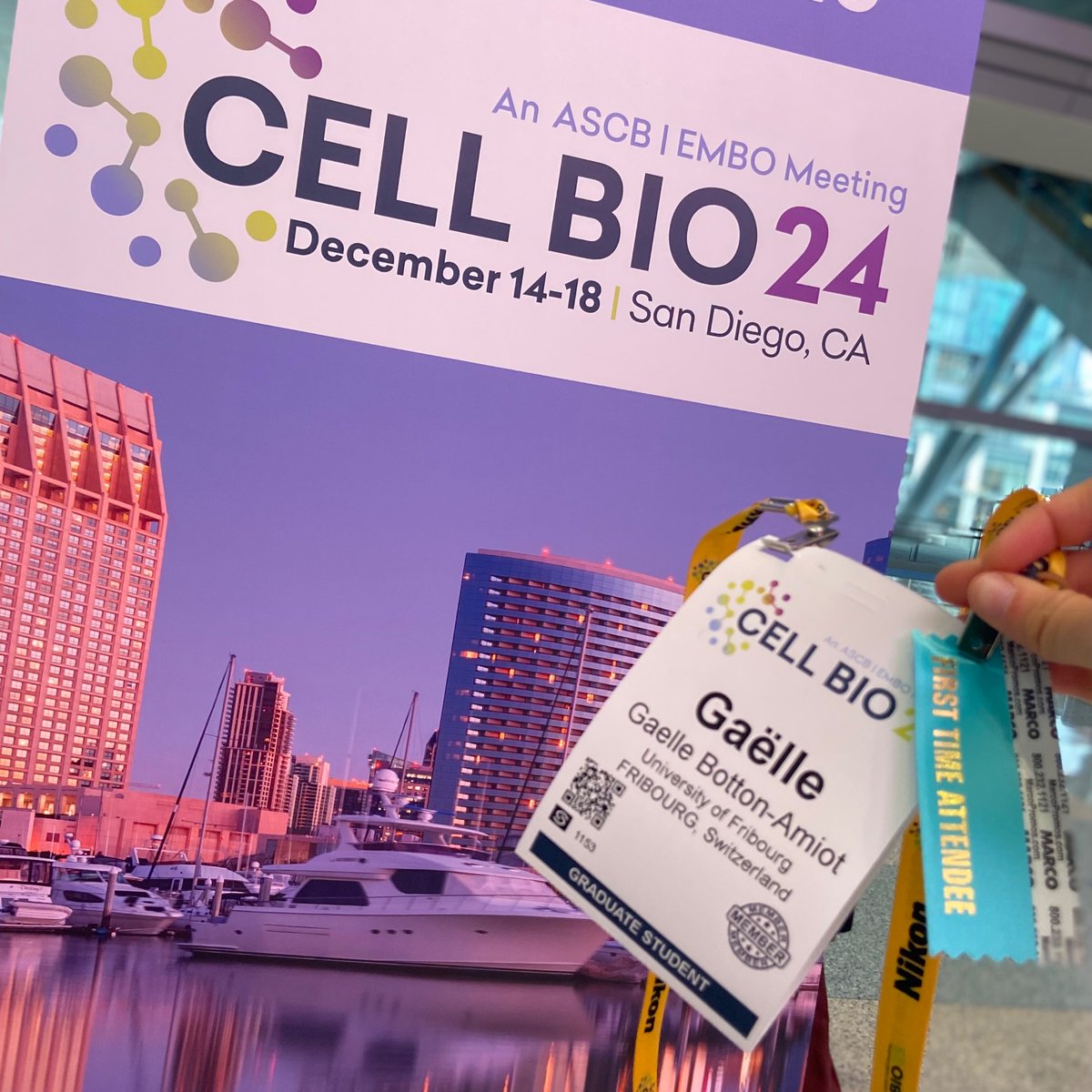
Now switching to holiday mode🎄🏙️and heading to NYC after #cellbio2023, the head full exciting science 🤯!
Many thanks to @Musser_CellEvo and @PhysPlanaria for organising this last session , and @LS2Switzerland and @scnatCH for giving me this fantastic opportunity! https://t.co/BXr3tNS1ZG
So excited to be attending #cellbio2023 !!!
Want to discuss how cool are brainless animals?
Come check out my poster and see my talk!
📌Poster P1389 - Sunday, Dec3, 12:15-14:45pm
🗣️Talk - Wednesday, Dec 6, 9:25am
Aujourd'hui au menu : les méduses
Ont-elles un cerveau ? Sont-elles capables de mouvements ? Ont-elles des capacités cognitives ?
les réponses à ces questions que vous ne vous posiez pas en vous levant ce matin 👇🪼🧠
avec @GaelleBotAm
https://t.co/yhDbCgY9Sw
#AvecSciences
Very happy to have finally defended my PhD a few weeks ago at @unifr ! A special thank you to my supervisor @simon_sprecher for his guidance along the way 🪼🔬🧬, and to all my friends and colleagues for this joyful ending 🥳🥳🥳
Very happy 🥳🥳🥳 to be part of this collaborative work with Matt Goulty, Ezio Rosato, @simon_sprecher and @RobertoFeuda
We found that most of the genes involved in monoamine production, modulation, and reception originated in bilaterians…
https://t.co/BuVJ9TcDZn
There are still are 5 days to apply for a PhD in my lab to work on the evolution of the monoaminergic system https://t.co/f1kPkxqMgx please apply and RT
Every time I hear about Mangold & Spemann I am reminded of the forgotten contribution of Ethel Browne 15 years before them. See: DOI: 10.2307/1542490. Original paper: Browne, E. 1909. The production of new hydranths in hydra by the insertion of small grafts. J. Exp. Zoo/. 7: l-37
In this issue: How red flour beetles recycle water in their rectums, how whale sharks may have adapted to deep-sea diving, and associative learning in starlet sea anemonies. https://t.co/OzDWuV9bIX
Brainless learning: According to a study, sea anemones can learn & remember an association between light and electric shocks. The evolution of associative learning may predate the emergence of centralized nervous systems, according to the authors. In PNAS: https://t.co/qFEax9rDh9
@gershbrain @PhilCorlett1 We were not able to implement the Rescorla “truly random” unpaired control for practical reasons, but we assume that in our case, the possibility for the animals to remember the CS-US order and delay sequence is minimal…
@gershbrain @PhilCorlett1 I had absolutely the same thought after my preliminary experiments!
I actually used a succession of 4 different delays and order between CS and US for the unpaired control : +1min, -1min, -30s and +30s (see SI) to limit the potential effect of trace or delay conditioning
Thus, already animals that did not yet evolve a brain, but contain a net-like nervous system are able to learn.
An exciting project with @GaelleBotAm and @martinezserrap1
@DeepLabCut meets Cnidarians!