The patterns of light on the sea floor.
They are called caustics: they are created by light refracted and reflected from the air/water interface. Water acts as a dynamic magnifying glass.
Light Enter a Magnetic Storm
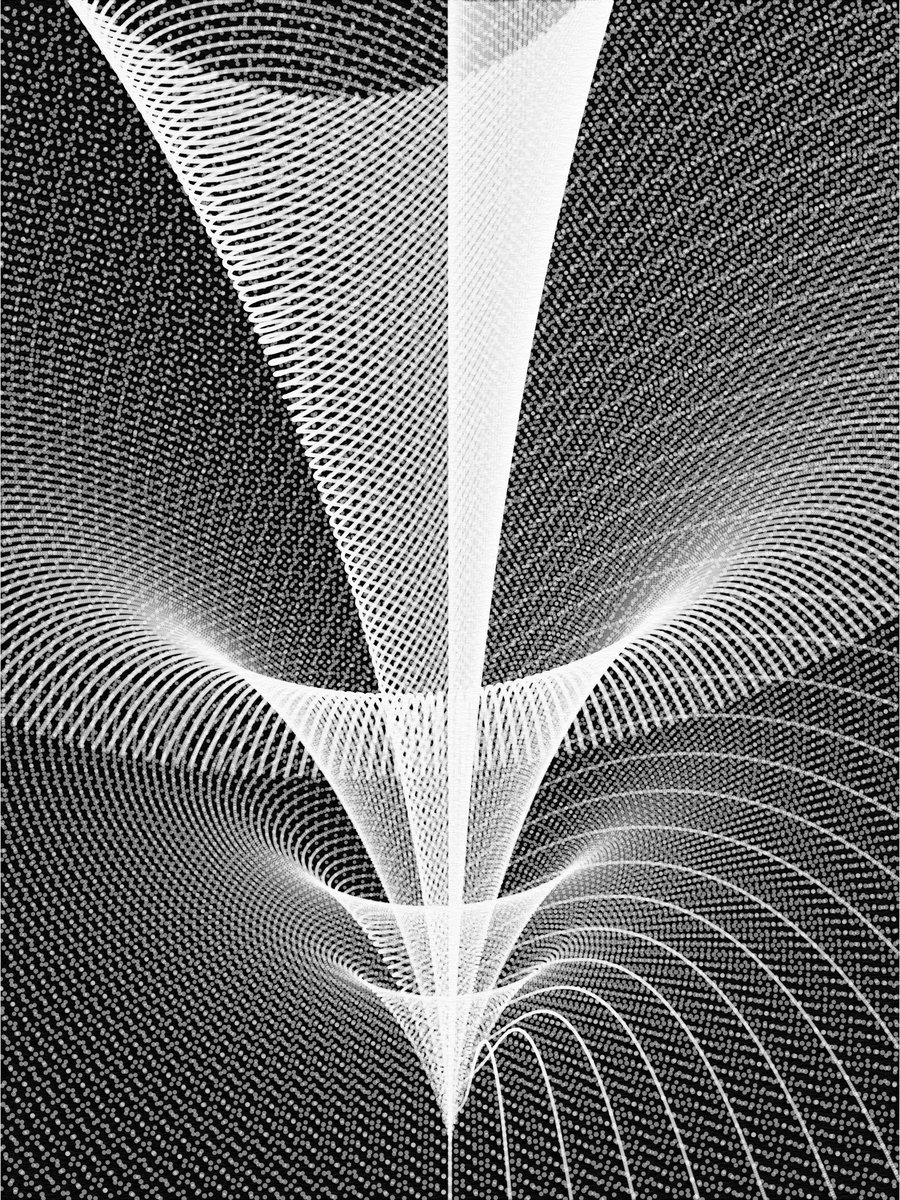
A protected beam enters a topological photonic crystal.
Then the crystal is flooded with synthetic magnetic flux.
The field obeys the gauge-coupled Dirac equation
i∂Ψ/∂t = [vᴅσ·(p - A) + mσ𝓏 + VI]Ψ.
Its optical density and probability current are
ρ = Ψ†Ψ,
j = vᴅΨ†σΨ.
At first, the current follows one protected boundary. Then moving flux vortices cross the crystal and twist the phase of the wave. The channel divides into several routes. Part of the light remains locked to the edge, while another part is thrown into cyclotron-like bulk orbits.
The glowing threads are histories of the gauge-coupled probability current itself.
This is light surviving a magnetic storm by continuously rebuilding its geometry.
#Physics #Photonics #QuantumMechanics #Topology #DiracEquation #MagneticField #ScientificVisualization #Satisfying #Mathematics
Near the end of a lecture about flowing water, Richard Feynman suddenly asked a question much larger than fluid mechanics:
Could Schrödinger’s equation already contain life?
The question emerged from a simple problem.
Physicists know the equations governing fluids. Yet those compact equations can produce smooth currents, vortex streets, travelling waves and chaotic turbulence, behaviours so complicated that we still struggle to derive and explain them fully.
The law may be known while its consequences remain mysterious.
As Feynman wrote:
“That we have written an equation does not remove from the flow of fluids its charm or mystery or its surprise.”
This distinction is often lost in physics education.
Writing down an equation is not the same as understanding everything the equation can generate.
No vortex is visibly written inside the fluid equations. No turbulence appears between their symbols. These patterns emerge only when countless interacting parts evolve under particular conditions.
Feynman wondered whether life might present the same problem.
Perhaps Schrödinger’s equation already contains, to a good approximation, the physical possibilities from which atoms, chemistry, cells, nervous systems and human beings can emerge.
Not your name or biography explicitly hidden inside a formula.
Not every decision predetermined on the page.
The equation would provide the physical rules and possibilities. History, environment, evolution and countless contingencies would determine what actually appears.
The distance between a quantum equation and a living person looks enormous.
But so does the distance between a compact fluid equation and a turbulent ocean.
Perhaps life seems absent from fundamental physics because we still lack the mathematical and conceptual power to extract the full qualitative richness contained in the laws.
But Feynman refused to turn this possibility into a declaration that physics had explained everything.
He asked whether Schrödinger’s equation contains frogs, composers and morality or whether something beyond the equation, even God, is required.
His answer was honest:
“Today we cannot.”
That is the real importance of the passage.
Feynman was neither claiming that physics had reduced life, consciousness and morality to a formula, nor declaring that these things must exist outside nature.
Both conclusions went beyond the available evidence.
The equation might contain far more than we currently know how to read.
Or something essential might still be missing.
Feynman left the question open because physics had not yet earned the right to close it.
Perhaps the next great revolution will not come from discovering another fundamental equation.
Perhaps it will come from learning how simple laws generate worlds of almost unimaginable complexity.
The equation is written.
The living world is here.
The intellectual distance between them remains one of the deepest mysteries in physics.
Source: The Feynman Lectures on Physics, Vol. II, Chapter 41, “The Flow of Wet Water,” closing passage, pp. 41-11–41-12.