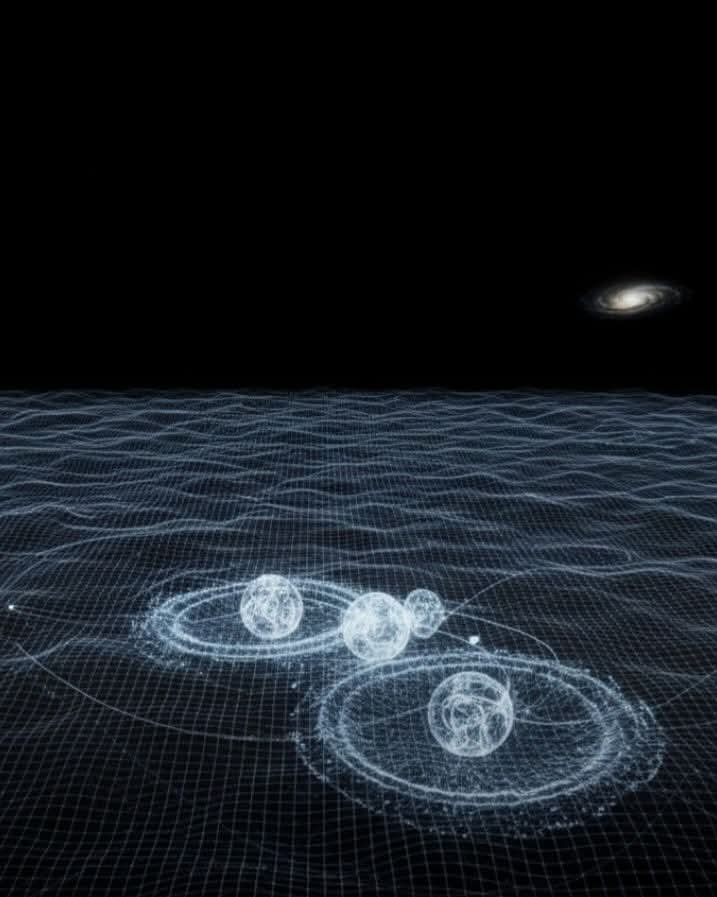
Quantum field theory shows that empty space is not truly empty. Instead, the universe is filled everywhere with fundamental quantum fields, each corresponding to a type of particle. What we call a particle, such as an electron or photon, is actually a localized excitation—a tiny ripple—within its underlying field. The electron field exists everywhere, and an electron appears when that field is disturbed in a specific way.
This framework explains why particles of the same type are perfectly identical and why interactions occur through field-mediated processes rather than direct contact. Forces arise from fields exchanging energy and momentum, and even the vacuum exhibits measurable effects, such as quantum fluctuations and virtual particles. Quantum field theory unifies special relativity with quantum mechanics and underpins the Standard Model of particle physics.
Understanding particles as field excitations reframes matter itself as dynamic structure rather than solid substance, revealing that the universe’s most basic reality is a continuous, interacting network of invisible quantum fields.
Source
Physical Review Letters, Nature Physics, Quantum Field Theory Standard Model Literature
I spent the evening reading a Google Research paper that completely broke my understanding of why AI models like ChatGPT can't learn new things.
I thought it was a software problem we could just patch. It's not. It's a fundamental design flaw.
We all know the feeling. You ask an LLM about a major event that happened yesterday, and it has no idea.
It feels like it has amnesia. It can't form new memories.
The common belief is we just need bigger context windows or more frequent retraining. But that's like treating amnesia with a bigger notepad.
The paper ("Nested Learning") has a better explanation, and it clicked for me instantly.
The problem isn't the size of the AI's memory. It's the speed.
Our brains have multiple memory speeds. A fast, fleeting speed for what's happening now (short-term), and a slow, deliberate speed for consolidating important stuff into permanent knowledge (long-term).
Current AI models have only ONE speed.
Imagine a brain where every single neuron, from the ones processing sight to the ones storing your childhood memories, all tried to update at the exact same time, for every single new experience.
It would be chaos. Nothing would ever stick.
That's basically what today's LLMs are.
This is where the idea of "Nested Learning" comes in.
Instead of a flat architecture where everything learns at once during a "training phase," you build the AI in levels, or nests.
Each level has its own clock speed.
The fastest levels react to new information instantly, like an attention mechanism processing a sentence. This is the AI's "present moment."
Slower levels don't update on every new piece of data. They wake up periodically to compress and integrate the important patterns from the faster levels.
(I had to read this part a few times, but this is the core idea. It’s an architecture for memory consolidation.)
This reframes everything. Even the optimizer (the thing that helps the model learn) isn't just a tool anymore. In this model, its internal state (the 'momentum') is treated as its own memory module that learns to remember past updates.
It's memory systems all the way down.
The paper introduces a new architecture called HOPE based on this, and it shows promising results in continual learning.
This completely changes how I see AI. The goal isn't just to build a bigger brain, but a brain with more temporal depth—more clock speeds.
The "pre-train, then deploy" model suddenly seems incredibly primitive. It's like building a human that stops learning at age 5.
So, next time you notice an AI is "stuck in time," you're not just seeing a knowledge cutoff date.
You're seeing the limitation of a single-speed architecture. You're seeing a system that has no way to move experiences from its temporary notepad into its long-term memory.
The whole thing reduces to this: An AI's ability to learn isn't a software patch. It's a question of architecture.
The future of AI probably isn't just about scale, but about building models with a rich hierarchy of learning speeds, just like the brain they're inspired by.
If we want this to be the beginning of the end, now is the time to step up and make the right decisions, for your fellow humans. Stay home if you're sick, get tested, follow quarantine guidelines, wash your hands, and most importantly, WEAR. A. MASK.
https://t.co/ZwkEdVjkiR
I’m willing to hold you accountable for lying about climate change for 30 years when you secretly knew the entire time that fossil fuels emissions would destroy our planet 😇
50 years ago this week, two Sicilian immigrants, Filippo and Rosa, opened a small pizza shop in Monticello. To this day it is in the same building, using the same recipes that created their legacy. Filippo and Rosa dedicated their lives to their family restaurant.
@madflavor Joey, just got front row tickets to your show on March 3rd at the store. Very excited man, you're one of my favorite comics, and I've never seen ya do stand up. You gotta roast my dad I'm bringing him.