🌞 July 2026 just entered the UK weather record books.
According to provisional Met Office data:
📉 England and Wales recorded their driest July since records began in 1836
📉 Southern England experienced its driest month on record
☀️ Some areas recorded their sunniest month since sunshine records began in 1910
🌡️ England recorded its second warmest July on record
To put that into perspective:
📜 Queen Victoria wasn't even on the throne when some of these rainfall records began.
📜 The first public railway was only a few years old.
📜 Charles Darwin hadn't yet published On the Origin of Species.
Yet records stretching back nearly 190 years have just been broken.
What's perhaps most striking is the timing.
This summer arrived exactly 50 years after the legendary drought summer of 1976, one of the most famous weather events in modern British history.
And by mid-July, 2026 had already recorded more days above 30°C than the whole of 1976.
Weather records are meant to be difficult to break.
This summer has broken several.
🌍 Will July 2026 still look extraordinary in another 50 years?
Or will it look like a preview?
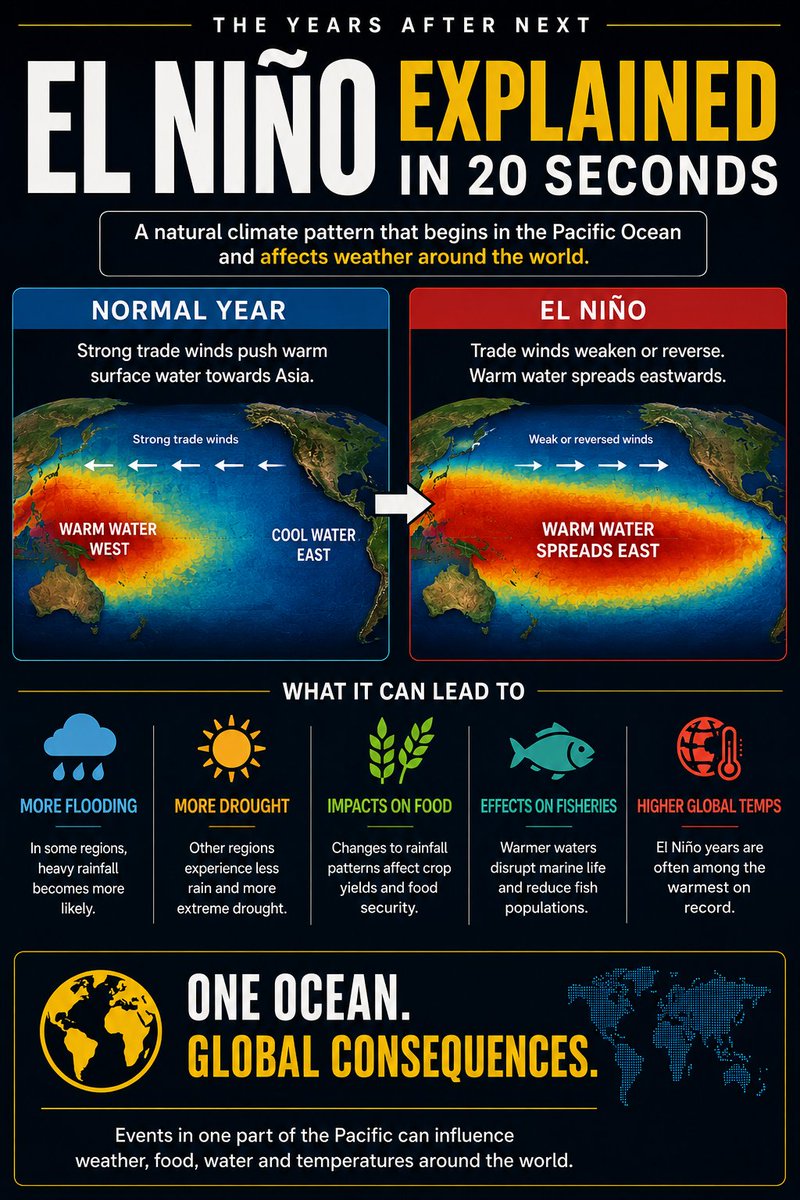
🌊 El Niño explained in 20 seconds.
El Niño isn't a storm, a hurricane, or caused by climate change.
El Niño is a natural climate pattern that begins in the Pacific Ocean.
Normally, strong trade winds push warm surface water towards Asia and Australia.
This leaves cooler water near the west coast of South America.
During an El Niño event, those winds weaken.
The warm water spreads back across the Pacific, releasing more heat into the atmosphere and changing weather patterns around the world.
The effects can include:
☔ More flooding in some regions
🔥 More drought in others
🌾 Changes to crop yields and food production
🐟 Disruption to fisheries and marine ecosystems
🌍 Higher global temperatures
El Niño doesn't cause every extreme weather event.
But it can increase the likelihood of certain weather patterns occurring worldwide.
One of the most important forces shaping global weather starts with a change in ocean temperatures thousands of miles away.
🌎 One ocean. Global consequences.