📣 Update: we raised our $60m Series B from @Lux_Capital, @IndexVentures and @01Advisors, with participation from @sequoia, @eladgil and @BainCapVC .
When we came out of stealth 283 days ago, we had negotiated contracts worth $30m for our clients. As of last month, that number is over $1 billion.
We work with the most ambitious companies in the world, including @tryramp, @clay and @RogoAI. Today, we want you to hear from some of them directly.
Contracts are the rails of commerce. @crosbylegal is a hybrid AI law firm that gets them signed 80% faster. We’re announcing our Series B to keep scaling the dream law firm.
AI is shifting from seat-based SaaS to owning and monetizing outcomes. But owning the outcome means owning the downside.
Even when an agent can do the work end-to-end, fields like law, medicine and finance still want a "throat to choke" when something goes wrong.
Insurance is the unlock. Underwriting agent work is a key enabler of the long-term shift from human labor to AI.
Huge congrats to @ryanjdaniels and the @crosbylegal team on what may be the first legal malpractice policy for AI agents!
@ryanjdaniels@crosbylegal When people ask "won't [lab] do this?", these are the types of things to point to. Every industry has different needs to be successful, and many of those needs require creative thinking and being the first to do something. Kudos, Crosby team.
across so much of AI (replacing knowledge work, making purchases online), liability + downside protection feel like prerequisites for mass adoption
another baby step in that direction as @crosbylegal bought $5M of AI liability coverage for its agents from Testudo, a Lloyd's-backed insurer w/ $1B of underwriting capacity
Crosby reviews + negotiates commercial contracts (NDAs, MSAs, DPAs) w/ AI agents doing the first pass and ~60 lawyers checking the work
now that the policy is live, Crosby's agents handle its "gray area" tasks solo, like answering questions about a doc, reformatting, and applying playbook rules (~20% of its work)
https://t.co/rtb52YsyF9
After months of trying to find and put in place the right solution, @crosbylegal has managed to secure $5m of insurance for its agents. This means we can have our agents do paralegal work without human oversight.
This is just the start. Lots of exciting new updates to come on this front in the next few months!
@crosbylegal has secured a $5m malpractice insurance policy for our agents. As far as we know, this is the first of its kind.
9 months ago we began to notice our agents were getting extremely capable. In some cases, they did better work than our lawyers.
We are a law firm. We needed to invent a safe way for our agents to do client-facing work without human oversight. It took a lot of work, but this is it.
As soon as the policy went into effect on Nov 3, we removed lawyer oversight from any task that doesn't legally require licensed attorney oversight - what we call "paralegal tasks."
This is ~20% of our work. It frees up our lawyers to focus on what they're best at: thinking, exercising judgment, advising our clients.
This is just the beginning. Once regulations change, we see no reason why our agents can't do excellent legal work too.
Read more in the NYT: https://t.co/cko6DSgDMB
Lux family co @crosbylegal and founder CEO @ryanjdaniels
Law Firms Have Malpractice Insurance. Should Their A.I. Agents? https://t.co/aGZffj85yP via @NYTimes
It's a difficult technical and product challenge to teach AI to act exactly like a lawyer. We trained a 27B model to judge whether an edit is “surgical", i.e. makes targeted edits like a real lawyer would.
Our model beat every frontier model we tested at 90.6% accuracy (vs. 84.3% for the next closest).
At Crosby, messy AI-generated redlines cost lawyer time and damage client trust. For example, rewriting an entire paragraph mkaes the other side defensive, and a string of small edits are hard to follow. Great lawyers make thoughtful, targeted changes that protect the client and keep the deal moving.
So we worked with our attorneys to define what makes an edit surgical, then trained a model to judge it.
To me, this is the future of evals. Doing the work ourselves allows to teach the model what great looks like, and steer our agents and evals.
What happens if you give away the service for free, and monetize the network?
Thoughts on new business models in AI-native services https://t.co/yq790mp5hU
I've been waiting for TWO YEARS to say this... @crosbylegal is officially OPEN FOR BUSINESS.
We've always been limited by lawyer capacity, but now our agents are really working. They have so much capacity! Today, we're live in general release.
Don't let EOQ backlogs slow you down this week. Book a call today at https://t.co/0V3qZMcacO
Huge news: we trained our first model. It's a toy experiment, but the implications are big.
It's allegedly impossible to measure quality in legal work. Great lawyers reasonably disagree about what "good" looks like. They have idiosyncratic taste, judgment, etc.
But what if the answer is just... more data?
One of our star researchers cut through the discourse in legal research and seriously pursued that question.
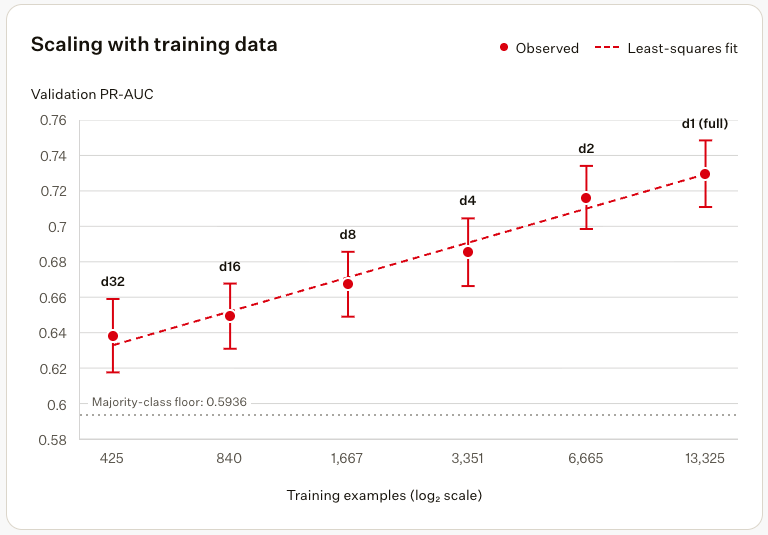
Over the summer, Sharan oversaw training a verifier. It predicts if a lawyer will send an AI output to a client. And indeed, the more data we trained on, the better the results.
In other words, scaling laws hold up for legal!!
This sets the stage for a ton more research we will be doing in the coming months. Blog post linked below.
We’re hiring for 3 of the most fun jobs I can imagine @crosbylegal:
1. Head of Brand: craft the look and feel of a brand new type of company. Neither software, nor services but a third type of company blending the two. You think all day every day about one of our most enduring assets.
@crosbylegal 3. Growth Lead: rethink the traditional growth playbook for an AI native services company. Relentlessly experiment to find repeatable, scalable channels that are brand accretive.