Like the Video Game Art Archive? Help support us on Patreon at https://t.co/a6AWniKiSG
Follow us FOR FREE to see what we're working on, new GIF and Artwork content, and access to the original files!
Support us for just $1 to help us continue to keep adding more features!
Comparison of Mario artwork from 'Super Mario Bros.' and the Japanese 'Super Mario Bros. 2' on the Famicom. They had sorted out his design a bit by then.
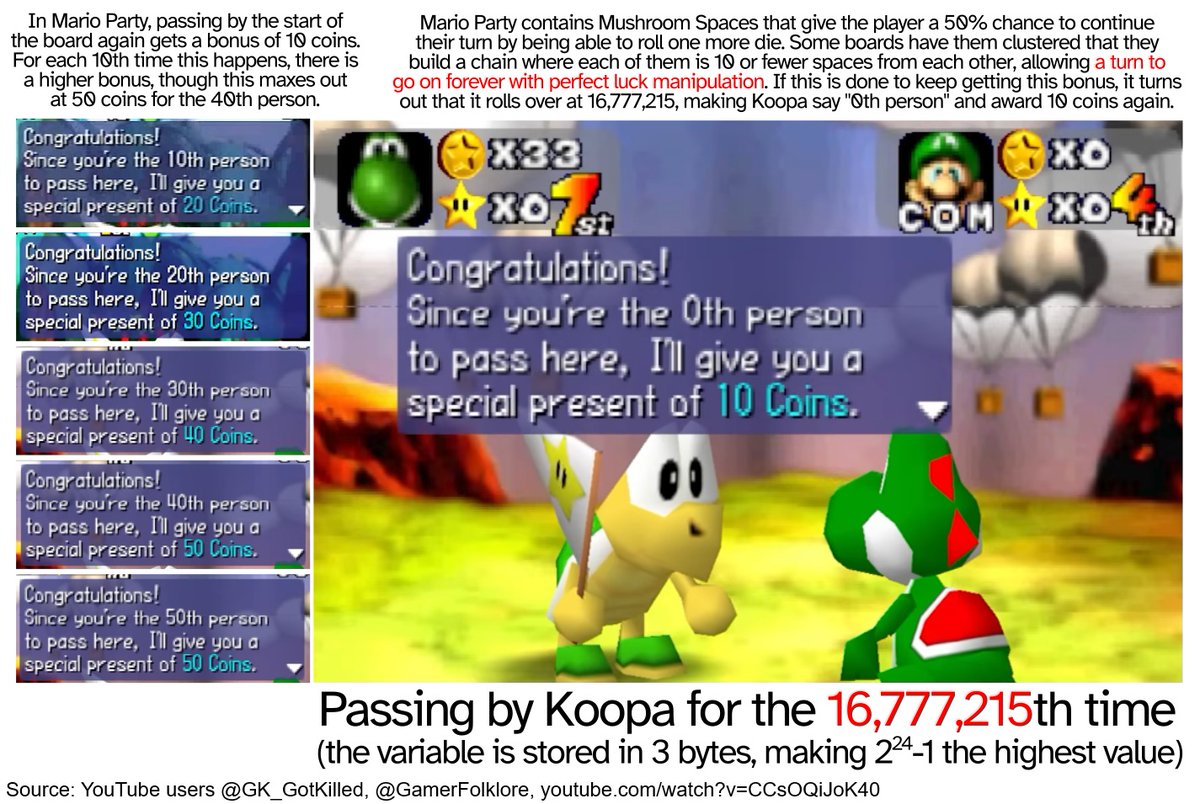
In Mario Party, passing by the start of the board gains special bonuses for each 10th, 20th, etc. person. However, using luck manipulation to make a turn last forever and pass by the start 16,777,215 times will make the counter roll over and give a smaller prize than usual.
In Super Mario Galaxy, waking Mario up from a short nap and not moving will make him look sleepy. Waking up from a long nap will make him look even sleepier. Remarkably, this appears to be entirely unintentional and merely an extremely appropriate bug in the blinking engine.
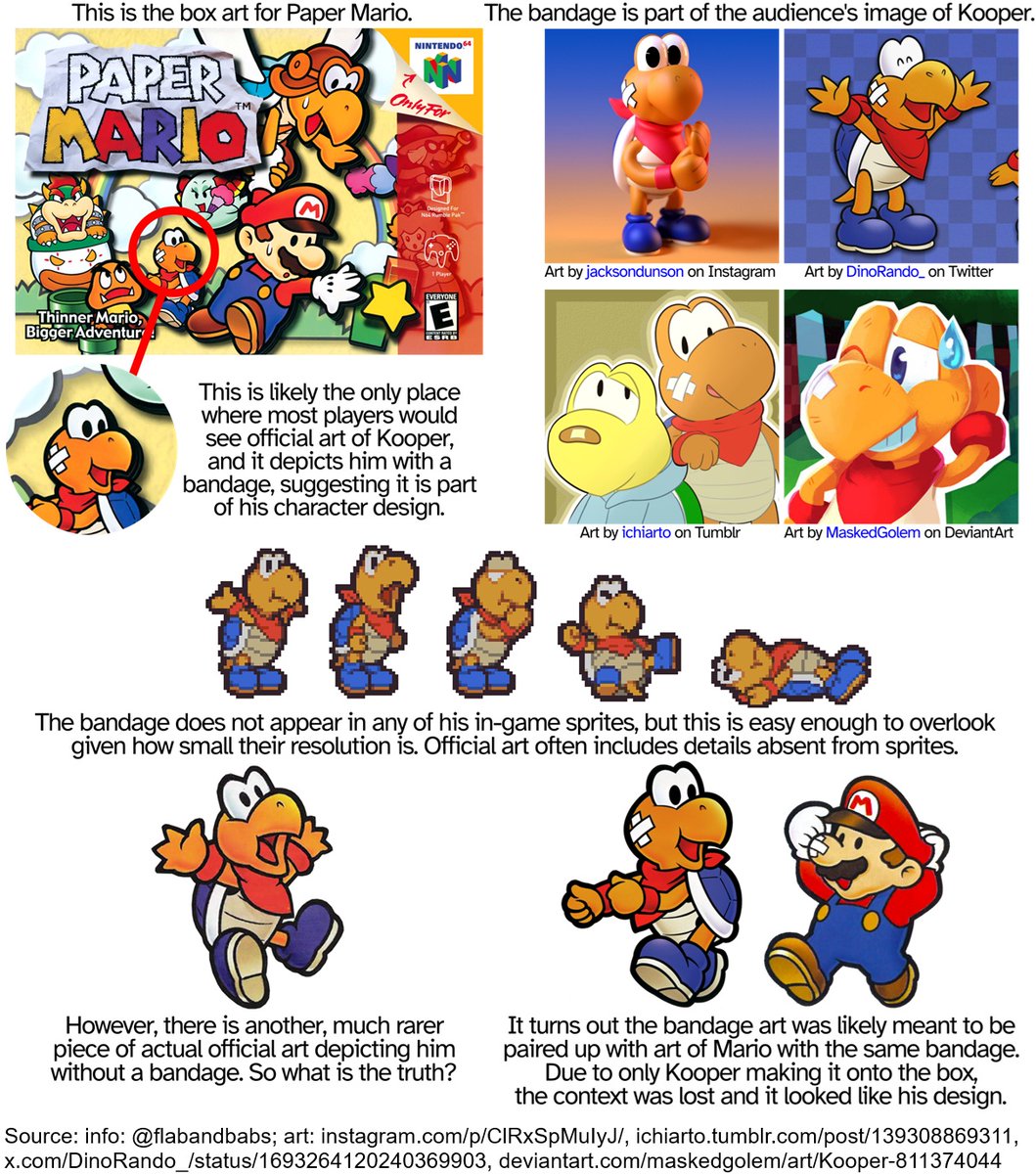
Players of Paper Mario are made to believe that Kooper has a bandage as part of his character design, featuring heavily in fan depictions. As it turns out, the bandage was never supposed to be permanent and this is a case of artwork being removed from its intended context.
A commonly shared Super Mario Bros. fact is "the clouds and bushes are the same", but the bushes only use half the cloud graphics. However, this statement is completely true for WarioWare: Twisted, where the bushes are actually just full green clouds buried halfway in the ground.
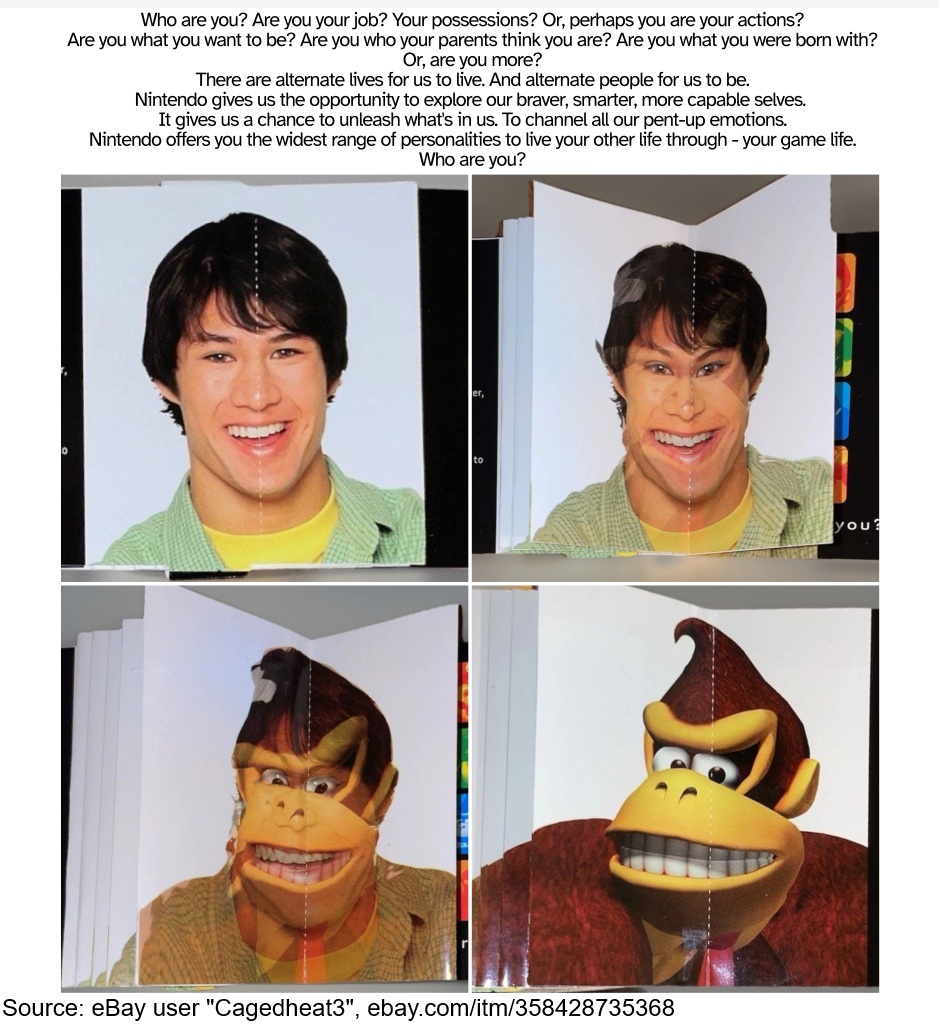
Bizarre promotional flipbook distributed in 2003 as part of Nintendo's "Who Are You?" marketing campaign, featuring inspirational text alongside a sequence of images of a person transforming into Donkey Kong.
Experimental post: The Time 5-Year-Old Supper Mario Broth Thought Luigi Was a Cryptid
I share a story from my personal life about the first time I encountered Luigi at the age of 5. Due to a combination of factors, I was unprepared for him and ended up believing he was a cryptid.
These two 2000 print ads were not intended to be placed together. If they are, they inadvertently seem to tell a grim story of a person who played Mario Golf as a solace from an unsuccessful love life, only to get addicted to the game and starve.
A particularly entertaining flaw in the Super Smash Bros. Melee programming is Bowser Floor Blindness, where Bowser regularly forgets that his Fire Breath affects the floor in front of him.
Scott Burns voiced Bowser in his famous voiced appearance in Super Mario Sunshine. Upon request by @GamingReinvent, he voice acted the intro to the final boss battle from Mario & Luigi: Bowser's Inside Story, providing a glimpse into a world where he had remained Bowser's voice.
When playing Donkey Kong Country Returns, you may notice that Donkey Kong never clips through platforms even when he should. The secret is that Donkey Kong does not actually exist on the same plane of reality as the rest of the game, and is merely superimposed on top of it.
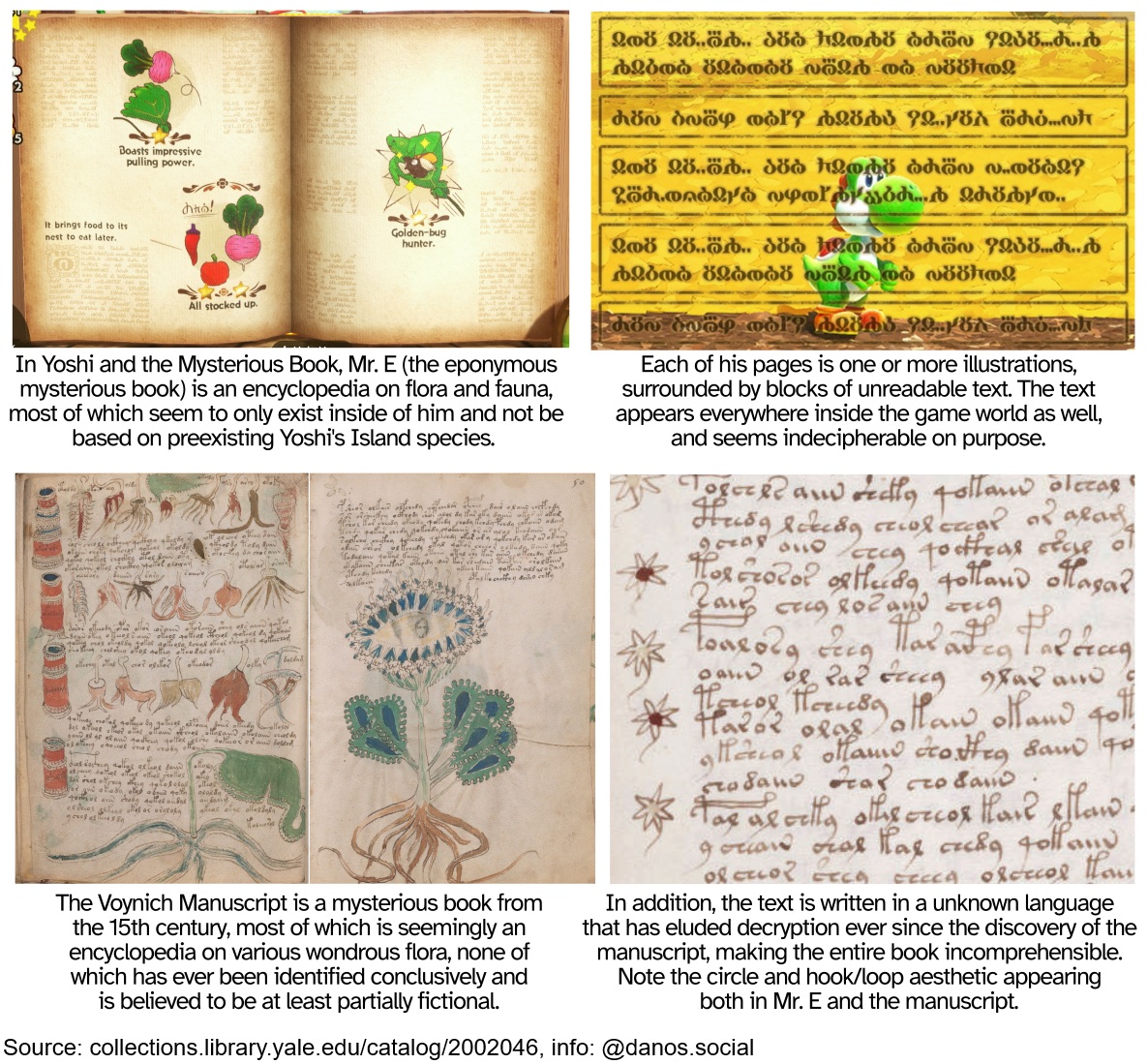
It is possible that Mr. E, the eponymous mysterious book from Yoshi and the Mysterious Book, is inspired at least partially by the Voynich Manuscript, a famous medieval book that seems to describe unindentifiable wondrous flora in a completely incomprehensible language.
The English manual for WarioWare, Inc.: Mega Microgames states that Dr. Crygor created Wario's car. However, the French manual changes this into Dr. Crygor claiming to have created Wario himself. This makes him either Wario's father or Wario some kind of "Crygor's Monster".
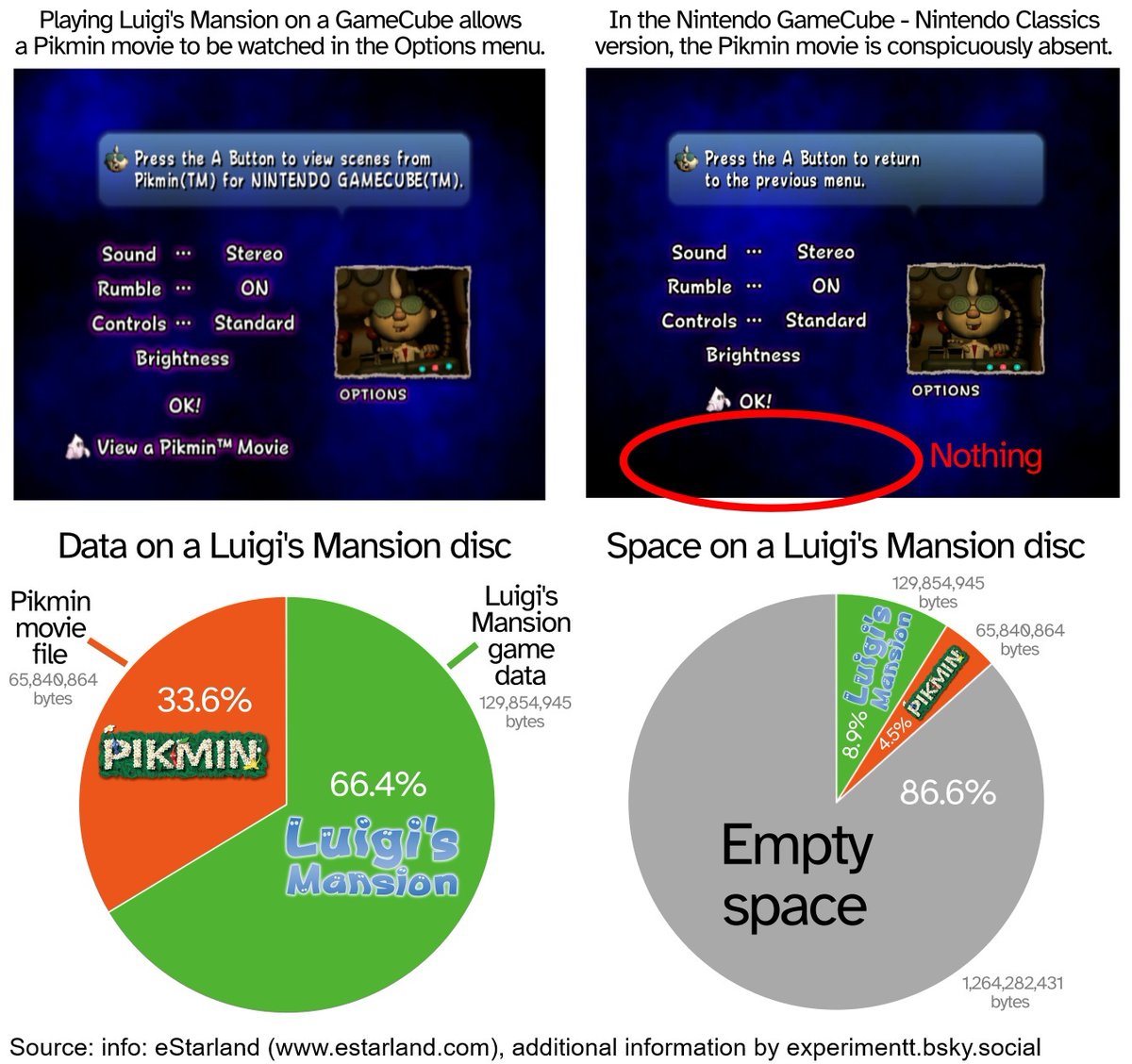
Luigi's Mansion originally included a Pikmin movie, which was removed in the NSO Switch 2 version. This was to save space; with 63 MB, the Pikmin movie is half the size of Luigi's Mansion itself. The original disc had plenty of empty space so the movie was just thrown in.
In Mario & Luigi: Partners in Time, an unused room takes Mario and Luigi through a time portal into a white void. This inadvertently highly resembles the classic SpongeBob SquarePants episode "SB-129", where the same exact scenario happens to Squidward.
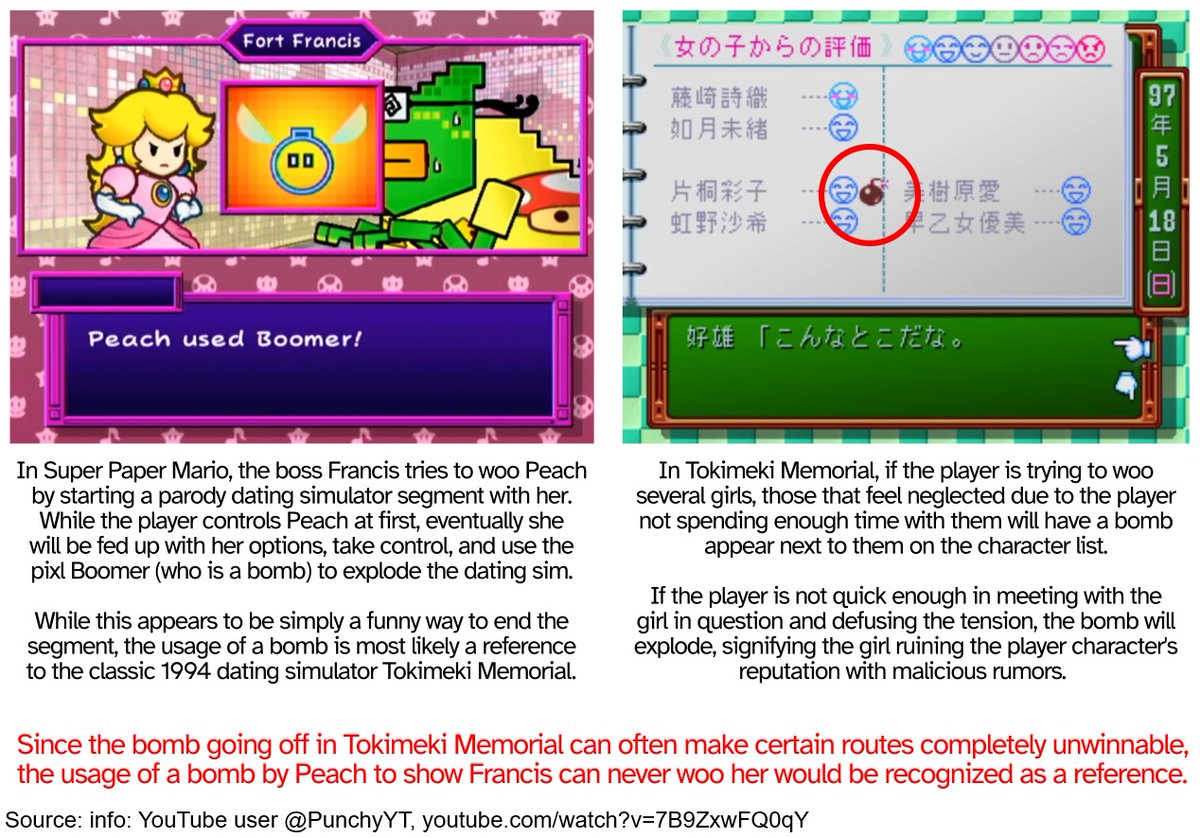
In Super Paper Mario, Peach ends a dating simulator segment by blowing it up with a bomb. This is most likely a reference to classic 1994 dating simulator Tokimeki Memorial, where girls neglected by the player character will destroy his reputation, represented by cartoon bombs.