Most people assume that if an opportunity is real, it will come around again.
In reality, the best opportunities rarely do.
On October 6th, 2026, you'll have access to a room filled with Family Offices, Fund Managers, Allocators, Institutional Investors, Private Market Leaders, Builders, and Service Providers.
Tokenized Capital Summit 2026 Singapore has become one of the most effective places to build relationships that lead to real outcomes.
The people matter. The conversations matter.
Make sure you're in it.
A $10T+ room is forming in Singapore.
5,000+ in person. 50,000+ virtual.
Tokenized Capital Summit 2026 is bringing Family Offices, Fund Managers, Allocators, Institutional Investors, Private Market Leaders, Builders, and Service Providers into one place.
The Fullerton Hotel Singapore, in the center of Singapore’s financial district.
That concentration of capital should feel impossible.
Most people spend years trying to get one intro into this network.
For one day, the network is the room - October 6th, 2026
If you raise capital, deploy capital, advise capital, tokenize assets, build infrastructure, or sell to private markets - don’t watch the recap.
Be there. Registration below.
Our CEO & Co-Founder @GammaEvan joined @therollupco to discuss why inflation may no longer be the market’s biggest risk - and why a recession looks far more likely.
They also covered why Gamma Prime was built, why family offices are increasingly looking at delta-neutral crypto strategies, and where the market may be heading next.
Watch now 👉 https://t.co/KJPv1Xv0Hf
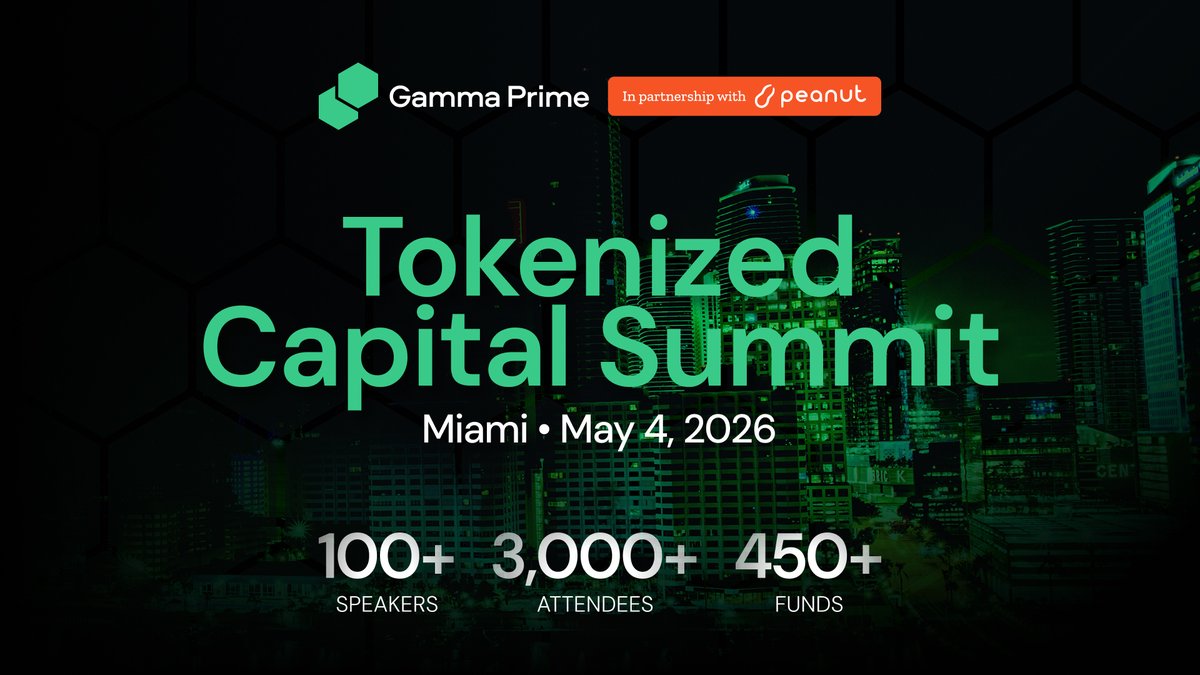
We're bringing the future of finance to Miami 🌊🇺🇸
@TokenizedSummit 2026 takes place on May 4
3,000+ attendees - institutions, funds, VCs, and builders actively turning tokenization into real capital - all under one roof.
🧵Here’s what to expect
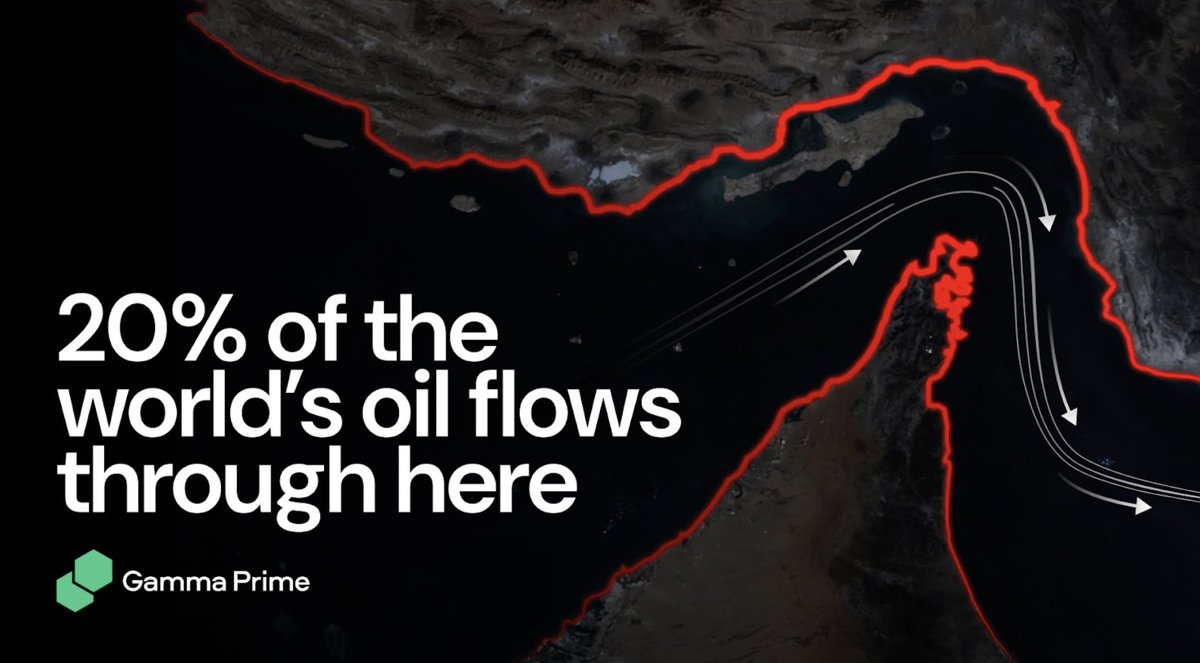
20% of the world's oil passes through a 33-mile chokepoint.
It's been closed for 6 weeks and caused global chaos.
US and Iran agreed to a 2-week ceasefire. Oil dropped 16% in minutes.
🧵Here's what it means for your money
Broadcom bought VMware for $61B. Raised prices 10x. Hit a $1T market cap.
That’s a chip company turning into a software empire. In under two years.
Here’s what actually made it work:
The entry looked like overreach. When Broadcom announced the deal in May 2022, the logic wasn’t obvious. Hock Tan built Broadcom by acquiring unglamorous semiconductor businesses and squeezing them. VMware was enterprise software — a different animal entirely. Regulators in the EU and China blocked it for 18 months.
He didn’t change the plan.
The deal closed in October 2023. Within weeks, Broadcom eliminated perpetual licensing entirely and forced customers onto subscription bundles. Prices went up 3–10x depending on the product. Dell, AT&T, and others went public with their complaints. It didn’t matter.
VMware’s customers had nowhere to go
Virtualisation infrastructure is deeply embedded. Ripping it out takes years and costs more than the price increase. Hock Tan knew this. The protests were loud. The churn was not.
Broadcom’s market cap crossed $1T in 2024. The software segment — which didn’t exist before VMware — now drives the majority of its operating income.
One thing worth noting:
This is the same playbook Broadcom ran on CA Technologies ($18.9B, 2018) and Symantec ($10.7B, 2019). Buy mission-critical software, cut costs, raise prices on locked-in customers. It works every time — because enterprise software switching costs are real, and most CEOs are too polite to use them.
Hock Tan is not.
Captive customers. Surgical pricing. Zero apology.
That’s the playbook.
Blackstone bought Hilton for $26B. Rode out the financial crisis. Made $14B.
That’s a 3x on equity. In seven years. Through the worst financial crisis in a generation.
Here’s what actually made it work:
The entry looked catastrophic. Blackstone closed in October 2007 - weeks before credit markets froze. When Lehman collapsed eleven months later, revenues cratered. The company nearly breached its debt covenants.
Most firms in that position sell. Blackstone held.
They brought in Chris Nassetta from Host Hotels — an operator, not a dealmaker. He cut costs, rebuilt the loyalty program, and pushed international expansion while the balance sheet was still bleeding.
The crisis, paradoxically, helped.
While competitors were locked out of capital markets, Hilton was signing franchise agreements and expanding its pipeline. The downturn gave them room that a hot market never would.
The exit reflected it.
Hilton IPO’d in December 2013 — the largest hotel IPO in history. Blackstone didn’t exit all at once. They sold down over several years as the stock kept climbing. Total profit - roughly $14B.
One thing worth noting beyond the multiple:
This wasn’t a lucky survival story. The debt structure had enough cushion to absorb a severe downturn by design. The operational plan was in place before close. When the crash hit, they executed it anyway.
Structural resilience. Operational execution. Patient exit.
That’s the playbook.
AI is Breaking. And Nobody Wants to Admit It.
Since 2025, once Trump became president, we saw a major push toward investing in the US economy.
Meanwhile, AI was at the peak of its hype.
These two major narratives, happening at the same time, created strong consumer pressure and drove investments aimed at the growth of data centers.
Stocks grew rapidly (Nvidia, Apple, Meta, Microsoft, Tesla, and others).
Right now, we are seeing a major pullback.
- Microsoft and Tesla stocks have dropped 20% within the last quarter
- Anthropic (aka Claude) has many reports of usage limits being reached quickly, officially claiming system issues, but in reality, it seems they lack sufficient computing power.
- OpenAI is closing Sora, its AI video generation app
etc.
What will be next steps?
I think this is only the beginning of a downturn that will unfold over the next couple of years. Why?
- Many AI giants are still not public, so we will likely see major growth followed by a significant drop caused by daily competition on the market, consumer panic and lack of new investments for infrastructure.
- There are not that many AI b*llshit companies on the market yet, but in the last 2–3 months more have started appearing. What impact will they have? The launch of pump & dump tokens and investments from VCs that will disappear.
TL;DR
The AI boom was driven by hype and heavy investment into US infrastructure, pushing tech stocks up fast.
Now cracks are showing - pullbacks caused by consumer panic because of the politics and many other reasons, limited computing power, and slowing products.
This could be the start of a larger correction, as competition grows, weaker projects enter the market, and funding struggles to keep up.
The most expensive PowerPoint slide in finance right now:
"Our AI strategy."
Only 6% of PE firms can back it up with results.
McKinsey surveyed private equity firms globally. Only 6% of GPs report high impact from AI in their own internal operations and investment processes -today.
70% expect high impact in three to five years.
That gap - 6% now, 70% expected - is the most honest data point in private equity right now.
It's not that GPs don't believe in AI. They do. Deeply.
It's that belief and implementation are two very different things.
Here's what's actually happening on the ground:
Some GPs report productivity gains of 30-40% in analyst-intensive tasks. Sourcing. Diligence. Portfolio monitoring.
But adoption is uneven. Often limited to one or two lighthouse use cases. The rest of the firm operates exactly as it did five years ago.
Meanwhile, the leading firms are moving faster. They're embedding AI directly into underwriting, operational value creation plans, pricing, sales effectiveness, back-office automation.
They're not treating AI as a future bet. They're deploying it now - and using it to prepare portfolio companies for exit.
The gap between leaders and the rest is already widening.
In three to five years, 70% of GPs expect to be where the top 6% are today.
The question isn't whether AI will reshape private equity.
It already has.
The question is whether your firm is in the 6% - or still waiting to become part of the 70%.
Fragile Economy: How Close Are We to a Global Slowdown
We’re bringing together leading voices to unpack macro signals, market risks, and what comes next.
Featuring: @michael_venuto, @PawelSynapse, @GarettJones, @thejobchick
📅March 25 | 5 PM CET
Listen live:👉https://t.co/ev3lr8rdES
What Breaks First in the Global Economy: $100 Oil and Beyond
We're hosting a live conversation with our guests to discuss this
Paul Lalovich @paullal8
ALEX DAMSKER @AlexDamsker
Tobias Bauer @TobiasTBV
Danny Dayan @DannyDayan5
March 20, 5 PM CET
Link: https://t.co/ONdlJxf8T9
Great take on understanding counterparty view, this is exactly where most cross-border capital conversations quietly break down.
What looks like hesitation is often just a different risk lens.
Same assets, same decks - but completely different questions behind the table.
If you don’t adjust to that, you’re not misaligned on strategy - you’re misaligned on reality.
US family offices: "Interest rates are keeping me up."
International family offices: "There are tanks on the border."
Same asset class. Completely different reality.
The numbers say it all:
US top risks:
-interest rates 64%
-inflation 61%
-economic growth 61%
International:
-geopolitics 74%
-trade policy 60%
-economic growth 57%
Same asset classes. Same return targets. Completely different threat models.
This matters more than most people realize.
When a US CIO and a European CIO sit in the same LP meeting, they're not just speaking different languages. They're operating from different risk realities.
What looks like a buying opportunity to one looks like a red flag to the other.
Neither is wrong.
But if you're building relationships across geographies - raising capital, sourcing deals, forming partnerships - you need to understand which risk universe your counterpart lives in.
The conversation starts from a completely different place.
Geography isn't just where your office is.
It's how you see the world.
You manage hundreds of millions.
You have a team, advisors, access to every asset class on earth.
And you're holding cash while inflation is your #1 fear.
That's not a strategy. That's just fear with a spreadsheet.
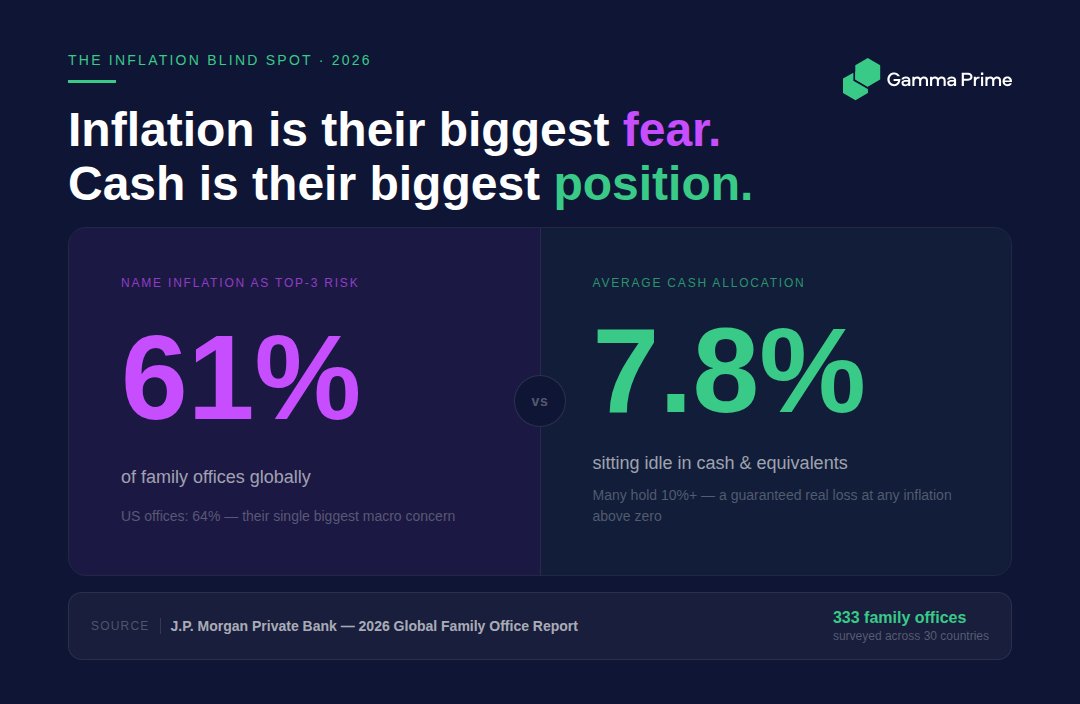
61% of family offices name inflation as their biggest risk.
Average cash allocation: 7.8%. Many hold double that.
The math doesn't lie:
🟢Inflation at 3% on 10% cash = guaranteed real loss, every year
🟢Real assets, commodities, infrastructure all under-allocated relative to stated fear
🟢The hedge exists. It's just not being used.
Sophisticated capital. Unsophisticated positioning.
The Inflation Blind Spot isn't a knowledge problem. It's a behavior problem.
I just watched 3 hours of Alex Hormozi explaining exactly how he’d build an audience in 2026.
Not theory - the actual playbook from someone who gained 4.5 million followers in a year and sold $105 million worth of books in a single weekend.
Here are the 5 biggest lessons that stood out ( UNDER 3 MINUTES )👇
My biggest takeaway
In 2026, content is no longer just about attention.
It’s about building clear associations, trust at scale, and a system that turns views into revenue.
Reach matters. But relationship, positioning, and monetization matter more.
5. Influence has four levers.
According to Hormozi, influence is built through four things:
Status - control over what people value.
Power - the ability to make things happen.
Authority - proof, results, and case studies.
Affinity - “this person is like me”.
When all four work together, your influence compounds fast.
Most experts only build one of them and then wonder why growth stalls.