AI is now taking on some of the hardest open problems that scientists have posed. But research is broader than solving problems. Can AI also propose research questions that experts find genuinely interesting?
We built After42 to find out. Experts judged 45 of its 135 final questions genuinely interesting, across mathematics, statistics, theoretical computer science, and physics, with wide variation across subfields.
The key idea: develop questions by trying to solve them.
We also asked whether AI can judge which questions are interesting. We find that model judges' top choices align with expert consensus but do not consistently capture individual experts' preferences.
We release the expert-assessed questions as an open resource for researchers to discuss, refine, and pursue, as a step toward integrating AI into the broader research enterprise.
https://t.co/iOrs6L7E9Y
I made this prediction 3 years ago, in July 2023. Few attending my talk believed me back then.
In retrospect, replace was not quite the right word. AI won’t replace any fields. Instead, it will fundamentally reshape, and is already reshaping, fields by rewarding deep connections to real-world challenges and other disciplines.
AI-generated scientific output is scaling beyond available human review capacity. Scaling scientific discovery requires scaling verification.
We introduce OSVerify, a framework for one-sided verification: rejecting as many invalid solutions as possible while preserving rare valid ones for expert review.
We used OSVerify to referee 11 recent OpenAI math preprints, identifying 5 major and 13 minor issues, all verified by human experts.
Our key insight: checking a proposed error can be easier than judging an entire solution. Instead of directly judging solution correctness, OSVerify decouples verification into error proposal (searching for potential errors) and error validation (checking whether they are real and substantial).
On competition and research mathematical benchmarks, OSVerify reduces invalid solutions requiring expert review by 46% on average compared to voting under the same low-FNR constraint, or 57% with an RL-trained validator.
Verification can also guide discovery. OSVerify can be integrated into existing scientific discovery workflows. Paired with an agentic math solver, it helped resolve 3 open conjectures in the Langlands program and contributed to resolving the Manin constant conjecture. All proofs were confirmed by mathematicians.
Our broader goal is to provide verification-based evaluation signals for scientific discovery, enabling test-time scaling and self-improvement even when reliable automatic evaluators are unavailable.
Project: https://t.co/pSW9iJhvHg
Paper: https://t.co/WUXDDhIz0o
GitHub: https://t.co/2BF5EfdbUe
[1/n]
Using OSVerify, a verification system we built, we identified two substantial issues in the October 4 version of OpenAI’s “Global quantum geometric Langlands at irrational level.”
OSVerify also proposed a repair for one of them. Details in the images below.
The attached report was generated by OSVerify and may contain errors. We welcome independent checking and feedback from domain experts.
We plan to release OSVerify and more verification results next week!
Frontier labs are rumored to be adopting looped Transformers for their potential to unlock implicit reasoning. But can looped Transformers really master it?
We find a bottleneck that keeps looped Transformers from perfect implicit reasoning. Using mechanistic interpretability, we show how looping helps implicit reasoning, why it still struggles to generalize, and how to fix it.
We introduce DiscoLoop: a residual design for looped Transformers that improves implicit reasoning.
🧵 Long thread ahead 👇
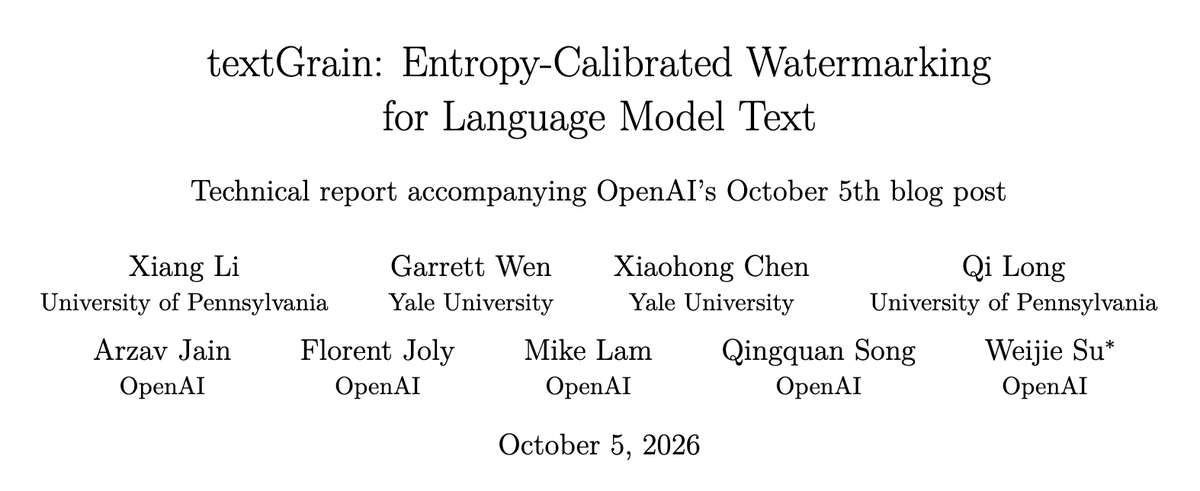
Thrilled to see textGrain launch! So many ideas and iterations led us to its sampling-diversity perspective, and a huge team effort brought it to life. Proud of what we’ve built together. Our paper will come out about a week. Happy to chat, stay tuned!
Announcing our work textGrain, @OpenAI's text watermark in response to the EU AI Act. OpenAI is rolling out textGrain in the EU and opening detector access to researchers.
We'll open-source it so the community can build on top.
This is outrageous framing. Quite frankly, given the current tensions around AI and mathematics, this kind of announcement does not help.
After the recent Buckmaster/OpenAI dispute over scientific credit and provenance, the last thing we need is more promotional PR language that blurs the history of a research problem.
Meta presents its work by asking: “Can AI contribute when a problem is genuinely open and without an existing solution path?”
Seriously?! For the ellipsoid-fitting example, this is misleading and insulting. There was an established research programme, substantial rigorous progress, and by the time of their announcement, publicly available proofs of the exact threshold.
Let us be specific:
- In 2023, Antoine Maillard and Dmitriy Kunisky gave a statistical-physics derivation of the conjectured transition at n/d² = 1/4, using the replica method. Their analysis also predicted the geometry of the solutions and suggested directions for rigorous proofs. This was not a proof, but it was a detailed and successful theoretical picture, not an absence of a path.
https://t.co/F9CLHANv6G
- Afonso Bandeira and Antoine Maillard then rigorously established the sharp threshold for approximate fitting, using methods inspired by the statistical physics of disordered systems, using actually spin glass mathematical technics. Their preprint appeared in 2023 and was published in the Electronic Journal of Probability in 2025. Their Gaussian-equivalence framework provided a foundation for further work (including many of mine!). At this point, the "exact" fitting and removing the spectral restriction were the outstanding gaps, but these are technical problems, it was not about not discovering the threshold from scratch. https://t.co/V15hMsu3kv
- On 10 August 2026, Theodor Misiakiewicz and Garrett Wen posted a proof of the exact Gaussian threshold, explicitly closing those two gaps.
https://t.co/qdlrzO8q75
- On 12 August, Sofia de la Cerda, Aaron Potechin, Madhur Tulsiani and Jeff Xu posted another proof, establishing both sides of the transition up to a vanishing multiplicative factor. https://t.co/vHjN9BHUY3
- On 27 August, Frederic Koehler and Youngtak Sohn posted a broader universality theorem that includes the Gaussian threshold. https://t.co/zpuDGpSqVF
These were not researchers merely “on the verge” of solving the problem. THE PROOFS WERE ALREADY PUBLIC. Meta's announcement comes in October, and Section 3 of their paper begins:
“We use the groundbreaking approximate-fitting theorem of Bandeira and Maillard…”
Dear META: Those are your words. This is not simply a reference in the bibliography: your feasibility proof explicitly starts from their theorem.
How is that consistent with advertising this example through the suggestion that there was “no existing solution path”?
Yes, your social post mentions independent solutions, and your paper and blog identify the August results and describe your work as independently developed. That does not answer the objection to the framing. A generic acknowledgement of parallel work does not make clear that the exact threshold already had publicly available proofs before this announcement.
An independently developed AI-assisted proof, released after other proofs, should be presented as exactly that. Readers should not have to reconstruct the chronology to understand what is, and is not, new.
A new proof can contain valuable ideas. But a new proof and a newly solved problem are not the same claim. Nor does a problem being open when a project begins mean it is still open when the marketing campaign launches.
You say the aim is to “empower researchers”? Nothing more “empowering” than seeing years of collective research turned into the backdrop for a cheap marketing stunt.
Correct the announcement! Give the scientific history the same prominence as the product. Give Antoine, Afonso, Theo and all the other researchers involved the public credit they deserve.
A question on synthetic data generation: If we want a language model to solve k-step arithmetic problems (such as a+b*c-d=?), with operands from 1 to 100, which training distribution should we use?
A. Uniform distribution: Sample these k operands uniformly from 1 to 100
B. Power law: randomly shuffle 1-100 and impose an artificial power law. Sample these k operands according to this power law.
⚡Our ICML 2026 (spotlight) paper shows: Option B is better! Surprisingly, the same idea extends far beyond this simple example to many reasoning tasks that require implicit composition of multiple atomic skills, including multi-hop QAs and synthetic GSM problems.
📄Paper: https://t.co/8LVlmCCBz9
📝Blog: https://t.co/t2yhIJ0s1P
Very insightful work! Repeating data in pretraining seems to be becoming common again. Maybe another way to reduce obstacles in learning hard functions!