Memory is what allows Claude to learn from experience. In a new Engineering Blog post, we share how “dreaming” helps Claude organize what it’s learned, correct its mistakes, and find what it needs more easily the next time. https://t.co/uUEN4bNkr9
The fact he only had one extramarital affair with a state asset after leading the greatest technological revolution in history is what impresses me. For anyone else that number would be double, even triple, digits.
We asked GPT-6 Astra to edit Qwen3.5-0.8B weights to improve math.
It directly changed only 0.016% of weights, fixing 0.8B's reasoning loops & improving math up to 6x and even instruction following 3x, without gradients or training.
We call this Weight-Space Programming: frontier LLMs can now natively read/write neural network weights! 🧵
Blog: https://t.co/bOWCcFhCVq
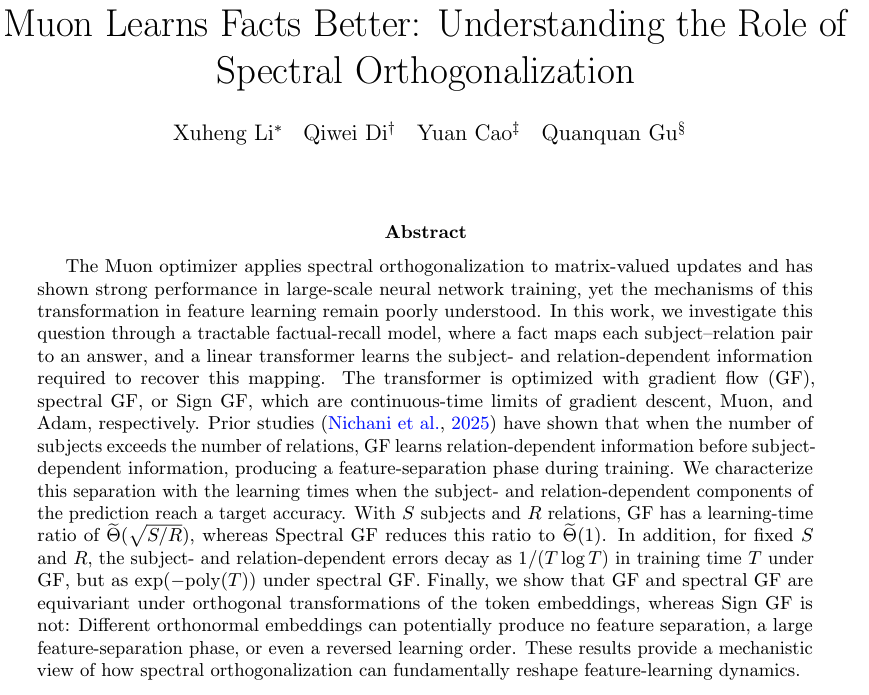
Muon now trains frontier LLMs. But how does its spectral orthogonalization shape feature learning?
New paper: on factual recall, Muon learns facts in a more balanced way and is far less slowed by softmax saturation.
🔗https://t.co/hPm5VI0SG2
[1/8]
Excited to partner with @GenScript to launch the Beyond Binding Challenge! 🧬
AI-designed antibodies need to go beyond binding affinity to become real therapeutics.
Let's push the boundaries of AI-driven antibody design and turn computational breakthroughs into real-world impact.
Up to $2.5M in awards. Stay tuned!
We’ve acquired Orchestra Bio, a platform that helps biopharma teams coordinate the complex process of drug development.
Together, we’ll build on Rosalind, our AI models and tools for life sciences research, to streamline those operations and help new treatments reach patients sooner.
Welcome @ashokaraj_ and team!
https://t.co/vi51OhznQn
We are bringing agents to the wet-lab bench at Google Research to navigate complex biological landscapes. Learn how we are grounding agents in physical lab robotics to run fast closed-loop molecular design cycles, ultimately discovering single-digit nanomolar protein binders for cancer targets →https://t.co/iPesR5MXCd
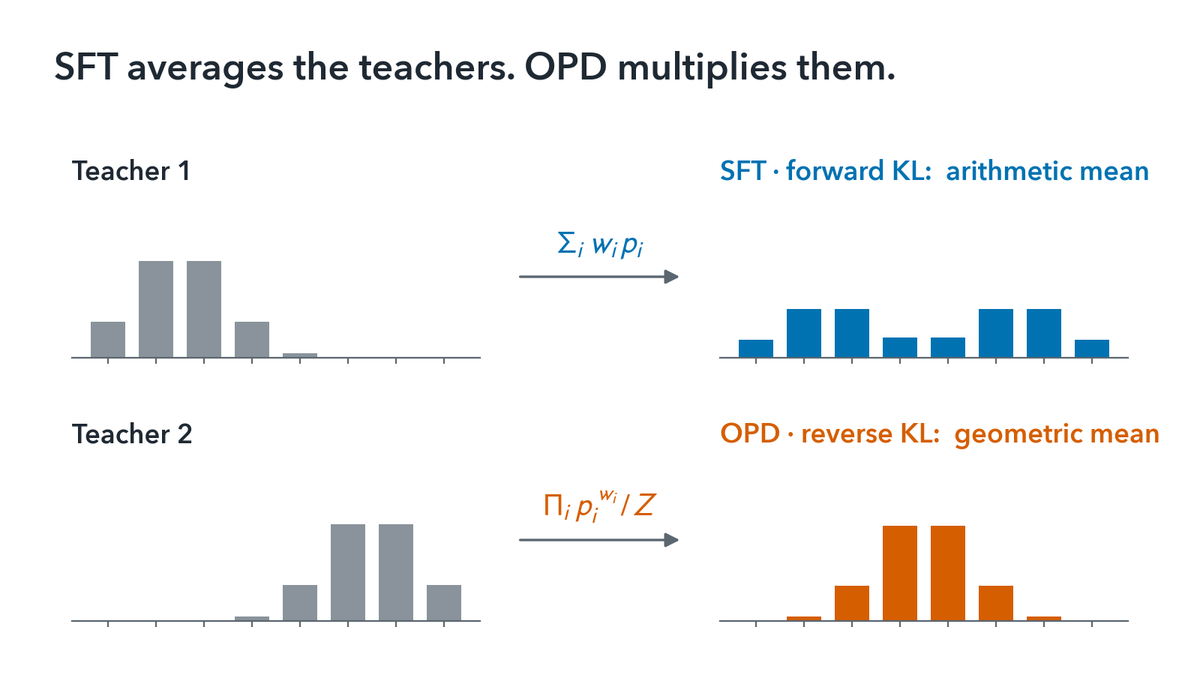
OPD forgets less than SFT, yet breaks under teacher mismatch and on long rollouts. Why? Our answer: they optimize different targets. With multiple teachers, SFT (forward KL) learns their arithmetic mixture; OPD (reverse KL) learns their normalized geometric mean. 🧵
🚨 Thrilled to be co-organizing a Simons Institute semester-long program on diffusions and flows with @joanbruna, Sinho Chewi, @KonstDaskalakis, @ArnaudDoucet1 in Fall '27!
The call for Simons postdoctoral research fellowships for the program is out now, more info below ⬇️ 1/3
launching 𝐒𝐎𝐓𝐀 𝐓𝐕: 𝐚 𝐧𝐞𝐰 𝐩𝐨𝐝𝐜𝐚𝐬𝐭 𝐰𝐢𝐭𝐡 𝐥𝐞𝐚𝐝𝐢𝐧𝐠 𝐦𝐢𝐧𝐝𝐬. we'll kick off a series of conversations at COLM this week.
for episode 1, @Madisonkanna and I sat down with @gneubig, CMU professor, OpenHands co-founder.
we talked about his new agents course at CMU, which AI agents will still be around in five years, why he is an agent-forward professor, and more.
Thrilled to see textGrain launch! So many ideas and iterations led us to its sampling-diversity perspective, and a huge team effort brought it to life. Proud of what we’ve built together. Our paper will come out about a week. Happy to chat, stay tuned!
AI Drug Discovery Is Becoming a Bottleneck Trade
I get excited when an industry starts going through a real regime change. AI drug discovery (“AIDD”) increasingly looks like one of those moments.
Two things are happening:
1/ Upstream: the frontier AI labs are piling in.
2/ Downstream: The supply chain is clearly moving.
Supply-chain checks suggest the upstream picks-and-shovels of discovery and early preclinical R&D are starting to feel the increase in experimental volume.
DNA → protein → assays → sequencing → automation → preclinical testing
Names across that stack include $TWST , @GenScript , $ILMN , $TXG , lab-automation vendors and CROs.
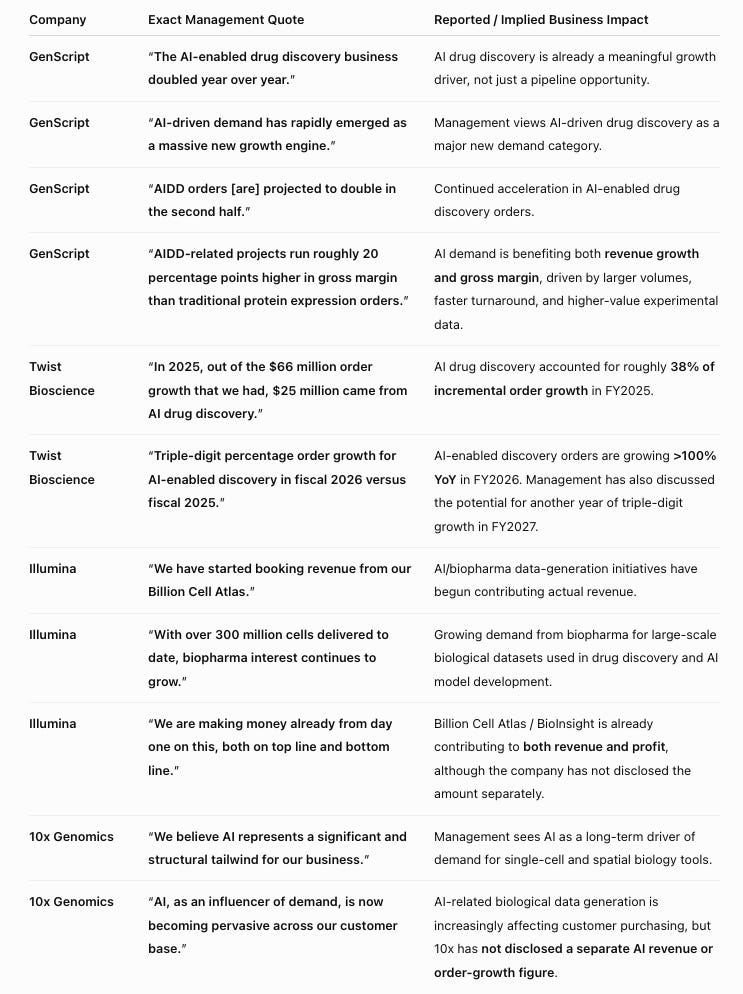
$TWST expects triple-digit percentage growth in AI-enabled drug-discovery orders in FY26, and another year of triple-digit order growth in FY27.
@GenScript's AIDD business doubled YoY in 1H26. Its current platform advertises industrial-scale validation of 4,000+ designs/day, with integrated sequence-to-data workflows. Our channel checks suggest the ramp is moving even faster: roughly 8,000 designs/day currently, with a path toward ~16,000/day by YE26.
---
Why does AI drive more wet-lab demand?
1/ AI makes hypothesis generation almost free → way more shots on goal.
The bottleneck is moving from expert-driven design to biological validation.
2/ AI models need continuous experimental feedback — and both good and bad data are useful.
Traditionally, only the highest-conviction A+ candidates might get pushed into expensive validation. With AI, even the B/C candidates can be valuable because failed experiments generate training data.
@GenScript has said its sequence-to-binding workflow can return data in 4–7 days, and that faster cycle times matter because AI models depend on continuous experimental feedback.
@Anthropic is a clean example. @claudeai designed 1,320 protein binders. @adaptyvbio converted those digital sequences into DNA, expressed the proteins and tested binding. Only 354 actually bound. And the 966 failures are not wasted. They are useful negative labels: what does not express, what does not bind, what has poor affinity. Those results help train the next model iteration.
3/ Wet labs are no longer just making drugs. They are making training data.
$TWST / @GenScript increasingly look like biological data foundries.
$TWST explicitly talks about generating model-ready data from AI-designed sequences. In some workflows, the customer may care less about receiving the physical protein than about getting structured experimental results back into the model.
Traditional drug discovery asks: “Does candidate X work?”
AI drug discovery also asks: “What can this experiment teach the model?”
---
TAM of AIDD
If AI is simply a better R&D tool, the relevant spending pool is the $300–400B of annual global pharma R&D. If AI meaningfully increases the number of viable drug programs, the opportunity is larger because it expands downstream demand for DNA synthesis, protein production, assays, and preclinical work.
Near term, we can also size demand from AI-company spending. If Anthropic reaches $80B of ARR in 2026 and spends just 1% on AIDD, that alone would imply ~$800M of annual investment.
---
Trade setup
This is a trade that could have long legs. It’s hard to really stop working until PhaseI/II results (2028+)
It smells a lot like the bottleneck trade we just saw in semis: GPUs → HBM → networking → power/cooling. In biology, It basically follows the drug discovery process downstream: AI models → designs → DNA/protein → assays → preclinical capacity.
After the upstream picks-and-shovels, animal testing could become the next bottleneck. Monkey prices are already near prior highs and CRO capacity is tight. AIDD pushing more candidates into preclinical development would only add demand.
?? But clinical trials are still the bottleneck?
This is the biggest pushback I keep coming back to. No matter how fast discovery becomes, drugs still need to go through preclinical → Phase I → Phase II → Phase III → approval. You still need patients, time and capital.
But that doesn’t mean the bottleneck trade won’t work. More viable candidates — especially with higher success rates — still means more demand throughout the development process.
And who knows: clinical trials themselves may eventually be optimized by AI.
?? What breaks the trade?
Near term, the picks-and-shovels trade breaks if experimental budgets stop growing, AI-generated designs don’t translate into useful wet-lab hits, or capacity catches up too quickly.
Longer term, the thesis breaks if AI drugs look great in discovery / Phase I but fail at normal rates in Phase II/III. That is why Phase II matters so much.
?? Milestones
Late 2026–2027: first Isomorphic-designed drugs enter human trials; more AI-native programs move into IND-enabling work / tox.
2028–2030: clinical trial results start telling us whether AI-designed drugs actually perform better than conventional drugs.
Calling all the "bottleneck bros". :) @jukan05@zephyr_z9@aleabitoreddit@ParadisLabs
+++
More comprehensive analysis: https://t.co/vaTuiyyYB6
What does an AI-native workflow for protein binder design look like in practice?
In our latest post, we walk through a pilot design run using NovaDDE:
Given a target, the AI agent analyzes the design problem, helps select an epitope and design approach, submits the job, and guides the computational evaluation of the resulting candidates.
We also share some of the directions we’re exploring as we continue to develop the workflow.
A closer look at NovaDDE and where we’re taking it next:
https://t.co/I9eOefsOP6
5/5
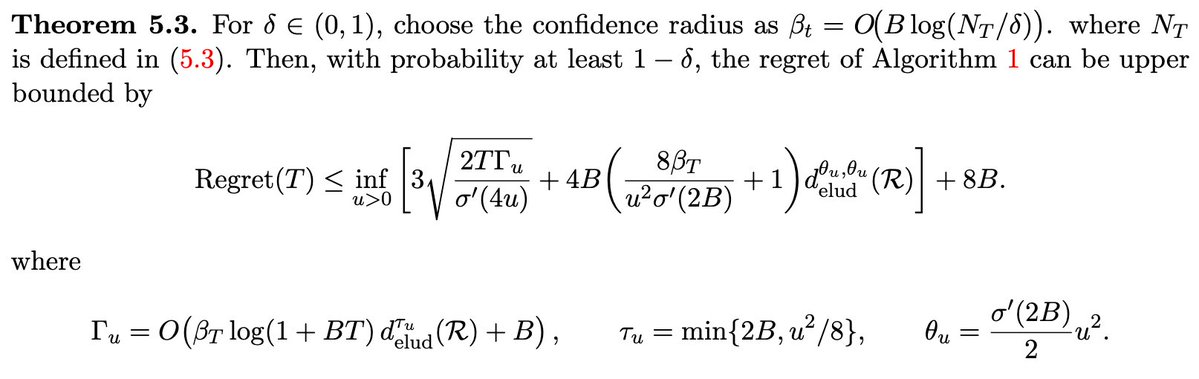
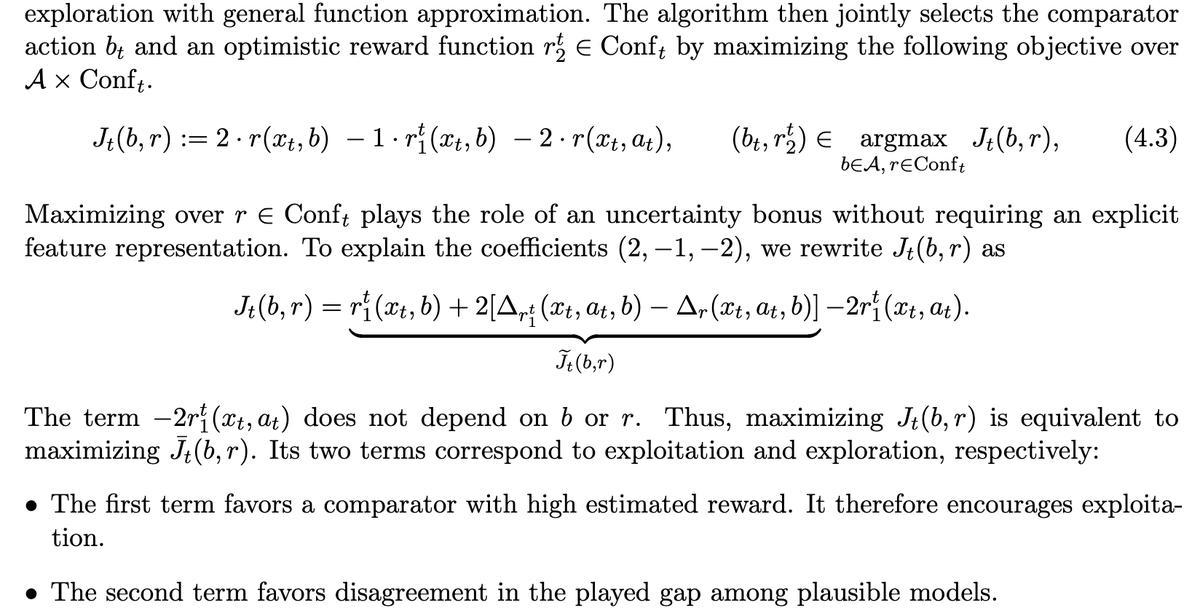
📐 The proof uses a localized Eluder dimension https://t.co/Gxrhz3szUx for the excess log-loss class, separating informative local rounds from rare non-local ones.
1/5
🚀 New paper: Saturation-Insensitive Dueling Bandits with General Function Approximation
Can we learn from pairwise preferences without paying exponentially for BTL saturation? Answer: YES!
@ChenggongAlex@xuhengli_@di_qiwei@WeitongZhang@QuanquanGu
🔗https://t.co/WASIeCfYza
4/5
🔥 The key insight: two-arm regret matters even if we ultimately care about ONE arm.
Small two-arm regret forces BOTH queried arms to be near-optimal ⇒ a small reward gap ⇒ unsaturated, informative comparisons.
Small one-arm regret alone gives no such guarantee.