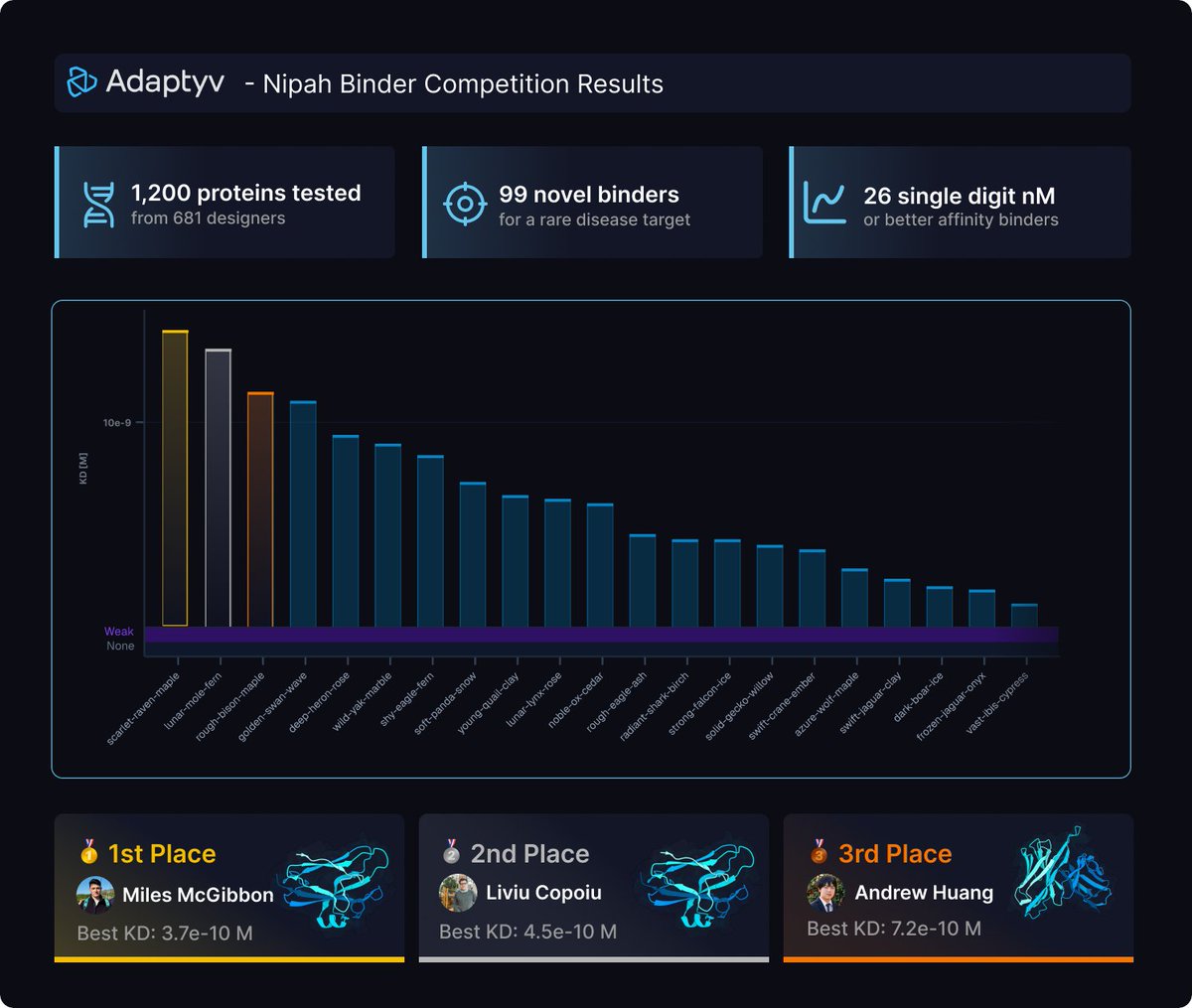
The results of the Nipah Protein Design Competition are out!
🧬 1200 proteins experimentally validated (3x more than last year)
📈 99 novel binders against the target protein (a challenging tetramer with little prior work)
💪 26 single digit nM or better binders, with the best ones at single-digit picomolar affinity!
All data now available open-source on Proteinbase!
Let's take a look at the results ⬇️
How to design your own PD-1 binder in 4 easy steps:
1. Download the tutorial notebook from the ESM team
2. Get a @modal API key to scale it up
3. Scaling it up, O($1000) will get you a 96 well plate of minibinders with >50% success rates on typical targets
4. Test it in the lab!
We have fully open sourced our binder design protocol, which generates nanomolar affinity scFvs.
The code here implements a faithful reproduction of the pipeline described in the paper, which is exactly what was used to produce our designs.
Check it out here: https://t.co/CDH6SPo7d3
Binder design has come of age thanks to generative models—but how can we access the wider array of dynamic, multistate protein functions, so elegantly employed by nature?
@mihirbafna14 and I are excited to share SwitchCraft, a framework for designing such functions. (1/7)
Everything's open. Designs and binding affinity data on @proteinbase, all open-source under ODC-BY.
Blog: https://t.co/SZqOUcfVY4
Proteinbase collection: https://t.co/oa0S7N9DIG
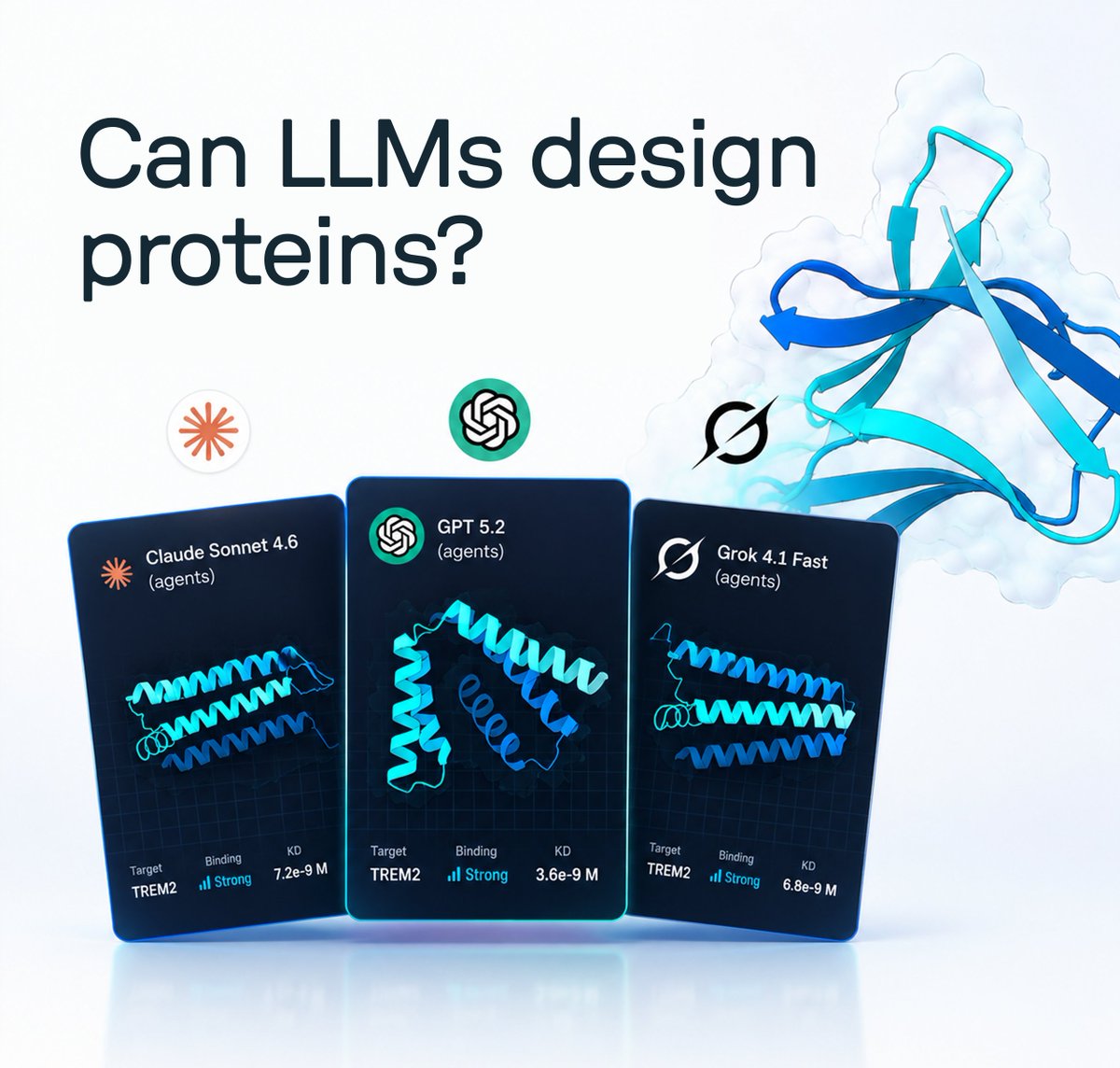
What happens when you let frontier LLMs design proteins, and then synthesize and test them in a wet lab?
We ran a protein design competition with @muni_bio where AI agents competed against humans to design molecules that bind TREM2, a key receptor linked to Alzheimer’s.
Results: GPT 5.2 and Grok 4.1 both placed in the top 5, with molecules showing strong binding to TREM2 when tested in our lab.
Honest caveat: we measured binding, on one target, in one day, which is the easy half of a therapeutic. We'd go as far as to claim binding is roughly solved. Whether agent-grade design holds for developability, immunogenicity, PK/PD or in vivo potency, we don't know yet.
We've been saying it for a while, and @labriataphd makes the same case in his new article: binder design is having its AlphaFold moment. Several of our open competitions are cited as the main wet-lab evidence: BindCraft on EGFR, @cradlebio on the follow-up, and the Nipah competition with >8% binder rate and 26 single-digit nM binders.
How the agent fleet is built and how it pays for tools autonomously.
Each receptor has a dedicated agent with tiered memory of the full gate methodology, covering BioOS candidate sourcing, Lightfold computational analysis, and the @adaptyvbio API for wet lab handoff.
Agents hold Privy agentic wallets and pay for tools machine-to-machine via x402. Gate 5, molecular dynamics, takes 2 to 3 hours per candidate to run. Autonomy is tunable at every gate. When an agent reaches its own limits, it escalates to human review.
A fourth agent slot is reserved for a community-selected receptor, chosen by governance at a later stage.
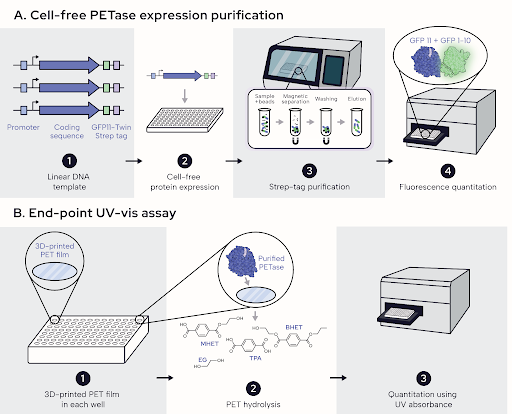
@Align_Bio just published the methods and learnings from their PETase Engineering Tournament. We built the cell-free assay platform, yielding expression and activity measurements across varying temperature and pH values for the same enzyme panel.
The same setup is feeding into more enzyme work from our side. More on that coming up soon.
📊 Engineering better PETases isn’t just a modeling problem, it’s a data problem.
In the PETase Engineering Tournament, we partnered to develop three independent assay platforms to measure expression and activity across temperature and pH: cell-free systems, E. coli + Rapid Fire Mass Spec, and microfluidic droplets.
The takeaways:
→ High-throughput ≠ high-quality
→ Realistic assays ≠ scalable assays
→ Generating reliable, ML-ready data is still the bottleneck
Though challenging, this is the kind of groundwork needed to actually move the field forward.
🔗Full methods + learnings: https://t.co/IzCBunHrES
💪 Many thanks to our sponsor Twist Bioscience for DNA synthesis and to Adaptyv for their valuable collaboration on assay development.
#ProteinEngineering #SyntheticBiology #EnzymeEngineering #MachineLearning #Biotech #AssayDevelopment #DataScience #Bioengineering #Sustainability #PlasticRecycling
In early access for all Benchling customers starting today. To set it up, get an Adaptyv API key by reaching out to us at [email protected]
Blog: https://t.co/hPaVMRQC0m
Benchling's full announcement: https://t.co/sfIcqmn3NL
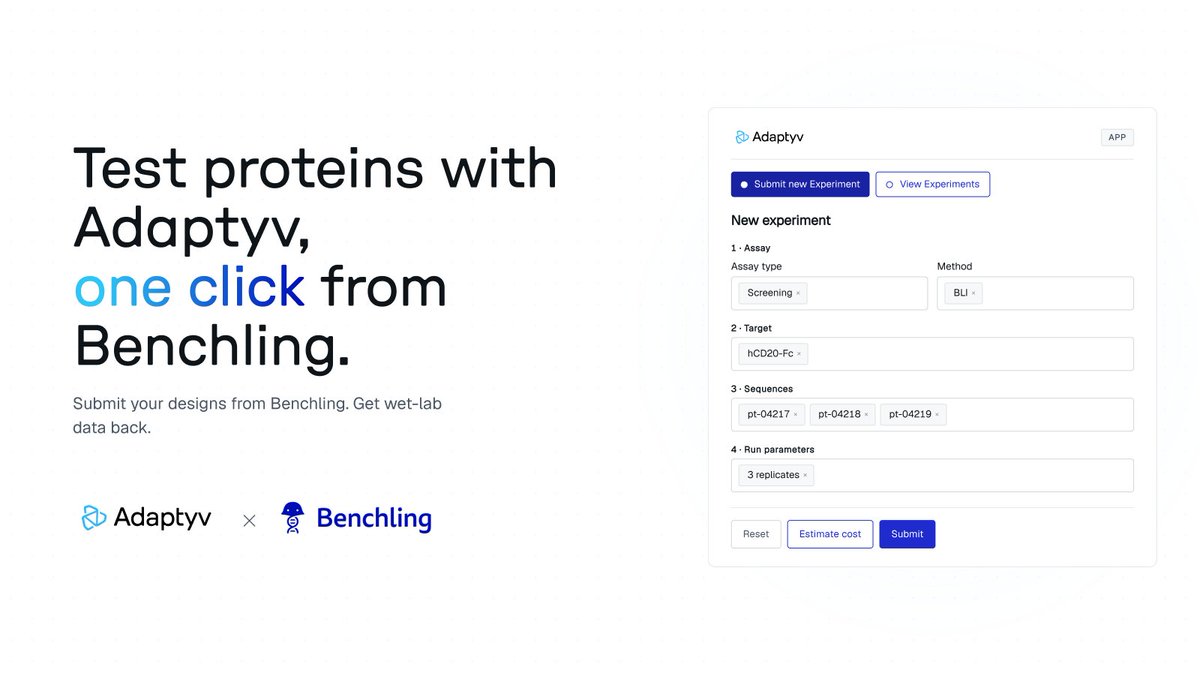
Starting today, you can submit protein candidates from Benchling directly to the Adaptyv wet-lab.
We're launching as part of @benchling's Direct Ordering Partners, alongside @TwistBioscience for DNA synthesis and @Ginkgo for antibody developability.
Some of our customers already run this way, meaning a few designers with Benchling accounts and Adaptyv as the lab. As of today, test it on Adaptyv is one click away from where their work already lives.