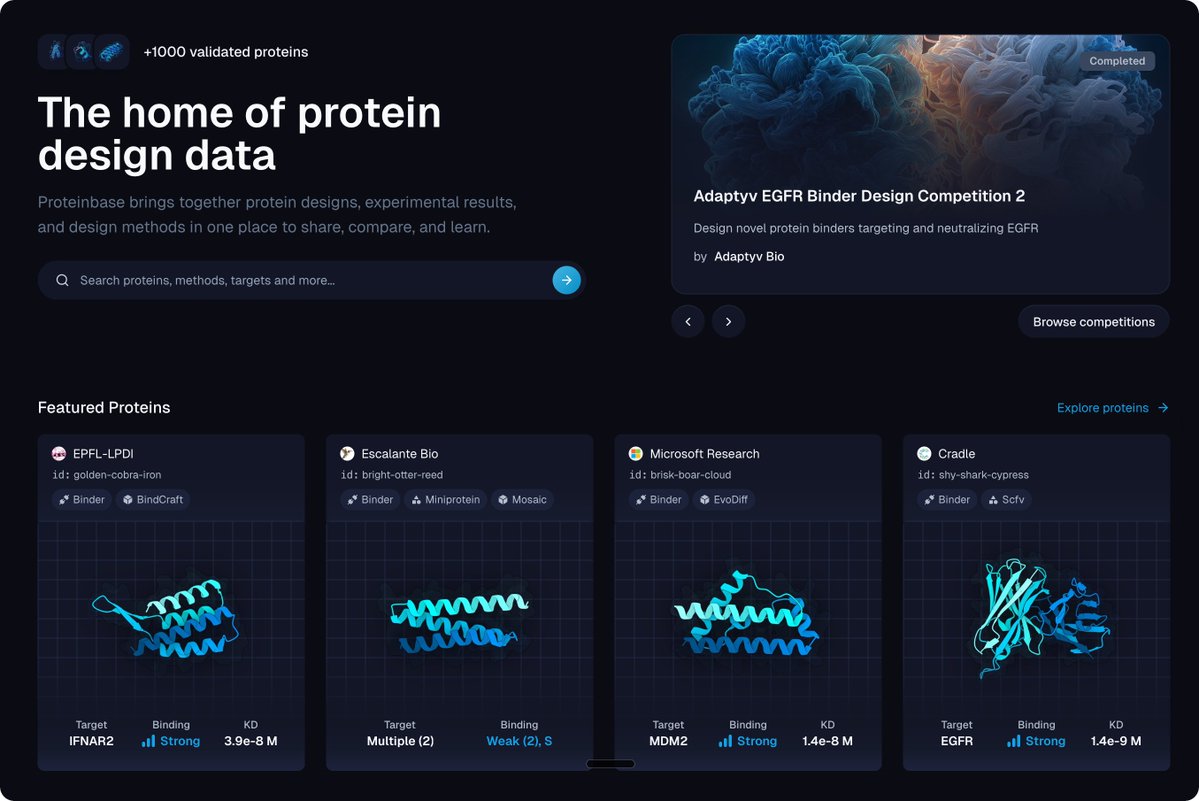
Today we’re launching Proteinbase, a single hub for experimental protein design data. Over 1,000 novel proteins are already live, each with computational predictions, experimental validation, and the method used to design them.
Everything comes from one lab under standardized protocols, which means the results are reproducible, comparable, and include negative data that usually never gets shared.
I have 0 bio background. I didn’t even go to college.
Now I just designed my first protein with AI.
If it works, it’d be the start of a cancer drug.
Here is me learning about a cancer target and its drug discovery process.
Demo:
We're entering the final stretch of the Anthropic x Adaptyv protein design competition
Two challenges are still open:
• Challenge 4: Blood-brain barrier
Design a binder targeting TfR1.
Deadline: November 1, 23:59 AoE
• Challenge 5: Immunotherapy
Design a binder targeting KRAS G12D pMHC.
Deadline: November 8, 23:59 AoE
▶️ Make a submission: https://t.co/2xdqES82rG
We built a website to make it super easy to get started with protein design and participate in the Anthropic x Adaptyv protein design competition
▶️ https://t.co/L3dg6H6BTU
This week, we're challenging people to design an Ozempic-like drug. You can get started in just a few clicks, using the newly released RFD4 model to design proteins targeting the GLP-1 receptor.
We'll synthesize and test 1000+ of these designs in our automated biology lab, including whether they actually activate the cell receptor, and make all the results publicly available
We're excited to share results from our latest wet lab campaign with @AnthropicAI and @citrini.
Claude designed novel proteins to neutralize scorpion toxins and we tested 211 of these protein designs in our automated wet lab. 17 of them showed binding to the toxins in our experiments, with all data now available on @proteinbase.
This is a great example of what we're building towards: A world where anyone can run drug discovery campaigns on our automated wet lab.
Challenge 4 of the Anthropic × Adaptyv Protein Design Competition on @proteinbase is open: design a pH-sensitive protein to help shuttle drugs into the brain.
TfR1 is a receptor protein that brings iron-loaded transferrin into cells. It is highly expressed in the blood-brain barrier and drug developers can use this receptor to get drugs to pass the blood-brain barrier. The drug is fused to a binder to TfR1, which makes cells absorb the protein complex. If the binder is pH-sensitive it will release from the receptor inside the endosome and then exit the cells on the brain-facing side to deliver the therapeutic into the brain.
In this challenge, the goal is to make a pH-sensitive binder to TfR1 that targets precisely the right region on the receptor in order to allow absorption into the cell.
Free and open to everyone. We test the selected designs in our automated lab and publish every measurement on Proteinbase.
Submit here: https://t.co/vurVIotb81
Less than 24 hours left for Challenge 2 of the Anthropic x Adaptyv Protein Design Competition.
Design a TNF-α binder that binds human and mouse TNF-α that binds pH 7.4 and doesn't bind at endosomal pH.
Submissions close Sunday 18 Oct, 23:59 AoE.
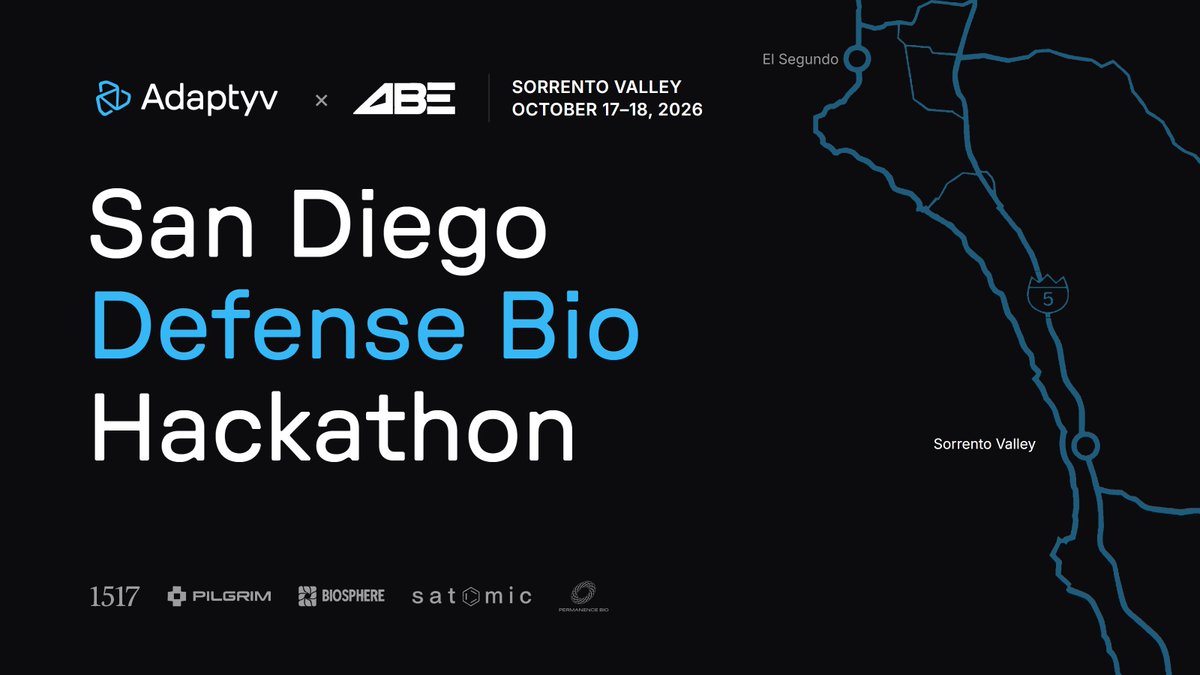
We’re sponsoring wet-lab validation for the Defense Bio Hackathon, hosted by American Bioenhancement today in San Diego
180+ designers, 300 designs wet-lab tested in 5 tracks:
- Frontier bio
- Biological data
- Human performance
- Biomanufacturing
- Biosecurity
See you there! https://t.co/4LdItjPIuN
Challenge 3 of the Anthropic × Adaptyv Protein Design Competition is open. You have to design a protein that switches on GLP1R, the receptor that semaglutide (Ozempic, Wegovy) and tirzepatide act on in type 2 diabetes and obesity.
Google DeepMind just released SynthID Bio, a watermark written into the amino acid sequence of an AI-designed protein. We validated the proteins in our lab at @adaptyvbio and you can now find all the experimental results on Proteinbase.
Announcing Challenge 2 of the Anthropic x Adaptyv Protein Design Competition!
Humira, the best-selling drug ever, blocks TNF-α, an inflammation marker protein that’s overexpressed in rheumatoid arthritis and Crohn’s disease. In this challenge, the goal is to make a better binder for TNF-α that also releases selectively at pH 6.0 in the endosome of cells to improve drug half-life.
The protein must also bind both human and mouse TNF-α, making it easier to test the same design in preclinical models.
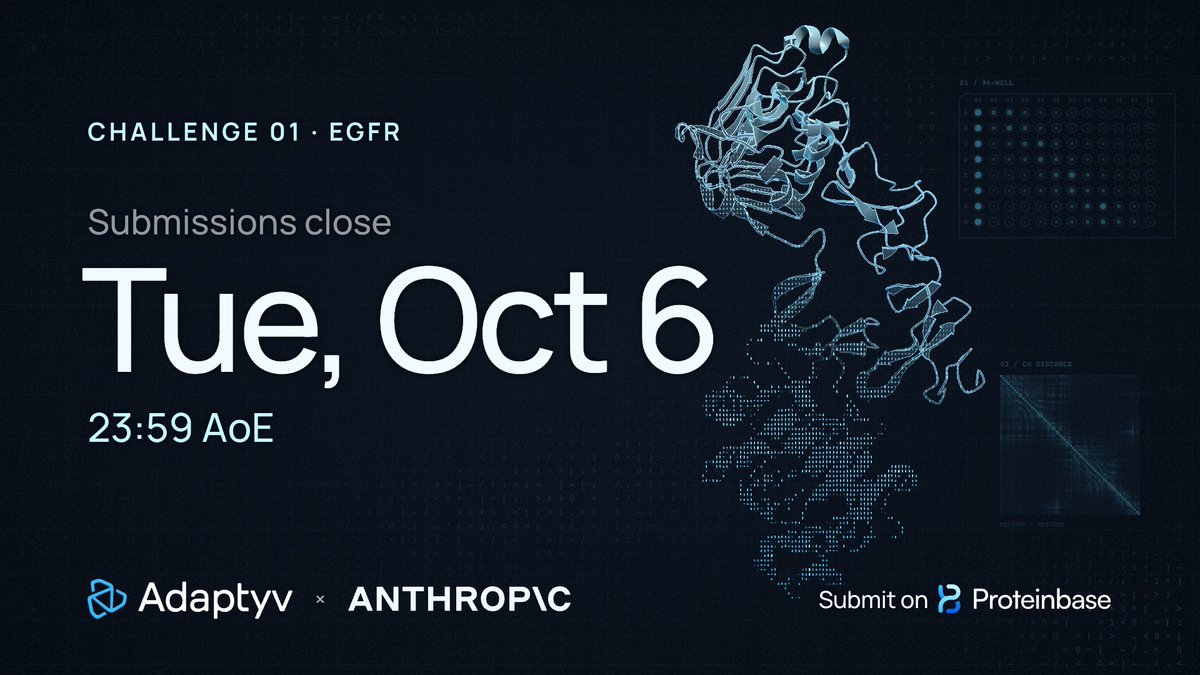
Two days left for Challenge 1 of the Protein Design Competition! You have until Tuesday, October 6 to submit your designs.
The goal of Challenge 1 is to design proteins that bind EGFR in the acidic environment of a tumour, but not at the neutral pH of healthy cells. Moreover, the proteins must bind to both the human and the mouse variant of EGFR to support easier preclinical testing.
Submit your designs on @proteinbase now: https://t.co/qRvrOYMJs0
The Protein Design Competition is back, bigger and better than ever thanks to our partnership with @AnthropicAI
The competition will feature five challenges, each focused on a specific disease or biological mechanism. Compared to previous competitions, it will be a big step-up in complexity and scale to push the boundaries of AI-driven protein design.
The competition is open to everyone and free to enter. It will feature 3 tracks:
- Track 1 is aimed at expert protein designers, with up to 20 teams to be selected.
- Track 2 is targeting life science academics and industry researchers.
- Track 3 is open to everyone from tech enthusiasts to high-school students.
A big thanks to @Modal for contributing compute for protein design and to @TwistBioscience for contributing the DNA for the experimental validation!