The Tragedy of Man, a Hungarian animated film, directed by Marcell Jankovics, production for this film spanned 23 years, from 1988 to 2011. It adapts Imre Madách's classic play and explores themes regarding the cyclical nature of human history and the search for meaning.
Still. About the Whole
#scifi#practice
“ If a civilization becomes capable of creating conscious simulations, it could generate so many simulated beings that a randomly chosen conscious entity would almost certainly be in a simulation.”
Nick Bostrom
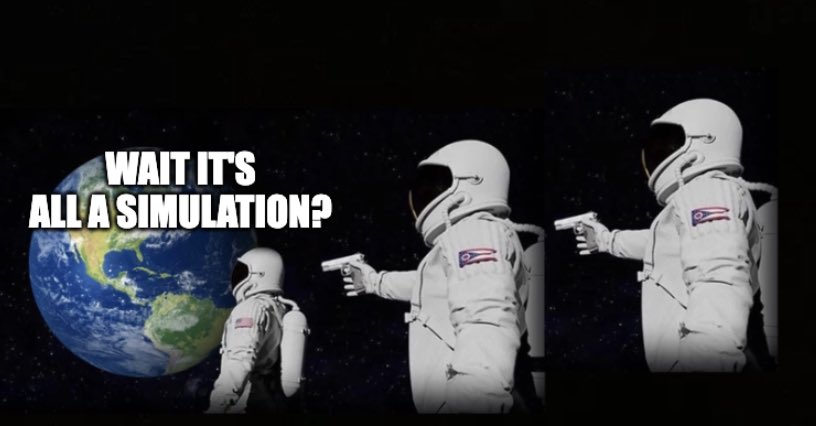
So uh, simulation theory might be real.
I dropped a sim computer into the simulation my Astra agents live in. One agent sat down and built a simulation of his own, with its own agents living inside.
Simulations all the way down.
“The fraction of posthuman civilizations that are interested in running simulations of their evolutionary history, or variations thereof, is very close to zero", or
“We expect this approach will accelerate realization and lead to new breakthroughs in our understanding of quantum states and future technology”
#PlayMore
ORNL researchers developed an AI-guided system that can arrange molecules to build functional materials atom by atom, opening new possibilities for electronics and quantum materials.
Read more 👇
https://t.co/MtIOXoWH8N
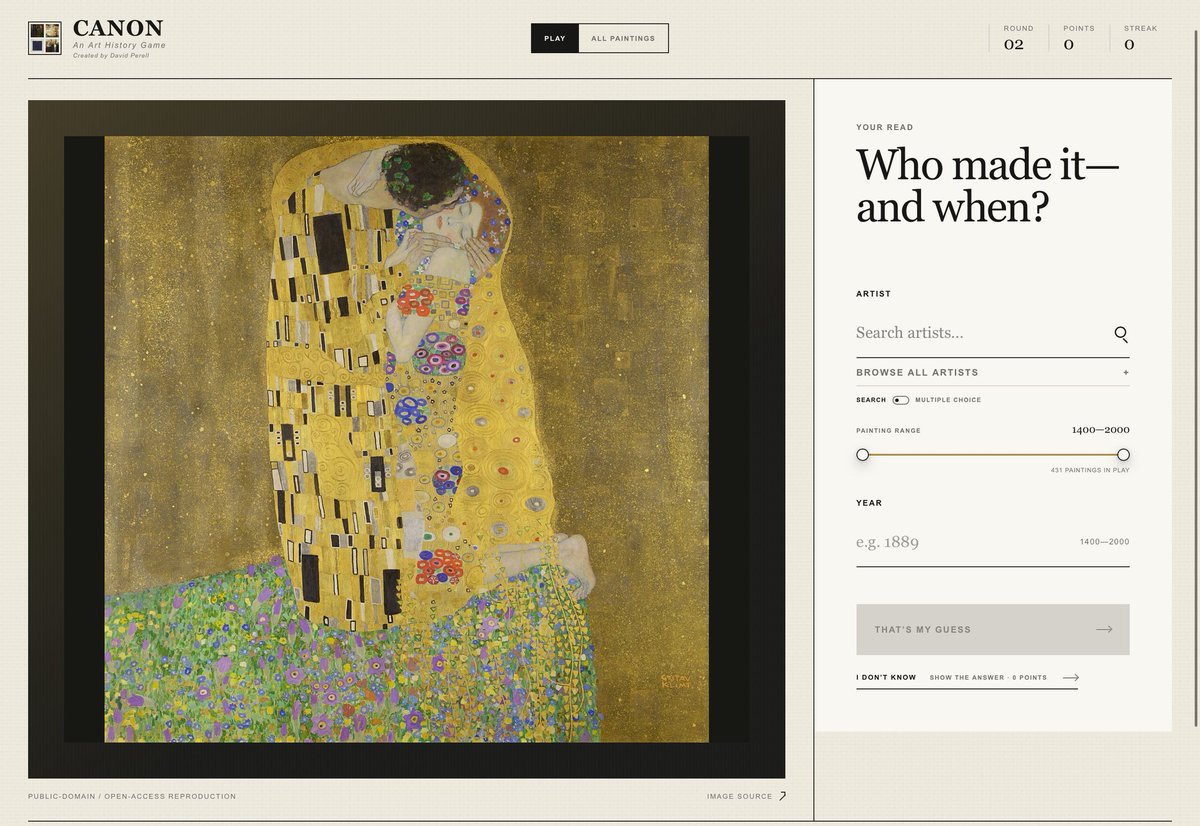
I made a game to teach myself art history.
And now I’m sharing it here, for free. It’s a trivia game that shows a painting, then asks you to guess when it was made and who painted it.
You can play with friends or by yourself.
I designed it to highlight the relationship between the spirit of an era and its paintings. Playing the game, for example, will give you a visceral sense for how different the energy was in Europe when Impressionism was popular in the 1880s vs. when Cubism was coming into fashion in the 1910s. The shift in style is a reflection of how the tectonic plates in society were shifting in the years before World War I.
Similar themes show up throughout human history. That’s why the answer page is filled with so many rabbit holes, such as Wikipedia pages about:
- The painting itself
- The year it was painted
- The artist
- The people who inspired the artist
- Popular works of art created at the time
And also a timeline of the artist’s life and a guide to looking at the painting.
Here’s the site: https://t.co/32yXT6v52f
Philosophers have something I wish more of us would adopt. It’s called the principle of charity. It means, when reading something (a physics paper, a philosophy paper, a YouTube comment, etc.), to endeavour to interpret it in a charitable light; don’t readily attribute logical fallacies or irrationality to one’s opponent. It doesn’t mean you should pretend an argument is correct or ignore genuine contradictions. It means to attempt to maximize the truth and coherence in your interlocutor. The meaning of what’s being read becomes more apparent when you do so, and (unintentionally) life becomes more graceful.
Well it’s about time they caught up. I’ve been teaching this for 10 years.
Lymph Mojo if you can’t get waste out of the brain, your brain stays on fire.
Man alone, in nature, is incapable of enduring monotony, man alone wants something to happen at all costs,something, anything.
Thereby he shows himself unworthy of his ancestor: the need for novelty is the characteristic of an alienated gorilla."Cioran
The Trouble with Being Born
Also much love to all of you. It weirdly feels like my consciousness is deeply intertwined with yours. Feels like family. You’re assholes and terrible. You’re also…nah, just mostly assholes and terrible. Still love you all anyways.
Three Maiko or apprentice Geisha wearing traditional kimonos and have their hair styled in a traditional manner, posing as the Three Wise Monkeys - mimicking the proverb “Speak no evil, hear no evil, see no evil". Vintage Japanese postcard, 1910...
The story of the Three Wise Monkeys begins in Japan. Earliest known depiction of these symbolic primates is found in the sacred Toshogu Shrine in Nikko, a masterpiece of 17th Century wood carving. However, the roots of the monkeys’ message dig deeper, linked to older Buddhist traditions that spread from China and India, carrying with them a confluence of philosophical ideas.
These monkeys are believed to have been inspired by Buddhist principle of not dwelling on evil thoughts. This principle is a reflection of Buddhist teaching of Three Poisons: greed, anger, and ignorance, which are seen as the source of all suffering. Monkeys serve as a compelling embodiment of this teaching, their gestures a symbolic refusal to engage with moral corruption.
In Japan, monkeys also became associated with Shinto deity Koshin, a guardian against evil spirits. This melding of Japanese Buddhist and Shinto beliefs (Shungendo) exemplifies Japan’s unique syncretic religious culture, where multiple faiths often coexist and intermingle, creating rich, multi-layered traditions.
• Mizaru - See No Evil
The first of the monkeys, “See no evil,” is represented by Mizaru, the monkey who covers his eyes. Mizaru derived from the Japanese “mi” (miru, to see) and “saru” (monkey), a linguistic play on words, combining the action of seeing with the negative form “zaru”, indicating “not”.
Mizaru symbolizes choice to avoid witnessing immorality. This concept is not just about physical sight but encompasses a broader philosophical stance. By choosing not to see evil, Mizaru embodies notion of guarding one’s mind and moral integrity against corruption. This idea was particularly significant in Japanese culture, where maintaining moral purity was highly valued.
The moral implications of Mizaru’s gesture does raise universal questions about nature of evil and our response to it. It challenges us to consider the balance between being aware of wrongdoings and the choice to ignore them, idea of willful ignorance versus moral discretion.
• Kikazaru - Hear No Evil
Kikazaru, with his hands covering his ears, represents a deliberate choice to shut out malicious speech. The name Kikazaru, like Mizaru, plays on the Japanese words “kika” (kiku, to hear) and “saru” (monkey), forming a phrase that means “not hear monkey” when combined with the negative form “zaru”.
What we hear can influence our thoughts, beliefs, and actions. Kikazaru symbolizes the wisdom in being selective about what we allow into our minds through our ears. By embodying the principle of “Hear no evil,” Kikazaru reminds us of the importance of discernment in what we choose to listen to.
The symbolic act of Kikazaru is not just about ignoring evil speech but also about the broader implication of not being a part of malicious conversations. It is a reminder of the power of words and the responsibility that comes with this power.
• Iwazaru - Speak No Evil
Iwazaru, depicted with his hands covering his mouth, symbolizes the conscious choice to abstain from malevolent speech, to “Speak no evil“. This action is deeply embedded in notion of self-governance over one’s words. The name Iwazaru, following the pattern of the previous monkeys, combines “iwa” (iu, to speak) with “saru” (monkey), thus translating to “not speak monkey.”
In various cultural contexts, power of speech is recognized as a potent force, capable of both building and destroying. Iwazaru’s gesture is a call to use words thoughtfully, to avoid gossip, slander and falsehoods, and to speak in ways that contribute positively to well-being of others.
In Buddhist philosophy, Iwazaru’s principle is closely aligned with right speech, which is part of the Noble Eightfold Path.
#archaeohistories