🚨🚨🚨 ALERTE SÉCURITÉ MAXIMALE ! Python est compromis.
🔸 Mettez immédiatement pip à la version 26.2.2 ou plus.
🔸 Dans chaque projet Python (chaque venv) : python -m pip install --upgrade pip
🔸 uv : uv self update (0.13.4 ou plus)
🔸 Mettez aussi à jour les certificats du système (apt / dnf upgrade ca-certificates) et vos images Docker
pip install est compromis.
L'autorité indienne eMudhra (emSign), qui signe les « passeports » prouvant qu'un site est bien celui qu'il prétend être, utilisait des clés secrètes ridiculement faibles : 8 clés, toutes inférieures à 256. L'une valait 4. Autrement dit, n'importe qui peut fabriquer un faux passeport valide pour n'importe quel site.
Le risque pour Python : quelqu'un sur ton réseau (wifi public, FAI, État) se fait passer pour https://t.co/KxkevWMTiB, et ton « pip install » télécharge un paquet piégé sans aucune alerte. Aucune attaque n'a été signalée pour l'instant, mais c'est trivial à faire.
Un paquet piégé peut installer n'importe quoi. Porte dérobée, virus, vol d'informations en tout genre.
La situation est terrifiante !
Rien que dans l'écosystème Python, chaque installation de CPython, chaque venv, uv, tout est exposé.
Et je ne vous parle même pas de npm, pnpm, yarn, Go, Rust.
Ma stratégie de sécurité 2026 : rester chez moi et ne me connecter à Internet que depuis un FAI de confiance.
C'est quand il y a de la mer qu'on reconnaît les vrais marins...
Crazy 72 hours in security. Three major incidents dropped back-to-back: eMudhra, PingCAP (TiDB Cloud), and PHP.
Here is the short version of what happened and who got hit.
1. eMudhra (Trusted CA compromise)
eMudhra generated 8 intermediate CA certificates in April 2025 (cross-signed by Sectigo). A bug in their HSM key-wrapping test script created a second set of P-384 keys where the private keys were single-byte numbers under 256. Operators picked the wrong key labels and signed them into real CA certs.
One of the intermediate CA private keys was literally the number 4.
The other seven: 56, 66, 115, 155, 156, 230, 237.
Three weeks later (May 2025), their CRL signatures started failing because the CRL signer was using the real keys instead of the weak ones. Instead of asking why the keys didn't match, someone switched the CRL signer to the weak keys and closed the ticket.
• Browsers are safe: Chrome, Firefox, Apple, and Microsoft already blocked them, and zero rogue certs hit CT logs.
• Servers are not: curl, Python (certifi), Go binaries, and Docker base images don't check CRLs. Update ca-certificates, certifi, and Go (1.27.3 / 1.26.10).
• 10-second check on any server:
curl https://t.co/vhiGLxNhIS
(TLS error = safe. 200 OK = still vulnerable.)
2. PingCAP / TiDB Cloud (10.6 TB breach)
Attackers found GCP and Azure credentials committed inside PingCAP's own repos. They set up a replication feed of TiDB Cloud's production control plane and exported the entire database every 6 hours for 22 straight days. 88 full exports, zero alerts. 200 GB is already out on torrents.
Beyond the 413 private repos and 20.6M customer SQL queries logged from their web SQL Editor, PingCAP engineers were pasting customer secrets into Jira tickets.
Who is affected in the leaked records:
• Live credentials exposed in support tickets:
- Pinterest: AWS keys for their pingcap-logs S3 bucket
- CardX / Silverlake (NPCI-linked env): AWS admin key in a backup log with full access to 258 external S3 buckets
- DeBank: 38 presigned S3 URLs
- An unnamed AI/dev platform: a 314 MB slow-query log attached to a ticket containing 8,027 live customer secrets (an AWS root key, a GitHub admin PAT over 1,701 repos, 7,485 AWS STS tokens, and 192 OpenAI/Anthropic/Gemini keys)
• Tenants with infra metadata, VPC CIDRs, app-server IPs, or contract pricing exposed:
- Tech: Atlassian, Databricks, Airbnb, Baidu, LINE, Nylas, Persona, PatSnap
- E-comm & Travel: https://t.co/C512KFOEq5, Shopee, Flipkart, Mercari, ZOZO, AEON, Delhivery, Klook
- Gaming: Capcom, Square Enix, Konami, Bandai Namco, Cygames, Colopl, DMM
- Finance: PayPay, SoftBank, SBI, SB Payment Service, Fujitsu, TOPPAN, Bank of China, China Life
- Crypto: Bitget (said only public trade logs were on it and they already left), Pionex, DigiPlus, NFTscan, Chainbase
• Developer profiles leaked (from a purchased https://t.co/28tjHqd5Wr table in PingCAP's BigQuery):
- 24,900 personal emails + GitHub/LinkedIn profiles of engineers at Tencent (3,327), Huawei (2,726), ByteDance (2,475), AIG (2,140), Mastercard, Flipkart, and bKash.
If you use TiDB Cloud: rotate your console API keys, DB passwords, and anything you ever pasted into a support ticket.
3. PHP "PHP2Shell" (CVE-2026-109618 & CVE-2026-109619)
Two CVSS 9.2 pre-auth RCEs leaked yesterday ahead of today's 14:00 UTC patch.
Public writeups trace it to a heap Use-After-Free in PHP's native C multipart/form-data session upload-progress handler (ext/session/session.c).
Because C-level multipart parsing runs before line 1 of index.php:
• App auth, Laravel/WordPress middleware, and file_uploads = Off do not stop it.
• Only PHP 8.2–8.5 get official patches today (59% of PHP servers on Shodan are on EOL <= 8.1).
• Until you patch php-fpm: lock php_admin_flag[session.upload_progress.enabled] = off and block unexpected multipart requests at Nginx/Apache/Cloudflare.
Sigh.
I wrote this post below, but then I didn't post it because I am tired of the consistent pushback I get from folks with the same safety worldview as Anthropic. I guess that means I should send it. Here goes!
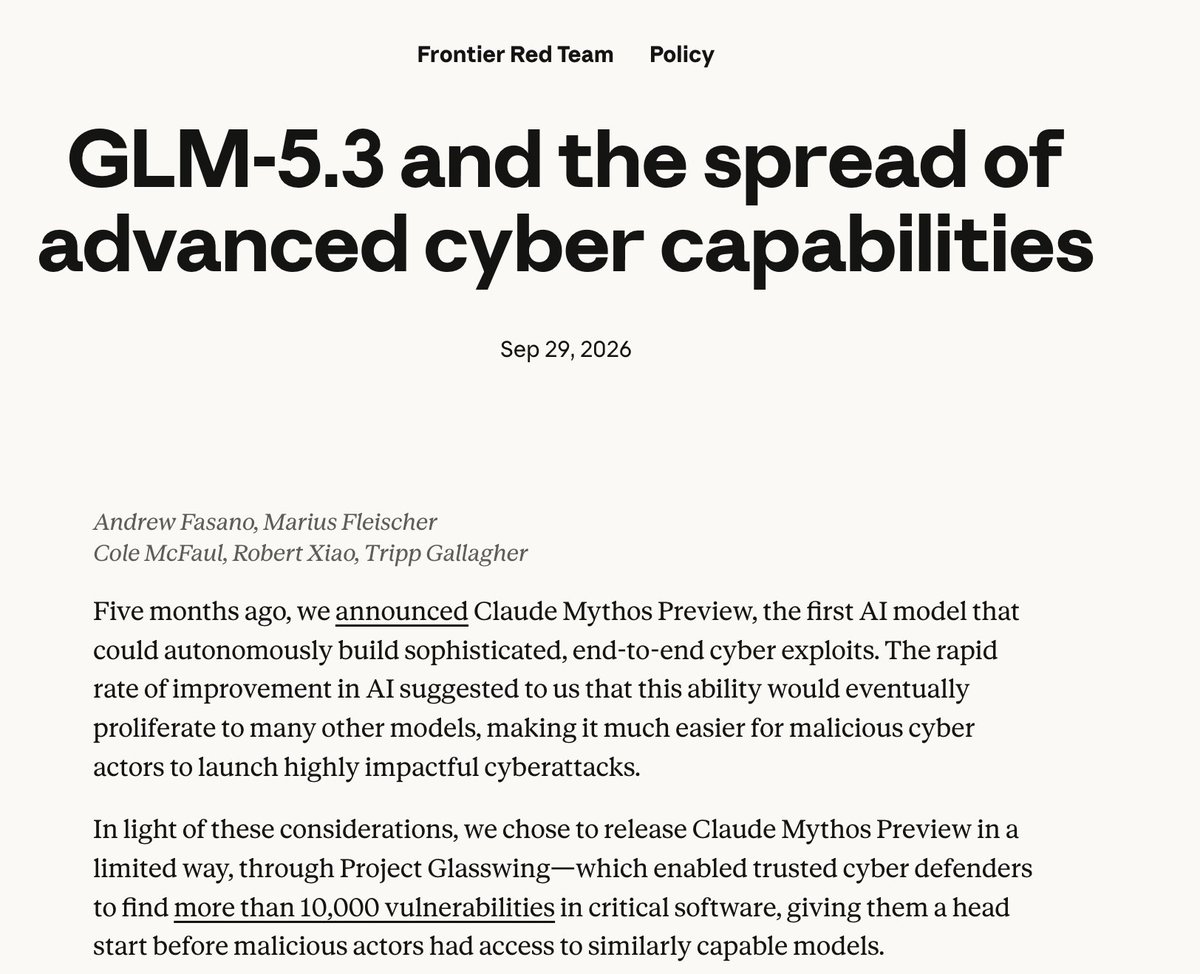
This post is pretty solipsistic and doesn't properly take recent events in cyber risks into it's discussion. It is really hard for me to watch how the US frontier labs like Anthropic don't have the ability to consider other approaches to safety and ways things could play out.
It insinuates that Z ai (Chinese lab, builds GLM series) doesn't really care about safety and is reckless to take their business strategy.
Saying things like "Given this evidence, we think it's likely both state and non-state actors will use models like GLM-5.3 to cause real-world harm." and "This is unlike any other similarly capable AI model, all of which were released with safeguards or through limited access programs." while closed models have been used on more of the documented cyber attacks is just bowing out of the interesting question.
A plausible view is that open model weights and closed model apis (with some safe guards) are both far closer to being easy to mis-use, rather than API models being closer to safe. The trope "Open Dangerous, Closed Safe" may be closer to "Open Unsafe, Closed Unsafe"
Closed models have stronger capabilities and stronger safeguards, but the stronger capabilities part could matter more in net harm if both the safeguards are porous.
At the same time, as the authors do acknowledge (thanks - thats progress!), open models without extreme cyber guardrails are important to rapidly diffuse cyber readiness in the economy -- as programs like project glasswing are not perfect in getting all critical industry onboarded.
There will be more issues like the time when Fable was released and Amazon found a workaround, which allowed them to access the full capabilities of the model served readily at an API.
The blog overall is reasonable in it's narrow line, but it's a very effective tool in a complicated, rapidly evolving media ecosystem to reinforce a certain type of safety thinking.
Can the US build a DJI? We bought a 2019 Mavic Mini and a 2023 Mini 4 Pro, tore them down in our hardware lab, and put them under a bench microscope to find out.
What we found: https://t.co/2nxcHd8cSF.
For anyone curious how Jev works, I made a visual explanation using @claudeai :)
This is based on the Qwen2.5-RLCD model which @harshagundal released on @huggingface
The idea is to replace autoregressive LLM generation by a single Transformer decoder (of a pre-trained LLM), which processes the context + JSON schema only once. The keys and values of those tokens are cached.
Next, for each field of the JSON schema, we:
1. pass its field suffix tokens through the Transformer decoder again (reusing the KV-cache)
2. obtain a final hidden state, which we pass through the language modeling head
3. we obtain scores, also called logits, for all tokens in the vocab of the LLM
4. we only look at the scores of the tokens we care about for the given field, and pass those through a softmax to obtain probabilities which sum to 1
5. we take the token with the highest probability.
The benefits of this are that:
1. it's fast (we don't need to generate the JSON schema token by token)
2. it's 100% valid JSON (we don't need to rely on the model to generate a valid schema)