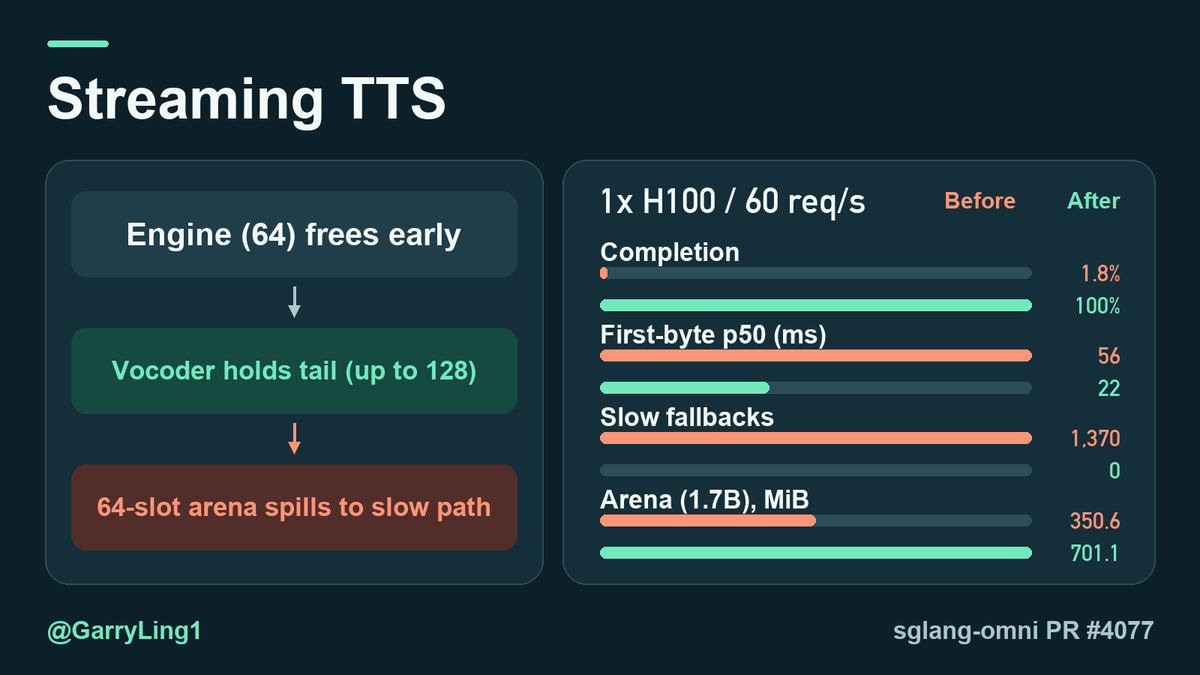
At 60 req/s on 1x H100, streaming TTS fell to 0.5-1.8% completion with 64 vocoder slots. Tail decoding outlived engine slots. Sizing the arena for 128 in-flight requests brought completion to 100% across 3 seeds. SGLang Omni PR 4077.
#SGLang#TTS#LLMInference
@cheese_cakee_9 The 8 full-attention visits give ~16 KiB/tok in FP8 (~32 KiB in BF16) on paper, yet vLLM #69039 still measures ~69 KB/tok on GB200 TP1 (124.9 GiB for 1.9M tok) and caps 80GB H100 at 262K. vLLM #69028 also blocks loop_share_cache on fixed-loop Inkling 2 Mini.
@christopherowen expandable_segments issues 2 MiB CUDA VMM chunks (~58K disjoint handles), spraying unmovable 64 KiB SecPageTables across buddy blocks. Curious if disabling expandable_segments for a single slab KV pool or carving ZONE_MOVABLE keeps 512 MiB blocks intact at 263 GB/s.
@Bobliuuu@magnihq@OneTriangleAI Mapping 4B activations into 27B's 16 full-KV layers and 48 Gated-DeltaNet 128x128 recurrent states cuts 32K TTFT (1.37s vs 2.81s in vLLM). Curious if the >32K recall drop or tau2-telecom gap comes more from recurrent-state approximation or map capacity.
@deeponailabs Right - N3mezis tested up to conc. 4 on the 5070 Ti (+9%, 37.9->41.6 tok/s vs +12% at conc. 1). By conc. 4 a step hits 32-40 experts while prefetch only covers up to 3 missing experts from the 1st request's activations, so it targets 1-2 conc. on tight VRAM.
Fitting the model on one card still leaves decoding stuck waiting for weights. On a 16GB RTX 5070 Ti, moving expert copies alongside compute lifted single-request speed from 103.1 to 116.2 tok/s. SGLang PR 51279.
#LLMInference#CUDA
@muradylan vLLM #69028 adds loop_share_cache via --hf-overrides, but rejects it on fixed-loop checkpoints like Inkling 2 Mini. Each pass merges gated messages from the prior pass so K/V diverges; its 20 local layers use window=1024, leaving the 4 full layers as the long-KV cost.
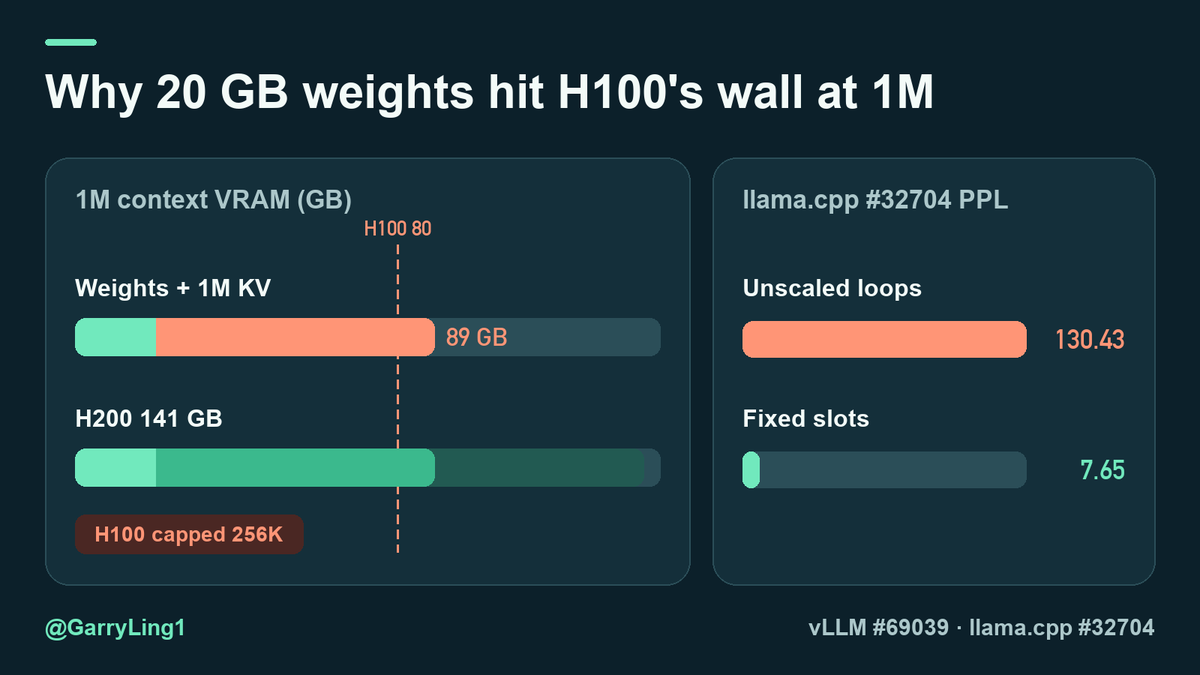
A 20 GB model still misses 1M context on an 80 GB GPU. Inkling 2 Mini loops 12 layers 3x per token: weights stay shared, yet vLLM keeps 3x KV caches (~69 KB/tok, ~69 GB at 1M). llama.cpp also fixed a 130.43 PPL NVFP4 scale bug.
#LLMInference#vLLM#AIInfra
Treat ZDR as a first-hop commitment until downstream handling is verified. OpenRouter off-boarded 3 providers and linked advisories from Novita, Phala, and Together AI.
https://t.co/w7YYLY65Hm
A request marked zero retention left a canary link in a Lark chat 24 days later. Dragos traced hidden hops and logged 11.2k alerts. OpenRouter pulled ZDR eligibility from 125 endpoints.
#AISecurity#OpenRouter#LLMInference
Wei Qiang, Ganxiang Yang, Yi Rong, Xupeng Li & Ronghui Gu check race freedom, termination, functional equivalence and FP tolerance. Hopper FA-3 fwd may deadlock (#3193). Trust PTX/ptxas/TC rounding. No random sampling or cross-GPU atomic flags.
https://t.co/cdBy98W5iS
Even with every test passing, a kernel can return wrong results. TensorLean checked compiled PTX with Lean 4 and SMT. Of 149 open-source kernel instances, 83 proved correct and 66 had bugs. Existing tests missed 38 distinct bugs.
#CUDA#GPU#AIInfra
@N3mezis: Predict from current input, pre-copy up to 3 experts on a side stream, then join before next routing. Consecutive softmax top-k layers only. Full CUDA Graph decode or eager; skips breakable prefill. Best at 1-2 requests with tight VRAM.
https://t.co/DsYs57ocOA
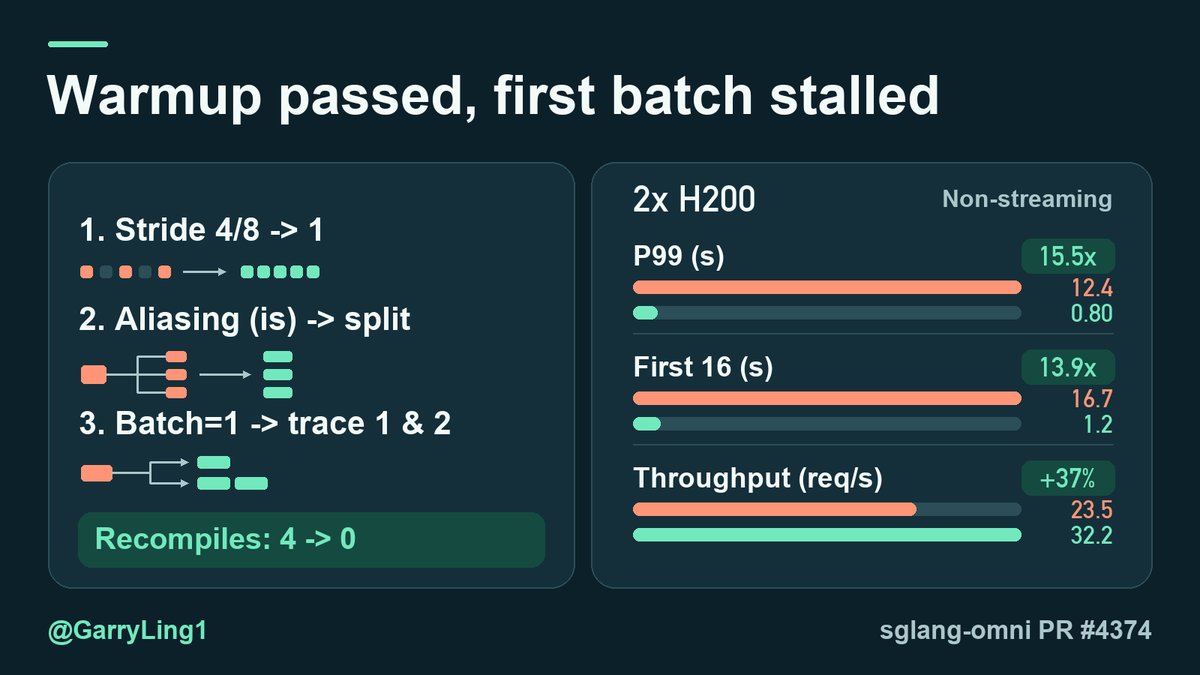
Warmup passed /health, yet the first 16 non-streaming requests took up to 16.7s (P99 12.4s). DSpark recompiled on live tensors. Matching warmup to real inputs cut P99 to 0.80s on 2x H200. SGLang Omni PR 4374.
#PyTorch#SGLang#LLMInference