Tech gave me everything I have
Its capacity to lift people into abundance is incredible and there is nothing like it
We must make that into prosperity for everyone
"I realized tech is this thing that can bring people out of whatever situation they're in and often into prosperity. And that's what I want for everyone."
@ycombinator’s @garrytan tells @emilychangtv how tech changed his family's life.
Watch here: https://t.co/0HiusBQwCD
Connie Chan does not want new market-rate housing to be built.
Do not elect someone who has no clue about how economics works to Congress.
https://t.co/kK73GmbaTY
introducing t-rex
with t-rex enabled, greptile doesn't just review your PR, it runs your branch in a sandbox to find bugs.
it mocks api calls, clicks around the UI, and writes + runs unit tests
in our benchmarks, it caught ~20% more bugs than base greptile. most of the new bugs caught could not have been caught with more inference, they required code execution.
t-rex is available in beta to all greptile users
Doing a lot of pitch practice lately. I saw a founder this week who'd engineered his pitch so investors couldn't interrupt with hard questions. He thought a clean, unbroken pitch was the win.
It's the opposite. A great pitch invites the hard question early, because you have the answer, and watching you handle it live is what actually convinces them. A pitch built to prevent questions reads as a pitch that can't survive them.
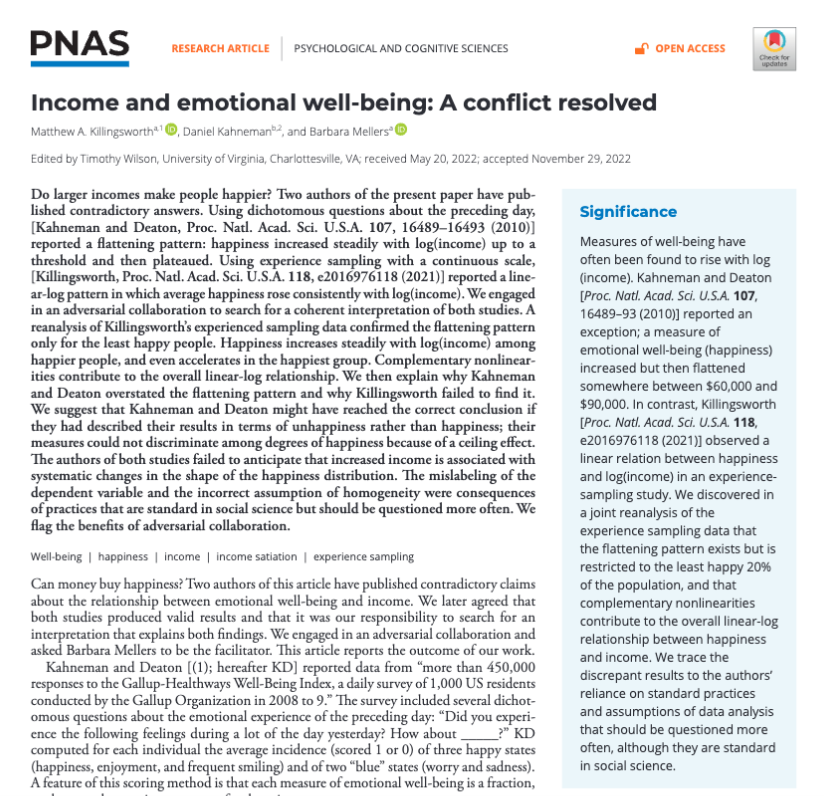
Does money buy happiness? A Princeton Nobel laureate said no above $75,000. A Penn researcher with 1.7 million data points said yes. The day they sat down together to settle the fight, the answer they reached should change how you think about your own life.
The Nobel laureate is Daniel Kahneman. The Penn researcher is Matthew Killingsworth.
The fight between them lasted 13 years, and the way it ended is one of the cleanest examples in modern science of two smart people being wrong in opposite directions about the same question.
In 2010 Kahneman and his Princeton colleague Angus Deaton published a paper that became one of the most quoted findings in the history of social science.
They analyzed 450,000 responses to the Gallup-Healthways Well-Being Index and concluded that emotional well-being rose steadily with income up to about $75,000 a year, and then flattened out completely. Above that line, the extra money was not buying any more daily happiness.
The headline traveled around the world. Every news outlet ran the number.
A CEO in Seattle famously cut his own salary to raise his employees to that exact threshold. The 75,000 dollar figure became cultural shorthand for the idea that the rich are not actually any happier than the rest of us once basic needs are met.
For 11 years almost nobody seriously challenged it. Kahneman had a Nobel Prize in Economics, the sample size was massive, and the conclusion was emotionally satisfying in a way that made everyone feel a little better about not being wealthy.
Then in 2021 a 33 year old researcher at the University of Pennsylvania published a paper that quietly destroyed the entire finding. His name is Matthew Killingsworth.
He had spent the previous decade building a smartphone app called Track Your Happiness that pinged users at random moments during their day and asked them a simple question.
How do you feel right now, on a scale from very bad to very good. The app was designed to catch happiness in the act, not to ask people to recall it later.
By 2021 he had collected over 1.7 million real-time happiness reports from 33,000 adults. When he plotted income against in-the-moment well-being, there was no plateau anywhere.
The line just kept rising. People earning $200,000 were happier on average than people earning $100,000. People earning $400,000 were happier than people earning $200,000. The curve flattened slightly but never stopped climbing.
The famous $75,000 ceiling that the world had been quoting for 11 years simply did not exist in his data.
Now there were two Nobel-quality findings sitting in direct contradiction with each other. One of them had to be wrong, and neither researcher was willing to walk away.
What happened next is the part of the story almost nobody knows.
Kahneman called Killingsworth and proposed something rare in academic science. He called it an adversarial collaboration. The two of them, joined by Penn psychologist Barbara Mellers as a neutral referee, would sit down together and reanalyze the raw data from both studies, line by line, until they figured out which one of them was wrong.
The paper they co-authored was published in March 2023 in the Proceedings of the National Academy of Sciences. And the answer they reached was not what either of them had expected.
Both of them had been right at the same time. They had been measuring two different populations without realizing it.
When the team broke Killingsworth's 1.7 million data points apart by baseline happiness, the picture clarified completely. For the happiest 70 percent of people, more money kept buying more happiness all the way up to $500,000 a year, with no sign of slowing down.
For people in the middle, the same pattern held. But for the bottom 20 percent of the sample, the ones who were already unhappy before the question of money even came up, the curve flattened almost exactly where Kahneman's original paper had said it would. Above roughly $100,000 a year, adjusted for inflation, more money did nothing for them.
This is the finding that changes how the question should be asked.
If you are not already unhappy, money keeps buying happiness for a much longer stretch than Kahneman's original paper suggested. The runway is wider than the world has been telling itself for a decade.
If you are already unhappy, money does almost nothing past a certain point. There is a ceiling, but the ceiling is not about income. It is about the underlying state of the person collecting it.
The deeper insight in Killingsworth's original research, the one almost nobody talks about, is the part that should sit with you longer than the income numbers. The Track Your Happiness app had been telling him for years that the single biggest predictor of in-the-moment well-being is not money at all. It is whether your mind is on the thing you are doing.
His most cited paper, written with Daniel Gilbert at Harvard, is titled A Wandering Mind Is an Unhappy Mind. The data from the app showed that people are mentally absent from what they are doing 47 percent of the time, and that mental absence is one of the strongest predictors of unhappiness in the entire dataset. More predictive than income. More predictive than the activity itself. More predictive than almost any demographic variable you could measure.
Which means the unhappy 20 percent that Kahneman's plateau actually described were probably not unhappy because they did not have enough money. They were unhappy for reasons that more money could not reach.
The reason the curve flattened for them at $100,000 a year is the same reason it would have flattened at $300,000 or $700,000. The thing they were missing was not buyable.
The most uncomfortable line in the entire 2023 paper is the one that nobody on the internet quotes. The authors note that the relationship between income and happiness, while real, is much weaker than the relationship between attention and happiness. A person earning $40,000 who is fully present in their own life will, on average, report higher in-the-moment well-being than a person earning $400,000 whose mind is somewhere else.
The fight about money was the wrong fight the entire time.
The two researchers spent 13 years arguing over whether the dollar ceiling was at $75,000 or $500,000, and the data from Killingsworth's own app was sitting there the whole time saying the ceiling was not about dollars at all. The ceiling is whether you can hold your attention on the life you actually have.
You can run the experiment yourself the next time you catch your mind drifting. Stop. Put your phone down. Look at the room you are in, the person across from you, the food in front of you, the work you are actually doing. That is the part the apps cannot sell you and the salary cannot buy you.
The data has been clear for over a decade. The plateau is not in your bank account. It is in your attention.
Very helpful endorsement for anyone still undecided.
For the average San Franciscan who thought Saikat was an obnoxious, self-satisfied, entitled district shopper who tried to buy a Congressional seat, it’s now more clear than ever to vote for @Scott_Wiener in November.
@moriah_bridges Jesus does this multiple times with his disciples. It’s deeply effective when done from a place of best intentions and belief the person can get there.
remember: when you don't build new luxury housing, luxury buyers outbid for down-market units and convert them.
this makes housing more expensive for everyone, and it's why building all housing (regardless of price) is critical to reduce prices
I just got home and there were about 30 people in their twenties outside the property across the street waiting to see it and rent it. This is an awful property too, yet such is the nature of the rental market in SF.
We could literally add 10% housing capacity to the entire city and would still have people desperate to rent.
What’s the so-called progressive movement, as best represented by Saikat and Connie Chan doing about it? Jack shit. They would rather have people go homeless than building homes.
Peak SF vibe based politics. Claiming to be for the people while at the same time promoting the laws that put people on the street.
on the one hand the spacex stock price is totally bananas on the other hand he's the only guy in the West that can build physical things so maybe it's way underpriced
san francisco is the best city in the world for builders.
except we can't seem to build a damn thing.
we are in a housing crisis, and nobody is treating it like one.
this should be a five alarm emergency. instead, most of our downtown sits as single story convenience stores and parking lots. there is wasted space everywhere while my one bedroom apartment is pushing over $5k/month.
if we want this city to continue thriving, we can't keep waiting. every month we don't act, more talented people get priced out. founders, engineers, artists. the people who make this city what it is.
by now we should have 50 cranes filling the skyline. the entire downtown corridor should be filled with high density high rises. instead we have parking lots and a permitting process that takes longer than building the actual building.
the demand is there, the supply is not. cut the bullshit, and let people build:
- fast track permitting. cut the approval timeline from years to months
- cut developer fees. we'll make it up ten times over in tax revenue from a thriving economy
- create tax incentives for developers who break ground immediately. remove transfer tax on abandoned buildings. make it easier to build than to let a building sit empty
- reform ceqa so a single lawsuit can't kill a project. stop letting politics destroy our city's future
- set a target. approve enough projects to replace 50% of our vacant buildings within 12 months
the city that tells founders to move fast and break things has spent decades moving slow and breaking almost no ground.
our city is on fire. people want to live here. we need to start acting like it.
a YC founder i'm working with was worried because one customer had already built a simple version of his product in-house.
i told him that's not a bad sign, and it's actually the best proof point he has.
if a company is spending expensive engineering time on the problem you're solving, that validates a bunch of things at once:
- the pain is very real
- other vendors are not good enough
- many companies likely have the same pain too
wow - this is huge!
anthropic is officially walking back their decision about banning programmatic use of claude code subscription quota
why is this a big deal?
this is a signal that anthropic is revisiting their ecosystem strategy which many of us have been criticizing
by allowing invoking claude code programmatically, anthropic will basically extend their subsidized subscription to power a much wider range of applications, not just their own, which effectively means they are leaning more into being an infrastructure provider rather than the super app that eats everything else
they still have more to do to gain back my trust as a developer but this is a very positive change and i'm happy to see anthropic revisiting their strategy
California is turning UC Berkeley — the best public university on earth — into a remedial high school. At least half the students now entering its primary STEM sequence aren't even proficient in precalc:
California is turning UC Berkeley (whose professors won 4 Nobel Prizes last year) into remedial school. No SAT for admissions and a new mandate to make everyone's "outcomes similar."
No mention of excellence.
This is how bureaucrats kill the nation’s best public university.
In 1960, California’s Master Plan built the greatest public university system on earth with a simple division of labor: community colleges for access, Cal States for broader competitive range, UCs for PhD training and frontier research.
Then came the 2022-2027 Multi-Year Compact.