Manas Arora is overrated.
His strategies don't work.
Is what his jealous haters say.
But I took his 1-On-1 Mentorship and it transformed my trading.
Here are 8 powerful ideas I learned that you won't find anywhere else on X👇
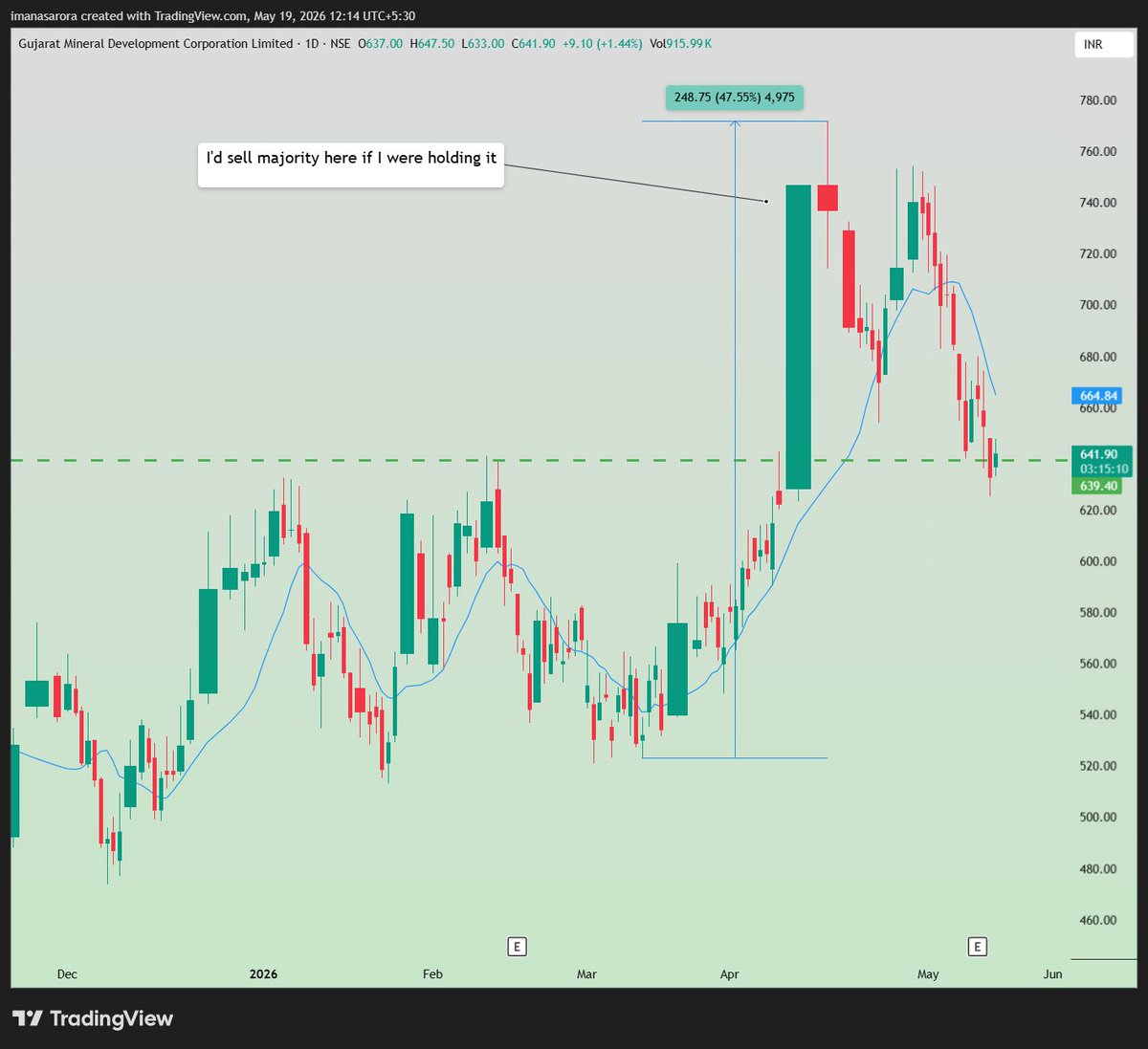
There was a discussion on #GMDC and I said I’d sell majority here if I were holding it. The other person was surprised because it had just given a roaring 6 month base breakout with gigantic volume.
“Then why sell?”
Because you are a swing trader. Not a long term investor.
50 to 60% upside is your bread and butter in most cases. This is crucial to set expectations right.
The stock was already up 47%.
If you don’t sell into strength, the stock will eventually force you to sell into weakness a few days or weeks later.
Most beginners think the breakout candle is the opportunity. Experienced traders know the move usually starts much before the obvious breakout appears on everyone’s screen.
Could it still go higher? Sure.
But swing trading is not about squeezing the last 10 to 20%.
It is about taking the fat middle safely and repeatedly.
#BroTip
WHY MY STOCKS GO NOWHERE EVEN WHEN THE MARKET IS MOVING
A couple of days back, I got this question on WhatsApp, and honestly, it’s one of the most common ones traders ask. So, let’s address it.
The answer is simple: it’s a stock selection problem.
Most traders avoid the real leaders, the top-tier stocks, and instead settle for the second-tier ones. They stay away from where the actual momentum is, thinking the top stocks are “too high” or “too risky.” So, they end up putting money in dull, lifeless names, stocks with no demand, no volatility, and no real movement.
This mindset is often reinforced by so-called “gurus” who have no real trading experience, advising people to “buy near the 50-day average.” The truth is, by the time a great stock comes near its 50-day average, the strong part of its run is usually over, momentum is fading, and the leadership is shifting elsewhere.
Settling for the mediocre is a common human tendency, especially among those who subconsciously believe they don’t deserve the best. A few days ago, I came across a wonderful article on this topic that I think everyone should read. Although the subject was dating, the conclusion was exactly the same. I especially loved how the author, @BritHugoboom, ended the piece:
"Most people think small. Most people live small. They don’t care to step outside the ordinary, and that’s why so few ever get the extraordinary. I often use the “walk sign” theory as a reference: most people will follow once someone takes the first step, but they rarely make the first move.
Thinking big takes no more energy than thinking small. In fact, it often takes less. And when you think big, you’re competing against fewer people. The kind of people you want on your side. Few understand this."
The same applies for your stock selection.
https://t.co/U5vjsJrA8J
Qullamaggie shows Exit Strategy for Long Swings
“What’s your exit strategy for such long swings? How do you decide this? Okay, that’s easy. Let’s take an example, ROKU. So I bought it here, on the opening range size. It gapped up on earnings, huge volume. All the things I’m looking for. You know, long range break had like a 6, 7-month range break had surprising good earnings. Great growth, etc.
I sell some, maybe 15 to 20%. A quarter of my position, and then I trail it. Then I just start trailing it like the first close below this purple line. That’s the 10-day moving average. I sell maybe say a quarter or a third of what I still have left. The shares I have left after the ones I bought. Sold into strength, and then I sell another third or quarter when it hits the first close below the 20-day moving average, which is the yellow line. And then the next level is the red line, which is the 50-day, etc.
So that’s how I scale out. So that’s what I use these moving averages for. I wait for them to be my stop pretty much. So I wait until the end of the day and I sell it.
Then I also have a level. Let’s just take an example right here. I usually use the previous swing’s lows as my stop. Then I would get out at 79. Even though it turns up intraday and closes above this yellow line, I would have to stop. You know, you can get stopped out because you know. I can, so you know. Sometimes stocks, they go, they can go down, you know, 20%.50% in a day, even. You know mid and large cap names can do that sometimes. So, you know, if it hits my last resort stop, it is my last resort stop. I just sell it.
If that was helpful, those are my sell rules, sell into strength and I trail the rest.”
Q - How do I know if I’m chasing a stock too late?
It’s so hard to tell when it’s already gone up so much.
A - That’s where base analysis helps you see through the noise.
A stock doesn’t go up in a straight line it runs, rests, then runs again. These resting zones are called bases. The first two bases usually come early in the trend that’s where the real money is made.
But by the time a stock is building its fourth base, it's already run a long marathon.
At base 1, institutions are loading.
At base 2, smart traders are still early.
Base 3 is where retail starts noticing.
By base 4 the crowd has arrived. The stock's been stretched, the growth’s priced in, and expectations are sky-high. Risk is no longer worth the reward.
People think they're buying momentum.
They’re actually buying exhaustion.
So Move on when you find a stock at base 4.
It’s already had its party. Don’t be the guy who shows up when the DJ’s packing up.
Most traders wait for breakouts.
But the strongest stocks reveal themselves *before* price moves.
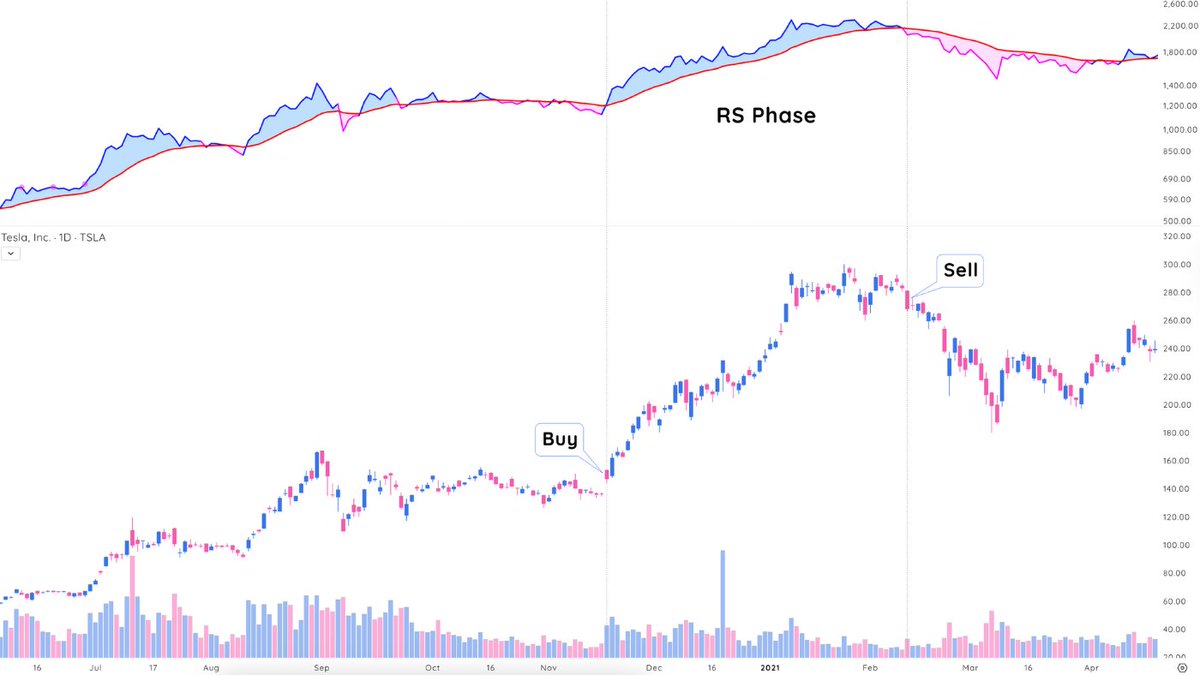
It’s called the RS Phase; a repeatable signal of quiet strength.
Here’s how to spot it and trade it step-by-step:
Qullamaggie On Doing The WORK @Qullamaggie
"I went to TC2k and looked at all U.S stocks. Put up the monthly chart as far back as possible and look at all the big moves. Every stock that went up a few hundred of % I looked at price action, news, and earnings."
"Same patterns occurring over and over again. Learn the setups and patiently wait for them."
Number one goal for any new or struggling trader should be to have absolute mind clarity about a setup.
if you don’t understand a setup just don’t trade it.
you are going to loose money doing that
@finallynitin Trading is a play of timeframe. Any chart is meaningful in some timeframes. My question is do we need to change my trading timeframe to find a meaningful chart ? 🤔
Do not misunderstand the phrase “keep your losses small.”
It is relative, meaning “in relation to the profit you are aiming for.”
Blindly tightening your stop-loss does not work; it only lowers your win rate.
Traders are not fortune-tellers who can predict the future with precision🧵
Profitable traders are not winning because they can foresee the future accurately.
I do not make predictions, nor do I believe it is necessary to know what lies ahead.
🧵1/5
Learn the art of “not learning from losses” 🧵
Many interpret the phrase “learn from failure” as “learn from losing,” but in trading, loss does not equal failure.
Seeing every loss as a failure and trying to extract a lesson from it only undermines your consistency.
🧵1/5