🎉 "Ask Twice, Look Twice" was a Spotlight Oral at the eXCV Workshop, #ECCV2026! #eXCV
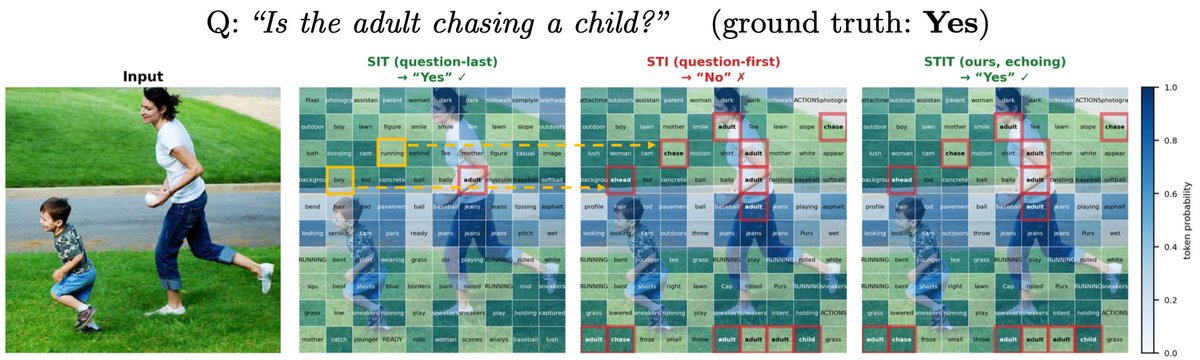
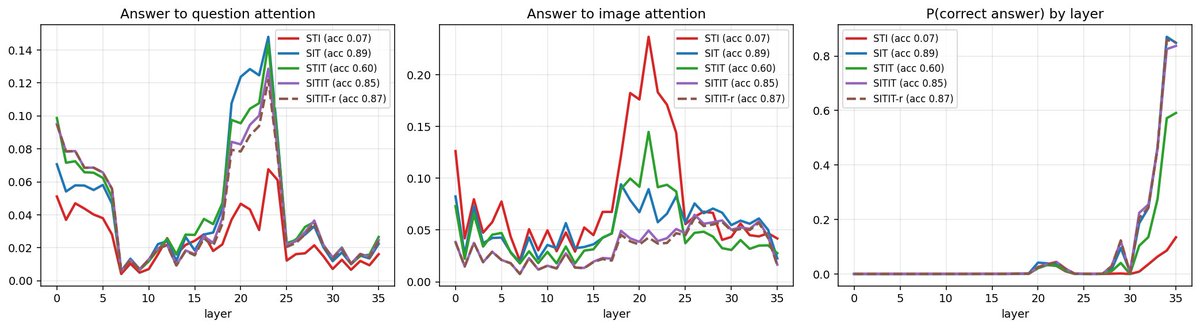
The question before the image should help: it steers where the model looks, and we show it does. Yet it answers worse. Our fix: echo the question.
📄 https://t.co/IrO0yJh5Ud
Bonus 1: this is an extreme few-shot learner. One image per class is enough to rank the pool: 60.1 vs 57.2 for CoOp prompt tuning, fitting in under a minute instead of 14 hours. And the classifier is a readable word list, not a soft prompt.
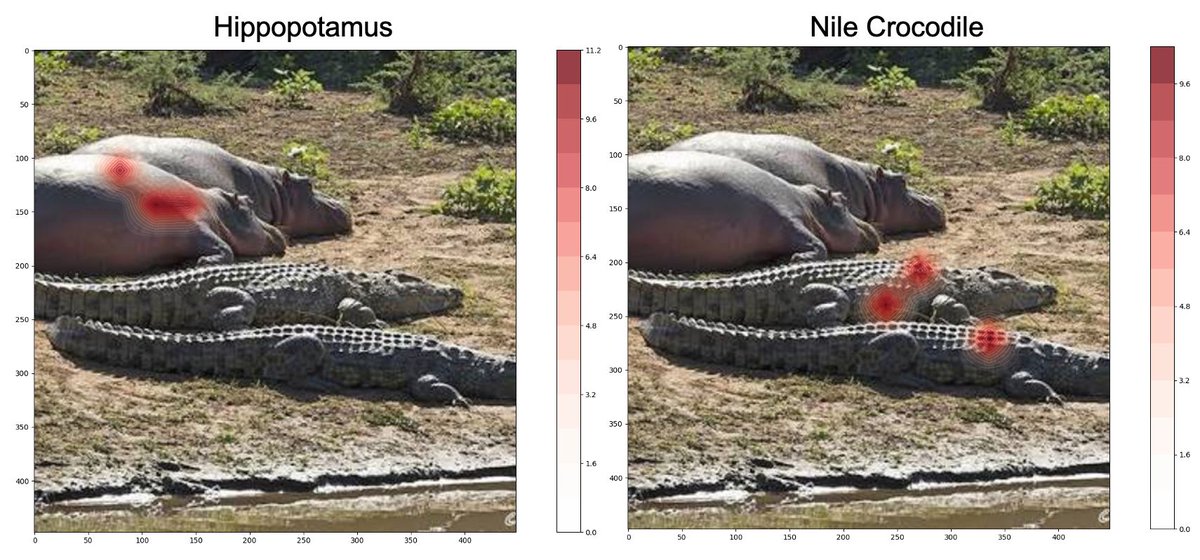
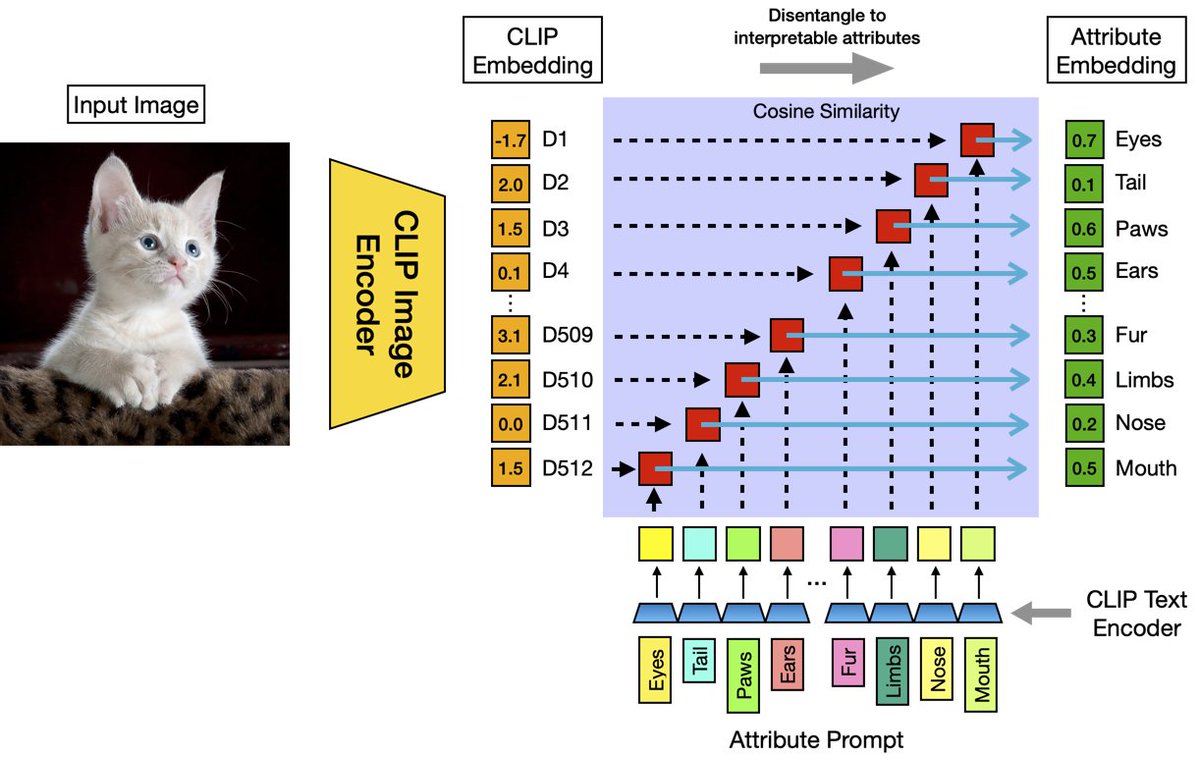
Bonus 3: the attributes localize. Keep CLIP's spatial grid, query the patches with a class's attribute words, and the object lights up with no class name in the query. The same trick describes any image region in words.
The fix: get attributes from the images. A frozen CLIP scores a candidate pool against the target collection; each class keeps its top matches. Same pool, reselected: 15.5 → 19.4. Bigger pool at 5 words/class: 23.8. Uncapped: 45.5, nearly 3x the LLM descriptors.
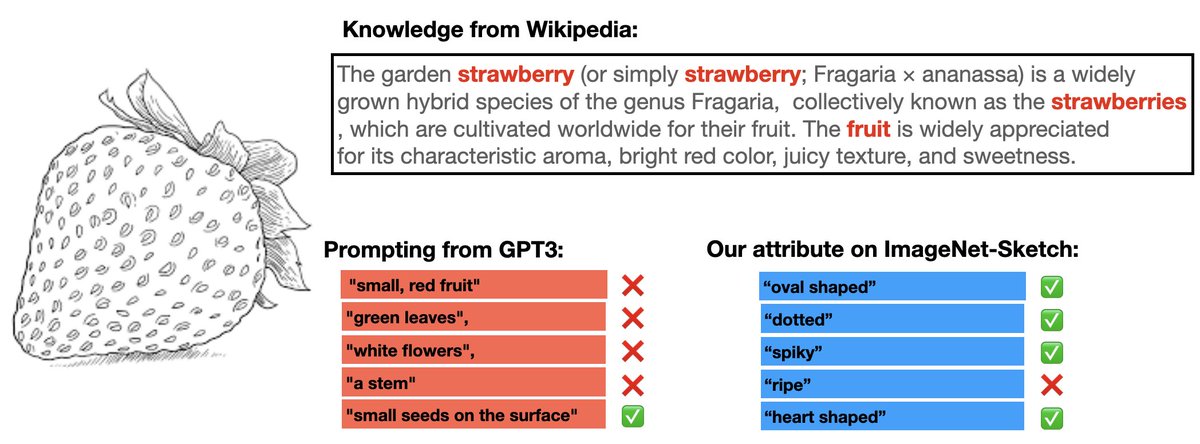
The test is simple. Take the popular GPT-3 descriptors for ImageNet ("a strawberry is red, has seeds"). With the class name in the prompt: 59.5%. Descriptors alone, class name removed: 15.5%. The descriptors never carried the evidence; the class name did the work.
Why: a descriptor conditioned on a label can only describe the typical concept, so under distribution shift it is confidently wrong. The LLM insists strawberries are red and ripe; every strawberry in ImageNet-Sketch is a colorless line drawing.
Concept bottleneck models promise interpretable vision: predict named attributes first, classify from them. Where do the attributes come from? Usually an LLM prompted with the class name. No image is ever consulted. That turns out to be the weak link 🧵
@ylecun@Dan_Jeffries1 What keeps me awake isn’t that AI will hate humanity, but that it will understand us too well and conclude that we’re the problem: intelligent enough to know the consequences, yet still harming ourselves, our children, our planet, and countless other species.
Bonus: the same idea appears in a 50-year-old result on human "adjunct questions." 🧠 Led by @RakshandaHA, with John Galeotti & @RamananDeva. 🌐 https://t.co/JCjPgFCriR
The fix, question echoing: repeat the question on both sides of the image. One copy steers perception, the other is read at answer time. +19 group-acc on Winoground, plus gains on NaturalBench, POPE, VQAv2. No training.
The intuition is half right: a question placed first really does steer perception to the right regions. But stranded behind hundreds of image tokens, that steering is never read at answer time. Good perception, bad access.
🎉 "Ask Twice, Look Twice" was a Spotlight Oral at the eXCV Workshop, #ECCV2026! #eXCV
The question before the image should help: it steers where the model looks, and we show it does. Yet it answers worse. Our fix: echo the question.
📄 https://t.co/IrO0yJh5Ud
At #ECCV2026 presenting DetPO.
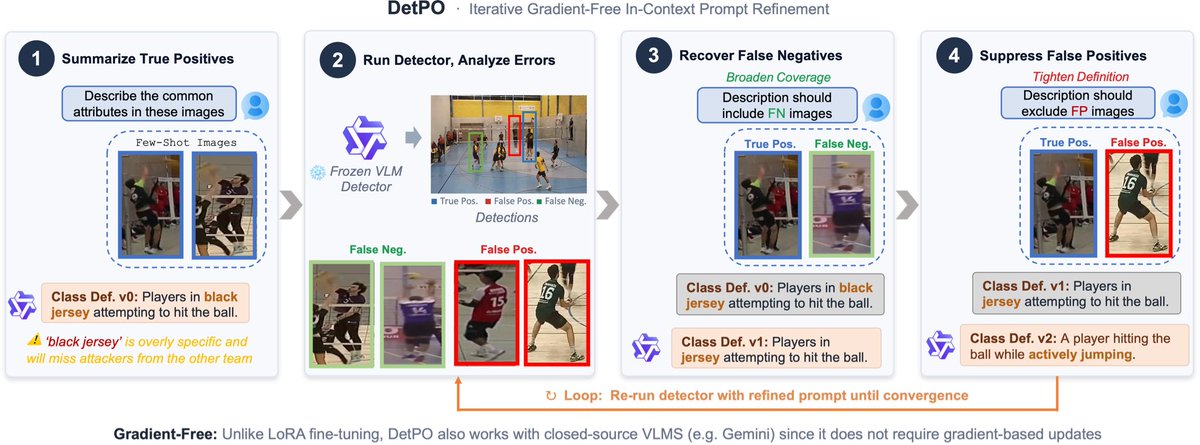
TLDR: don't feed a VLM few-shot examples at inference. Use them to find what it gets wrong, then rewrite the class prompt to fix them. No fine-tuning.
Poster #211, Session 5. w/ @NeeharPeri@Matvezy Shruti Jain, John Galeotti, @RamananDeva
Error-driven prompt optimization makes VLMs better at few-shot object detection, outperforming general-purpose prompt optimizers like GEPA. Stop by to see "DetPO: In-Context Learning with Multi-Modal LLMs for Few-Shot Object Detection" at ECCV poster session 5 poster #211!
Error-driven prompt optimization makes VLMs better at few-shot object detection, outperforming general-purpose prompt optimizers like GEPA. Stop by to see "DetPO: In-Context Learning with Multi-Modal LLMs for Few-Shot Object Detection" at ECCV poster session 5 poster #211!