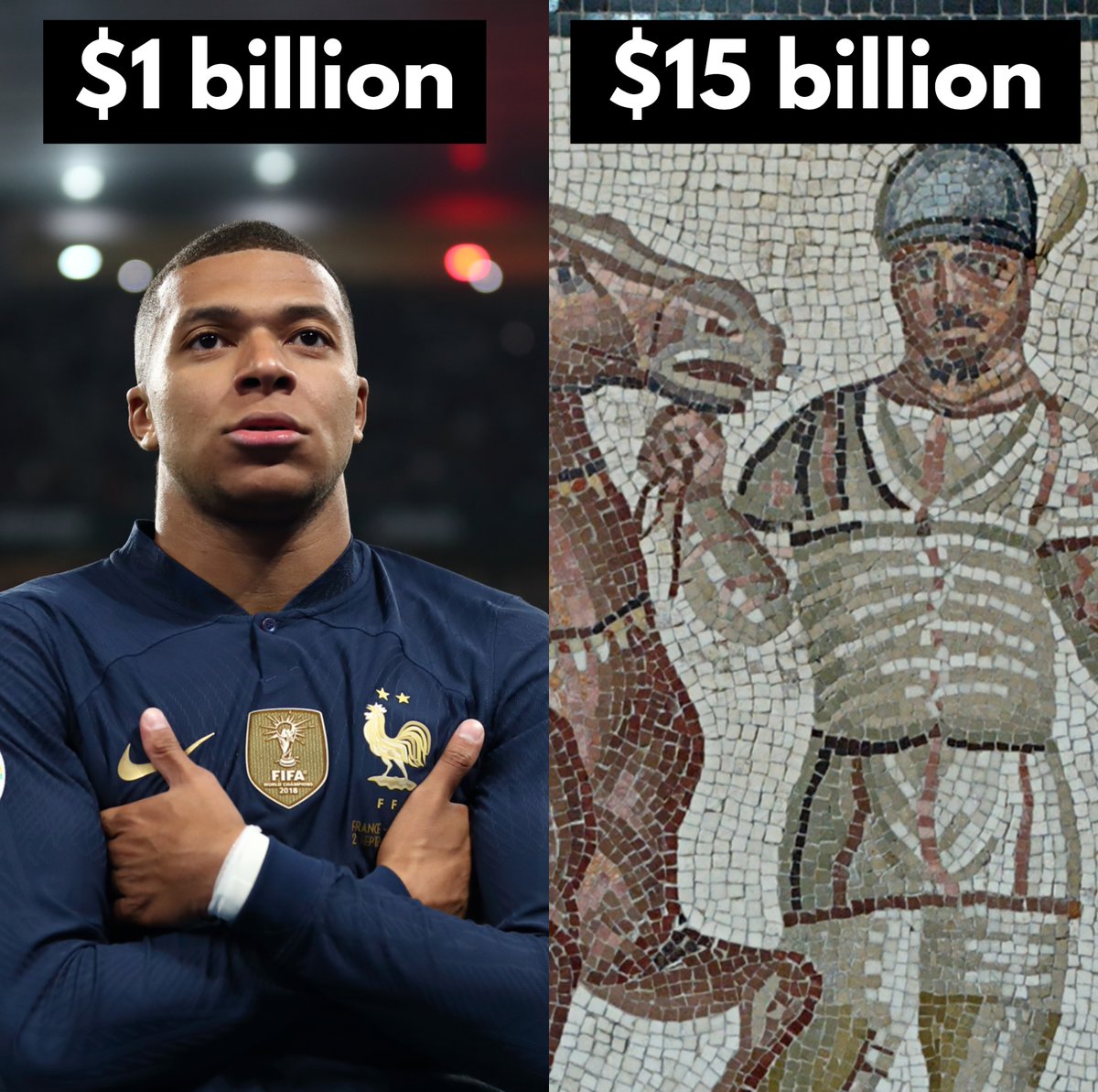
The football star Kylian Mbappé was offered $1 billion to join the Saudi Arabian team Al-Hilal.
But that wouldn't have made him even nearly the richest athlete in history.
Because there was a Roman chariot racer called Gaius Appuleius Diocles who earned more than $15 billion...
Chelsea FC in England have spent over one billion dollars on new players in the last year alone, and Cristiano Ronaldo is currently earning $200 million per year at the Saudi club Al-Nassr. Has football gone mad? Is it right for athletes to earn such exorbitant wages?
Let's leave the politics of that question to one side and simply observe that, as with so much else, there are historical precedents — and one in particular: Gaius Appuleius Diocles.
Chariot racing was the most popular sport in Ancient Rome, with races held all over the empire — there are ruins of huge stadiums around Europe. The crowds flocked to watch their favourite teams or racers, and the money came pouring in.
Gaius Appuleius Diocles was born in the province of Lusitania, modern-day Portugal, in 104 AD. That's where many charioteers came from — not just those who raced in Rome itself, but right across the empire — because it was where the fastest racehorses on the continent were bred.
And such was the career that Gaius pursued; he made his racing debut in Rome, which then had a population of well over one million and was the richest and largest city on earth, at the age of just 18.
There were four "factiones", sort of like teams, in Ancient Roman chariot racing: Green, Red, White, and Blue. Each had their own stables, managers, breeders, agents, patrons, sponsors, and racers. These were large, professional organisations with hordes of fans and fierce rivalries. Even the Emperor himself usually had a favourite faction.
Gaius joined the Whites and won his first race after two years. He stayed with them for another four years. Then he moved to the Greens, where he had a torrid run of poor performances and a serious injury, followed three years later by a move to the Reds. There he remained for fifteen years, winning over one thousand races, before retiring at the age of 42 to a lovely little town called Praeneste.
Where did Gaius race? At the Circus Maximus in Rome, now a ruin but once a racing stadium which could hold more than 150,000 spectators. It's hard to imagine the atmosphere, with the thundering of the horses drowned out by the roaring of the crowds and the sound of splintering chariots...
We know much of this because of two monuments made in Gaius' honour after his retirement. They also include the rather impressive statistics of his racing career — 4,257 starts and 1,463 victories — and the prize money he won: a grand total of 35,863,120 sesterces.
These earnings are estimated to have been, in modern terms, about $15 billion, which would make him by far the richest athlete in history. His fortune was equivalent to about 1.5% of the Roman annual state expenditure, which would be like an American sportsperson being worth over $100 billion.
But this is not merely an interesting factoid. What does it tell us about Ancient Roman society during the Empire that regular people had enough time, and that there was enough money in the system, to support such a wealthy sporting scene?
Alas, if you don't much like sports and wonder why some people get so worked up about athletes running round a field and kicking a ball... there's also a Roman precedent for that. Here's what the lawyer Pliny the Younger wrote to a friend in the year 98 AD:
"The Races were on, a type of spectacle which has never had the slightest attraction for me. I can find nothing new or different in them: once seen is enough, so it surprises me all the more that so many thousands of adult men should have such a childish passion for it."
Whether sports stars should earn the money they do is a complicated question. But, in any case, Kylian Mbappé has a long way to go before he's on the level of Gaius Appuleius Diocles...
Pierre Poilievre voted against building affordable and low income housing in 2014 when his party was in power. Did in again in 2018 and 2019 as part of the official opposition.
Canadians: this guy will solve the housing crisis
And finally, the ramp we were getting out was so steep the same RV that was parked next to us bottomed out on the ramp and it screwed up the bottom real bad.
Safe to say under any circumstances avoid travelling with Alaska Ferries...
Our Alaskan ferry from Haines to Skagway is actually so stupidly inefficient its hilarious
Literally makes BC Ferries look like an angel in comparison.
Currently hunting throughout the #yukon and #alska for bottles of #Sriracha to resell on the black market (fb marketplace) back home... No luck so far but we're searching.