Principal Deputy Assistant Secretary for Planning & Evaluation @HHSGov @HHS_ASPE. On leave: Professor @JHUCarey @JohnsHopkinsSPH @JohnsHopkins. Personal account
Part II of Professor @JohnHCochrane's talk at @HHS_ASPE Health Economics and Policy Forum:
"The litany of arguments for market failures is largely wrong, including asymmetric information and preexisting conditions.
Regulations are usually far worse than the market problems.
Even so, there is no case that the current mess is a minimally crafted, beautiful technocratic regulatory solution to well-documented market failures. This is simply a fairy tale if you want to defend the current mess."
Full video, "Freeing the Market for Health Care," in the original post.
h/t @caseybmulligan@HooverInst@HHSGov
Part I of Professor @JohnHCochrane's talk at @HHS_ASPE Health Economics and Policy Forum:
"🟡Healthcare is a relatively complex, personalized service, with great variety in what people want and how they want it, and with elastic demand.
🟡There is no inherent reason for economic regulation of healthcare—who pays for what and how much. Airlines don't tell you how much you have to pay to come to D.C.
🟡Health insurance is also a complex, personalized service. One of the biggest sources of confusion is the distinction between healthcare, which protects your life, and health insurance, which protects your pocketbook. Health insurance is completely amenable to the free market."
Full video, "Freeing the Market for Health Care," in the original post.
h/t @caseybmulligan@HooverInst
Summary of Professor @JohnHCochrane's scholarship on health policy by @HHSGov Deputy Chief Policy Advisor Christiana Nulty
Full video "Freeing the Market for Health Care" is in the quoted post below.
Summary of Professor @JohnHCochrane's scholarship on health policy by @HHSGov Deputy Chief Policy Advisor Christiana Nulty
Full video "Freeing the Market for Health Care" is in the quoted post below.
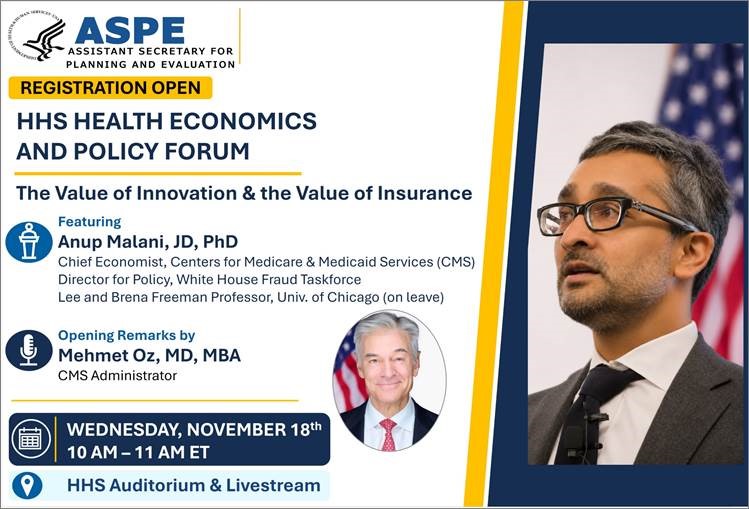
Join us in person or tune in today at 10 AM ET for Professor @anup_malani's lecture, "The Value of Innovation & the Value of Insurance":
https://t.co/m1j6q0i03a
Event page: https://t.co/XwiGeQ6cCF
h/t @DrOzCMS@CMSGov
Join us on Wednesday, Nov. 18, at 10 AM ET in the @HHSGov Auditorium for a lecture by @anup_malani: The Value of Innovation and the Value of Insurance.
Opening remarks by @DrOzCMS.
Registration is open to the public: https://t.co/XwiGeQ6cCF
@CMSGov@HHS_ASPE
Join us in person or tune in today at 10 AM ET for Professor @JohnHCochrane's lecture, "Freeing the Market for Health Care":
https://t.co/ktdWzwHFYB
Part III of Professor Cochrane's insights:
Elastic Demand: The demand curve for healthcare is incredibly elastic. When healthcare is provided at low cost, people consume prodigious amounts of healthcare services. When asked to pay more, consumers economize rapidly, refusing “too much” care in the judgment of the medical community. Variation of demand across people within income categories is far greater than variation of demand with income by the average person
Healthcare Need: “Need” is not an economic concept. Need is essentially impossible to measure externally for a personal service with so much variety and imperfection as healthcare. What you “want” is where you make the cost/benefit decision. What you need is what a panel of bureaucrats— think you should get. The distinction between “need” and “want” is at best unmeasurable and at worst simply meaningless. The word “need” also has a moral tone, implying “what society owes you.” How much back treatment did society owe me? If the patient chooses to forego treatment, or to find a cheaper alternative and keep half the cash, you cannot argue the patient “cannot afford” treatment.
Nature of Healthcare: Healthcare is a complex, highly varied personal service. The demand curve is as elastic as any in economics. When, where, how, how much, by whom are vital components of that service. Objective and subjective quality and corresponding cost vary tremendously, and many dimensions of that quality are not easily measurable. Healthy markets do not emerge because our current web of healthcare laws and regulations forbids them from doing so, not because of intractable market failures.
Freeing the Market: Health is so important— and so varied, so personal, and so subjective— that it must be left to the market. If you do not trust the vast majority of people to make the most important decisions of their lives, and a government bureaucracy can make better decisions on their behalf, you are a devout patrician, not a devout capitalist. Most health-economics policy discussion takes the bulk of our current legal and regulatory structure for granted, in particular that the government will have a heavy hand in providing, paying for, and directing the private provision of and payment for healthcare. A market-based alternative does exist, and it is realistic.
Reading: https://t.co/TPEQGZUnJE
Event page: https://t.co/UdjQTKdMY1
@caseybmulligan
Part II of Professor @JohnHCochrane's insights. Livestream Tuesday at 10 AM ET:
https://t.co/SJNvUcAkj8
11. Nature of Healthcare: Healthcare is an economic good, not that different from the services provided by lawyers, auto mechanics, home remodelers, financial planners, and restaurants.
12. Third-Party Payment: When somebody else is paying, people do not economize. More importantly, it is a lot harder for new entrants to attract business when people are paying with someone else’s money.
13. Limits of Medicine: For most patients, “Stop smoking, exercise and lose some weight” is the best advice they could take. How much drugs and treatment do patients need who won’t stop smoking, lose weight, exercise, do the physical therapy, or comply with drug regimes?
14. Cash Market: The absence of a functional cash market lies at the heart of many insurance pathologies and government cost-control problems. Insurance functions best when it is a small part of a market, in which prices are set by marginal consumers paying cash and competitive businesses supplying them. With little price discovery left in healthcare, health insurers have to do all the price negotiation in a vacuum. If there were functional cash markets, health savings accounts could substitute for much of the necessarily cumbersome functions of insurance.
15. Medicare Rates: Many pricing decisions are based on Medicare reimbursement rates. But from where does Medicare get its rates? With no supply-equals-demand pricing going on anywhere, how does price discovery happen?
16. Freeing the Market: Freeing up either supply or demand without freeing up the other will do little good. Both supply and demand must be freed, along with insurance.
17. Patient Shopping: Healthcare involves many difficult decisions involving course of treatment, extent of treatment, method of delivery, and so on. People can shop. Thinking the vast majority of us are incompetent is a breathtaking aristocratic paternalism. The poor little peasants cannot possibly be trusted to take care of themselves. We, the bien-pensants who administer the state, must make these decisions for them.
18. Provider Reputation: Healthcare is a long-term relationship. In fact, roadside car repair and gas stations on interstates are remarkably honest, even though most of their customers meet them once. Competition leads to clear posted prices, and businesses anxious to gain a reputation for honest and efficient service. The theory that unregulated competitive suppliers will pawn off shoddy merchandise on consumers, so often expressed in medical contexts, is exactly false in every other industry.
19. International Context: I’m often told, “All countries regulate health care or governments provide it.” 150 years ago, the U.S. looked across the ocean and nearly all the governments were monarchies. That observation did not prove that monarchy was a better system.
@caseybmulligan@HooverInst
In anticipation of Professor @JohnHCochrane's lecture at HHS on Tuesday, 11/17, here are his insights (Part I):
1️⃣Nonprofits: Nonprofits’ legal and regulatory treatment protects inefficiency from competition. The whole point of a nonprofit is to pursue goals other than economic efficiency. If a for-profit company is inefficiently run, another company or a private-equity firm can buy up the stock cheaply, replace management, and force reorganization. Nonprofits (especially their management) are protected from this “market for corporate control.”
2️⃣Quality: A big stated point of regulation is to ensure quality. It is interesting how bad a job it does. Regulators can impose minimum standards, requiring degrees, certification, inspections, and the like, and keep out really dangerous quacks. But beyond that, they are terrible at pushing for higher quality, especially when quality means so much in the experience of a customer in a service-oriented business.
3️⃣Competition: How can healthcare emulate the quality improvements and cost reductions of successful service industries? Intense competition—in particular, competition from new entrants, who put old companies out of business or force unwelcome and disruptive changes. The simple fact that hospitals will not tell you a price ahead of time makes it blatantly obvious. No competitive industry would dream of getting away with this.
4️⃣Bend the Cost Curve: Look for every limit on supply of healthcare services, especially entry by new companies, and get rid of it.
5️⃣Cost Reduction: Cost reduction is a painful process, and our political system is allergic to pain. Regulators can stand back and let the market do it.
6️⃣Medical Records: Rather than ask what features of current law and regulation are causing hospitals to avoid the computer revolution, and rather than remove those roadblocks, the government adds a new layer of subsidies and contradictory legal pressure.
7️⃣Cross-Subsidy: You cannot have cross-subsidies with competition. Thus, the hospitals providing EMTALA service have to be protected from competition. But businesses protected from competition soon become complacent and sclerotic and find other ways to lose money. They also find ways to lobby regulators for even more protection from competition, so as to continue to provide the regulators’ desired cross-subsidy.
8️⃣Regulatory Capture: Regulators are notoriously captured by industries, especially when those industries feature large and politically powerful businesses with large and politically powerful constituencies, as in health insurance or as in most cities’ hospitals. In turn, regulated industries quickly become dominated by large and politically powerful businesses.
9️⃣Bureaucratic Power: Our regulatory system hands vast discretionary power to officials and their administrative bureaucracy. And criticizing a regulator with such power is a dangerous business.
🔟Regulation, mandated cross-subsidies, and protection from competition also help to hide the size of the government’s interventions from a skeptical electorate. The economic effect is exactly the same as “taxing and spending,” and the distortions are exactly the same.
@caseybmulligan@HooverInst
1️⃣Share of Global Pharmaceutical Drug Revenues by OECD Country, 2020–2025
2️⃣Pharmaceutical Drug Revenue Share Relative to Population Share by OECD Country, 2020–2025
3️⃣Pharmaceutical Drug Revenue Share Relative to GDP Share by OECD Country, 2020–2025
h/t Stephen Murphy
1️⃣Share of Global Pharmaceutical Drug Revenues by OECD Country, 2020–2025
2️⃣Pharmaceutical Drug Revenue Share Relative to Population Share by OECD Country, 2020–2025
3️⃣Pharmaceutical Drug Revenue Share Relative to GDP Share by OECD Country, 2020–2025
h/t Stephen Murphy
ASPE report by economist Stephen Murphy: https://t.co/GoAoSFyk9G
1️⃣Global financing of pharmaceutical innovation remains highly concentrated in the United States.
2️⃣The study clarifies the burden-sharing issues embedded in international debates over drug pricing and access.
@HHS_ASPE@HHSGov