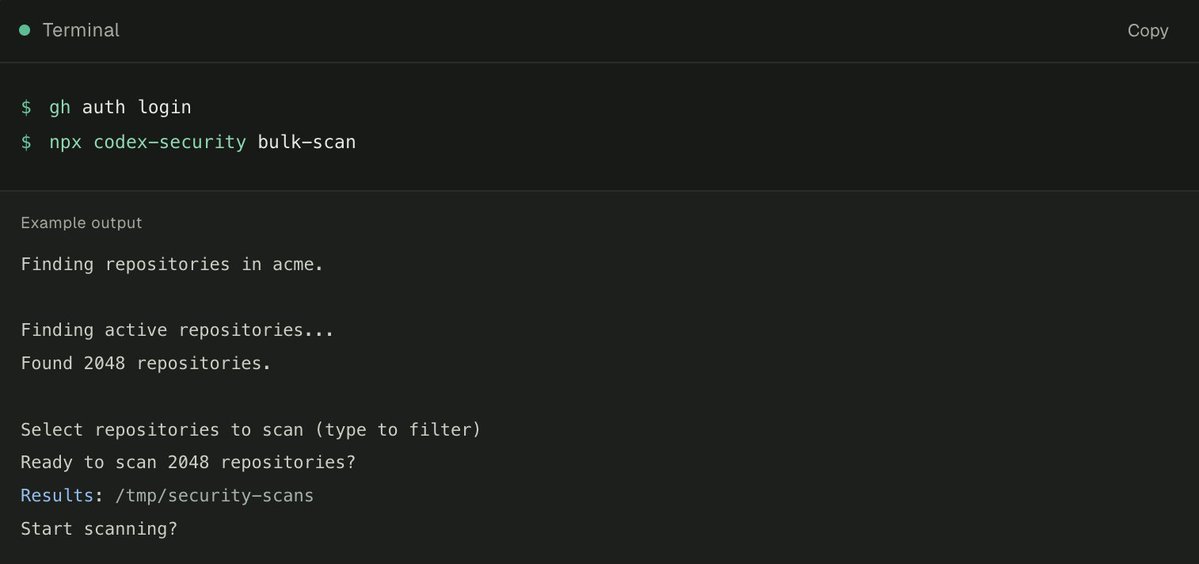
We quietly released the open-source Codex Security CLI, but Hacker News found it before we had a chance to share it here...
You can now use it to scan repositories, track findings across runs, verify fixes, and add security checks to CI/CD.
This is an early release, and we're listening to your feedback as we continue improving it.
NEW: 🇨🇳 China's nuclear fusion research has completed a massive magnet weighing 582 tons.
The goal is an "unlimited energy" artificial sun.
They plan to start the first power generation by 2030.
A safe, CO2-zero ultimate energy race.
Today we're releasing Laguna S 2.1, our most capable model to date.
It's a 118B total parameter Mixture-of-Experts model with 8B activated per token, a context window of up to 1M tokens, and thinking and no-thinking modes.
Capable enough to hold its own against models many times its size. Small enough to run on a single @NVIDIAAI DGX Spark.
Laguna S 2.1 is fully open under OpenMDW-1.1, with weights available today on @huggingface
https://t.co/xxGeAgo35R
Browser automation gets brittle when every layout change breaks a selector.
Skyvern is a browser automation toolkit for developers and teams automating manual workflows across websites.
It helps you build multi-step web automations by combining Playwright-compatible controls with LLMs and computer vision, rather than relying only on fixed XPath selectors.
Key features:
• AI page commands – act, extract, validate, and prompt using natural language.
• Playwright integration – mix standard selectors with prompt-based targeting and AI fallback.
• Workflow builder – chain browser tasks, extraction, validation, loops, HTTP requests, and custom code.
• Structured outputs – return extracted data against an optional JSON schema.
• Flexible setup – use Python or TypeScript SDKs, and run locally with pip or Docker Compose.
It’s open-source (AGPL-3.0 license), with managed-cloud anti-bot measures excluded from the repo.
Link in the reply 👇
I had early access to GPT-5.6 Sol.
It’s an amazing model, but for almost every task I tested, Fable was quite a bit better, and more agentic to boot (one Fable turn does the same thing many 5.6 turns do).
Full review coming on launch day!
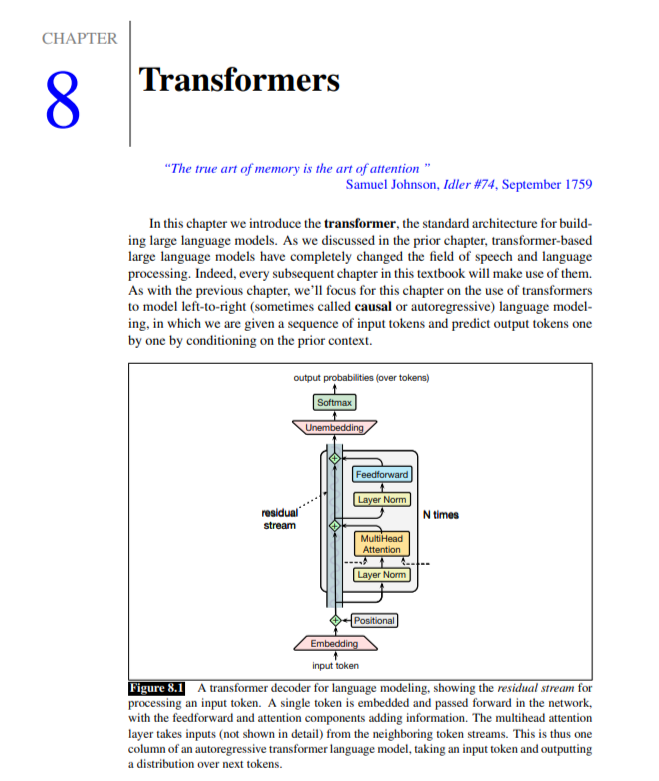
A great source to understand or refresh Transformer architecture
It explains how transformers process text token by token, using self-attention to build contextual representations
Covers:
- Token embeddings and positional encodings
- The residual stream that carries information across layers
- Multi-head self-attention and long-range dependencies
- Feedforward networks, layer normalization, and residual connections
- Transformer blocks stacked into deep language models
- The language modeling head that predicts the next token
It also connects these concepts to GPT and BERT
Hermes Agent now reads the web up to 60x faster and 49x cheaper.
Scraping backends pass clean content straight to the agent without redundant processing steps; large pages are saved locally and paged on demand so you get the same quality at a fraction of the time and cost.
Ex-Google engineer reveals how to build AI agent loops, harnesses, LLM ops, and evals in 19 minutes.
Trace → evaluate → diagnose → fix → ship → repeat.
That loop is how agents self-improve over time.
Agentic loops + harness + memory + evals - that’s the senior engineer stack.
This is better than $500 paid courses on the same topic, explained in under 20 minutes.
Watch it, then save the framework below.
We open-sourced BrowserBC:
A system that turns human browser trajectories into reusable agent skills. Just one recording is enough to generalize a skill.
🛠️ GitHub: [https://t.co/WP8mQGuJ6N]
Here’s how it works.
👇
Microsoft has open sourced bitnet-cpp
A 1-bit inference framework that runs 100B parameter models on a CPU with no GPU
6.17x faster inference, 82.2% less energy
No cloud, no GPU, just your local machine
We believe in broad access and plan to make GPT-5.6 Sol, Terra, and Luna generally available in the coming weeks.
For now, at the request of the U.S. government, we’re starting with a limited preview among a small group of trusted partners in Codex and the API.
everyone is talking about agent loops, harnesses, and self-evolving agents.
but almost no one is talking about the actual hard part:
you cannot run a company on one giant agent with every tool, every file, and no accountability. that's not autonomy. that's a fog machine.
here's how we're building an agent company OS inside Matrix.
—
the stack:
Workspace Brain
→ Matrix Runtime Orchestrator
→ Department Verticals
→ Department Lead Agents
→ Worker Agent Pool
→ Proof / Check-in Loop
Matrix is not a chatbot. it's an operating system for autonomous work.
—
the workspace brain is the company boundary.
it gets loaded with the things a real company actually runs on:
→ product docs
→ codebase context
→ chats, files, goals
→ operating rules
→ prior runs + examples of good work
→ approvals, memory, skills
this isn't "context." it's the shared operating layer. it knows what the company knows, what it's trying to do, who owns what, what good looks like, and what must be proven before work counts as done.
—
on top sits the Matrix Runtime. it coordinates wake, cron, department messages, OKR state, permissions, worker dispatch, proof ledger, memory updates.
under the runtime, work is organized into departments.
a department is not a chat thread. it's a long-running agent with identity, memory, skills, goals, history, tool boundaries, taste, and accountability.
Founder Strategy. Product Engineering. Growth. Ops. Research.
each one has a lead agent that decides what happens, reads the relevant Memory Skill, breaks work into scoped tasks, and picks the right execution seat.
—
sometimes that seat is a native Matrix worker.
sometimes Codex.
sometimes Claude Code.
sometimes a browser / computer automation worker.
the point is not "one model does everything." the point is:
→ the right agent
→ with the right context
→ inside the right boundary
→ using the right tools
→ with a clear definition of done
—
this is why scoped workers matter.
a "do everything" agent is too vague. but:
→ a release worker with repo context, tests, and approval gates → very good
→ a Codex worker scoped to one patch and one validation path → very good
→ a Claude Code worker doing deep repo analysis → very good
→ a browser worker with a specific flow and proof requirement → very good
narrow scope reduces drift. Memory Skill keeps narrow agents from going blind. proof prevents fast output from pretending to be progress.
—
that is the loop:
Workspace Brain → Department Lead → Worker → Artifact → Proof → Check-in → Memory Skill update
every cycle, the company gets smarter. that's the real self-evolution. not a single agent rewriting its own prompt in a void — but a whole org compounding through proof.
—
each workspace is an isolated agent company. its own brain, departments, memory, workers, proof ledger.
workspaces can talk when needed. but context should not bleed by default.
isolation is not a limitation. it's what makes the system usable.
—
once a department pattern works, you fork the pattern — not the raw context. you still customize memory, examples, approval gates, tools, voice, definition of done.
but you're not starting from zero. you might already have 70% of the OS for that kind of work.
—
what this actually changes:
a small team of strong operators can now run surfaces that used to require entire departments.
but only if the agents are actually good. and good agents don't come from connecting more tools. they come from source material, taste, iteration, narrow scope, workflow design, proof, memory, and human judgment.
vague agents just create vague output faster.
Matrix is our attempt to build the opposite:
an agent company OS where autonomous work has structure, memory, ownership, and proof.
the loop is the product.







![vida_agent's tweet photo. We open-sourced BrowserBC:
A system that turns human browser trajectories into reusable agent skills. Just one recording is enough to generalize a skill.
🛠️ GitHub: [https://t.co/WP8mQGuJ6N]
Here’s how it works.
👇](https://pbs.twimg.com/media/HL1dTj4boAAq7wn.jpg)


