Started a post with intention to share portfolio moves since mid March, but got into portfolio management a little bit. Usefulness of cash position for psychology, thin line between investing-trading and some food for thought.
https://t.co/7YdjHOYX6L
Ramp credit card spending data suggests recently Jevon’s Paradox broke for AI.
AI inference per unit of intelligence keeps coming down but usage is not spiking up accordingly of late
Former Romanian Defense Minister Radu Miruță says Russia set a no-fly zone over the Neptun Deep gas project in Romania's EEZ on Aug 20 and threatened to strike Romanian jets.
Romania sent an F-16 anyway, which destroyed a naval drone. Russia did not respond.
Today S&P500 closed with a solid +4.41% gain.
For a true risk-on, I would expect:
-VIX < 20 (closed 26.6 at ~mid days range)
-DXY down (+0.5%)
-yield curve to relax (+0.9% on 2Y; +0.16% on 10Y)
-junk bonds to relax ($HYG +0.25%)
Fragile.
NEW: According to a new investigation by German broadcasters WDR and NDR, together with Süddeutsche Zeitung (SZ), Russia is reportedly preparing to launch a satellite carrying a nuclear warhead into orbit, potentially as early as December.
Western intelligence agencies, including those in Germany, reportedly believe that the satellite, known as Sputnik-S, has already been built and stored in the Moscow region. Intelligence warnings circulated in early November reportedly indicated that a launch could take place within the following 60 days.
The German Armed Forces and Federal Intelligence Service (BND) are said to be taking the threat seriously. Military officials have reportedly briefed government representatives, including Defence Minister Boris Pistorius, on the potential consequences.
A nuclear detonation in space could have catastrophic consequences for global satellite infrastructure. The resulting radiation could disable or destroy large numbers of satellites, affecting both civilian and military systems. GPS navigation, telecommunications, banking networks, power grids and military communications could all be severely disrupted.
US Space Command chief General Stephen Whiting has warned that approximately one-third of all satellites in low Earth orbit could fail within hours or days following such an explosion, with further failures potentially occurring over subsequent months.
The US Defense Intelligence Agency also stated in an October assessment that Russia is developing a satellite designed to carry a nuclear weapon. Such a deployment would violate the 1967 Outer Space Treaty, which prohibits placing nuclear weapons or other weapons of mass destruction into Earth's orbit.
Western intelligence agencies have also raised concerns about Russia's Kosmos-2553 satellite, launched in February 2022, shortly before the full-scale invasion of Ukraine. Although Moscow officially described it as a scientific research satellite, Western intelligence reportedly suspects it may have served as a test platform to study the effects of radiation on satellites and assess spacecraft performance under highly radioactive conditions.
The Russian Embassy has rejected the allegations, describing them as unfounded and part of a propaganda campaign, while insisting that Russia's space activities serve exclusively peaceful purposes.
A nuclear explosion in orbit could threaten the satellite infrastructure on which modern societies depend, potentially disrupting essential services across multiple countries simultaneously.
Unlike conventional anti-satellite weapons, such an explosion would not necessarily affect only a specific target. Its consequences could extend across entire orbital regions, creating a threat to satellites belonging to numerous countries, including those not involved in any conflict.
Mizuho highlighted 5 takeaways from their dinner with SemiAnalysis:
> ASICs closing the gap with GPUs.
> Agentic-AI CPU demand headwinds with token consumption potentially slowing (e.g. Muse) as SA sees 50-70% 2027E CPU growth challenged.
> Neocloud headwinds into 2H27E as SpaceX adds ~13GW in 2027E.
> SA seeing a significant HBM portion on 4-Hi, while 12-20Hi potentially pushed further out or canceled. Also noting slower NAND inference rack demand, potentially lowering the need for SLC/HBF.
> China InP oversupply headwinds into 2027E.
$AXTI $SPCX $NBIS $CRW $AVGO $GOOGL $AMD
"As Nvidia became wealthier and wealthier in recent years, Jensen Huang grew increasingly frustrated with his staff. He told groups of subordinates that they had become so rich that he couldn’t motivate them simply with money...The only way he could grind more work out of them, he added, was through humiliation" - NYT
Morgan Stanley: SpaceX
Morgan Stanley's latest report indicates that a single fully loaded Starship launch could generate approximately $400 million in annualized revenue for Starlink, with a revenue payback period of about 13 weeks and an EBIT payback period of about 19 weeks, surpassing even the profitability efficiency of the emerging neocloud business.
This calculation is based on each Starship carrying 50 Starlink V3 satellites, with each satellite generating approximately $8 million in annualized incremental revenue. Assuming a variable cost of about $100 million per launch by 2030—comprising $60 million in launch costs and $40 million in payload costs—the payback period for Starship investments would be quite substantial.
$SPCX
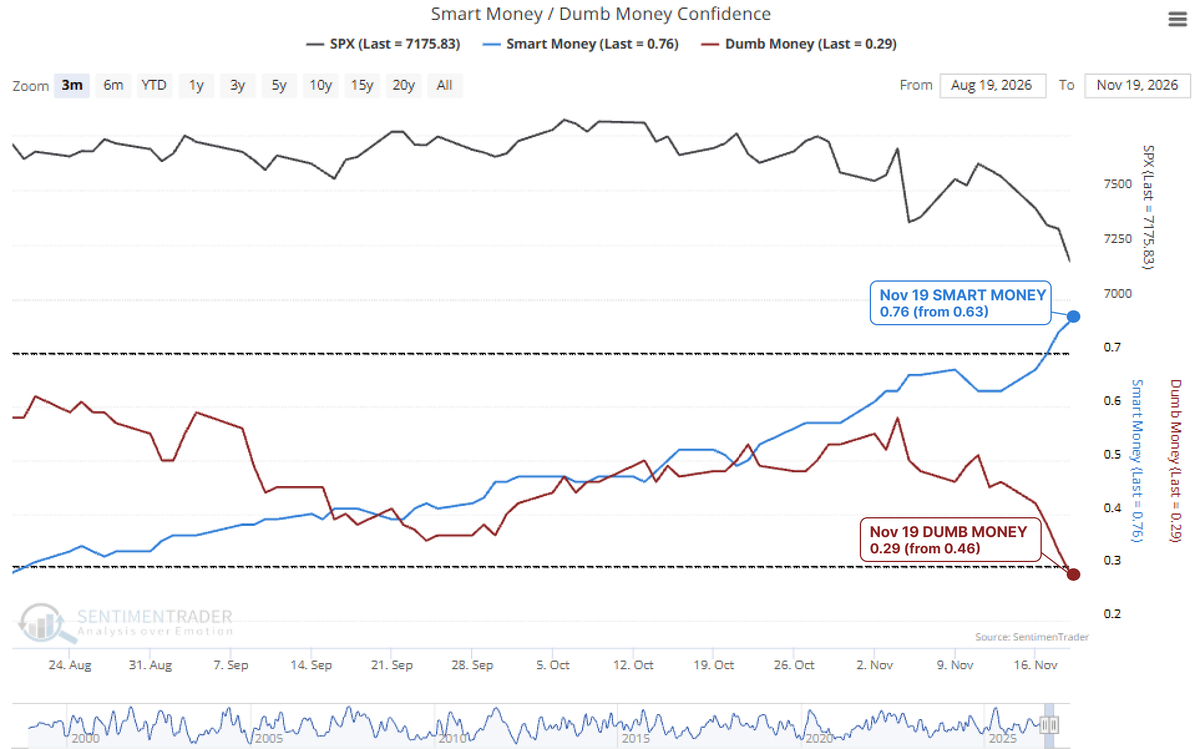
The divergence widened again as the S&P 500 fell another 2.0% on Thursday.
Smart Money Confidence climbed to 0.76, while Dumb Money Confidence dropped to 0.29.
The gap has now reached 0.47, its widest level in this week's selloff.
See the chart behind this move:
https://t.co/vTXFOp6L89
Personally, think $GOOG could be living off model backlog and recent Gemini 4 Neon, Hydrogen, Carbon, Argon releases don't mean they are "back".
2027 will show if talent drain means anything for innovation cadence.
Could be wrong.
Markets appear to be wrongly interpreting Chinese eSSD cuts as deteriorating demand and NAND oversupply.
Phison CEO commentary today + more context behind $SNDK / Kioxia selloff regarding Trendforce revisions:
- "Pua attributed China's recent enterprise SSD demand slowdown to GPU shortages since November 2026"
- "Without GPUs, additional purchases offer little value, prompting some companies to sell server components on the spot market to recover cash"
(for context enterprise SSDs are growth driver for NAND)
- "Chinese cloud giants nevertheless plan substantial GPU prepayments, temporarily tying up capital and delaying procurement of other components."
- "the principal challenge in 2027 would be insufficient supply rather than weakening demand, with persistent AI shortages potentially prompting further procurement and inventory accumulation."
Markets seemed to have wrongly interpreted this as demand destruction + pricing collapse.
When Phison CEO attributed it to
-> GPU shortages
-> causing procurement timing mismatch
-> Chinese CSPs needed capital for GPU prepayments, so liquidation in inventory (causing spot price volatility)
-> timeline shift in order procurement
TLDR: delayed procurement from GPU shortages. there were actual order cuts, but this is deferred procurement not structural demand weakening.
Chinese CSPs needed capital for GPU prepayments so they liquidated other inventories in the meantime.
Phison says its inventories are insufficient for anticipated 2027 demand and it's sees this as an opportunity for NAND accumulation.
It's interesting the bottleneck in China migrated back to GPUs though.
"Fwd 12m P/E ratio for the S&P 500 is 17.1. This P/E ratio is below the 5yr average of 19.8 and below the 10-year average of 19.1"
Factset Fridays earnings insight
1. TRUMP: WILL NOT ALLOW COMPANIES TO BUILD DATA CENTERS OUTSIDE US
2. TRUMP: WILL NOT ALLOW BECAUSE CHINA WILL TAKE ALL OF THEM
Could be an interesting froidian slip.