🚨 JUST IN: While France burns, Polish Member of European Parliament Dominik Tarczynski is WALKING THROUGH Krakow LATE at night, showing all of Europe it's PERFECTLY CALM
"Look how safe we are. Churches are safe. Because we did not let them in. Zero means zero. 'Be like Poland' means be brave." 🇵🇱🇺🇸
"We know what jihadists are capable of. We do not know what second or third generation of so-called refugees will do. Well, actually we do know... we can see what is happening in France."
There are no riots, no burning buildings and no police lines
Poland refused the EU's migrant relocation quotas, and the EU's top court ruled against it. Poland didn't budge!
In the same 24 hours, France's major streets and businesses are burning and being ransacked by leftists, Islamists and invaders
EVERY NATION CAN BE LIKE THIS. It's a matter of CHOICE
On a beach in West Africa the fishermen now haul in more clothes than fish, and the clothes have your charity shop's label on them.
The beach is in Accra, the capital of Ghana. A mile inland is Kantamanto, the biggest second-hand clothes market on earth. Every week about 15 million garments arrive there in bales, from Britain, Canada, China and America. Most of what you drop in a clothing bank ends up on its way to a place like this.
The locals have a name for the trade. Obroni Wawu. It means dead white man's clothes, because nobody could imagine a living person giving away so much.
The traders open the bales and sort them. 40 years ago nearly everything sold. Now about 40% of every bale is rubbish before it leaves the market, because the garments were built to be worn 5 times. That is 6 million pieces of clothing a week with nowhere to go.
The city collects what it can. The rest goes into the gutters, the lagoon and the sea.
Then it comes back. The waves roll the clothes together into ropes of knotted polyester as long as a boat, and the beach monitors who count them have a word for those too. Tentacles. They logged 2,344 of them along 4 miles of shore in one year. Fishermen's nets come up full of trousers. Propellers foul on them. Men have had their canoes capsized by somebody's old leggings.
A fishing community cannot fish, because of what the rest of the world was too virtuous to throw in its own bin.
When those clothes were wool and cotton they would have rotted on that beach in a season. Instead they are becoming the coastline.
There is a mountain of unworn clothes in the driest desert on earth, large enough to be photographed from space. It grows by 39,000 tons a year and almost none of it will ever rot.
The Atacama, in northern Chile, is a place where it may not rain for a decade. On its edge is a duty-free port called Iquique. Every year about 59,000 tons of clothing arrives there from Europe, America and Asia. It is last season's stock that never sold, and the bags people leave at charity shops.
Dealers pick through it for anything they can resell across South America. Two thirds of it is worthless. Nobody will pay to ship it back out, so lorries drive it into the desert at night and tip it.
The local landfill refuses to take it. The reason given is that the clothing does not biodegrade and is full of chemicals. Most of it is polyester, which is plastic, and in a place with no rain and no soil life it will lie there for centuries. Some of it is set alight, and the smoke drifts over a town of 100,000 people.
In 2025 a Chilean court ruled that the dumps had done serious damage to the land.
For most of history this could not have happened. Clothes were wool, linen and leather. They were worn out, handed down and patched, and at the very end a rag merchant paid for the scraps. In Yorkshire, from 1813, old woollens were shredded and spun into new cloth. Anything left went on the fields, where wool breaks down in months and feeds the grass.
Nobody ever had to find a desert for worn-out wool. We invented a fabric that cannot die, and then we started making it to be thrown away.
Future message to my kids: Me and your Mom are in fact free childcare for our grandkids. Good grandparents show up for their kids and grandkids. It’s a blessing, not a burden. It’s our job to show up and make life easier. Go on that date with your spouse. Go get that hour to yourself. Go get those errands run. Go take that nap you need. We got you. We didn’t have that help but you will. Always and forever, because that’s how it should be.
The report found that Seattle taxes grew 172% between 2013 and 2025, compared with 31% population growth and 23% employment growth. https://t.co/ukMwaBdtga
After thirty years of atheism, belief in God came soon after I realized that the love I felt for my wife and children wasn’t sufficiently explained by evolutionary pressures, a burst of oxytocin in my brain, or any other naturalistic account. There was something supernatural about this love that simply didn’t fit within a materialistic worldview.
That realization opened me to belief. But it isn’t why I believe in God.
I believe in God because I became convinced by the arguments. I read William Lane Craig, C. S. Lewis, Aquinas, G. K. Chesterton, and others, and realized that the versions of their arguments I’d encountered through Dawkins and others were sad little straw men that never addressed the sophistication of what these thinkers actually argued.
It was the most extraordinary experience of the scales falling from my eyes that I’ve ever had. I had made an idol of atheism and discovered it to be as false as the golden calf in the desert.
So when I consider the atheist position now, and when I encounter atheists, I know where they’re coming from. I know how they feel and what they think. I know they can be good people even when they disagree with me.
But I also know there are basically two things keeping them from seeing the light of God: a hardened heart or a lack of understanding.
I don’t mean this patronizingly, and I don’t yet know how to help someone overcome either. In my own case, that opening came purely as a gift of God’s grace.
The only thing I can say to those who don’t believe is that He is there if you seek Him. He is there in the love you have for your children. He is there in the kindness you feel toward strangers. He is there in your ability to make sense of the world. He is there in the logical consistency of mathematics.
He is everywhere for those with eyes to see.
Wow. Lindsay Clancy hasn't even asked forgiveness for murdering all of her children. No remorse at all. That fact alone completely destroys any "temporary insanity" claim.
“If you give yourself 30 days to clean your home, it will take you 30 days. But if you give yourself 3 hours, it will take you 3 hours. The same applies to your goals, ambitions and potential.”
— Elon Musk
In response to the clip going around with the African lady saying 'WHAT WHITE CULTURE!?!'
Because I can explain it in more detail than anyone else... here are the main things that create western civilisation.
The principle, the law of nature that is an adaptation to and what operation it creates in our civilisation.
THE WESTERN CIVILISATION STACK
Western civilisation can be understood as a set of adaptations to the laws of nature that allow millions of people to cooperate, solve problems and innovate together.
1. SOVEREIGNTY — Let people act.
Law of nature: Knowledge and ability are distributed among individuals.
No ruler or institution can know everything everyone knows. Sovereignty gives people freedom to choose, experiment and solve problems for themselves. That creates millions of independent problem-solvers instead of waiting for one authority to find the answer.
2. RECIPROCITY — Don’t impose your costs on others.
Law of nature: Cooperation survives when it benefits both sides.
Freedom cannot mean freedom to steal, defraud, injure or force others to carry your costs. Reciprocity means pursuing your interests while respecting the same right in others. It turns conflict into cooperation and makes peaceful life among strangers possible.
3. RESPONSIBILITY — Make people accountable for consequences.
Law of nature: Every action produces consequences.
Freedom works when the person making a decision also bears responsibility for its results. When people can keep the benefits of their choices while forcing the costs onto others, cooperation breaks down. Responsibility reconnects choice with consequence.
4. PROPERTY — Make control and consequences clear.
Law of nature: Resources are scarce and cannot satisfy every competing use at once.
Property establishes who controls something, who may use or exchange it, and who bears the consequences of those decisions. That reduces conflict, encourages people to improve what they possess, and makes investment and long-term planning possible.
5. TRUTH — Correct error faster than reality punishes you for it.
Law of nature: Reality does not change because we believe something false.
Truthful testimony, open criticism and evidence allow people to discover mistakes before those mistakes become catastrophes. A civilisation that can criticize and correct itself can learn faster than one that protects comforting falsehoods.
6. CONTRACT — Make cooperation possible across time.
Law of nature: Cooperation requires predictable future behaviour.
Promises backed by reputation and law allow strangers to trust one another enough to cooperate. Contract lets one person invest today because another can credibly promise performance tomorrow. That makes enormous networks of specialization, trade and investment possible.
7. RULE OF LAW — Replace arbitrary power with predictable rules.
Law of nature: People have conflicting interests, and power creates opportunities for predation.
Law provides a common procedure for resolving disputes without violence or personal rule. When rulers and citizens are both constrained by known rules, people can cooperate, invest and experiment without constantly fearing arbitrary interference.
8. DUE PROCESS — Test accusations instead of trusting authority.
Law of nature: Human beings are biased, mistaken and sometimes dishonest.
An accusation is not proof. Evidence, defense, confrontation, impartial judgment and appeal create an adversarial process for discovering error. Due process protects both society from wrongdoing and individuals from arbitrary punishment.
9. DECENTRALISATION — Let many solutions compete.
Law of nature: No one knows in advance which adaptation will work best.
Families, firms, towns, institutions and governments can try different solutions to different problems. Failures can remain local while successful solutions spread. Decentralisation therefore turns society itself into a continuous experiment.
10. MARKETS — Let reality select among competing solutions.
Law of nature: Evolution advances through variation, selection and retention.
Markets allow people to try different products, services and ways of organising resources. People select among them through voluntary choice. Successful solutions attract resources; unsuccessful ones disappear or improve. Markets turn millions of choices into continuous social learning.
11. SPECIALISATION — Let differences become advantages.
Law of nature: People differ in knowledge, ability, resources and circumstances.
Instead of everyone doing everything badly, specialization lets people become exceptionally good at different things and exchange the results. Cooperation converts human differences from a source of conflict into a source of increasing productivity.
12. SCIENCE — Institutionalise error correction.
Law of nature: A false model eventually fails when tested against reality.
Science turns doubt into a productive institution: observe, propose, test, criticize, replicate and correct. Knowledge therefore does not have to depend upon authority or tradition. Every generation can discover where the previous generation was wrong and build upon what it got right.
13. CAPITAL — Preserve successful adaptations.
Law of nature: Progress compounds only when successful adaptations survive.
Tools, businesses, infrastructure, institutions and knowledge allow yesterday’s successful experiments to become tomorrow’s starting point. Each generation does not begin again from zero. It inherits accumulated solutions and adds another layer.
14. EDUCATION — Transfer accumulated knowledge between generations.
Law of nature: Individuals die; knowledge does not have to.
Writing, schools, apprenticeships and universities allow discoveries to survive their discoverers. Instead of every generation rediscovering mathematics, engineering, medicine and law, it begins with thousands of years of accumulated learning.
15. COMMONS — Build things that make everyone more capable.
Law of nature: Cooperation can produce benefits no individual could produce alone.
Courts, roads, standards, security, scientific knowledge, infrastructure and trustworthy institutions multiply everyone's ability to act. A successful civilisation does more than protect private interests: it continually creates shared capital that makes future cooperation cheaper and more productive.
THE RESULT
These principles form a system:
Sovereignty creates experimentation.
Reciprocity makes it peaceful.
Responsibility makes it sustainable.
Property makes interests clear.
Truth corrects error.
Contract creates trust across time.
Law suppresses predation.
Decentralisation preserves alternatives.
Markets select successful solutions.
Specialisation multiplies productivity.
Science accelerates discovery.
Capital preserves what works.
Education transmits it.
Commons multiply everyone's capabilities.
That is the deeper logic of the Western stack:
Stable rules + distributed freedom + relentless error correction = cooperation at scale and accelerating innovation.
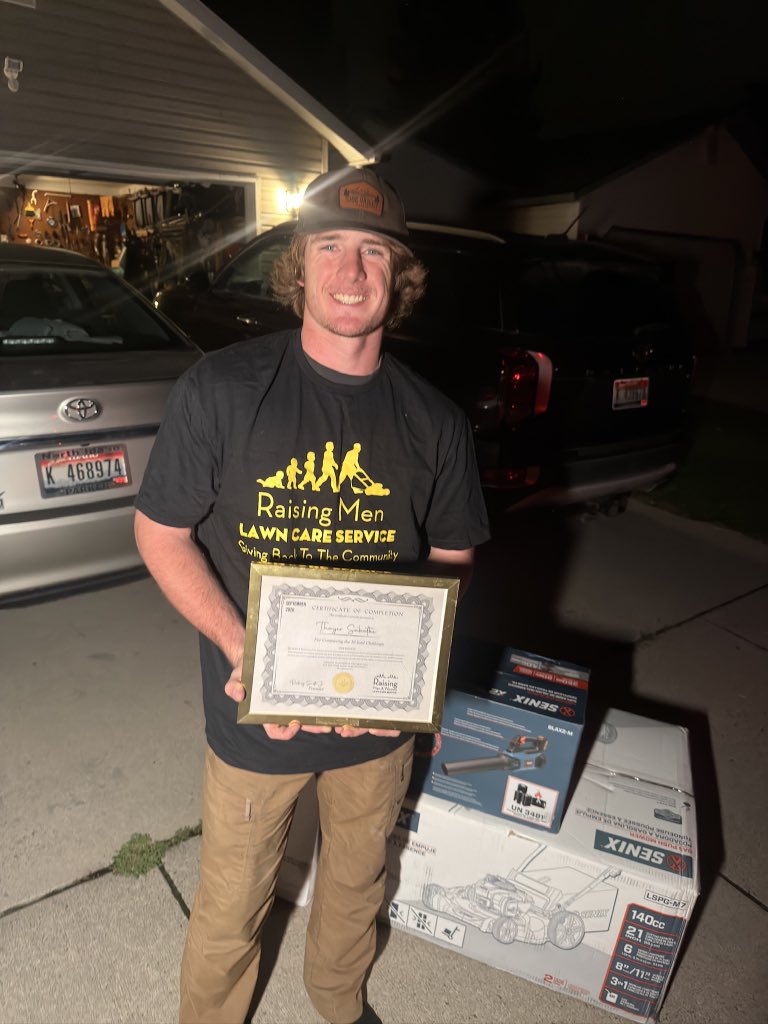
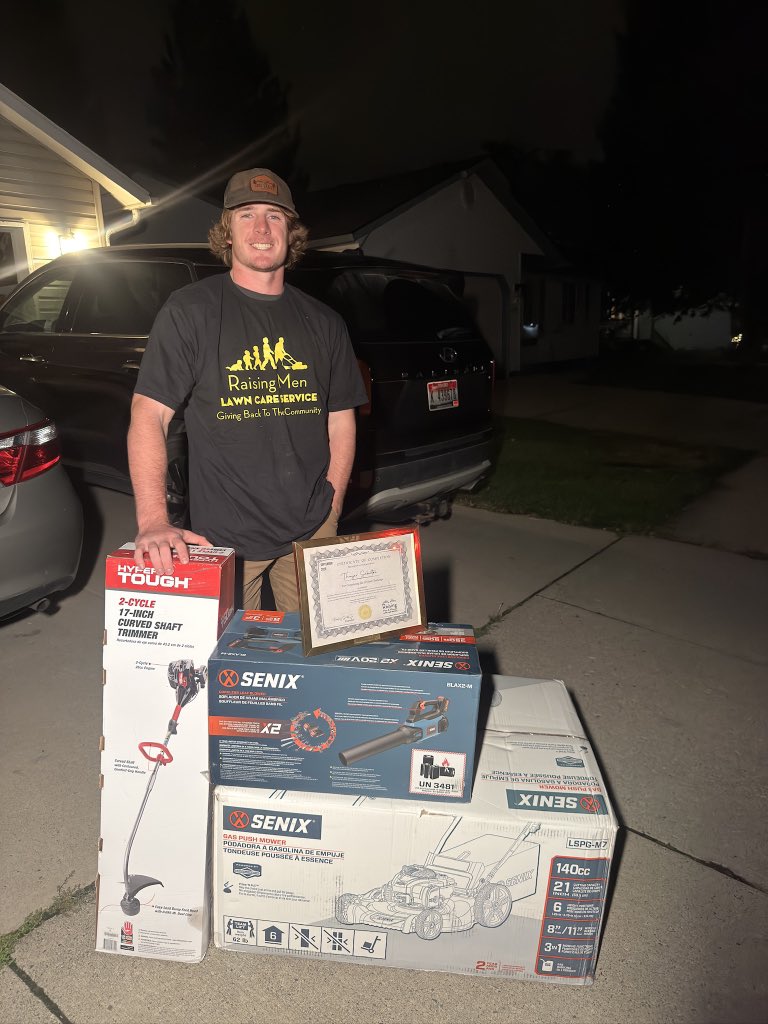
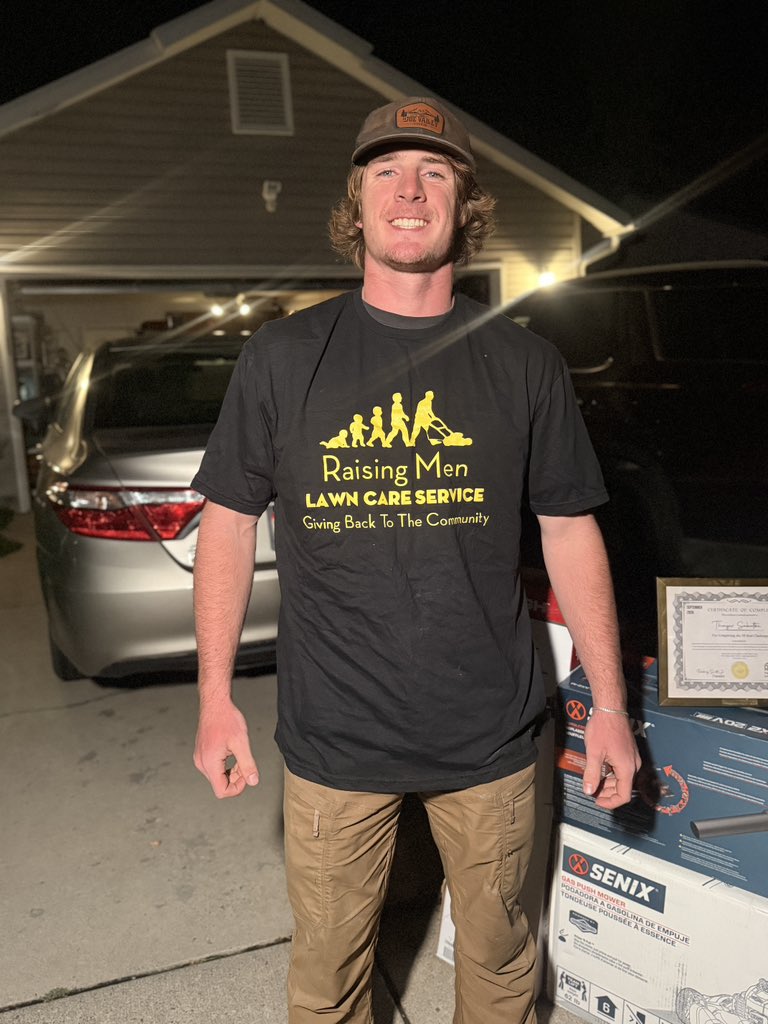
Family, please help me congratulate Thayer of Rathdrum, ID on completing our 50 Yard Challenge! Thayer mowed 50 free lawns for the elderly, people with disabilities, single parents, and veterans in his community. What an incredible accomplishment and a great example of giving back! * He signed up in his senior year of HS at 17, then turned 18 & finished at 19. Thank you for seeing the challenge through.
werner herzog on why he will never go to therapy
"i'd rather die than go to an analyst"
"if you harshly light every last corner of a house the house will be uninhabitable it's like that with your soul"
he just dropped the coldest take on therapy ive ever heard and somehow made it sound completely normal