My group is looking to recruit 2 postdocs👩💻👨🏫 on the "A-SOuRCCE" project:
1⃣ AI for Knowledge Graphs in Regulatory Genomics
2⃣ Agentic AI for Scientific Discovery in Genomics
Ideal positions for recent bioinformatics/genomics/compbiol PhDs looking to pivot towards AI 🖥️🧠 & to do impactful science. Also great for computer science people looking to get into genomics.
Apply via links below! 👇 Deadline in ~2 weeks (10.2.)
Our new preprint! Inhibiting nonsense-mediated mRNA decay makes tumors more visible to the immune system. In a 🐭 tumours blocking NMD reduced tumor burden, and NMDi + anti–PD-1 worked even better.
A great team effort @FranSupek and @TheAnaJanic labs 👇🔗https://t.co/N8ZlXQiSCQ
🚨 My PhD paper is officially published in @GenomeBiology! 📜🚀
We quantified the efficiency of a key cellular mRNA QC pathway (NMD) 🧬across thousands of human tumors & healthy tissues, revealing its activity is highly variable!
🧵1/8 👇
🔗https://t.co/dAWE2LkTO2
Fantastic to be in such great company!🤩
👏Congrats to 19 colleagues from my institutions (🇩🇰BRIC @UCPH_health and 🇪🇸@IRBBarcelona) in this year's Elsevier/Stanford top 2% most cited researchers list
🧬Indels drive the separation into m-SBS3a & SBS3b HRd signatures
Only SBS3b strongly predicts survival in ovarian cancer patients, exceeding other genetic markers
➕utility of MMRd signatures also improved with indel+SNV joint inference
Read more: 👇
https://t.co/1zWLawGWqI
Paper by our Patricia feat. Ivan GF is now out in @GenomeMedicine!
🧩HR-deficiency mutational signature SBS3 decomposes into at least 2 signatures when analysed in a multi-modal manner (indel+SNV jointly)
As WGS gets widely available, good to include indels in mutsig analyses✅
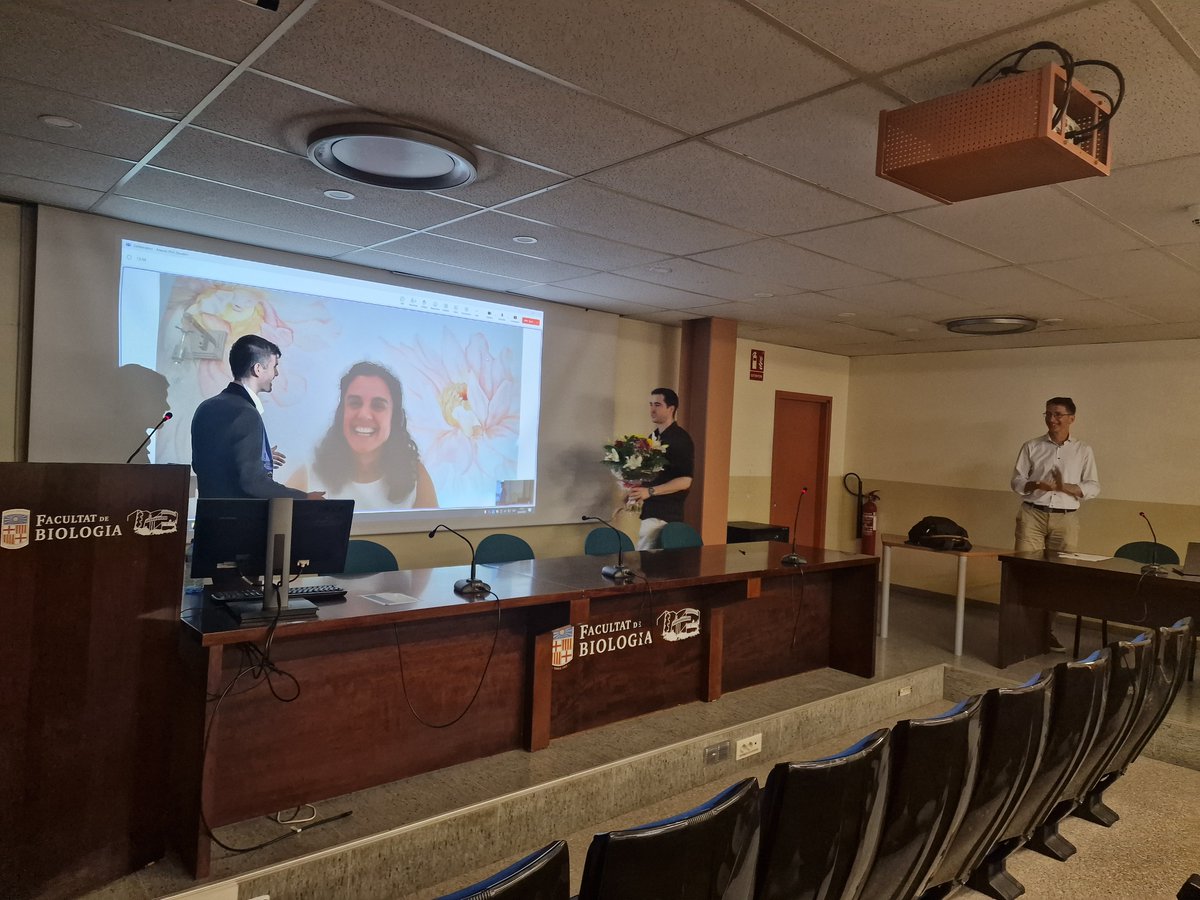
Congrats to our CRISPy fresh doctor 👏👏 Marcel McCullough for successfully defending his PhD thesis:
🧬✂️Combinatorial Gene Editing in Human Cells to Model Deficiencies of DNA Repair in Cancer
Thx to committee members @CeronLab@LValleResearch and @DSzuts for great discussion!
Very cool collaborative work of our lab w/group of Lluis Ribas at @IRBBarcelona, spearheaded by the 2 Marinas 😀Marina Murillo and our alumna @msalvadoresf
In this fascinating preprint, the authors uncover an eye-opening feature of tRNA genes: they’re insanely prone to mutation. Analyzing somatic mutations in cancer tissues, they report that tRNA genes are up to 9 times more mutated than protein-coding genes.
Interestingly, the known biology of tRNA biology seems to line up neatly with this observation.
tRNA genes are hypermutable for three reasons:
- they are heavily transcribed than most protein-coding genes—more transcription means more chances for damage.
- they’re transcribed by RNA Polymerase III, which lacks the robust DNA repair machinery that is coupled with RNA polymerase II that transcribe protein-coding genes.
- they’re prime targets for APOBEC3 enzymes—viral defense agents that mutate single-stranded DNA and seem to hit tRNA genes as innocent bystanders.
But the most interesting finding is this: when the somatic mutations hit the anticodon region (that recognizes amino-acid), they make the tRNAs to insert the wrong amino acids during translation, misspelling proteins without any change to the underlying DNA or mRNA.
It's like a stealth mode mutation that defies the central dogma of biology, rewriting the proteome without touching the genome!
Paper:
Murillo-Recio et al. bioRxiv. Characterization of Somatic Mutations in Human tRNA Genes Reveals Tumor-Specific Mutational Loads, and the Generation of tRNA Variants that Alter the Genetic Code. bioRxiv 2025
🧵Ahmed’s @GenomeDataLab paper on evolution of chemotherapy resistance is out in @NatureComms!
We developed DiffInvex - a method tracking how #cancer driver genes change under therapy, applied to ~10k genomes. Key insight: resistance often emerges through existing pathways. 1/5
🚨 Big news!
I'm thrilled to share that our latest research has just been published in Nature Communications 🎉
🔍 Title: DiffInvex identifies evolutionary shifts in driver gene repertoires during tumorigenesis and chemotherapy
📎 https://t.co/2L3mOgJ6mm
(1/4) ⬇️
Great news – we received funding from the Independent Research Fund Denmark @DFF_raad!
🧬We will study #cancer driver mutations in tumor suppressor genes. In particular, we will focus on so-called "dominant negative" mutations, by combining #genomics, #AI & CRISPR gene editing
Double PhD defense day in the lab 🤩
Congrats to our dr. Guille Palou @gpaloumarquez, fresh from the oven 🎊🥳 and similarly so our newly-minted dr. Ignasi Toledano @IgnasiToledano!
Amazing defense both, bravo 👏👏
Website for the Marie Curie "INTERACT" call for interdisciplinary PhD fellowships at UCph/DTU/DCS is now up 👇
https://t.co/7Detp2PKKZ
Applications open 20th December.
No less than 6⃣6⃣ PhD fellowships will be available to assorted groups at 🌆U of Copenhagen & to 🇩🇰DTU via the "INTERACT" call
🎓Applications open 20/12. Spread the word!
Apply + join us👇 Maybe there is a Nobel prize in physics awaiting you as well 😁
https://t.co/D5YqMxy76D
The youngsters from lab are at @EMBLEvents DNA Replication symposium #EESreplication 🧬
Our alumna dr. Marina @msalvadoresf and PhD Marcell @MarcellVeiner gave talks on their recent work 👏-- identifying DNA replication origins by mutation patterns and neural nets🤖
🔥PhD student & postdoc opportunity @GenomeDataLab!
Are you keen on:
- driving cutting-edge science @ interface of #AI and cancer #genomics?
- working in a dynamic & supportive environment of @UCPH_BRIC?
- joining the U of Copenhagen, top-3 ranked uni in EU?
Apply below👇
No less than 6⃣6⃣ PhD fellowships will be available to assorted groups at 🌆U of Copenhagen & to 🇩🇰DTU via the "INTERACT" call
🎓Applications open 20/12. Spread the word!
Apply + join us👇 Maybe there is a Nobel prize in physics awaiting you as well 😁
https://t.co/D5YqMxy76D
EMBO DNA Replication symposium -> still in time to register to attend!
👏to our @MarcellVeiner and @msalvadoresf - they will have talks on using 🤖#AI and cancer mutation analysis to understand 🧬DNA replication in human cells👇
https://t.co/NBdtFvO7g6
New pre-print out! 👨🔬
🔗https://t.co/AVTkbFyeWr
Here, we studied the incidence and impact of allele-specific expression (ASE; imbalance between two alleles in mRNA levels ⚖️) in tumorigenesis.
1/6