The looming sulfuric acid shortage is not getting much attention yet but could be a big problem for miners.
Copper, nickel, lithium and cobalt could be particularly hard hit, given how dependent the world's biggest producers of these minerals are on imports of acid.
@robert_ivanhoe Look at the current size of the US Strategic Minerals Reserve by historical comparison. I don't think people realize yet how much of demand driver stockpiling could become. And that's just the US. The EU is also planning to stockpile along with others... https://t.co/YAan2OH7qR
Critical mineral stockpiling could have bigger implications for investors than price floors.
Trump's $12bn "Project Vault" is still small by historical standards. At its Cold War peak, the US stockpile was around $80 billion in today's dollars. $MP $UUUU $EQR $NB $PAAS
Critical mineral stockpiling could have bigger implications for investors than price floors.
Trump's $12bn "Project Vault" is still small by historical standards. At its Cold War peak, the US stockpile was around $80 billion in today's dollars. $MP $UUUU $EQR $NB $PAAS
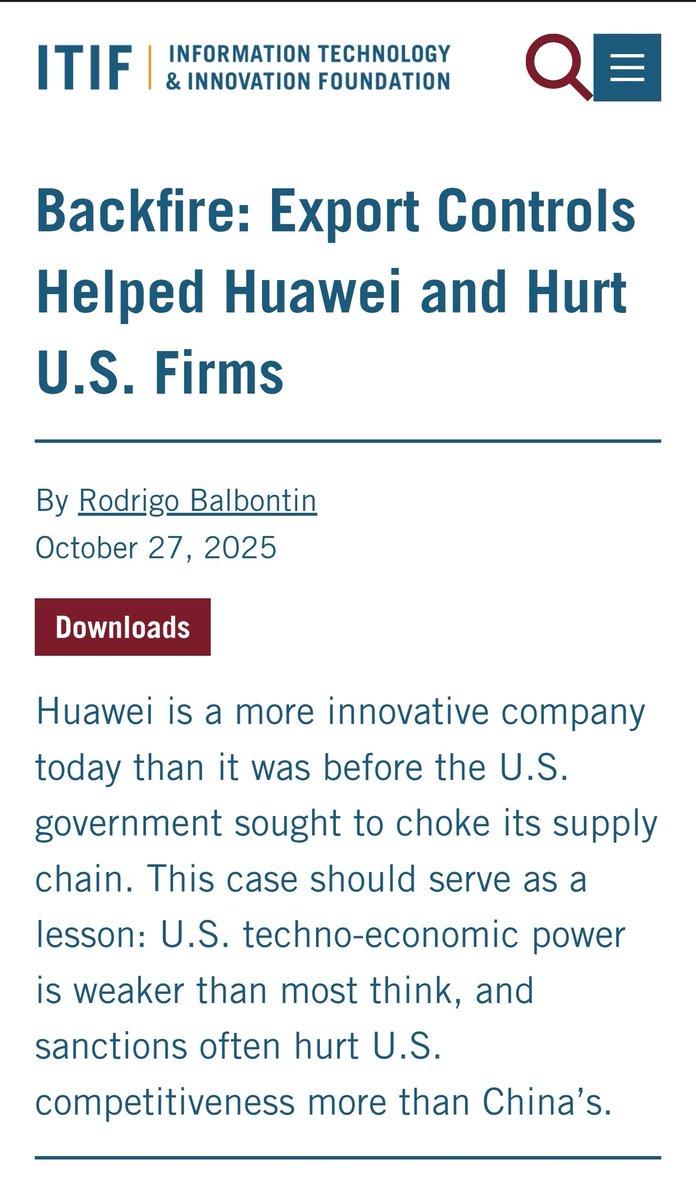
If you weren't convinced yet that the US technology sanctions on China hurt the US more than they did China, please read this incredible report by the Information Technology & Innovation Foundation (ITIF), the world's leading think tank for science and technology policy.
They studied in depth the attempt by the US to kill Huawei (full report here: https://t.co/oHAlQR8tmN) and their overall conclusion is that "sanctioning Huawei and attempting to cripple the company has proven to be hubristic and self-defeating" as "the only outcome was to weaken U.S. technology companies and strengthen Huawei and China’s innovation."
Among other things they found that:
- The sanctions had zero impact on Huawei's global market share: "it remains the world’s largest telecom equipment manufacturer, with a 34 percent global market share in 2024, up 2 percentage points from 2018."
- The sanctions hurt US companies first and foremost as "restrictions on doing business with Huawei caused U.S. companies to lose at least $33 billion in sales between 2021 and 2024." It also led Huawei to "successfully launch its in-house OS, HarmonyOS, which is now being rolled out on mobile devices, tablets, and laptops - potentially threatening U.S. firms’ market share in these sectors."
Last sentence of the report's conclusion: "the United States needs a realistic, not hubristic, policy approach [to China]."
OIL MARKET: Indian Oil Corp., the state-run major refiner in the south Asian nation, held earlier today a conference call with investors. Surprise, surprise, it seems that news of the death of Russian oil in India were greatly exaggerated | #OOTT
From Bloomberg: “Beijing has been accumulating gold reserves for a decade and is now seeking to woo other nations to store gold in China's bonded warehouses and trade the metal on the Shanghai Gold Exchange.”
#economy#china#gold#markets
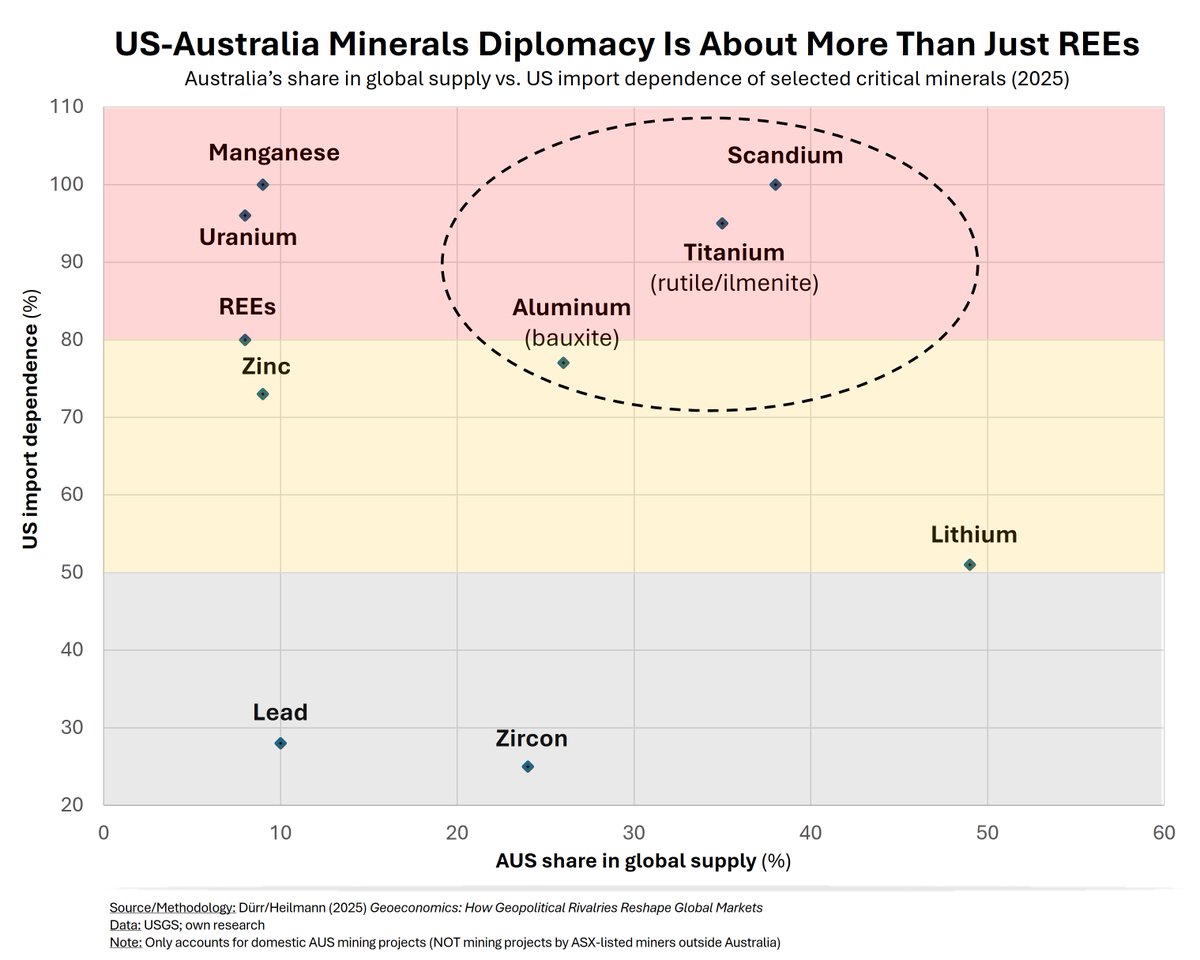
@giginator_@robert_ivanhoe If you look at the minerals with the greates US-AUS complementarity. It's no surprise that scandium is getting attention. https://t.co/ij99A94eX9
US-Australia cooperation on minerals is about more than just REEs. Mapping out US vulnerabilities and AUS capacities, titanium feedstocks, scandium and bauxite show the largest complementarity.
@SamsonLi7 Scandium is also quite interesting in the context of US-AUS cooperation. US is 100% import dependent and Australia has substantial export capacities.
https://t.co/ij99A94eX9
US-Australia cooperation on minerals is about more than just REEs. Mapping out US vulnerabilities and AUS capacities, titanium feedstocks, scandium and bauxite show the largest complementarity.
Yesterday's drop in gold prices was a function of overbought conditions. It does not change the fact that gold is fundamentally underowned at a time when the world is transitioning to an unstable period of multipolarity – rendering gold the natural alternative global reserve currency until a viable alternative rises.
1. Non-Western central banks officially do not nearly hold as much gold as most people believe (that includes the PBoC).
2. Private capital as a whole is still very much underallocated when compared to historical averages (around 2 percent of the average portfolio is in gold).
3. Most fund managers missed out on the gold rally. This may make multi-asset funds eager to jump on any correction in gold prices as a form of window-dressing.
@duediligenceguy This will probably turn into a buy-the-dip moment for those underallocated to gold (aka: the vast majority of both retail and institutionals).
https://t.co/s7KQuPovof
Yesterday's drop in gold prices was a function of overbought conditions. It does not change the fact that gold is fundamentally underowned at a time when the world is transitioning to an unstable period of multipolarity – rendering gold the natural alternative global reserve currency until a viable alternative rises.
1. Non-Western central banks officially do not nearly hold as much gold as most people believe (that includes the PBoC).
2. Private capital as a whole is still very much underallocated when compared to historical averages (around 2 percent of the average portfolio is in gold).
3. Most fund managers missed out on the gold rally. This may make multi-asset funds eager to jump on any correction in gold prices as a form of window-dressing.
@marcfriedrich Die Korrekturen werden sich wahrscheinlich aufgrund der nach wie vor sehr niedrigen Goldgewichtung in den meisten Portfolios in Grenzen halten. Die breite Masse hat die Goldrally schlichtweg verpasst und könnte nun Einstiegsgelegenheiten sehen. ⬇️ https://t.co/s7KQuPovof
Yesterday's drop in gold prices was a function of overbought conditions. It does not change the fact that gold is fundamentally underowned at a time when the world is transitioning to an unstable period of multipolarity – rendering gold the natural alternative global reserve currency until a viable alternative rises.
1. Non-Western central banks officially do not nearly hold as much gold as most people believe (that includes the PBoC).
2. Private capital as a whole is still very much underallocated when compared to historical averages (around 2 percent of the average portfolio is in gold).
3. Most fund managers missed out on the gold rally. This may make multi-asset funds eager to jump on any correction in gold prices as a form of window-dressing.
Is gold becoming the world's de facto reserve currency?
When looking at the currency composition of central bank reserves as a key metric of reserve currency status, gold could surpass the USD in 2027.
@steve_hanke It looks like fund managers are poised to buy the dips until the end of the year to do some “window dressing”. Otherwise they have to explain why they completely missed out on the best performing asset.
#Gold remains strategically under-owned – especially among fund managers. The October BofA fund manager survey shows that almost 40 percent of portfolios are devoid of gold.
This may explain why every dip gets aggressively bought.
Do you have a link to the article? Would be interesting to see their data source. When we last ran the numbers less than 2 weeks ago it was a little above 2%. Maybe they counted jewelry as part of the equation? Wouldn’t make sense though at is not really a liquid asset. If you count jewelry you have to count real estate, art, … also. Then the share of gold would plummet.
#Gold remains strategically under-owned – especially among fund managers. The October BofA fund manager survey shows that almost 40 percent of portfolios are devoid of gold.
This may explain why every dip gets aggressively bought.
US-Australia cooperation on minerals is about more than just REEs. Mapping out US vulnerabilities and AUS capacities, titanium feedstocks, scandium and bauxite show the largest complementarity.