Two reasons why we integrated Grok 4.5 inside Perplexity Computer within a few hours:
1) It scored the best on our evals and was the most cost effective option
2) ZDR was available from the get go and that’s what our customers want
How is Perplexity specifically architected so that enterprises can build and compound their own proprietary learning loops (evals, memory, traces, feedback, and distillation) inside your orchestration layer, without that value flowing back to any single frontier model provider? @AravSrinivas
Palantir CEO Alex Karp on what customers actually want, the real business of frontier labs, and the importance of open source models:
“What the technical customers want is control over their compute, their models, their data stack, and their alpha. They want to know they own the means of production, and it's not being transferred to someone else.”
"Who owns the data? Are the prompts secure? Is this being transferred to you?"
"If it was so valuable, and I can make you a billion dollars, wouldn't I say I'll make you a billion dollars and I want 30%? Why are they charging for tokens if it's so valuable?"
Cerebras is going to 1T. Deep in the GPT 5.6 announcement is this gem. This offering will be a high priced fast mode offering for agentic coding. You will see customers like quant funds etc who have unlimited budget and the need for the fastest agentic coding in the world using GPT 5.6 on Cerebras. GPT 5.6 on Cerebras will enable coding projects to be completed in minutes due to this decode rate. The rate of progress in technology in the world is about to accelerate. $CBRS
Why I joined Opendoor and why you should too if you want to work on AI.
Few industries stand to gain more from AI than real estate.
Closing a single home takes 30-60 days. Why? One transaction touches law, insurance, title, contractors, utilities, inspections, phone calls and emails across dozens of parties.
And the complexity is ancient. Property law LITERALLY traces back nearly a thousand years to medieval England. Records and rules differ county by county. There are ~50,000 (!!!) water systems alone in the US, each with its own process to turn service on.
It's one of the messiest, most human, most coordination heavy markets there is. Which is exactly why it's a great place to build AI
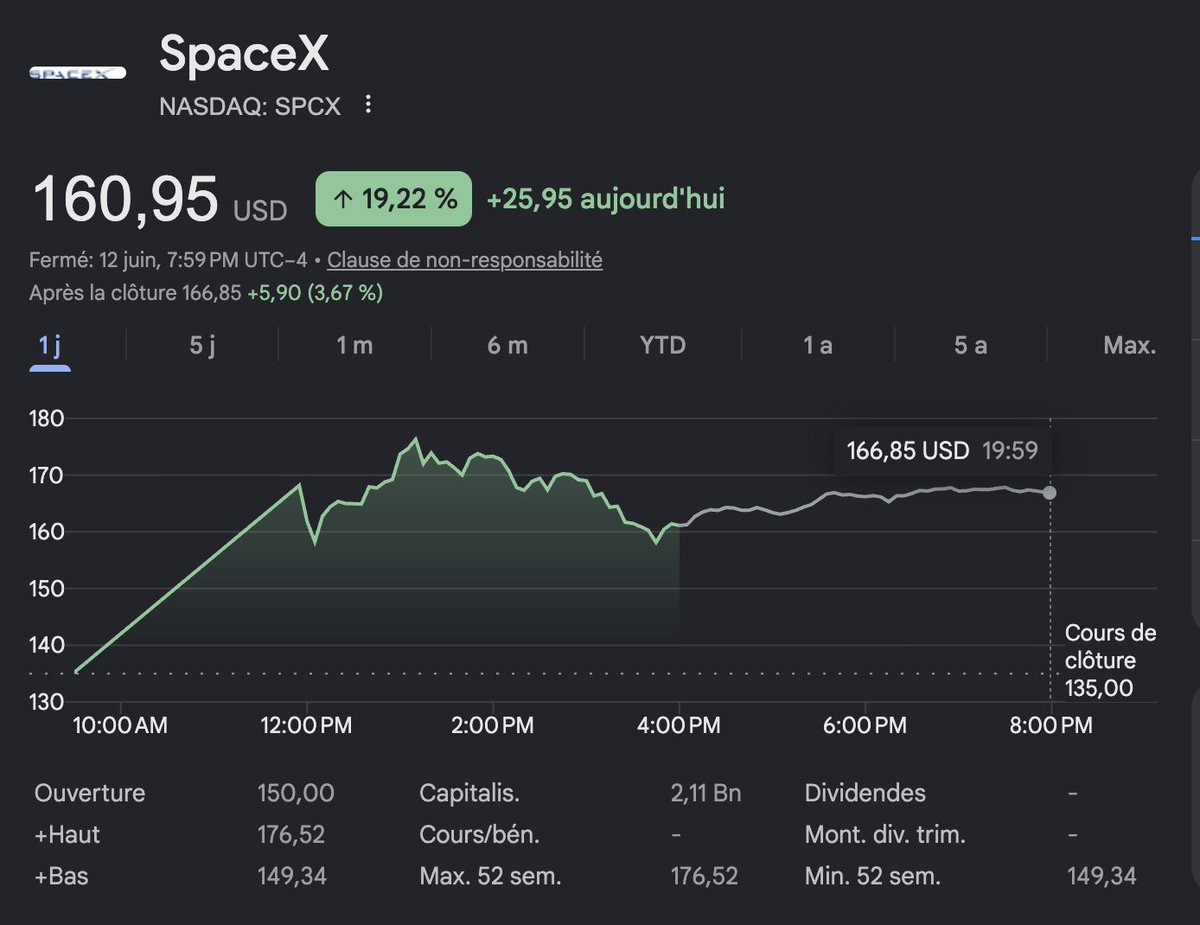
SpaceX a clôturé son premier jour de cotation à 2 100 milliards de dollars, +19%. Tout le monde regarde le chiffre. Personne ne regarde ce qu'il price réellement.
Laissez-moi vous dire ce que le marché vient d'acheter, et pourquoi je pense que cette boîte vaudra 30 à 50 trillions d'ici 5 ans.
D'abord, le symbole. Cette IPO est un référendum. D'un côté, 20 ans de discours sur la décroissance, la sobriété, la redistribution, la fin de l'histoire gérée par des comités. De l'autre, un homme qui a dit "je vais rendre l'humanité multiplanétaire", que tout le monde a traité de clown, et qui vient de créer la plus grosse entreprise cotée de l'histoire en partant d'un entrepôt à El Segundo. Le marché a voté. Le wokisme avait des départements RH, SpaceX avait des fusées. Les fusées ont gagné.
Ensuite, la mécanique économique, parce que c'est là que tout le monde se trompe. Les analystes valorisent SpaceX comme une entreprise de lancement plus Starlink. C'est comme valoriser Internet en 1995 sur le marché du fax. Starship ne réduit pas le coût du kilo en orbite de 20%, il le divise par 100. Et chaque fois dans l'histoire qu'un coût d'infrastructure est divisé par 100, ce n'est pas le marché existant qui grossit, ce sont des industries entières qui naissent. Le coût du calcul divisé par 100 a donné Internet, le smartphone, l'IA. Le coût de l'orbite divisé par 100 va donner une économie spatiale complète.
Faisons la liste de ce qui devient rentable quand le kilo en orbite coûte le prix d'un billet d'avion. Les data centers orbitaux, avec énergie solaire continue et refroidissement gratuit, au moment exact où l'IA fait exploser la demande énergétique terrestre. La fabrication en microgravité de semi-conducteurs, de fibres optiques, d'organes imprimés impossibles à produire sous gravité. Le tourisme orbital de masse, puis les hôtels lunaires, qui passeront du fantasme au business plan exactement comme la croisière de luxe au 20ème siècle. Le transport point à point terrestre, Paris-Tokyo en 40 minutes. L'industrie minière des astéroïdes, dont un seul corps de classe M contient plus de métaux que tout ce que l'humanité a extrait depuis le néolithique. Et Mars en ligne de mire, pas comme destination touristique, mais comme le plus grand projet d'infrastructure jamais entrepris, avec tout ce que ça implique de demande en énergie, matériaux, robotique, IA.
SpaceX ne participera pas à ces marchés. SpaceX possède le péage d'entrée de tous ces marchés. C'est AWS, mais pour la civilisation. Apple vaut 3 500 milliards en vendant des rectangles de verre sur une seule planète. Le premier monopole d'accès à une frontière infinie à 30 ou 50 trillions dans 5 ans, ce n'est pas de l'exubérance, c'est une simple règle de trois sur l'expansion du marché adressable.
Et maintenant, la partie que je préfère. Ce futur n'a pas besoin de bureaucrates. Il n'y a pas de comité consultatif en orbite. Pas de commission Théodule sur Mars. Chaque dollar de cette nouvelle économie sera créé par des ingénieurs, des techniciens, des soudeurs, des pilotes, des entrepreneurs. Les diplômés en gestion de la norme vont devoir apprendre un métier utile, et franchement, c'est une excellente nouvelle pour eux aussi : construire est infiniment plus fun que contrôler.
Parce que c'est ça, le vrai signal d'aujourd'hui. Pendant 50 ans on nous a vendu un futur rétréci : moins d'énergie, moins d'enfants, moins d'ambition, gérer le déclin proprement. Et là, d'un coup, le plus gros actif financier du monde est un pari sur l'abondance, l'expansion et l'aventure. Le pessimisme vient de passer en position vendeuse sur lui-même.
Le futur sera méga fun. Il y aura des hôtels avec vue sur la Terre, des honeymoons en orbite, des gamins qui diront "papa, c'était comment avant les fusées réutilisables" comme on dit "c'était comment avant Internet". Et quelque part dans les années 2030, un humain marchera sur Mars en livestream devant 5 milliards de personnes, et ce jour-là plus personne ne se souviendra du nom d'un seul de ses détracteurs.
Achetez de l'optimisme. C'est encore sous-valorisé.
.@cerebras is now running Kimi K2.6 - the leading trillion parameter open source model - at ~1000 tokens per second in enterprise trials.
6.7x faster than the next-fastest GPU cloud.
10x faster than Claude Opus.
3x faster than Gemini Flash 3.5 (Google’s latest fast model).
A coding task that typically takes 3 minutes finishes in under 6 seconds on Cerebras.
This is what wafer scale was built for.
Same here.
By way of background for those who care, I spent a lot of time last week with senior members of the Anthropic team to understand what they do to ensure Claude is good for humanity and was impressed.
Everyone I met was highly competent and cared a great deal about doing the right thing. No one set off my evil detector. So long as they engage in critical self-examination, Claude will probably be good.
After that, I was ok leasing Colossus 1 to Anthropic, as SpaceXAI had already moved training to Colossus 2.
Our run-rate revenue has surpassed $30 billion, up from $9 billion at the end of 2025, as demand for Claude continues to accelerate. This partnership gives us the compute to keep pace.
Read more: https://t.co/XgSjL0And7
Walgelijk wat de VVD is geworden en wat een lege statements. Als je wil dat NL niet volledig irrelevant is dan pak je fundamenteel de belastingen aan en incentives om galmt aan te trekken en hier bedrijven te creëren. Jullie hebben ja gestemd op het absurde idee om ongerealiseerde rendementen te belasten en daarmee elke vorm van credibility verloren
LIQUIDATION CONTAGION
Wealth taxes are even worse than you think. Any asset held by Californian billionaires or Dutch citizens is now at risk of experiencing forced liquidation pressure.
So: it’s not just that you don’t want to hold assets as a Dutchman. You also don’t want a Dutchman to hold your assets. Because the logic of forced liquidation is contagion.
Let’s think it through.
(1) First, suppose there is an asset with a total market cap of $10,000, with 10 shares total, of which 1 share each is held by 10 different holders, all in the Netherlands. To simplify the math, assume the Dutch holders bought those shares at par, or close to $0.
(2) Now suppose today is the unrealized cap gains tax day, and the share price is $1,000 per share. Each Dutch guy is hit with a 36% tax, and owes $360. The first guy sells his one share, gets $1,000, and pays $360 in tax while retaining $640.
(3) But the first guy’s sale reduces the market price to $960 per share. So when the second guy sells, he only retains $600 after paying $360 in tax.
(4) Now assume that by the 7th guy, all the selling has pushed the share price to collapse to $200 per share. This is a very reasonable scenario if 60% of the cap table has suddenly been dumped. Indeed it might go much lower.
(5) At $200 per share, the 7th guy actually has to go into debt to pay the tax as he owes $360. He sells his one share, pays all $200 of the proceeds in tax. And still owes $160 more in tax.
(6) The 8th, 9th, and 10th guys are even more screwed. By the time they sell, the price will likely have crashed to $100 per share or less. As with the 7th guy, even 100% liquidation will not cover their tax burden.
(7) So we immediately see many negative things about the Dutch unrealized cap gains tax bill.
(a) First, it will cause large simultaneous forced liquidations. Everyone must sell 36% of their stake near the same time.
(b) Second, it may be literally impossible to pay if a critical mass of the cap table is all subject to it at the same time. In the example above it was 100% Dutch holders, but has it been just 60% the result would have been much the same: a collapse in the share price.
(c) Third, that means it would be disastrous to have too many Dutch citizens (or Californian billionaires!) on the cap table. Their forced sales will crash your share price.
(d) So, you might have to start mass blocking those resident in wealth-taxing jurisdictions from investing in your companies.
(e) This in turn makes the poor Western European guy even poorer, as he gets locked out of high growth assets.
To be clear: I really do feel bad for the formerly Flying Dutchmen, now Crying Dutchmen. They invented much of modern capitalism. They founded New Amsterdam, now New York. They’ve punched way above their weight. I wish them only the best.
Nevertheless…they should prepare for the worst. This may be a tough century for Western Europe. The first ones out might get to freedom, while the slowest may be stuck behind a new Iron Curtain, spending a century paying off the debts their states incurred over the last century.
Because the long run fruits of Western Keynesianism are the same as Soviet Communism, in the sense of wealth seizure and pauperization.
I mean, if you knew the future, you wouldn’t want to co-own a farm with a Russian in 1916. For similar reasons, you might not want to co-own a share of stock with Dutch national in 2026. Or with anyone in a seizure-curious jurisdiction…which unfortunately includes much of Western Europe, Canada, and Blue America.
You instead want assets that are not held by those subject to forced liquidations. Now, I grant that this is an unusual way to rank assets…Dutch holders considered harmful?!? Yet it might sadly be necessary to minimize your exposure to liquidation contagion.
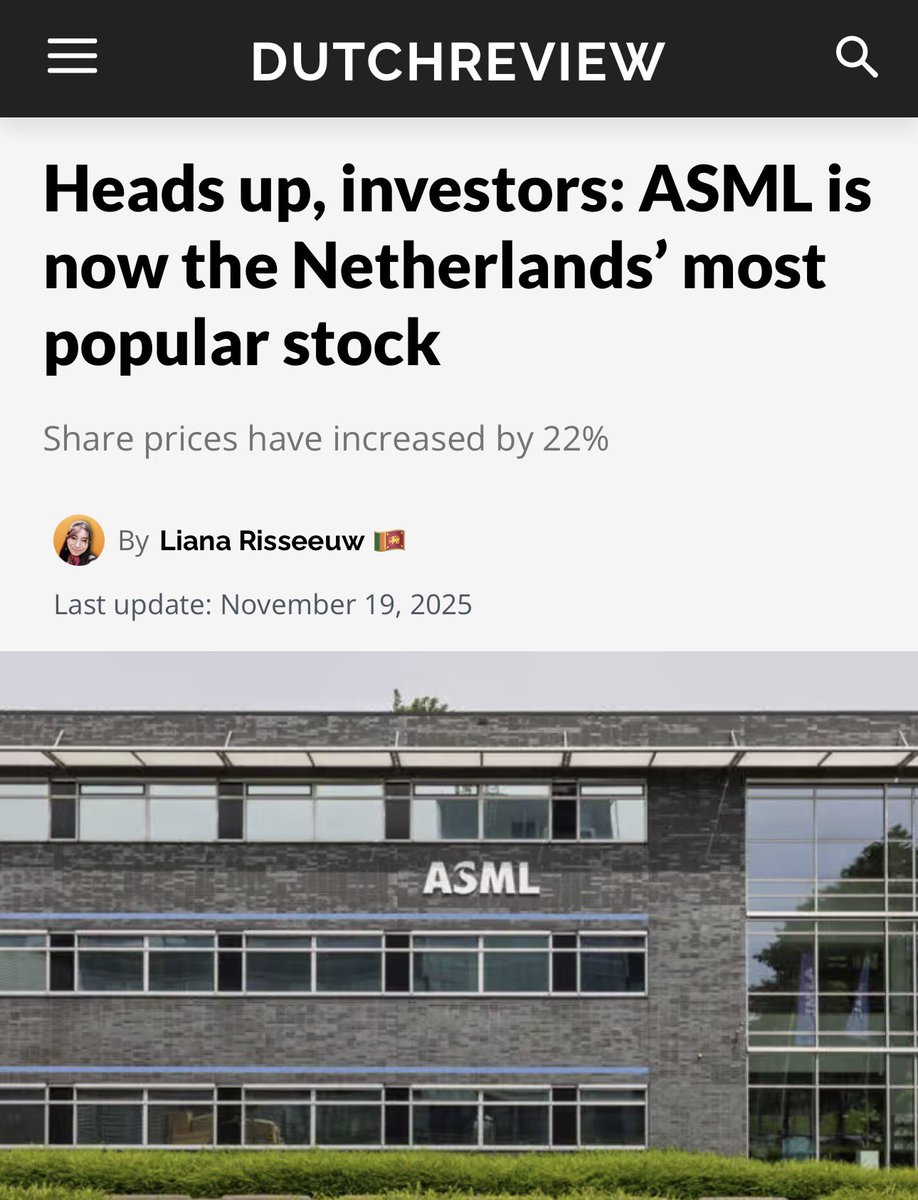
PS: guess which crucial stock is most held by the Dutch? ASML. So: this unrealized cap gains tax may not literally be a communist plot, but it would have the same effect.
@OpenAI and @Cerebras have signed a multi-year agreement to deploy 750 megawatts of Cerebras wafer-scale systems to serve OpenAI customers.
This has been a decade in the making.
Deployment begins in early 2026, and when fully rolled out, it will be the largest high-speed AI inference deployment in the world.
OpenAI and Cerebras were both founded in 2015 with radically ambitious goals.
OpenAI set out to build the software that would push AI toward general intelligence.
Cerebras set out to rethink computing hardware from first principles.
Our teams met as far back as 2017. We shared ideas, early work, and a common belief:
there would come a point when model scale and hardware architecture would have to converge.
That point has arrived.
ChatGPT set the direction for the entire industry. It showed the world what AI could be.
Now we’re in the next phase - not proving capability, but delivering it at global scale.
The history of technology is clear on one thing:
speed drives adoption.
The PC industry didn’t operate at kilohertz.
The internet didn’t change the world on dial-up.
AI is no different.
As models grow more capable, speed becomes the bottleneck.
Slow systems limit what users can do, how often they engage, and whether AI becomes infrastructure or remains a novelty.
Cerebras was built for this moment.
By keeping computation and memory on a single wafer-scale processor, we eliminate the data-movement penalties that dominate GPU systems. The result is up to 15× faster inference, without sacrificing model size or accuracy.
That speed changes product design, user behavior, and ultimately productivity.
For consumers, it means AI that feels instantaneous.
For the economy, it means agents that can finally drive serious productivity growth.
For Cerebras, 2026 will be a defining year.
With this collaboration with OpenAI, Cerebras’ wafer-scale technology will reach hundreds of millions - and eventually billions - of users.
We’re proud to work alongside OpenAI to bring fast, frontier AI to people around the world.
This is what a decade of long-term thinking looks like.
Noah and @NALAmoney are launching an instant stablecoin settlement network.
Global businesses can now collect USD and pay out local currency in minutes, not days – without relying on correspondent banking rails built for another era.
I shipped more code in the last 3 weeks than the decade before. The top AI models / agentic systems right now are an entirely different thing to what people used until the beginning of December.