“We have entered an era of fires that cannot be extinguished. These are fires that burn with the intensity of several atomic bombs and, as such, putting them out is extremely complex”
Thank you Big Oil for spending 40+ years, and billions, blocking climate action at every turn
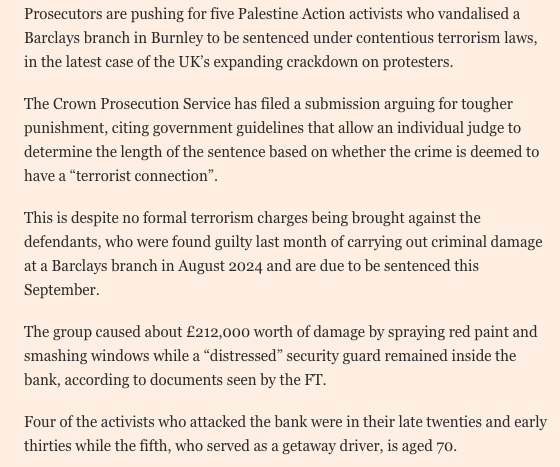
Spraying red paint on a bank. That's what the CPS wants sentenced as terrorism; for an action from August 2024, before Palestine Action was even proscribed. You might not care about Palestine. But this is dystopian as hell. Literally the stuff of authoritarian dictatorships.
We are witnessing the destruction of decades of legal protections and democratic principles, and for what?
So the British government can maintain and hide its atrocious complicity in genocide.
That is the real crime — and we will never give up until there is justice.
Israeli soccer hooligans in Amsterdam got more media coverage than actual pogroms against Palestinians happening right now in the occupied West Bank.
They always make it clear whose lives they actually value.
“What we have seen unfold in Gaza, where Israel stands accused in the International
Court of Justice of committing genocide in the aftermath of the Oct. 7 Hamas attacks, appears to portend a new future for the crime.
It is a future in which other nations or leaders may have an incentive to pursue
genocidal policies knowing they will not only get away with murder but may even
benefit from it. It is a future in which the countries and international organizations that had been committed to stopping and punishing genocide may give license to its recurrence.”
https://t.co/6ldRoTPVPW
At the beginning it was unclear if Delcy was a sell out or part of the second layer of resistance. Well, that question has in the meantime been answered.
We also see the new US approach toward International Law. With Assange, with Maduro, with the ICC. The strategy is now very clear. The US wants to make ITS LAW the law of nations.
This is indeed the most blatant attack on international law since it became a thing with Hugo Grotious‘ writings some 450 years ago.
It is also an approach that is doomed to fail. others like the Brits have tried similar shenanigans on the high sea, arguing for a „Mare Clausum“ doctrine that the high sea actually belonged to them. Hasn‘t worked then and won‘t work now, not with Hormuz, not with Malaka not with the global expansion of US kangaroo courts to the whole world.
Reason is simple: international law only actually changes once you get massive buy-in for new concepts by states through treaties or through practice. This US obsession with extending its judiciary over the entire globe will NEVER fly in a majority of countries.
But still, the audacity of the US trying to do this is boundless. Quite amazing.
Urgent message and call to prayer.
'Every day we wake up wondering which Palestinian village will be attacked next. We are exhausted. We live in fear and terror.'
Settler violence in the West Bank has become a daily, relentless reality. Families attacked in their homes. Farms burned. People killed. And Palestinians left defenseless with no protection and no accountability.
I do not want to share statistics. I am tired of numbers.
'We're not numbers. We're not headlines. We're talking about mothers, fathers, children, grandparents — with names, with stories, with futures that are being cut short.'
He calls us to pray. Not as a substitute for justice — but because we believe God hears the cry of the oppressed.
I call on you to act. To speak. To write. To mobilize. To refuse to look away.
'We owe it to every family living in fear today. We also owe it to our faith.'
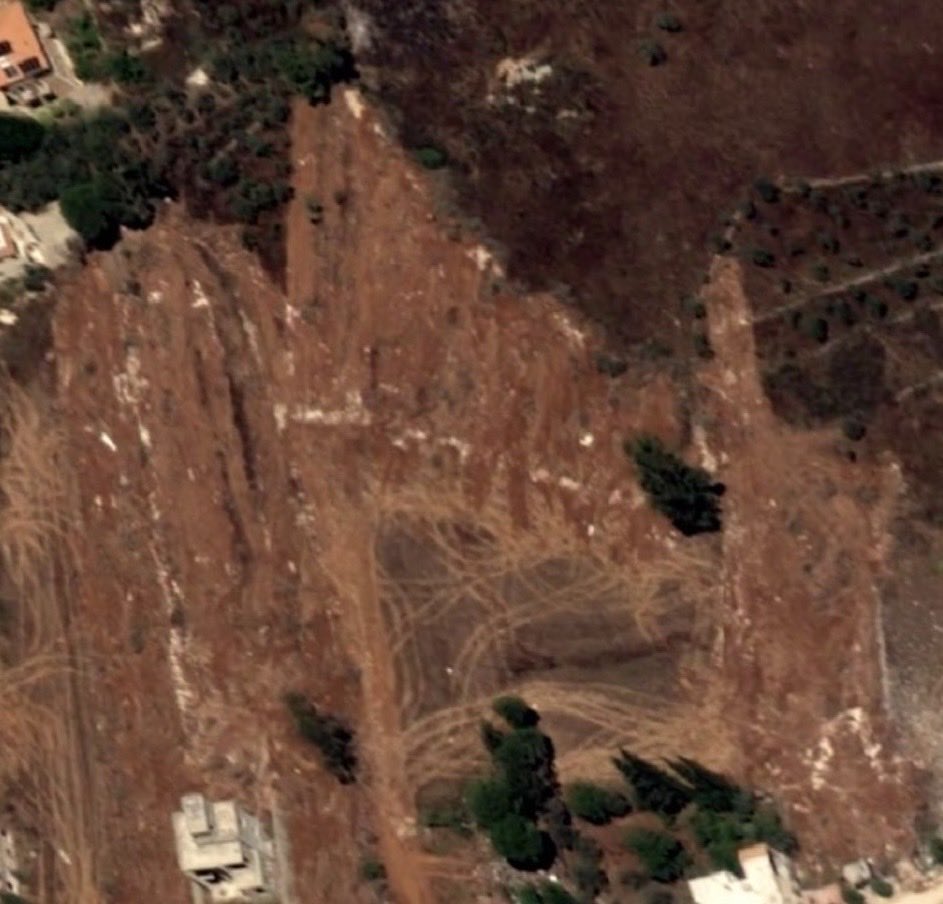
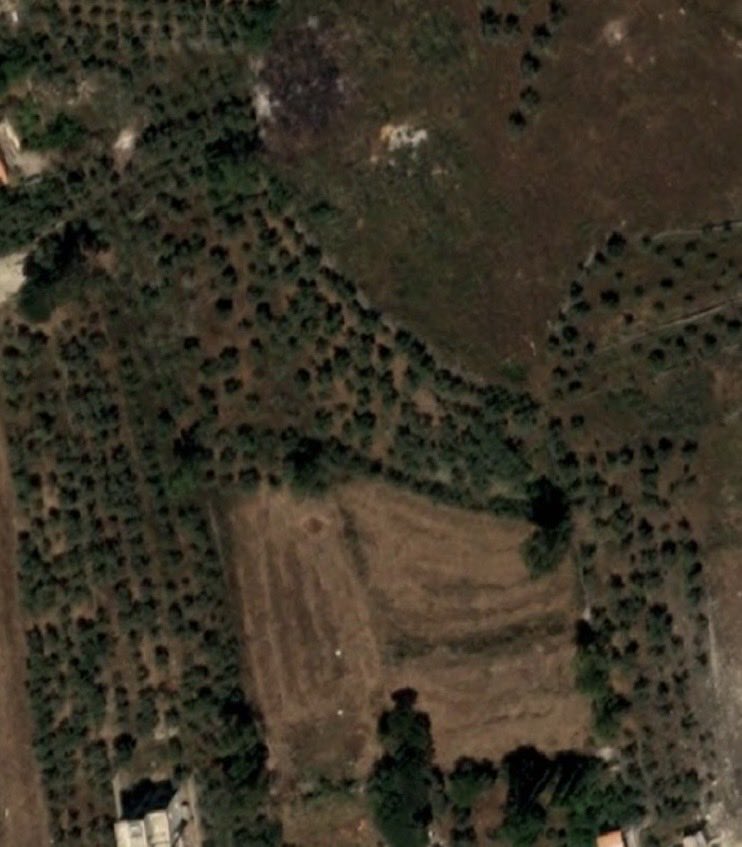
Cet automne, pour la première fois depuis 250 ans, ma famille ne récoltera pas d'olives au Liban.
Nos 600 oliviers ont été arrachés du sol par l'armée israélienne, racines comprises, et emportés. Les plus vieux avaient 500 ans !
Cette terre, mon grand-père la tenait de son arrière-grand-père. En deux siècles et demi, ma famille a acheté de la terre. Elle n'en a jamais vendu un mètre, pas un seul jour. Chez nous, on ne construit pas sur la terre. On y plante. Ces arbres ont survécu à plusieurs guerres. Ils ont survécu à tout.
Regardez les deux photos. À gauche, notre terre le 25 juin, la veille de la signature de l'accord entre le Liban et Israël. À droite, la même terre le 20 juillet.
Il ne reste rien. Et c’est justement ça, la preuve. Un incendie laisse des troncs noirs debout. Une frappe laisse des cratères. Ici, pas un tronc calciné, pas une souche, pas un débris. Une terre nue, raclée, griffée par les chenilles des engins. Déterrer un olivier de 500 ans sans le tuer demande des pelleteuses, un savoir-faire, des camions et une destination. Ce n’est pas un dégât de guerre. C’est une opération, sur une terre où il n’y avait ni armes, ni combattants, ni présence militaire. Ma famille n'a jamais été liée de près ou de loin au Hezbollah, et elle ne le sera jamais. Il n'y avait que des arbres, et des gens qui les taillent depuis huit générations.
D'après les témoignages qui nous parviennent, ces arbres auraient été emportés de l'autre côté de la frontière, vers Israël.
L'accord signé entre le Liban et Israël, censé préparer la paix, protège les biens des civils. Je demande simplement qu'il soit appliqué : que le sort des arbres déterrés soit établi, que ceux qui sont encore vivants soient rendus. Si nos arbres sont vivants quelque part, ils peuvent revenir. Je ne cherche pas une vengeance. Je cherche une adresse !
J'ai hésité à écrire ces lignes, pour ne pas provoquer des réactions d'un côté comme de l'autre. Mais je refuse de faire le deuil de ces oliviers. Dans ces arbres vit l'âme de mon grand-père, ancien général de la police libanaise, un homme qui a toujours cru dans la paix, dans les humains et dans la lumière. Il taillait ces arbres à mains nues. Il répétait : “on ne vend pas la terre, on la transmet”
Je lui dois de ne pas me taire.
The insurance industry predicted 4 billion people could die this century from climate breakdown. Then went silent.
We didn't.
Here is our public briefing with Prof. Bill McGuire on what's coming and what we do about it.
https://t.co/DyfdvmJy4p
Gaza: ‘We are literally living inside a tightly sealed prison. We cannot leave, people cannot enter, and patients are unable to travel for medical treatment. We are trapped by land, sea, and air, while the space where more than two million people can live continues to shrink day after day.’
Previous upbeat and beautiful video of the 22-year-old armed resistance fighter Nour Al-Din Jmasi, who humiliated Israeli soldiers and fell in battle shortly before the ceasefire, celebrating his 98.9% score in high school only 5 years ago.
Israel killed his entire family.
@jemgilbert it's still very much the case. and they react with astonishment and resentment when they get into the real world and realise that they're no longer the smartest person in the room.
A year ago today I was violently arrested dragged down stone steps painfully handcuffed roughly handled by a gang of thuggish police who managed knock my glasses to the pavement, expose the top half of my body, all of my bra and not one of them, man or woman did the decent thing to save me being exposed. I’m 75 now. I didn’t shout, struggle or give any sort of abuse or even disrespect the police. I was peacefully holding a piece of paper with words on- nothing more. I was held in a cell until 11.30 and effectively held under house arrest for weeks. I’m charged under the terrorism act. The court dates keep getting changed and we are a real problem. I feel a connection with the thousands of us who have done this - Im proud that we are fighting for our freedom of speech, our right to protest and against genocide. It’s not much but it’s the least we can do.
When I say freedom from colonial systems of oppression, I also mean psychological freedom.
Freedom from the system that coerced this need in you to seek validation through the system’s approval of you.
To be approved as “safe”, “good”, “moral”, “civilized”, with western “values” (no matter how arbitrary) – all of which are based on colonial definitions of both peace and violence.
Colonial “peace” ensures the safety and comfort of the colonizer, at the expense of both peace and justice for the colonized.
And colonial violence is simply seen as a necessary tool to maintain order and power over the inherently “savage” native, while the violence committed by the native is seen as proof of their “barbarity”.
How you define crime and deviance, who you see as a terrorist, which people you believe have a right to self-defence and who do not, who you CONDEMN and who you do not - all depends on how psychologically oppressed you are.
When I say freedom from colonial systems of oppression, I mean psychological freedom from the systems that force you to also define the colonizer as not only being worthy of a life of dignity and freedom, but also having the right to be alive, and the subjugated racialized native as not.
That force you to see the suffering of Black and brown people as necessary to imperial empire and colonial order.
That force you to enforce harm on the already oppressed, be it through silence, fear, or inaction, be they your own people; be it your own self.
This is a fascinating document that should be received as a tremendous validation of our movement.
Beyond the revisionist bluster, it does something you will rarely find in imperial records: it acknowledges the singular power of internationalism and in particular the ways in which it has been shaped and sharpened through the collision of Marxism with the anti-colonial struggle.
Most imperial accounts of actually-existing socialism rest on an uncomfortable contradiction. On one hand, socialism is a failure. On the other, it must actively be countered with the full weight of imperial power. The justifications typically given are less than satisfactory: socialist countries are “dictatorships” that deny their people “freedom”. With the slightest of effort, even apologists for imperialism could see through these claims.
More powerful socialist states are sometimes — absurdly given their supposed failures and inefficiencies — accused of unfair economic advantage. The finger has been pointed at both the Soviet Union and China: socialism generates “overcapacity”, intervenes in “free markets”, and floods Western markets with its goods. These accusations are similarly flimsy.
The claim made in this report is stronger. It rests on a cardinal principle of the internationalist tradition: that liberation in one site of struggle can serve as tinder for liberation everywhere. It attributes to Cuba’s revolutionary movement both the capacity and determination to act in the service of revolution outside its borders — and acknowledges its success in doing so. This, the State Department says, represents a “new Marxism” — what it calls Third Worldism — that saw the struggle for liberation in global terms.
Advocates of these ideas, the State Department writes, “spoke the language of a single planetary struggle – stretching from the battlefield to the classroom – between the West and the Third World. In their telling, the revolutionary agent was no longer the industrial proletariat, but the colonized nations and peoples of the Global South. The principal antagonist of world history was no longer “capital,” but Western civilization itself.”
The report misplaces the epistemological turn that saw Marxism shift in emphasis from simply “workers” to “workers and the oppressed”. This transformation emerged through Lenin’s work on imperialism and the Comintern’s engagement with the colonial question, not strictly with Cuba — although Cuba played a tremendous role in rallying the forces of the global anti-colonial struggle. But the report recognises that the greatest threat to empire is, first, the unity of the oppressed in the Global South and, second, their coming together with the oppressed in the North under a rubric of decolonisation.
Internationalism is the highest stage of class struggle — the moment at which class consciousness rises to the understanding that the global struggle for liberation is connected by the sinews of imperialist exploitation that extend into every state, every society, and every community.
At the end of the day, only a liberated people that have mastered the full capacities of their state can meaningfully practice internationalism. Until then, the task is to build powerful national movements and seize state power. Existing revolutionary states fuel this process not only materially, but also by infusing the wider global movement with the morale, spirit of struggle, and theoretical rigour to advance the cause everywhere — from occupied Palestine to the US settler-colony. The State Department recognises this dynamic, acknowledges its enduring power, and fears it.
This report is a signal that the US takes seriously the threat to imperialist hegemony, and intends to target it at its source. For internationalists, it should be read as a calling — our tradition of struggle works and our historical task is to rediscover its mission and escalate it on all fronts.