If you're wondering why $QNT price pumped 3x this week, this list is probably a good place to start ↓↓
• Quant was just chosen to build the next generation of US bank money. The Clearing House, owned by 25 major US banks like Chase, Bank of America, HSBC, and Citi settle more than $2 trillion per day and selected Quant to connect its new on-chain money network.
• Quant is now powering the largest banks in the UK. Barclays, HSBC, Lloyds, NatWest, Santander and others are now executing live customer transactions on infrastructure built by Quant.
• Quant is directly integrated into Murex’s MX.3 platform. MX.3 is the financial software engine powering 65 of the world's 100 largest banks, and Quant gives them crypto-ready infrastructure without requiring them to rewrite existing infrastructure.
• Oracle has put Quant inside its enterprise digital-asset stack. One of the world's largest enterprise software companies has certified Overledger to provide cross-ledger orchestration for settling transactions across different ledgers and off-chain databases.
• Quant is shaping the standards that will govern value movement across the internet. SATP is designed to let digital assets move safely between separate networks, and the protocol is now in the IETF's final community-review stage before a decision on publication.
• Quant has built technology for the Bank for International Settlements and the Bank of England. Project Rosalind tested 33 API functions and 30+ real-world use cases, with Quant supplying blockchain infrastructure, smart contracts and interoperability.
• The European Central Bank picked Quant to help experiment with the Digital Euro. Quant is testing how programmable payments could work directly with central-bank digital money, putting it inside one of Europe’s most important future payments projects.
• Quant has already integrated with Nexi’s European payments infrastructure. The underlying SIA network spans 580 nodes across 208,000+ km of fiber, connecting banks, payment providers, and financial institutions across Europe.
• Quant has been working on blockchain infrastructure spanning 12 countries across Latin America. The LACChain network gives Quant exposure to cross-border payments, tokenized money and interoperability across multiple national markets.
• Quant has a direct route into Japan’s banking system through Dentsu Soken. Dentsu Soken builds mission-critical systems tied to BOJNET, SWIFT, CLS, internet banking, and core banking, and the partnership includes a joint go-to-market plan for Japanese banks.
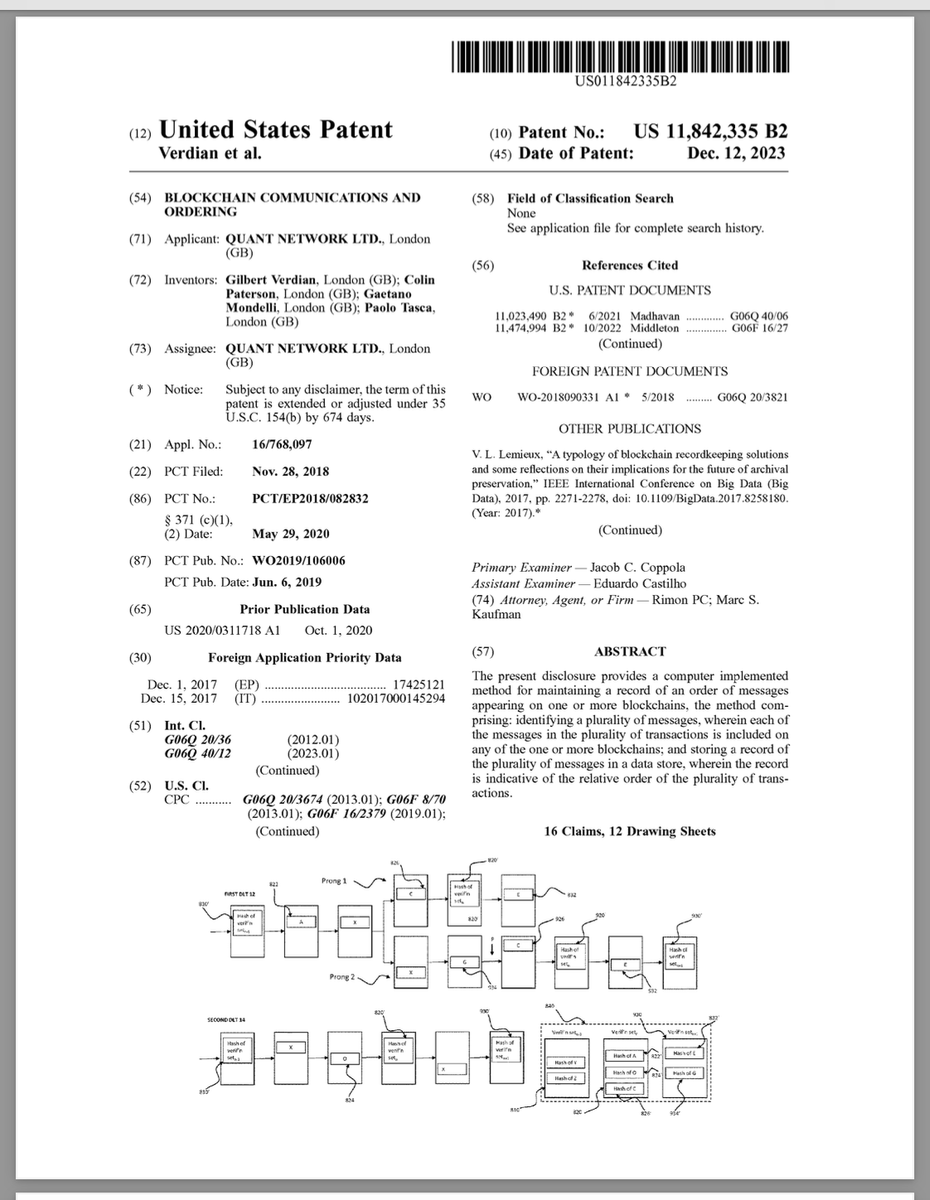
• Quant has been granted multiple patents across the US, Europe, Japan, and China. This gives Quant a defensible IP position in one of the hardest problems in digital finance — enterprise-grade multi-ledger technology.
• Quant’s founder helped launch the ISO standard for blockchain and distributed ledger technology. Gilbert Verdian was instrumental in establishing ISO/TC 307, the international committee for blockchain and distributed ledger standards, going on to lead its interoperability working group.
• Quant isn't betting the company on just one product. Overledger, Quant Flow, PayScript, QuantNet, and Fusion give it multiple products around interoperability, programmable money, payments, and multi-network settlement.
• Gilbert was working on this problem before most people had even heard the word “interoperability.” Before Quant, he spent 20+ years in cybersecurity and senior technology roles across the Federal Reserve, Bank of England, HM Treasury, Mastercard, PricewaterhouseCoopers, HSBC, Ernst & Young, and other major institutions.
• $QNT is unusually scarce for an asset servicing a global market. Its maximum supply is just 14.88 million tokens, giving it one of the tightest supply profiles in large-cap crypto. As we've seen this week, when demand spikes, upward moves can be violent.
• Staking could create an even more powerful supply-and-demand loop. Likely arriving in 2027, Quant's staking mechanism could see millions of $QNT tokens locked away, while participants earn rewards and growing network usage competes for the same fixed supply.
• All of this is only what we're allowed to see. Quant is built to operate behind the scenes as white-label infrastructure; we actually have no idea how many more integrations are already live, being tested, or sitting in the pipeline waiting to be announced.
So when people ask me why $QNT suddenly ran this hard this week, I think they're asking the wrong question.
The better question is why the market ignored all of this evidence for so long.
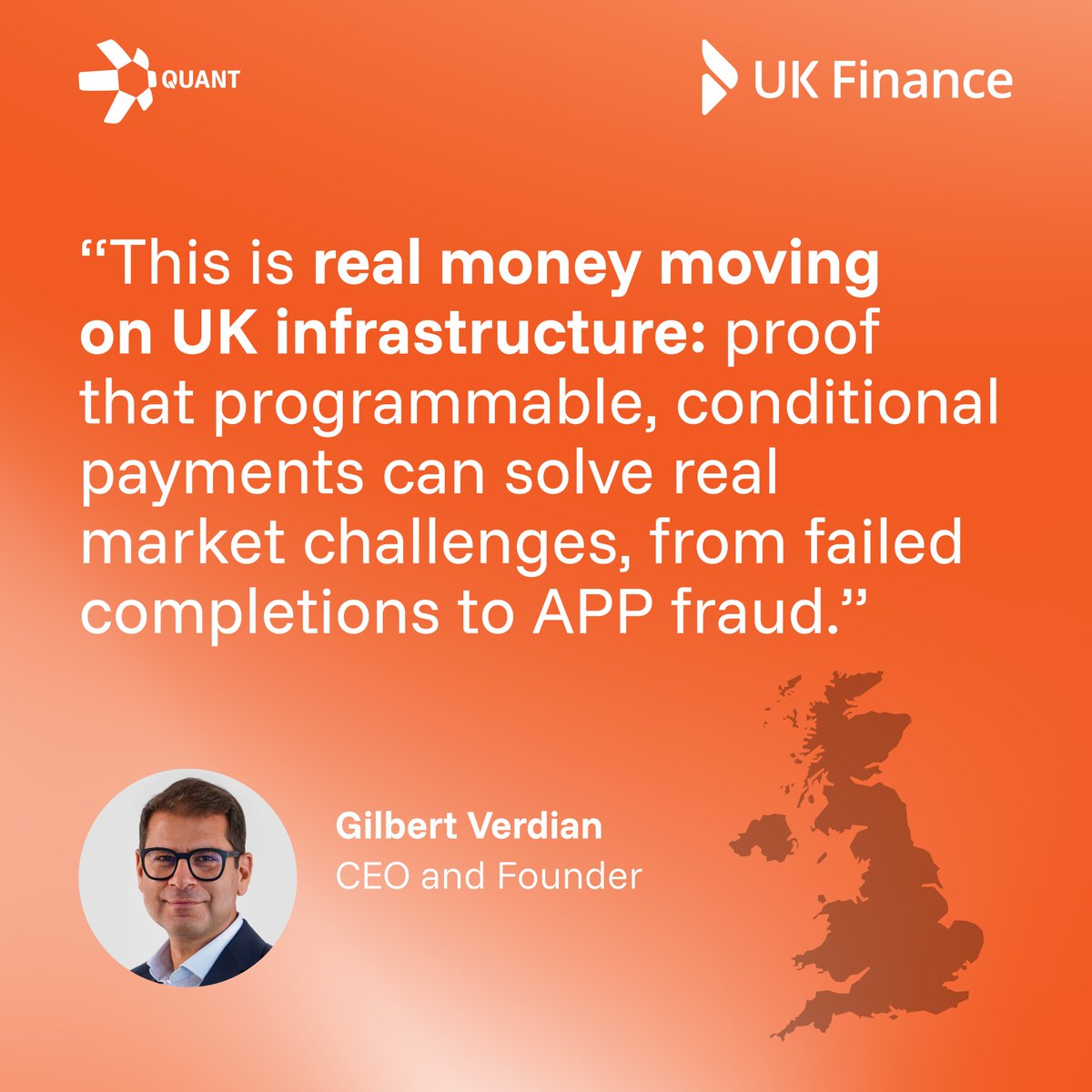
UK banks have completed the first live customer transactions using tokenised sterling deposits, and they ran on the #GBTD platform built by Quant.
Delivered through the Great British Tokenised Deposit initiative, convened by @UKFtweets with @Barclays, @HSBC_UK, @LloydsBank, @monzo, @Nationwide, @NatWestGroup and @santanderuk, the transactions included:
➡️ Two remortgage completions, with funds locked and released automatically at completion
➡️ A marketplace purchase from a private seller, with payment released only once the goods were exchanged
Payments that execute the moment agreed conditions are met give customers more control and can help reduce fraud. More pilots are expected in the coming months, including digital asset settlement.
We're proud to have built the shared infrastructure behind this milestone, alongside @UKFtweets, the participating banks, @EYnews and Linklaters.
Read the full announcement: https://t.co/WaycMtvjCq
#TokenisedDeposits #ProgrammableMoney #Payments
A decade in the making, we have published an ISO standard for blockchain interoperability.
This is a milestone I've been working towards since 2015, Remitt was founded with the conviction that blockchains could transform financial services but only if the industry solved interoperability and harmonised around global standards. Without that, blockchain would remain fragmented, siloed, and locked out of mainstream institutional adoption.
In April 2016, we published what was the world's first proposal for a blockchain standard (https://t.co/SL83Yl4Ejr) a bold move at a time when the industry was still largely focused on proofs of concept and competing protocol narratives, not standardisation.
The idea was simple but ambitious: if blockchains were going to serve global markets, they needed a common framework that transcended any single protocol or vendor.
Central to this thinking from the very beginning was the concept of a multi-gateway architecture, leveraging the know-how of 20 years of experience in cybersecurity to frame the principle that interoperability shouldn't depend on a single bridge or point-to-point connection, but on a layered gateway model that could abstract away the differences between underlying DLTs and connect them through a common interface. This was the architectural foundation of what would become Overledger, and it was also the design philosophy we brought to the standards process.
The belief was that a viable international standard for blockchain interoperability had to be protocol-agnostic and gateway-driven, enabling any DLT to communicate with any other DLT (any-to-any) and with existing networks, without requiring those ledgers to change how they operate. The standard and the technology were born from the same insight.
That same year, I worked closely with the team from @standardsaus (Standards Australia), who had the foresight in 2015 to champion the initiative at the international level. Together, we pushed for ISO to establish a dedicated Technical Committee for blockchain and not to be absorbed into an existing committee, but to stand on its own as a recognition that this technology warranted its own global standards programme. The industry demand was there, the use cases were multiplying, and the fragmentation was becoming a real barrier.
In September 2016, the New Work Item Proposal (NWIP) received global approval, and ISO formally gave the green light to establish a new Technical Committee (https://t.co/7biJjvHRk9). TC 307 — Blockchain and Electronic Distributed Ledger Technologies — was born (https://t.co/5SsFPIw0HH). The inaugural meeting was held in Sydney in April 2017, and from that moment the real work began.
As the standards work progressed internationally, the mission at Remitt was evolving too. What started as an effort to use blockchains for financial services and solve interoperability grew into something far larger, a full enterprise infrastructure platform for connecting any blockchain to any network. Remitt became Quant, and we built Overledger, the world's first blockchain operating system to deliver on that original vision. The multi-gateway architecture that informed the standards thinking became the core of Overledger's design: a technology layer that sits above all blockchains, providing institutions with a single integration point to access any DLT, any network, and any existing system. The interoperability challenge that drove the standards work was the same challenge we set out to solve commercially and the two efforts reinforced each other throughout.
For close to a decade since TC 307's formation, subject matter experts across the world have contributed their time and expertise to Working Group 7 — Interoperability is the committee I chair.
International standards are not built quickly they are built through consensus, technical debate, and relentless refinement. The same methodology and rigour that created the Internet, through publishing standards. The result is a published international standard for blockchain interoperability.
🔗 https://t.co/GRoR7fXNLQ
A huge thank you to @isostandards as the international standards developing organisation, to the team at @standardsaus who started the initiative in 2015 and worked tirelessly to get TC 307 approved and established globally, and to every subject matter expert who contributed to Working Group 7 over the years. This would not exist without that collective effort.
From a blog post proposing the world's first blockchain standard in 2016, to a published ISO standard in 2026 and from Remitt to Quant, from an architectural concept of multi-gateway interoperability to Overledger and a global standard, this has been a decade-long journey of building both the standards and the technology to make blockchain interoperability a reality for institutions worldwide.
There is still much more work ahead. More standards to develop, more to evolve, and more to build. But today, we mark a significant milestone.
#Blockchain #ISO #Interoperability #Standards #TC307 #DLT #Quant #Overledger
$QNT Central Bank Ties🏦
• Bank of England (RTGS Renewal)
• Bank of Canada (Rosalind Test)
• Bank of Israel (Rosalind Inspired)
• Bank of Japan (Rosalind Inspired)
• Fed Reserve NY (SATP in Cedar)
• Monetary Auth Singapore (SATP in Ubin)
• Bank of Kazakstan (Rosalind Inspired)
• European Central Bank (Digital Euro Partner)
• Bank of Hungary (Rosalind Testing)
• Bank of Korea (SATP with BIS)
• Bank of France (Meridian FX)
• Bank of Spain (Hosted ISO TC 307)
• Bank of Italy (Project Leonidas x SIA)
• Bank of Thailand (IMF ASAP APIs)
In case someone was doubting $QNT being the core of the Digital Sandbox initiated by the FCA and Central Bank of England
Gilbert at the launch meeting🔥👀
First FCA registred tokenized Pound 🏴💷
$BTC = ~$105,000
Total Supply: 21 Mil
• "Store of Value"
• Uses lots of energy
• ~7 TPS
$QNT = ~$114
Total Supply: 14.88 Mil
• Used for Oracle Blockchain
• Orchestrated UK RLN
• ISO TC 307 aligned
• QNT for Overledger Flow & RCGs
• Patented & standardized tech
• CEO worked in multiple govts
• Used by multiple central banks
This isn't a price prediction or anything like that
It simply goes to show the heights that speculation can take an asset to VS real utility behind the scenes
Real world government backed infrastructure takes time to fully blossom🦋
Just remember, XRP added roughly $54 billion in 18 days.
That would put $QNT over $5,000 per token 👀
Could you imagine going from $110 to over $5,000 in 18 days 🤯
$QNT Overledger Fusion L2.5 Network rolls out in June 🗓️ ✅
Now I fully understand why Quant patented Overledger! 🤯😲 @quantnetwork
They patented how to track cross-chain transactions, ensuring all info is registered without forks or duplications, in a secure off-chain system. Those logs then update states in traditional banking systems.
Overledger creates a tamper-proof record of all transactions from connected DLTs via gateways; it builds a virtual off-chain log, then uses it to update data in banking systems or external services.
It’s like a virtual ledger—a blockchain of cross-chain events!
They patented how to extract that info (e.g., a swap between chains). It first ensures the swap happens atomically, then logs the data in its virtual record. That record proves the swap happened, which chains, wallets, and assets were involved, etc.
For banks, this logging means proof of transactions—update your TradFi system with ease!
It’s a true masterpiece, honestly.
Banking system — Handles traditional money and its states.
PayScript — Automates tasks simply.
Overledger — Ensures auditable, tamper-proof DLT logs.
Bank App (I want to send X tokens) —> PayScript translates —> Overledger executes and logs —> The logs update the banking system —> It shows balances and info in the app.
Quant is changing global finance, it's no longer a maybe, they are YEARS ahead of the game! $QNT
#SATP #Overledger #FutureOfFinance #Quant #Banking
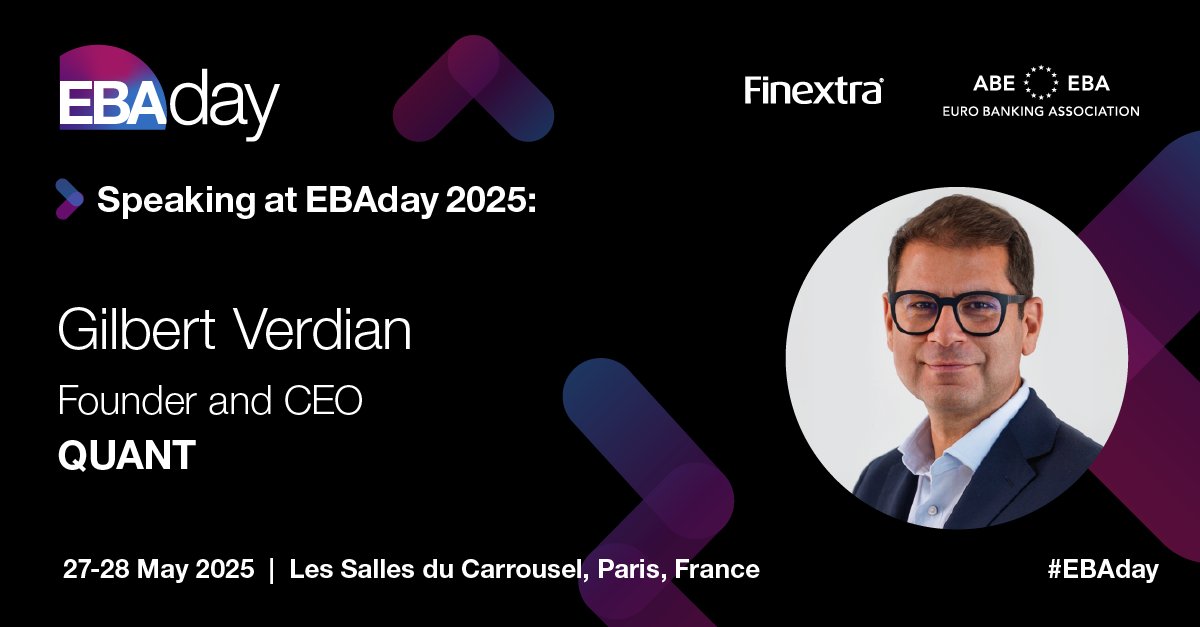
Next week, Europe’s commercial banks and payment firms will gather in Paris to discuss the latest trends in next-generation banking, #fintech collaboration, and innovations in #crossborderpayments.
Once again, Quant will be at the heart of the critical dialogue on the #futureofmoney.
Visit us at Stand 5 to speak to the team about how we’re redefining how money works for you.
Register your place here: https://t.co/I4KuLAHUtZ
#EBAday #ProgrammableMoney
$QNT has been accumulating for 5 years. The breakout will be legendary.
First rally? Just the beginning. The next move sends QNT into price discovery.
$100B market cap → $6,875
$500B market cap → $34,378
$1T market cap → $68,756
#QNT is ISO 20022 compliant, driving global finance innovation, and set for massive adoption.
With trillions about to flood into crypto, this is where you want to be.
Are you ready?
People don’t get that $QNT is the only future proof interoperability in crypto🧵👇🏻
✅The only internet scale one
✅No overhead / mailman needed
✅Connects to networks that use different tech supplier through internet standard SATP (like tcp/ip)
✅Fit for legacy<>legacy as well
✅Integrate any existing en future tech without code
And yes: There is a reason why the world largest banks chose Overledger in a next gen network build from the ground up (RLN), and moving to the next phase🔥
There is a reason why the Central bank of banks (BIS) chose Overledger in the worlds largest CBDC testcase (and moving to next phase) 🔥
There is a reason why the biggest Vendor in Enterprise Blockchain (Oracle) chose $QNT Overled at the core solutions🔥
Not even mentioning powering Europe’s largest payment infra (580 nodes) and worlds largest public-permissioned infra (Lacchain)🌎
What about team growth?
$QNT team recently added 4 NEW senior roles (no replacements):
✅Chief commercial officer
✅Head of sales
✅Head of partnerships
✅extra board member (ex CEO mastercard company)
And Quant is just getting started. We are in a phase:
➡️Before staking
➡️Before central bank digital currencies going live
➡️Before regulation
➡️Before enterprise going live
➡️Before commercial banks going live
Quant is the most underrated project in crypto. The true king of finance and RWA’s. Zero inflation. Only #85🚨
REMEMBER NOT ONLY DOES ORACLE BLOCKCHAIN USE OVERLEDGER
OVERLEDGER IS DEPLOYED INTO ORACLE CLOUD ASWELL 👀 👀
30MILLION USERS WORLDWIDE USING ORACLE CLOUD ALONE ‼️💰
$QNT $ORCL