I'm proud we are releasing LAION-fMRI, a densely sampled 7T fMRI dataset of natural images, with very broad stimulus sampling for testing countless hypotheses & deeply exploring brain representations. It is now available at
https://t.co/hOnILHonf9
What does LAION-fMRI offer? 🧵
Please circulate widely!
Open positions at the Vision Lab, Centre for Neuroscience, Indian Institute of Science (IISc)
Deadline: March 31 2026
(Link in thread below)
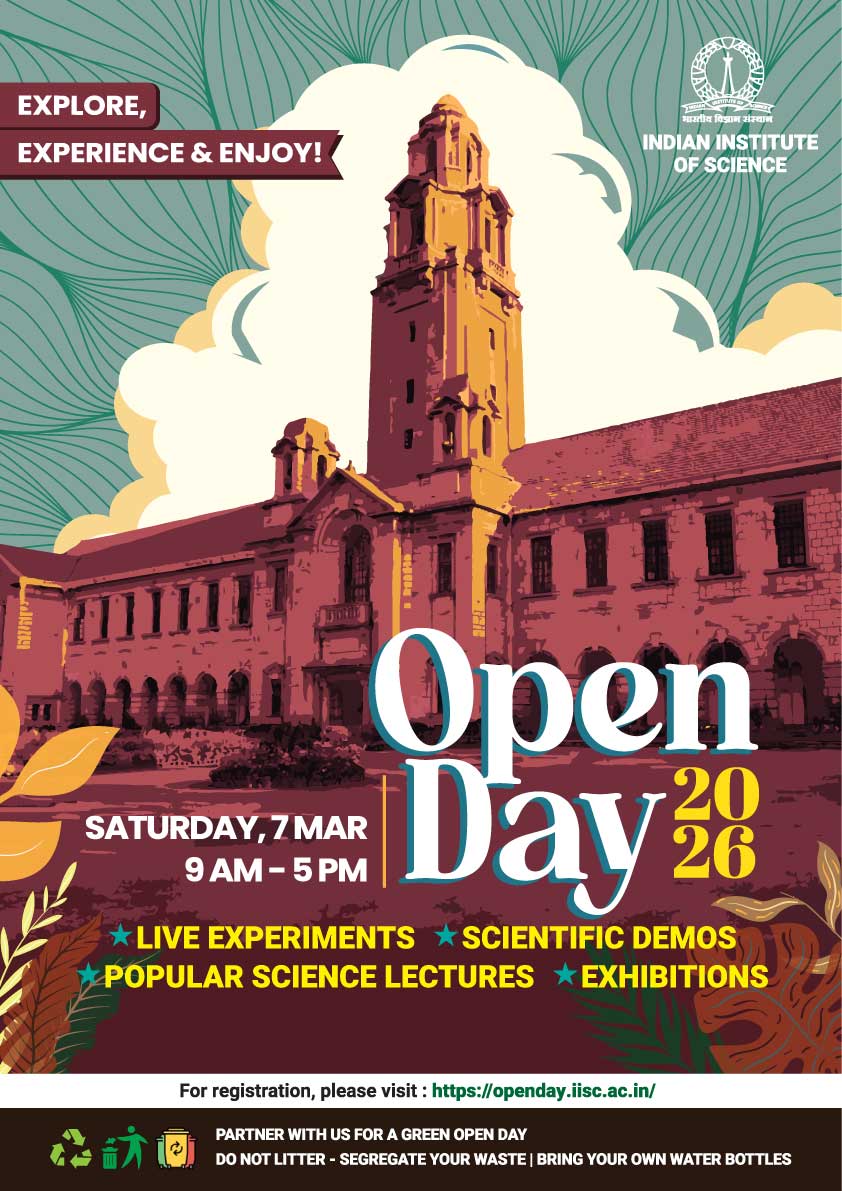
We are excited to announce Open Day 2026! 📷
Visit our campus on March 7th between 9 am and 5 pm. Explore the exciting research demos, displays, exhibits and experiments!
Use the hashtag #IIScOpenDay2026 to share what you see!
Details: https://t.co/wSVFMp3Io4
Today in Nature Machine Intelligence, Kazuki Irie and I discuss 4 classic challenges for neural nets — systematic generalization, catastrophic forgetting, few-shot learning, and reasoning. We argue there is a unifying fix: the right incentives & practice. https://t.co/2MWJ61XweG
Our new study in @NatComputSci, led by Haibao Wang, presents a neural code converter aligning brain activity across individuals & scanners without shared stimuli by minimizing content loss, paving the way for scalable decoding and cross-site data analysis. https://t.co/si0qg66Nu9
Exciting new preprint from the lab: “Adopting a human developmental visual diet yields robust, shape-based AI vision”. A most wonderful case where brain inspiration massively improved AI solutions.
Work with @lu_zejin@martisamuser and Radoslaw Cichy
https://t.co/XVYqQPjoTA
Attention! The American Heart Association has dropped their 2025 update on alcohol and the heart. This is intense. Here is what you need to know in plain language summary!
1/13
In a study now out in @eLife, @GeorginJacob@PramodRT9 and I have some exciting results: a novel computation that helps the brain solve disparate visual tasks, a novel brain region that performs this computation....what's not to like?! Read on.... 1/n
https://t.co/L2RKIpuShv
Some people today are discouraging others from learning programming on the grounds AI will automate it. This advice will be seen as some of the worst career advice ever given. I disagree with the Turing Award and Nobel prize winner who wrote, “It is far more likely that the programming occupation will become extinct [...] than that it will become all-powerful. More and more, computers will program themselves.” Statements discouraging people from learning to code are harmful!
In the 1960s, when programming moved from punchcards (where a programmer had to laboriously make holes in physical cards to write code character by character) to keyboards with terminals, programming became easier. And that made it a better time than before to begin programming. Yet it was in this era that Nobel laureate Herb Simon wrote the words quoted in the first paragraph. Today’s arguments not to learn to code continue to echo his comment.
As coding becomes easier, more people should code, not fewer!
Over the past few decades, as programming has moved from assembly language to higher-level languages like C, from desktop to cloud, from raw text editors to IDEs to AI assisted coding where sometimes one barely even looks at the generated code (which some coders recently started to call vibe coding), it is getting easier with each step.
I wrote previously that I see tech-savvy people coordinating AI tools to move toward being 10x professionals — individuals who have 10 times the impact of the average person in their field. I am increasingly convinced that the best way for many people to accomplish this is not to be just consumers of AI applications, but to learn enough coding to use AI-assisted coding tools effectively.
One question I’m asked most often is what someone should do who is worried about job displacement by AI. My answer is: Learn about AI and take control of it, because one of the most important skills in the future will be the ability to tell a computer exactly what you want, so it can do that for you. Coding (or getting AI to code for you) is a great way to do that.
When I was working on the course Generative AI for Everyone and needed to generate AI artwork for the background images, I worked with a collaborator who had studied art history and knew the language of art. He prompted Midjourney with terminology based on the historical style, palette, artist inspiration and so on — using the language of art — to get the result he wanted. I didn’t know this language, and my paltry attempts at prompting could not deliver as effective a result.
Similarly, scientists, analysts, marketers, recruiters, and people of a wide range of professions who understand the language of software through their knowledge of coding can tell an LLM or an AI-enabled IDE what they want much more precisely, and get much better results. As these tools are continuing to make coding easier, this is the best time yet to learn to code, to learn the language of software, and learn to make computers do exactly what you want them to do.
[Original text: https://t.co/HdI3Jb9HmF ]
The goal of the PhD programme in Brain, Computation, and Data Science is to train students such that they are able to address significant research questions in brain, computation, and machine intelligence.
Interested students can apply at https://t.co/zpOGOo5zlK
Runners, pick a number to find out who will join you on your holiday adventure!🎁🎄❄️
Which number will you choose?✨
Comment below 👇
#Holidayfun#templerun
Announcing the first annual Visual Neuroscience summer course, Woods Hole, MA, Aug 1-16, 2025. Come for an eye-opening, hands-on experience with inspiring faculty and students from around the world. Please help spread the word!
In a new study, out now in Attention Perception & Psychophysics, Thomas Cherian (@copy2thomas) and I have some exciting insights into what we see when an object is occluded. Like all good things, the origin of this study was simple curiosity. Consider the picture below: 1/25