Happy birthday to us!! 🎂 We just had a ceremony with honored guests from @unam_na and Namibian, as well as South African, French, and German scientific institutes and embassies, followed by a tour of the telescopes.
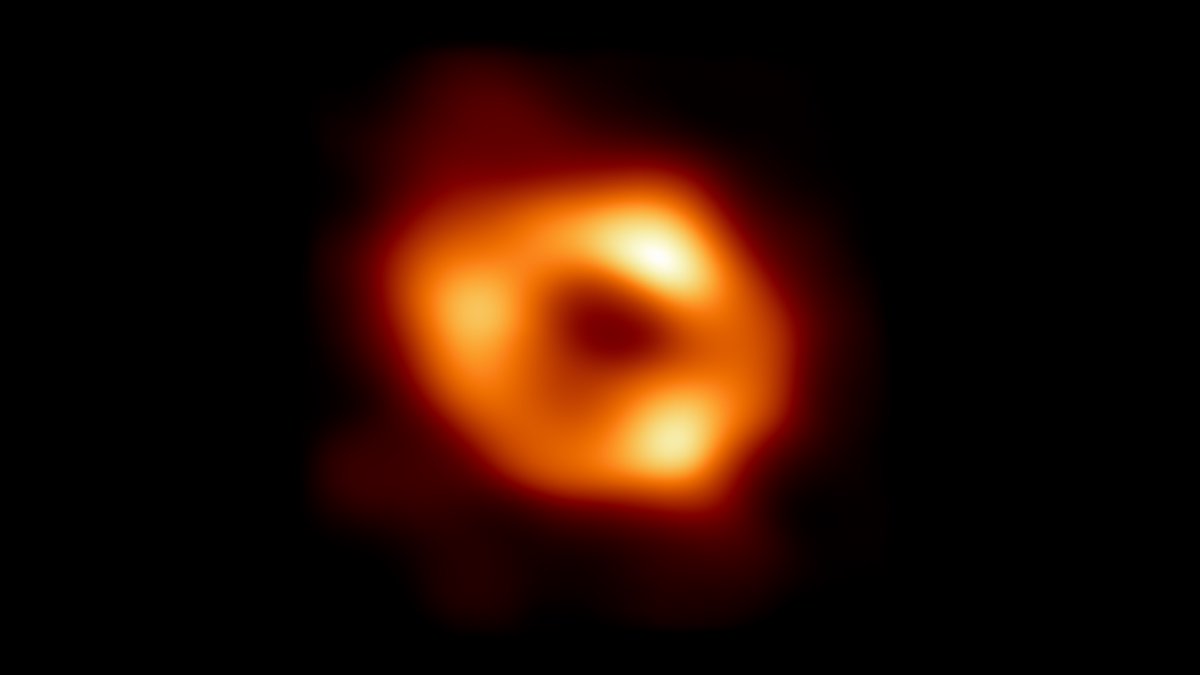
We finally have the first look at our Milky Way black hole, Sagittarius A*. It’s the dawn of a new era of black hole physics. Credit: EHT Collaboration. #OurBlackHole#SgrABlackHole
Link: https://t.co/Ax7ECRVg8A
A new study combining @hesstelescopes and XMM-Newton data measures, for the first time, hadronic (i.e. protons) and leptonic (i.e. electrons) origin of cosmic rays finding a roughly 70/30 split. Read more about it here: https://t.co/zy1H3kmw1V
and
https://t.co/e2ErXtpOmH
The #Namibia Scientific Society is offering #astronomy courses free of charge by Zoom, which will be delivered every Tuesday at 16:00 starting on 24 Aug and ending on 21 Sept. The course was developed by researchers at @unam_na and @UniofOxford
cc @africa_mm_tel@BlackInAstro
Hope everyone had a good weekend! This month's SOM is about UFOs. No, not that kind --- Unidentified @NASAFermi Objects. These are 'dark' at other wavelengths; maybe they shine in gamma rays due to dark matter annihilation? Read and find out!
https://t.co/8MxyjK8VIe
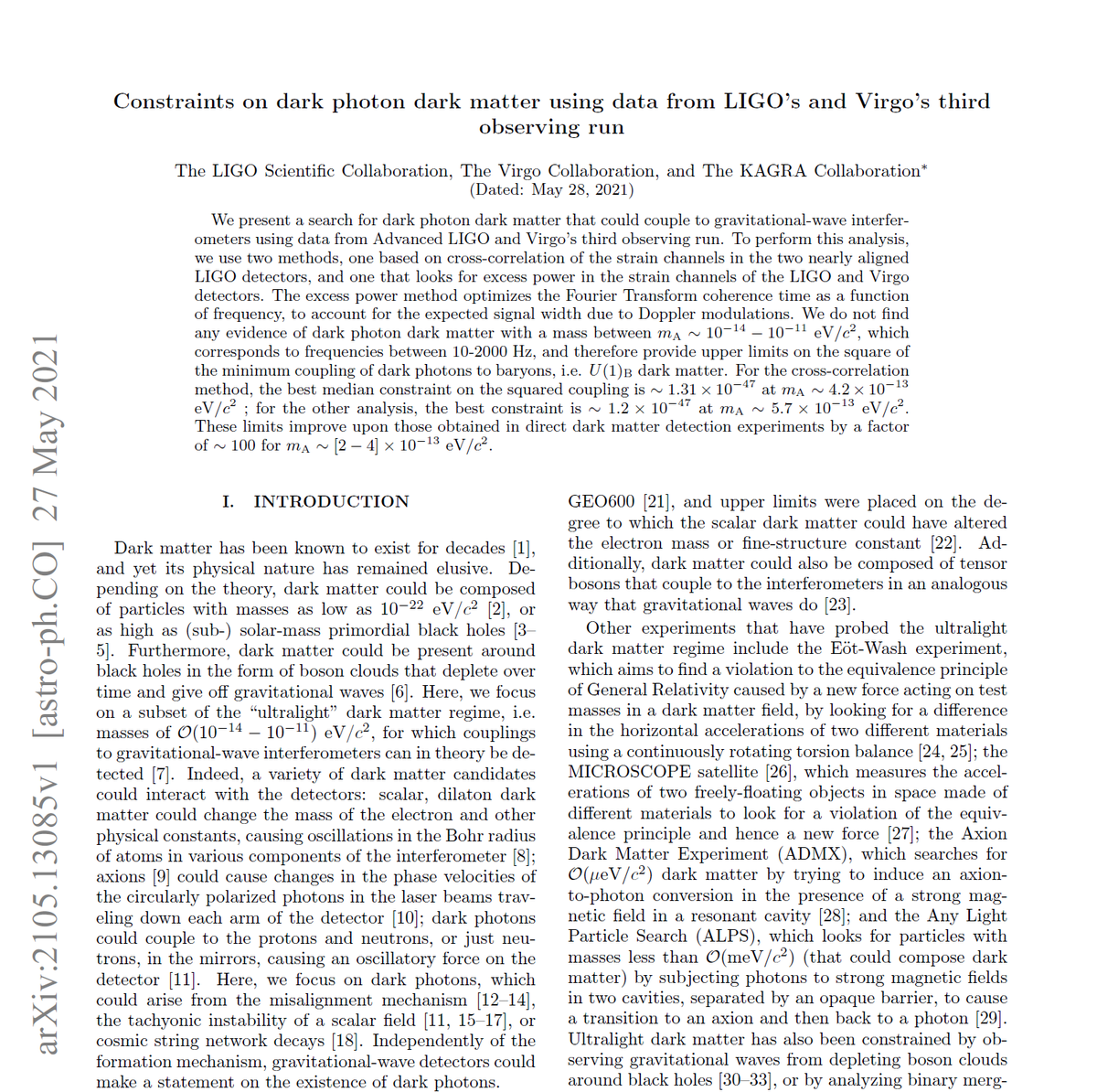
We have a new @arxiv paper, on our first search for dark photon dark matter using data from @LIGO and @ego_virgo's third observing run. Read more at https://t.co/kHnyuP8I2I and check out the paper at https://t.co/D0qKtbp7C8
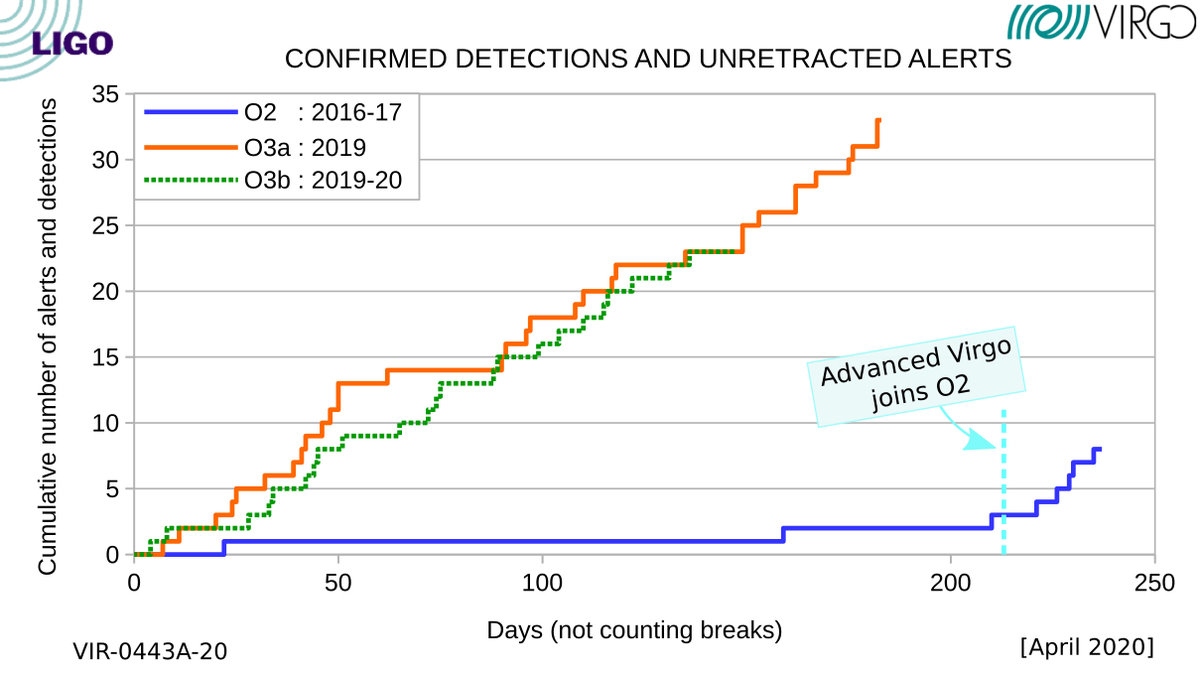
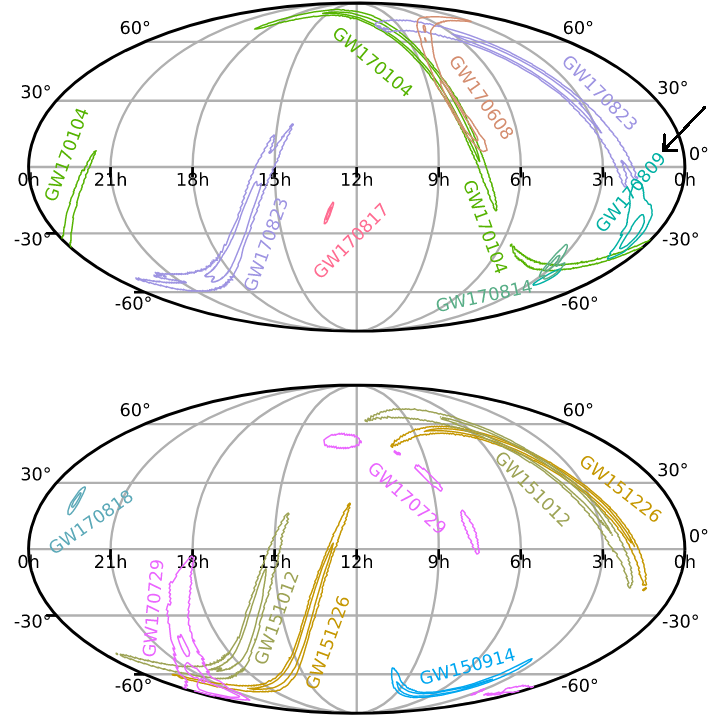
With @ego_virgo coming on-line, the change of rate is really impressive!
And the reduction of the size of the error box (not shown in the plot) is also an important @ego_virgo bonus...
Exactly 3 years ago @ego_virgo joined @LIGO. It turned out to be a wonderful month, full of #GravitationalWaves with very significant astrophysical implications, the 1st announced triple detection #GW170814 and the beginning of multi-messenger astronomy #GW170817 among them. 🎂
GW170809 is a gravitational wave detected by the @LIGO-@ego_virgo Ligo-Virgo network 3 years ago, emitted by the merger of two Black Holes (35 and 23.8 times the Sun mass), at a distance of 3 billion light years and resulting in a final spinning Black Hole of 56.3 Sun masses.
Barely 30 years after the very first VHE source discovery by Trevor Weekes and co., the field has made such tremendous progress that even non-detections from current Atmospheric Čerenkov Telescopes now provide strong physics constraints..
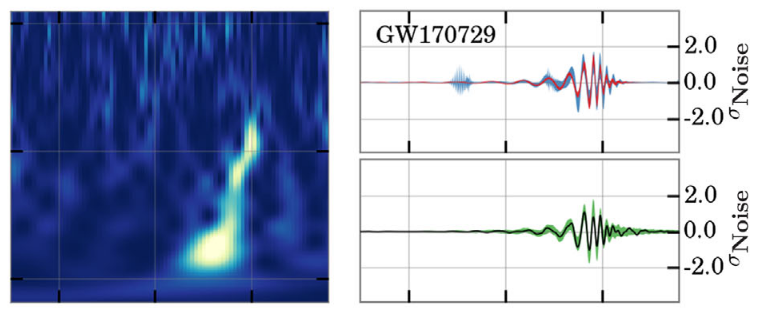
3 years ago the GW170729 arrived on Earth. It was generated from the merger of a Binary Black Hole system, the most distant source and also the heaviest among all detected during the runs O1-O2 of the Advanced @LIGO and Advanced Virgo @ego_virgo network.
Exactly 3 years ago @ego_virgo joined @LIGO. It turned out to be a wonderful month, full of #GravitationalWaves with very significant astrophysical implications, the 1st announced triple detection #GW170814 and the beginning of multi-messenger astronomy #GW170817 among them. 🎂
"Best constraints yet on the size of "mountains" on millisecond pulsars": you can read a news item about our most recent paper, about new results from @LIGO@EGO_Virgo searches for #GravitationalWaves from spinning #NeutronStars, at https://t.co/uASsouQUs0