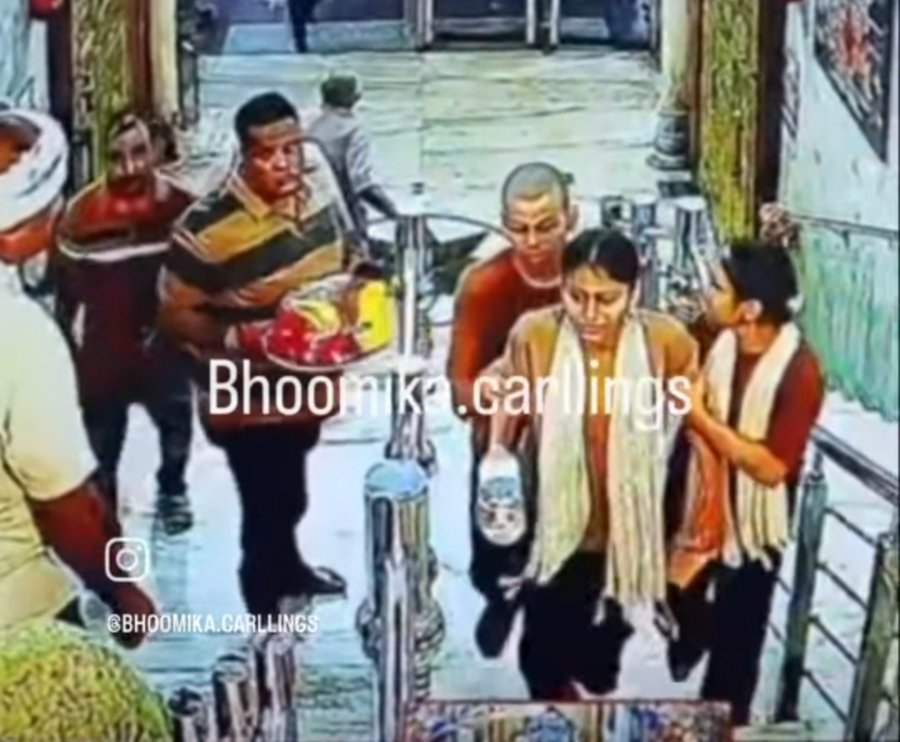
She looked into the camera and declared, "I am a Dalit. I was not allowed to enter the temple because of my caste." But the CCTV footage indeed shows that she and 40–50 others had already spent nearly three hours inside the temple.
This is how manufactured victimhood works, make an explosive allegation, invoke caste, trigger outrage, let the narrative spread, and by the time evidence surfaces, the damage is already done. This is exactly how powerful victimhood narratives can take shape where allegations of caste discrimination spread rapidly, while contradictory evidence receives far less attention. If no one asked her caste, no one stopped her from entering, and she was already inside the temple, then such claims don't expose oppression, they manufacture it.
@amitmalviya You stabbed your supporters, the GC, in the back by introducing UGC bill, strengthening SC ST act, nd the votebank that you supposed to be your new favourite now clawing scratching you down..cutting the branch while sitting on it..you have no street power left now.
El que empezó todo el kilombo fue Rodri. Fue a cargar a Molina, que se recontracalentó. Se empujaron y enseguida cayeron dos jugadores más de España a bardearlo. Ahí apareció Paredes y se los llevó puestos a los dos. 💀
Zlatan Ibrahimović predicted England would be punished by the “left foot of God,” referring to Messi.
Ninety minutes later, his prediction came true. I love how Messi never leaves his fans hanging.😂🔥🐐
Her name is Shreya Singhal.
She was twenty one years old, a law student, when she challenged a law that allowed people to be arrested for what they posted online.
She took the fight to the Supreme Court, and she won.
In 2012, two young women in Maharashtra were arrested.
One had questioned on Facebook why an entire city had been shut down after a politician’s funeral.
The other had simply liked the post.
Both were arrested under Section 66A of the Information Technology Act.
The law made it a criminal offence to send online messages that were “offensive” or caused “annoyance” or “inconvenience.”
Those words were never clearly defined.
That meant almost any online post could become a criminal case if someone in authority decided it was offensive.
Across the country, people were arrested under the law for cartoons, jokes and criticism posted online.
Shreya Singhal was not a politician or a well known lawyer.
She was a student who believed the law violated the Constitution.
She filed a petition in the Supreme Court challenging Section 66A.
The case took three years.
On March 24, 2015, the Supreme Court struck down Section 66A in its entirety, holding that it violated the constitutional guarantee of freedom of speech and expression.
With one judgment, a law that had been used to make arbitrary arrests over online speech ceased to exist.
She did not fight with the backing of a political party or a powerful organisation.
She fought because she believed an unjust law should not survive.
A law that threatened the free speech of millions was struck down because one twenty one year old law student refused to stay silent.
Follow for stories India deserves to remember.
During the ongoing conservation works by ASI at the Trimbakeshwar Temple, Nashik, a stone Shivalinga was discovered during the desilting of the temple’s historic water tank, locally known as Amrit Kund.
The Shivalinga was found at the bottom of the tank while removing accumulated silt and debris.
This remarkable discovery highlights how conservation efforts continue to reveal and preserve India’s rich cultural and sacred heritage.
This single Hymn (The creation hymn/nasadiya sukta , Rig Veda 3500 years old) mogs all religious books combined.
No wonder all Physicist/Scientist used to read Ved/Vedanta, Listen 👇
This 4,500-year-old terracotta dice from the Indus-Saraswati Civilization is a powerful reminder of India’s living heritage. Dicing is also mentioned as a popular game in Rig and Atharva Vedas (two of the four sacred Vedic scriptures).
From symbols and craftsmanship to rituals, yogic practices, and collective memory, numerous elements of ancient Indian civilization continue to thrive in the daily social and religious life of Indian society across regions and communities.
Civilizational inheritance is not just about geography or ruins, it is defined by living customs, symbols, rituals, and unbroken cultural consciousness. India is the enduring living continuity of the Indus-Saraswati Civilization.
#IndusSaraswatiCivilization #AncientIndianHeritage